Category Archives: Business

Think U.S. Agriculture Will End World Hunger? Think Again.

By Anne Weir Schechinger, Senior Analyst, Economics and Craig Cox, Senior Vice President for Agriculture and Natural Resources

The United Nations has forecast that world food production must double to feed 9 billion people by 2050. That assertion has become a relentless talking point in the growing debate over the environmental, health and social consequences of American agriculture.

America’s farmers, we are told, must double their production of meat products and grains to “feed the world.” Otherwise, people will go hungry.

Agribusinesses such as Monsanto sometimes cite the so-called “moral imperative” to feed a hungry world in order to defend the status-quo farm policy and deflect attention from the destruction that “modern” agriculture is inflicting on the environment and human health.

The real experts know better. Jose Graziano da Silva, director-general of the U.N.’s Food and Agriculture Organization argues instead that the current conditions of “modern” agriculture are “no longer acceptable.”

The key to ending world hunger while protecting the environment is to help small farmers in the developing world increase their productivity and income, and to promote “agro-ecology” everywhere, including in the U.S.

Poverty is the root cause of hunger, not too few exports of U.S. wheat, corn, soybeans and meat. American exports go to people who can afford to buy them.


American farmers are helping meet growing demand from millions of people in developed and developing nations who can afford better, or at least more diversified diets. This is a welcome business opportunity for our farmers, but those exports aren’t going to the countries where hunger is chronic.

  • 86 percent of the value of U.S. agricultural exports last year went to 20 destinations with low numbers of hungry citizens and human development scores that are medium, high or very high, according to the U.N. Development Program.
  • Only half of one percent of U.S. agricultural exports, calculated according to their value, went to a group of 19 countries that includes Haiti, Yemen and Ethiopia. These are nations with high or very high levels of undernourishment, measured by the U.N. Food and Agriculture Organization.

Even the hungriest countries produce most of their own food. Overall, in 2013, American farmers contributed only 2.3 percent of the food supply for the 19 most undernourished countries through food exports and aid.

We won’t end world hunger by doubling production in the United States while putting our nation’s environment and health at risk. We can and must help end world hunger by helping people in the hungriest countries do a better job of feeding themselves and ensuring that their farmers make a good living.

Reducing poverty, increasing income for women, providing nutrition education, improving infrastructure like roads and markets to increase access to food, and ceasing wars and conflict could all help undernourished populations better feed themselves.


There is a small farm, community based alternative to the dominant vision of industrial agriculture feeding the world.  Come to learn and grow with us in the UMass Stockbridge School of Agriculture!

The Food We Don’t Eat

American food writer MFK Fisher once said, “First we eat, then we do everything else.”  Food is central to so much in our lives – family, health and community. But what about the food we don’t eat?

garbage
Eight percent of the world’s greenhouse gas emissions can be ascribed to food loss and waste. Photo by jbloom/Flickr

More than a billion tons of food is never consumed by people; that’s equivalent to one-third of all food the world produces.  What many people may not know is that one in nine people on earth don’t have enough food to lead an active life, or that food loss and waste costs the global economy $940 billion each year, an amount close to what the entire UK government will spend in 2016.

They may also not know the incredible effect food loss and waste has on the environment.  Eight percent of the greenhouse gases heating the planet are caused by food loss and waste. At the same time, food that’s harvested but lost or wasted uses 25 percent of water used in agriculture and requires cropland the size of China to be grown. What an incredibly inefficient use of precious natural resources.

When you look at the kind of impact food loss and waste has on our environment, economy and society, it’s clear why the United Nations included it among the most urgent global challenges the Sustainable Development Goals would address. Target 12.3 [2] of the goals calls for nations to “halve per capita global food waste at the retail and consumer levels and reduce food losses along production and supply chains, including post-harvest losses” by 2030. It’s certainly an ambitious challenge, but it is also one that’s achievable.

This week is Climate Week, an opportunity to take stock of where we are on critical environmental issues like food loss and waste. A new report [3] on behalf of Champions 12.3 [4] – a unique coalition of leaders across government, business and civil society who are dedicated to achieving Target 12.3 – assesses our progress so far.

The report details a number of notable steps that have happened around the world, including national food loss and waste reduction targets established in the United States and in countries across the European Union and African Union.

It also highlights efforts to help governments and companies measure food loss and waste, such as the FLW Standard [5] announced in June, and new funding like the Danish government’s subsidy program and The Rockefeller Foundation’s Yieldwise [6], a $130 million investment toward practical approaches to reducing food loss and waste in Kenya, Tanzania, Nigeria, the United States and Europe. There have also been advances in policies as well as education efforts like the Save the Food [7] campaign to raise awareness of food loss and waste.

The progress is promising. But the report also notes that the action does not yet match the scale of the problem, and much more work is needed worldwide if we are to successfully meet Target 12.3 in just 14 short years.

Why the “food movement” is unstoppable..

yes

Excerpted from “Why the food movement is unstoppable.”

The direction of the food movement

…there are profound reasons why the food movement is succeeding and growing.

This analysis suggests that the food movement, compared to other great social movements of the 20th Century (such as the labour, environment, civil rights, climate and feminist movements), has many of their strengths but not their weaknesses.

Further, the food movement is unexpectedly radical on account of having a distinct philosophy. This philosophy is fundamentally unique in human history and is the underlying explanation for the explosion of the food movement.

Like any significant novel philosophy, that of the food movement challenges the dominant thought patterns of its day and threatens the political and economic structures built on them. Specifically, the food movement’s philosophy exposes longstanding weaknesses in the ideas underpinning Western political establishments. In the simplest terms possible, the opposite of neoliberal ideology is not communism or socialism, it is the food movement.

The reason is that, unlike other systems of thought, food movement philosophy is based on a biological understanding of the world. While neoliberalism and socialism are ideologies, the food movement is concerned with erasing (at least so far as is possible) all ideologies because all ideologies are, at bottom, impediments to an accurate understanding of the world and the universe.

By replacing them with an understanding based on pure biology, the food movement is therefore in a position to supply what our society lacks: mechanisms to align human needs with the needs of ecosystems and habitats.

The philosophy of the food movement goes even further, by recognising that our planetary problems and our social problems are really the same problem. The food movement represents the beginnings of a historic ecological and social shift that will transform our relationships with each other and with the natural world.

1) The food movement is a leaderless movement

The first important piece of the food puzzle is to note that the food movement has no formal leaders. Its most famous members are individuals. Frances Moore Lappé, Joel Salatin, José Bové, Vandana Shiva, Wendell Berry, Michael Pollan, Jamie Oliver, and many others, are leaders only in the sense of being thought-leaders. Unlike most leaders, including of the environment movement, or the labour movement, or the climate movement, they have all attained visibility through popular acclaim and respect for their personal deeds, their writings, or their insights. Not one of them leads in any of the conventional senses of setting goals, giving orders, deciding tactics, or standing for high office. They are neither bureaucrats nor power-brokers, but leaders in the Confucian sense of being examples and inspirations. It is a remarkable and unprecedented characteristic that the food movement is a social movement that is organic and anarchic. This not to argue it is unstructured, far from it. Rather, the food movement is self-organised. It is a food swarm and absence of formal leadership is not a sign of weakness but of strength.

2) The food movement is a grassroots movement

A second and complementary piece of the puzzle is that the food movement is far more inclusive than other social movements. It is composed of the urban and the rural, the rich and the poor, of amateurs and experts, of home cooks and celebrity chefs, farmers and gardeners, parents and writers, the employed and the unemployed. Essentially anyone, in any walk of life, can contribute, learn or benefit. Most do all three. Importantly too, just about any skill level or contribution can often be accommodated. To take just one example, in how many other social movements can a 14-year-old make an international splash?

This inclusiveness has various aspects that contribute significantly to its success. The first of these is that, unlike many protests, there is no upper limit to membership of the food movement. It is not defined in opposition to anything – it would include the whole world if it could – and so there is no essential sense in which it is exclusive. Exclusivity is often the Achilles heel of social movements, but though its opponents have tried to label it as elitist, for good reasons they have not succeeded. Granted, Prince Charles is a very enthusiastic member, but so too are rappers from Oakland, the landless peasant movement of Brazil, the instigators of the Mexican soda tax and the urban agriculture movements of Detroit, Chicago and Cleveland. Such groups are neither elite nor elitist. A better analysis would conclude that anyone can find space under its broad umbrella because the food movement does not discriminate on any grounds, least of all class. It is beyond grassroots. People see what they want in it because it is for everyone.

The second aspect of its inclusivity is that the food movement has barriers to entry that are low or non-existent. This is an important reason it has grown rapidly. These porous boundaries make the food movement unusually hard to define, however, leading some people to mistakenly conclude it is non-existent.

3) The food movement is international

A third unconventional attribute of the food movement is to be international and multilingual. In each locality it assumes different forms. The Campaign for Real Ale, Via Campesina, the Zapatistas, Slow Food and Europe’s anti-GMO movement are very different, but instead of competing or quarreling, there are remarkable overlaps of purpose and vision between the parts. This was on show at last winter’s British Oxford Real Farming Conference where food producers and good food advocates from all over the world shared stages and perspectives and the effect was to complement and inspire each other.

4) The food movement is low-budget

The fourth distinguishing characteristic of the food movement is that it has little money behind it. It might seem natural for “social movements” to be unfunded but it is in fact very rare. The climate movement has Tom Steyer, the Tea Party has the Koch brothers, Adolf Hitler’s car, chauffeur, private secretary, and of course his blackshirts, were funded by Fritz Thyssen, Henry Ford, and some of the wealthiest people in Germany. Even the labour and environment movements have dues or wealthy backers. The food movement therefore is highly unusual in owing little to philanthropic foundations or billionaire backers. Instead, it consists overwhelmingly of amateurs, individuals and small groups and whatever money they possess has followed and not led them. This is yet another powerful indication that the food movement is spontaneous, vigorous and internally driven.

5) A movement of many values

Most social movements are organised around core values: civil rights, social equality or respect for nature are common ones. What is unique about the food movement is that it has multiple values. They include human health concerns, animal welfare, agricultural sustainability, ecological sustainability, food justice and political empowerment, but even this list does not adequately capture the range of its concerns. It is a movement with many component parts.

=========================================

Join the Food Movement and create a career as a Sustainable Food and Farming major in the Stockbridge School of Agriculture at UMass Amherst.

Study proves the outsized economic impact of local food purchases

market
The Amherst Saturday Market is a popular place to meet your neighbors and support local farm families!

Consumers often cite supporting the local economy as a reason why they purchase locally produced foods. To find out whether there is such an impact, a University of California Cooperative Extension team interviewed producers engaged in direct marketing to measure the economic impact of local food marketing in the Sacramento Region    Their key findings indicate that, for every dollar of sales, local  direct marketers are generating twice as much economic activity within the region, as compared to producers who are not involved in direct marketing.  Here are the highlights of their findings:

  • Sacramento Region direct market producers averaged $164,631 in sales per producer, ranging from $2,141 to $4,620,000.
  • Of the direct market producers’ total revenues, 44 percent were generated through direct channels.

Continue reading Study proves the outsized economic impact of local food purchases

How much should food cost?

NOTE:  in this article about food costs in the industrialized world, the author claims that to create a more fair society, we must pay more for food.  What do you think?  Add your thoughts to the comments box below.

——————————————————

By Colin Trudge – Published on Sustainable Food Trust – July 22, 2016

tacobellNothing illustrates the weirdness, injustice, and unpleasantness of the present economy more clearly than the misdirected attempts of government to reduce the price of food. All seem to accept that to reduce food prices is good and necessary, and that it represents ‘progress’. Certainly it is necessary to ensure that everyone can afford good food, but this does not necessarily mean that we should seek to make it cheaper.

For starters, governments (and industry and the National Farmers Union and the various scientists and other intellectuals who travel in their wake) are obsessed with “efficiency” – which, like everything else in the present world, is measured entirely in terms of money. On many farms worldwide the biggest single expenditure is on labour, so the mantra is that above all, the efficiency of labour must be increased. This is achieved by sacking people, and getting more work out of those that are left. Workers are replaced by bigger and smarter machines and by industrial chemistry. But, as the numbers of unemployed increases and they become more desperate, more and more are re-employed for less Continue reading How much should food cost?

Make Farmwork a Viable Occupation

NOTE:  when you buy food from big box stores, you are supporting an industry that exploits farm workers so that you can have cheap food.  The following letter from a food industry leader, asks for higher wages and better working conditions for farm workers.


By Fedele Bauccio – CEO at Bon Appetit Management Company – July 28, 2016

farmworkA crisis of epic proportions looms in American farming — and thus American food. A labor shortage is “all but guaranteeing that crops will rot in the field on many farms this year,” according to Zippy Duvall, American Farm Bureau Federation president. The Farm Bureau has just released a video in which farmers criticize the government’s delays in processing H-2A applications. “We’re going to have to make a choice,” Duvall says in the video. “We either have to import our labor — workers to harvest our crops — or we’ll have to import our food.”

With respect to Mr. Duvall, as one businessman to another, yes the H-2A process needs to be fixed — including making sure it meets grower needs without sacrificing worker protections — but I think we have another choice.

Continue reading Make Farmwork a Viable Occupation

Growing Greens in the Spare Room

Dan Albert’s farm is far from traditional. There are no picturesque, rolling fields, no tractors tilling soil; there is no white farmhouse or red barn. For that matter, there is no soil, or sunlight.

The farm, Farmbox Greens, is inside a two-car garage behind Mr. Albert’s Seattle home. It consists of 600 square feet of microgreens grown in vertically stacked trays beneath LED lights.

The ability to grow in such a small space is the result of hydroponics, a system in which a plant’s roots sit in nutrient-rich water instead of soil.

Microgreens — the first, tiny greens on plants like arugula, radishes and bok choy — can go from seed to harvest in less than two weeks. That enables Farmbox Greens to compete on price against produce delivered from far away.

“We are fresher and our greens last 20 to 30 percent longer than those grown outside the area,” said Mr. Albert, who co-owns the farm with his wife, Lindsay Sidlauskas.

It has revenue of under $500,000, but was profitable enough in 2014 that Mr. Albert quit his day job as a landscape architect to farm full time. He now has three employees and sells his greens to about 50 restaurants in the Seattle area, a local grocery chain and four weekly farmers’ markets.

Consumer demand for locally grown food and the decreasing price and improved efficiency of LED lighting are driving the creation of more so-called vertical farm start-ups, said Chris Higgins, editor of Urban Ag News, which follows this segment of farming.

Enter a caption
Carrot microgreens, ready to harvest at City-Hydro. 

Energy costs are still a significant barrier to success, making few vertical farms in the United States profitable. Those that are tend to be smaller ones.

Continue reading Growing Greens in the Spare Room

Stockbridge Grad Willie Crosby Receives Farming Grant

June 22, 2016

willie
Willie Crosby, right, and Alex Dorr mix sawdust and pelletized cottonseed hulls to make a substrate for growing mushrooms at Fungi Ally in Hadley.

Forty-seven farms in western Massachusetts and eastern New York will tackle projects this summer — including a potato digger and an insulated room for a reverse osmosis machine — with help from an awards program for farmers.

The Local Farmer Awards gave more than $100,000 this year to farms for projects to improve equipment or infrastructure. The program, which began in 2015, is a project of the Harold Grinspoon Charitable Foundation and added Big Y Foods Inc. of Springfield as a partner this year.

Seventeen farms in Hampshire County were among those receiving the $2,500 grants. Max Breiteneicher, owner of Grace Hill Farm in Cummington, said his young business has benefited from the Local Farmer Awards and other programs.

“We’re only in our third year – and only entering our second full year right now,” said Breiteneicher, who will use the money to buy a pasteurizer to increase the varieties of cheese Grace Hill can produce.

He said starting a cheese farm is a difficult and expensive enterprise.

“These (grants) have really helped,” he said.

J.P. Welch of Justamere Tree Farm in Worthington and Joe Czajkowski of Joe Czajkowski Farm in Hadley both said the money will help them improve the efficiency of their operations.

Justamere, which produces maple products, focuses on energy efficiency and uses wood firing and solar power, according to its website. Welch said the farm’s new maple candy machine, which can help produce candy at a faster rate than its predecessor, has already been a significant improvement for the farm.

“We’re all about efficiency,” he said. “Anything we can do to streamline the process is what we want to do, and this just will go to help in doing that.”

Czajkowski said he became interested in making butternut oil after reading about its health benefits — it is cholesterol-free and high in Vitamin A — but lacked the equipment to separate butternut squash seeds from stringy flesh and to dry them enough to be pressed for oil.

The process lets farmers who grow butternut squash use parts of the gourd that might otherwise go to waste, he said. He’s also commissioning the building of seed driers locally to keep the money in the area economy.

“I think it’s better, if Big Y and Harold Grinspoon want to help the area,” he said. “Spending it locally is right in line with what they want.”

mshrroom
A cluster of Blue Oyster mushrooms growing at Fungi Ally in Hadley.

Growing mushrooms

For Fungi Ally, a mushroom-growing operation in Hadley, the award offered a chance to fast-forward existing plans. Willie Crosby, one of Fungi Ally’s co-founders, said the money will go toward building a new grow room.

The company produces about 150 pounds of mushrooms weekly, but the new room will add an additional 300 to 400 pounds to that total.

“It’s something that we were interested in and there was a desire for, but we didn’t have the capital to go for it,” Crosby said. “This is allowing us to jump forward a little bit.”

mushroom
Willie Crosby rotates stock in the existing grow room at Fungi Ally in Hadley. A new larger grow room, constructed with more durable corroguated plastic panel walls, is in the process of being finished with its own climate control system.

Cari Carpenter, director of the Local Farmer Awards, said Grinspoon himself started the program to help local farms compete economically.

She said Grinspoon, an octogenarian millionaire philanthropist who made his money in real estate, also appreciates the less tangible benefits that farmers like Welch and Czajkowski provide.

“When Mr. Grinspoon started this, he wanted to help the farms compete in the marketplace, but he recognizes the environmental advantages, the health advantages and the economic advantages of local farming,” Carpenter said.

Carpenter said she already is aiming to help the program grow for next year. She received 128 applications this year — a 45 percent increase over last year, she said. And partnering with Big Y let the number of farms receiving money rise from 33 to 47.

The results of the fledgling program are already apparent, Carpenter said.

“Some of the feedback we’ve gotten that’s consistent is it’s making a big impact on the farms,” she added.

“One of the farmers basically said, ‘Farmers are so used to doing frugal fixes, and this gives us a chance to step back and see what we need to address.’”

Jack Evans can be reached at jackevan@indiana.edu.

Original Post


Willie Crosby teaches courses in mushroom growing for the Stockbridge School of Agriculture in the Sustainable Food and Farming program.

Local Beekeeping at Warm Colors

For the Daily Hampshire Gazette –  Sunday, June 19, 2016

0a8dd50be01a411780f87aacdad297f3

Jessica Wisniewski’s two children play among old beehives during a CISA sponsored tour of Warm Colors Apiary, Thursday, May 26, 2016 in South Deerfield.  RECORDER STAFF/ANDY CASTILLO

——————————————————–

SOUTH DEERFIELD — The air suddenly becomes thick with angry bees as a beekeeper, garbed in white, removes the cover from a beehive at Warm Colors Apiary and searches for a queen.

Inside the swarm, the overpowering sound of wings beating against air is almost as strong as the permeating scent of raw honey, which drifts up from the cluster of hives, across a small farm yard and into a quaint building, where a group of about 20 local farmers, chefs, students and business owners have gathered for a tour of the apiary to learn both about the farm, and about honey production in the Pioneer Valley.

“We have currently about 800 (hives) that are primarily honey producing colonies, another 200 raise queens,” says Dan Conlin from the front of the room.

Conlin, who has kept bees since he was 14, owns the apiary on South Mill River Road, along with his wife Bonita Conlin. Throughout the year, the apiary produces honey, pollinates farmers’ crops, sells beeswax candles and beekeeping supplies, and offers educational classes to aspiring beekeepers.

Before he became a full-time beekeeper in 2000, Conlin worked at the Northfield Mount Continue reading Local Beekeeping at Warm Colors

Stockbridge Grad Willie Crosby Grows a New Business

By Cori Urban | Special to The Republican  on June 08, 2016


willie2
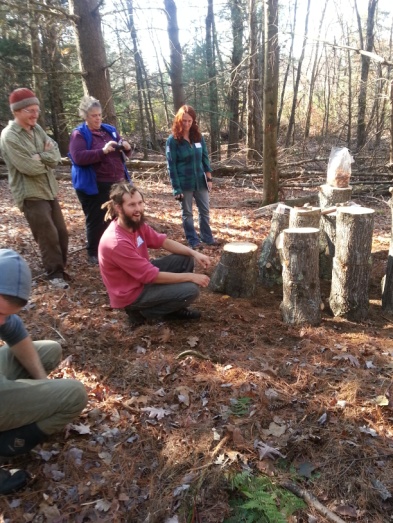
Willie Crosby teaches a class on growing mushrooms for the UMass Amherst Stockbridge School of Agriculture

HADLEY –Twenty-five year old William R. “Willie” Crosby grew up in a family of golfers in Boxboro, so it made sense that he went to school to study turf management at the Stockbridge School of Agriculture.

He earned a bachelor’s degree in plant soil science from the University of Massachusetts at Amherst in 2012, and he completed two internships at golf courses.

But he wasn’t satisfied with the work.

“I didn’t feel satisfied with the end result – a place for people to go and hit a ball around,” he said. “I want the end product (of what I do) to be something I’m really proud of and exciting to offer to my community.”

So, he changed courses and got involved in vegetable farming. Today, he is in the business of growing mushrooms.

“I didn’t see a huge opportunity to start a business in vegetable farming, so I started looking at mushrooms,” he said, noting that they are a medicinal food source and grow on waste products from other industries like sawdust or soybean hulls.

He learned how to grow mushrooms at a workshop in the state of Washington and during an internship in Nevada. He continues to learn “by trial and error,” he says, as well as from other farmers, buyers and Community Involved in Sustaining Agriculture.

Founder and owner of Fungi Ally in Hadley, Crosby began growing mushrooms in North Amherst in 2013 when he and a friend inoculated about 500 logs with shiitake mycelium.

fungiIn 2015 he moved the business to a 3,000-square-foot rented warehouse in Hadley where he and his two part-time employees harvest about 150 pounds of shiitake, oyster and lion’s mane mushrooms a week.

The process there begins with a delivery of oak sawdust from Lashway Lumber in Williamsburg – about 20 yards every couple of months.

Working with about 200 gallons of sawdust at a time, Crosby mixes in wheat bran, sorghum and gypsum to act as a nitrogen supplement. The mixture is wet and put in special 18-by-8-by-6 inch plastic bags with filters and then steamed to kill bacteria and unwanted fungi.

A small amount of mushroom mycelium is put into each bag; they are then sealed and stored in the warehouse where it takes one to three months to colonize. Holes are then poked into the bags – or the sawdust blocks are removed completely from the plastic – and placed in the fruiting (growing) room for about 10 days until the mushrooms are harvested.

Crosby eats mushrooms every day; he likes them sautéed, roasted and dried as well as in soups, salads and pate.

Mushrooms are harvested daily at Fungi Ally, where they are packaged then distributed to two area food co-operatives, restaurants and distributors for the Worcester, New York City, Boston and Providence markets.

Mushroom sales total about $10,000 a month.

Fungi Ally received a $10,000 grant earlier this year from the state Department of Agricultural Resources‘ Matching Enterprise Grants for Agriculture Program that helps beginning farmers grow or improve their farm operations. Crosby used the grant to begin construction of a lab for the steaming and inoculating process and to grow spawn to provide to people to grow mushrooms at home.

Fungi Ally sells shiitake and lion’s mane mushroom growing kits for $20; they produce about two to three pounds of mushrooms over two three months.

Grant money also was used to build a second fruiting room. “It has given us the opportunity to increase production and begin looking at large customers buying 100 to 200 pounds of mushrooms each week,” he said.

Besides selling mushrooms and kits, Fungi Ally offers workshops about mushrooms and how to grow them at home.

“Mushrooms are really tasty. They are a fun, different food source and good source of protein,” Crosby said. “And they have medicinal benefits like boosting the immune system.”

As he looks to the future, he would like to add more mushroom varieties to his business and expand production of the shiitake mushrooms, which he said are popular.

“Providing food for the community I’m living in and seeing the people my work is literally feeding feels really, really good,” he said. “As decomposers, (mushrooms) transform dead material into basic nutrients for plants and animals to use. They are a link between death and life.”

dried


Original Post