The University of Massachusetts Stockbridge School of Agriculture has accepted SUSTAINABILITY as one of the core principles guiding our programs. Toward this end, we help students learn to grow and sell food in a manner more consistent with the multiple, interconnecting objectives of economic vitality, environmental integrity and social justice.
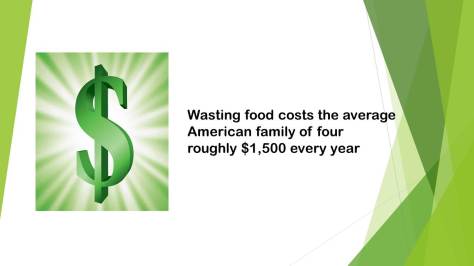
One of the areas we have identified as needing more attention however relates to food waste and food access, which are two sides of the same coin. To help us think about these issues, the following visuals were contributed by Mary Bell.
According to ME Food Systems Innovation Challenge program….
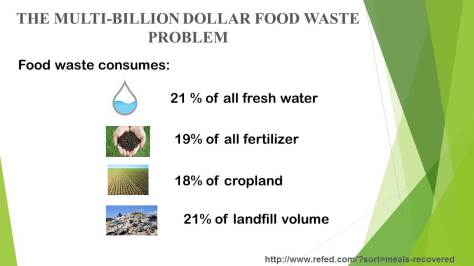
Several reports indicated that locally, nationally and globally, 30–40% of food produced for consumption is wasted every year. Food waste has significant implications for the economy, the environment and growing problem of food insecurity.
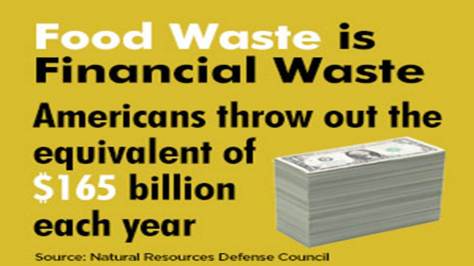
Economically, food loss and waste in US costs $165 billion per year. Globally, Forbes estimates the loss at $1 trillion per year. Environmentally, the impact globally of approximately 130 billion tonnes of food waste is a massive resource drain, using 45 trillion gallons of fresh water and generating about 8 percent of global greenhouse gas emissions. Globally over 800 million suffer from hunger and food insecurity and of that 48 million are in the US.
Reducing food waste could create economic opportunity and growth, conserve water, reduce greenhouse gases and eradicate the problem food insecurity and hunger.
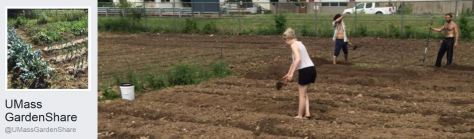
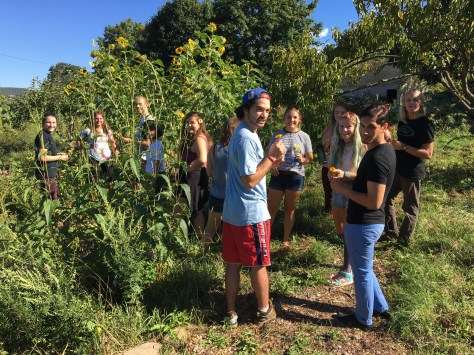
Our one credit, pass/fail class designed to help “non-gardeners” gain experience and learn from other students is now full. Watch for it next semester and register for STOCKSCH 298G early! This is student run class which meets on Mondays from 2:30pm-3:45pm and requires additional time in the garden at the top of Eastman Hill.
To register on SPIRE, look for STOCKSCH 298G – GardenShare Practicum (75664)
The first class was loads of fun (according to the participants). If you want to stay connected and/or volunteer, join the Facebook group here:
Mission Statement: GardenShare is a student-run community garden where students of all academic interests and background can come together to learn how to grow healthy food. Through community and self-directed learning students at UMass are able to engage Continue reading GardenShare is full!→
The Princeton Review Ranks UMass Amherst No. 1 for Best Campus Food
At least part of the reason is our commitment to buying local food and supporting the UMass Student Farm!
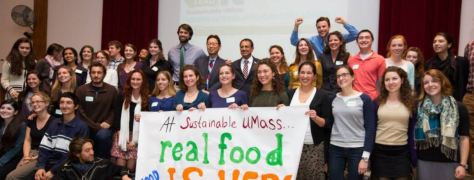
We are also the largest university in the nation to support the Real Food Challenge!
AMHERST, Mass. – The Princeton Review today ranked the University of Massachusetts Amherst No. 1 for best campus food in the nation.
After being ranked among the top three schools nationally since 2013, news of the No. 1 ranking is being celebrated by UMass Dining staff, who have worked tirelessly to achieve national recognition, says Ken Toong, executive director of Auxiliary Enterprises at UMass Amherst.
The university was among the schools featured live on NBC’s Today Show on Tuesday, Aug. 30. Sam the Minuteman, the UMass mascot, made a guest appearance and delivered a tray of delicacies, including pork sliders and Napoleons.
Robert Franek, senior vice president of Princeton Review, praised the university’s dining as “fresh, local and delicious” and called UMass Amherst “a glorious place … nourishing the body as well as the mind.”
“This honor is shared by every member of our staff who work each day to serve healthy, sustainable and delicious meals to our students,” says Toong. “This ranking is also a tribute to our students, whose high expectations drive our team to excel.”
“We’re pleased to see that The Princeton Review has recognized what all of us at UMass Amherst have long known: when it comes to college food, UMass Dining can’t be beat,” says Chancellor Kumble Subbaswamy. “Congratulations to the entire UMass Dining family.”
The rankings of the top 20 schools in 62 categories in The Princeton Review’s The Best 381 Colleges, released Aug. 29, are based on surveys of 143,000 students at the schools in the guide.
UMass Dining is now the largest college dining services operation in the country, serving 45,000 daily meals or 5.5 million per year. Since 1999, overall participation in the university meal plan has more than doubled, from 8,300 participants to more than 19,200.
The award-winning UMass Dining is a self-operated program committed to providing a variety of healthy world cuisines using the most sustainable ingredients. UMass Dining incorporates recipes from accomplished chefs and nutritionists as well as principles from the Culinary Institute of America and Harvard School of Public Health to its cycle menu. UMass Dining is known for being among the most honored collegiate dining programs in America by many national organizations. For the past six years, UMass Dining has been selected to the Princeton Review’s Best Campus Food list. Previously, it was ranked No. 10 in 2012, No. 3 in 2013 and 2014, and No. 2 in 2015 and 2016.
Ask yourself these tough questions to get unstuck….
Feeling stuck in your career isn’t just frustrating… it can be debilitating.
But the notion that we have to choose a single career path and stick with it from beginning to end is simply a myth. Regardless of your age or experience, we all eventually hit a roadblock at some point in our lives when we need to ask ourselves: “What’s next?”
Career impasses—those moments when you know you’re not happy where you are, yet don’t quite know what to do next—aren’t just common, they’re necessary, says Timothy Butler, psychotherapist and senior adviser for career development at Harvard Business School. “We build these mental models of what’s important for us and what we need to do in our lives,” says Butler. “These times of impasse when we’ve hit the wall about what we want to do [require] shattering those mental models.”
If you are attending the summer NOFA Conference this year, please be sure to stop by the vendors tent and look for the Stockbridge School of Agriculture booth. Our (smiling) students will be there to greet you and tell you about their experience studying Sustainable Food and Farming at UMass.
According to the NOFA Conference web page…
The Northeast Organic Farming Association’s Summer Conference is the community learning hub of the NOFA universe. We learn, we play, and we enjoy a weekend of skill building, inspiration and entertainment. It is our opportunity to get together and inspire one another during a family friendly weekend with people living the same lifestyle, holding the same vision and working respectively in many ways toward the same goals.Continue reading Meet our UMass students at NOFA→
Like many of you, we watched in horror as events unfolded across the country last week, and the hell and heartache has left us reeling. We’ve long reported on food justice and last year wrote about why food belongs in our discussions of race. But we know we have a lot more work to do. In that spirit, we reached out to leaders of color in the food justice community for their thoughts about how they think the “food movement” might come together on the issues of race, equity, and access. We encourage others to speak up, add your voices to this space, and to continue the conversation.
Erika Allen, Chicago and National Projects Director, Growing Power
When people say “The Good Food Movement” are they thinking about racial and economic parity? I do, which is why I see it as a Good Food Revolution. I’m not sure how you define sustainable agriculture without this being a central point of understanding. The economic scaling up and investment in urban and sustainable agriculture without the facilitation of anti-racism work on an academic level—to truly understand one’s role as a perpetuator of racism even within liberal thought and action—is a real disconnect. Undoing racism and its companions of oppression, does not magically happen, and it requires real effort. Not just talk, or a workshop, but daily vigilance, and a real cultural shift. We are at a historic juncture. We [at Growing Power] believe that growing food and justice for all goes hand-in-hand toward the realization of a truly sustainable agriculture movement domestically and globally. To achieve that, we need to integrate our understanding on a deep level. This isn’t political rhetoric, this is what we have been struggling for since abolition of slavery. We need to address racism and white privilege and supremacy in the Good Food Movement. As the Black Lives Matter movement continues to move forward Continue reading Social Justice is a Core Component of a Sustainable Food System→
Around 2003 I came across Charlie Munger’s 1995 speech, The Psychology of Human Misjudgment, which introduced me to how behavioral economics can be applied in business and investing. More profoundly, though, it opened my mind to the power of seeking out and applying mental models across a wide array of disciplines.
A mental model is just a concept you can use to help try to explain things (e.g. Hanlon’s Razor — “never attribute to malice that which is adequately explained by carelessness.”). There are tens of thousands of mental models, and every discipline has their own set that you can learn through coursework, mentorship, or first-hand experience.
There is a much smaller set of concepts, however, that come up repeatedly in day-to-day decision making, problem solving, and truth seeking. As Munger says, “80 or 90 important models will carry about 90% of the freight in making you a worldly‑wise person.”
This post is my attempt to enumerate the mental models that are repeatedly useful to me. This set is clearly biased from my own experience and surely incomplete. I hope to continue to revise it as I remember and learn more.
How-to Use This List
I find mental models are useful to try to make sense of things and to help generate ideas. To actually be useful, however, you have to apply them in the right context at the right time. And for that to happen naturally, you have to know them well and practice using them.
Therefore, here are two suggestions for using this list:
For mental models you don’t know or don’t know well, you can use this list as a jumping off point to study them. I’ve provided links (mainly to Wikipedia) to start that process.
When you have a particular problem in front of you, you can go down this list, and see if any of the models could possibly apply.
Notes
Most of the mental models on this list are here because they are useful outside of their specific discipline. For example, use of the mental model “peak oil” isn’t restricted to an energy context. Most references to “peak x” are an invocation of this model. Similarly, inflation as a concept applies outside of economics, e.g. grade inflation and expectations inflation.
I roughly grouped the mental models by discipline, but as noted, this grouping is not to be taken as an assertion that they only apply within that dicipline. The best ideas often arise when going cross-dicipline.
I realize my definition of mental model differs from some others, with mine being more broadly defined as any concept that helps explain, analyze, or navigate the world. I prefer this broader definition because it allows me to assemble a more wide-ranging list of useful concepts that may not be mental models under other definitions, but I nevertheless find on relatively equal footing in terms of usefulness in the real world.
The numbers next to each mental model reflect the frequency with which they come up:
(1) — Frequently (63 models)
(2) — Occasionally (43 models)
(3) — Rarely, though still repeatedly (83 models)
If studying new models, I’d start with the lower numbers first. The quotes next to each concept are meant to be a basic definition to remind you what it is, and not a teaching tool. Follow the link to learn more.
I am not endorsing any of these concepts as normatively good; I’m just saying they have repeatedly helped me explain and navigate the world.
I wish I had learned many of these years earlier. In fact, the proximate cause for posting this was so I could more effectively answer the question I frequently get from people I work with: “what should I learn next?” If you’re trying to be generally effective, my best advice is to start with the things on this list.
BOSTON – Governor Charlie Baker, in support of National Pollinator Week, has declared June 20 – 26, 2016 as “Massachusetts Pollinator Week” – an opportunity to celebrate and protect our pollinator populations. Additionally, the Massachusetts Department of Agricultural Resources (MDAR) will also celebrate the opening of the first state apiary, a collection of beehives to be used for education and research.
“Massachusetts Pollinator Week is an opportunity to raise awareness of the importance of pollination to our environment and agricultural industry, and the vital need to protect Massachusetts’ pollinators,” said Governor Charlie Baker. “I encourage all residents to learn more about our native pollinators and consider planting flowers, trees and other plants to provide pollinators with nectar, pollen and habitat.”
“This week, we appreciate the importance of pollinators to Massachusetts’ ecosystems, food sources and economy,” said Lieutenant Governor Karyn Polito. “Our administration is committed to preserving our native pollinator species and their habitats, and working with local beekeepers across the Commonwealth to ensure their hives are healthy and thriving.”
Pollinators include bees, birds, bats, butterflies and other species. Over 45 percent of agricultural commodities in Massachusetts rely on pollinator species for crop pollination and food production. There are approximately 4,500 honey beekeepers managing approximately 45,000 hives across the Commonwealth. Pollinator species provide significant environmental benefits that are necessary for maintaining healthy, diverse ecosystems, and produce valuable products including honey, propolis, royal jelly and wax.
The new state apiary at the University of Massachusetts Amherst will serve as a vessel for education, outreach demonstrations and research related to agricultural sustainability, pollination, honey bee health and hive management. The apiary consists of twelve honey bee hives located within an 80 foot by 30 foot plot situated adjacent to the UMass Pollinator Conservation Project.
The apiary will also be used by the UMass Beekeeping Club and for hives maintained for UMass beekeeping courses. The apiary was funded by appropriated FY16 funds for the DAR Apiary Program designated for projects that provide research, education and general support to benefit Massachusetts honey bees.
“Given the ability to do live, in-hive demonstrations onsite, this apiary will also be an important tool for providing outreach education to farmers, land managers, beekeepers and to the public in the Commonwealth on topics related to honey bees and agriculture,” said Energy and Environmental Affairs (EEA) Secretary Matthew Beaton. “Through the new state apiary and the Massachusetts Department of Agricultural Resources’ Apiary Program, we are working hard to educate the public about honey bees and support the Commonwealth’s honey beekeepers.”
In Amherst on June 20, 2016, Assistant Secretary for Environment Daniel Sieger will be joined by MDAR Commissioner John Lebeaux and representatives from UMass Amherst College of Natural Sciences for a tour of the new state apiary on the grounds of the UMass Agricultural Learning Center.
“The apiary has received considerable interest from students engaged in farming and sustainability,” said Massachusetts Department of Agricultural Resources (MDAR) Commissioner John Lebeaux. “Currently several are doing an internship with DAR to assist in hive management throughout the summer as well as conducting their own individual research projects related to hive vitality and pest management.”
“Making sure bees stay healthy and productive is necessary for vibrant agriculture,” said State Senator Anne Gobi (D-Spencer). “I appreciate the focus of the administration and look forward to continuing to work collaboratively with our many bee organizations to achieve that goal.”
“I applaud the initiative set forth by the Baker Administration and MDAR to recognize our vital pollinator populations here in Massachusetts,” said State Representative Paul Schmid (D-Westport). “We are incredibly fortunate to have so many active beekeepers that maintain thousands of hives throughout the Commonwealth in order to provide the well-known agricultural products that make our state so great and promote environmental stewardship.”
“This is an exciting collaboration for the Stockbridge School of Agriculture at UMass Amherst,” said Frank Mangan, Director of the Agriculture Learning Center. “Maintaining a state apiary with DAR provides our students, growers and bee keepers with preventative learning tools.”
The Massachusetts Department of Agricultural Resources (MDAR) has collaborated with the University of Massachusetts Stockbridge School of Agriculture to create a state apiary at the UMass Agricultural Learning Center, 911 North Pleasant St., Amherst. The apiary consists of twelve honey bee hives located within an 80 foot by 30 foot plot situated adjacent to the UMass Pollinator Conservation Project. The apiary is surrounded by a solar powered electric fence (to deter animals and serve as a safety barrier for visitors). It consists of six wooden stands (capable of holding five hives each) partitioned into two horizontal rows. The apiary will also be used by the UMass Beekeeping Club and for hives maintained for UMass beekeeping courses.
The purpose of the apiary is to serve as a vessel for education, outreach demonstrations and research related to agricultural sustainability, pollination, honey bee health and hive management. This apiary is also considered to be a critical component of the Stockbridge School’s student farm pollinator habitat conservation project. The apiary will provide valuable pollination services to the farms cultivated acreage of crops, trees and wildflowers. Given the ability to do live, in-hive demonstrations onsite, this apiary will also be an important tool for providing outreach education to farmers, land managers, beekeepers and the public on topics related to honey bees and agriculture. The apiary will be maintained through a collaborative effort of the MDAR Apiary Program inspectors, students and faculty members on campus.
AMHERST, Mass. – The University of Massachusetts Amherst has established a new School of Earth and Sustainability (SES), which will serve as a central hub for a suite of academic programs, research, innovation, outreach and extension activities focused on finding solutions to the complex, global environmental challenges of the 21st century.
The school was approved by the Board of Trustees on April 13.
A partnership between the university’s department of environmental conservation, department of geosciences and the Stockbridge School of Agriculture within the College of Natural Sciences, the school brings together 18 undergraduate programs and five graduate programs. Faculty associated with SES conduct research on conservation, sustainable agriculture, earth sciences, environmental geography, renewable energy, sustainable building and design, climate sciences, environmental policy and decision-making, and sustainability.
Professor Curt Griffin, the founding director of SES, says the structure of the school will create an engaging academic environment for students, faculty, staff and the community.
“Our innovative SES community of students and faculty are passionate about making a big difference in the world, and are committed to finding sustainable solutions for meeting the needs of people today without compromising future generations,” he says.
Griffin says SES showcases the campus’ significant strengths in earth, sustainability and environmental sciences, while also strengthening collaboration with partners across campus and beyond the university. The school is also unique in New England, he adds.
“With this new partnership, we have the largest and most diverse set of earth, environmental and sustainability sciences programs across all public and private universities in the region. SES—in concert with our diverse partners—has the capacity to make UMass Amherst the destination of choice for students interested in sustainability and the environment.”
The School of Earth and Sustainability adds to the robust sustainability-related opportunities available at UMass Amherst. The university not only offers 300 courses related to sustainability, it also has a variety of green initiatives on campus including energy reduction, the sourcing of sustainable and local foods, composting, clothing and furniture reuse, and the promotion of alternative transportation. UMass Amherst holds a STARS Gold designation from the Association for the Advancement of Sustainability in Higher Education (AASHE) and ranked among Top 50 Green Colleges by Princeton Review in 2015.
If you are interested in studying Sustainable Food and Farming in the fastest growing major at UMass, check us out here: https://stockbridge.cns.umass.edu/SFF-BS





 rapist and senior adviser for career development at Harvard Business School. “We build these mental models of what’s important for us and what we need to do in our lives,” says Butler. “These times of impasse when we’ve hit the wall about what we want to do [require] shattering those mental models.”
 If you are attending the summer NOFA Conference this year, please be sure to stop by the vendors tent and look for the Stockbridge School of Agriculture booth. Our (smiling) students will be there to greet you and tell you about their experience studying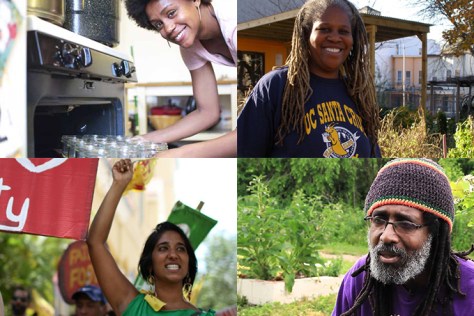

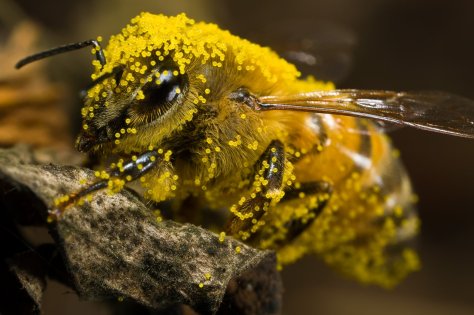
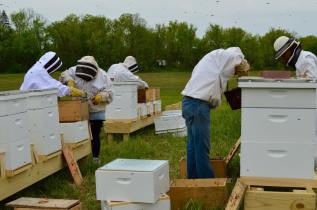 The new state apiary at the University of Massachusetts Amherst will serve as a vessel for education, outreach demonstrations and research related to agricultural sustainability, pollination, honey bee health and hive management. The apiary consists of twelve honey bee hives located within an 80 foot by 30 foot plot situated adjacent to the UMass Pollinator Conservation Project.
 The Massachusetts Department of Agricultural Resources (MDAR) has collaborated with the University of Massachusetts Stockbridge School of Agriculture to create a state apiary at the UMass Agricultural Learning Center, 911 North Pleasant St., Amherst. The apiary consists of twelve honey bee hives located within an 80 foot by 30 foot plot situated adjacent to the UMass Pollinator Conservation Project. The apiary is surrounded by a solar powered electric fence (to deter animals and serve as a safety barrier for visitors). It consists of six wooden stands (capable of holding five hives each) partitioned into two horizontal rows. The apiary will also be used by the UMass Beekeeping Club and for hives maintained for UMass beekeeping courses.
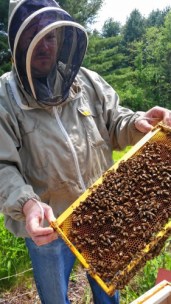 The purpose of the apiary is to serve as a vessel for education, outreach demonstrations and research related to agricultural sustainability, pollination, honey bee health and hive management. This apiary is also considered to be a critical component of the Stockbridge School’s student farm pollinator habitat conservation project. The apiary will provide valuable pollination services to the farms cultivated acreage of crops, trees and wildflowers. Given the ability to do live, in-hive demonstrations onsite, this apiary will also be an important tool for providing outreach education to farmers, land managers, beekeepers and the public on topics related to honey bees and agriculture. The apiary will be maintained through a collaborative effort of the MDAR Apiary Program inspectors, students and faculty members on campus.
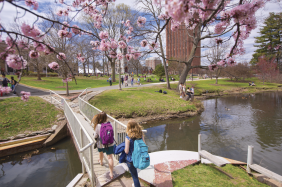 AMHERST, Mass. – The University of Massachusetts Amherst has established a new School of Earth and Sustainability (SES), which will serve as a central hub for a suite of academic programs, research, innovation, outreach and extension activities focused on finding solutions to the complex, global environmental challenges of the 21st century.
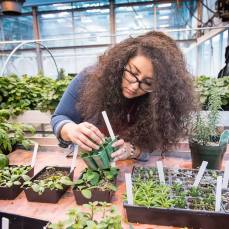 Professor Curt Griffin, the founding director of SES, says the structure of the school will create an engaging academic environment for students, faculty, staff and the community.
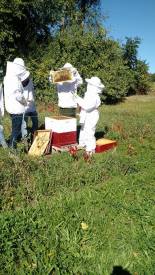 The School of Earth and Sustainability adds to the robust sustainability-related opportunities available at UMass Amherst. The university not only offers 300 courses related to sustainability, it also has a variety of green initiatives on campus including energy reduction, the sourcing of sustainable and local foods, composting, clothing and furniture reuse, and the promotion of alternative transportation. UMass Amherst holds a STARS Gold designation from the Association for the Advancement of Sustainability in Higher Education (AASHE) and ranked among Top 50 Green Colleges by Princeton Review in 2015.
 UMass Sustainable Food and Farming