All posts by jgerber123

I teach sustainable food and farming at the University of Massachusetts and try to contribute to my local community without causing too much harm....

Moment of truth: Is the ‘food movement’ for real — or just talk?

By Tom Laskawy

At the start of the Obama administration, the newly minted president, the same one who quoted Michael Pollan, immediately and disappointingly set about enforcing the food and farm policy status quo. To some political analysts, this came as absolutely no surprise. Ezra Klein, who now writes for the Washington Post but was blogging for the American Prospect at the time, explained the dynamics of the situation:

The broader community of folks who eat food — all of us, more or less — don’t clearly see the connection between policy and plate and so pay little attention to federal action. Our interests are largely lost because there’s little in the way of political reward for serving the silent. Expecting Obama Continue reading Moment of truth: Is the ‘food movement’ for real — or just talk?

Watering the grassroots economy: an editorial

By By BOONE W. SHEAR

Sunday, October 14, 2012

AMHERST — The day after the first presidential debate, local and national newspaper headlines reiterated the tenet that Democrats and Republicans have different, opposing plans for improving our economy. The New York Times construed their differences like this: “On a basic level it was a clash of two ideologies, the president’s Democratic vision of government playing a supporting role in spurring economic growth, and Mr. Romney’s Republican vision that government should get out of the way of businesses that know best Continue reading Watering the grassroots economy: an editorial

Sustainability grows in healthy soil

By Christine Clarke, Massachusetts State Conservationist

Thank you Mr. Elmer O. Fippin. Who is Elmer O. Fippin? He was the soil scientist who mapped and wrote the 1903 publication entitled The Soil Survey of the Connecticut River Valley. Thanks to his groundbreaking work more than a century ago, we have the tools today to reduce the effects of drought and increase our ability to feed the world.

In 1899, Congress appropriated $16,000 to the USDA Bureau of Soils to conduct four soil Continue reading Sustainability grows in healthy soil

National Grid Green Scholar Recognized at UMass

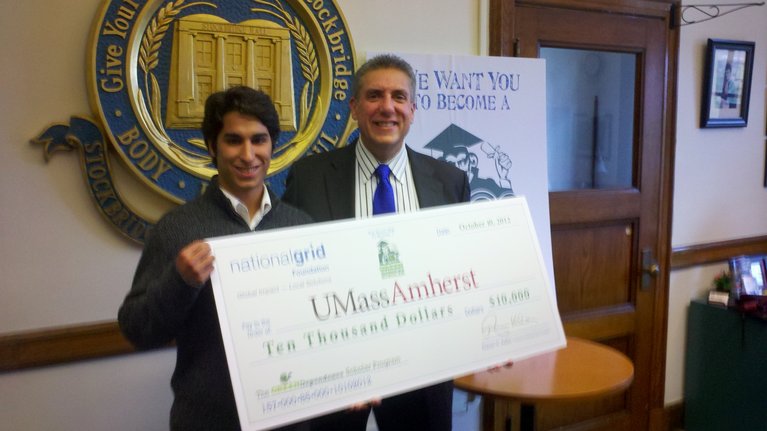
Congratulations to Mr. Derek Silva, a sophomore in the UMass Sustainable Food and Farming program in the Stockbridge School of Agriculture, for being selected as the recipient of the 2012 National Grid Foundation Green Scholarship Award.

Presenting the award in Stockbridge Hall was Mr. Robert Keller, President of the National Grid Foundation.

Derek was selected by the faculty of the Stockbridge School of Agriculture as an outstanding example of a young person committed to both academic excellence and sustainable living.  His education includes practical, scientific and policy aspects of sustainable food and farming.

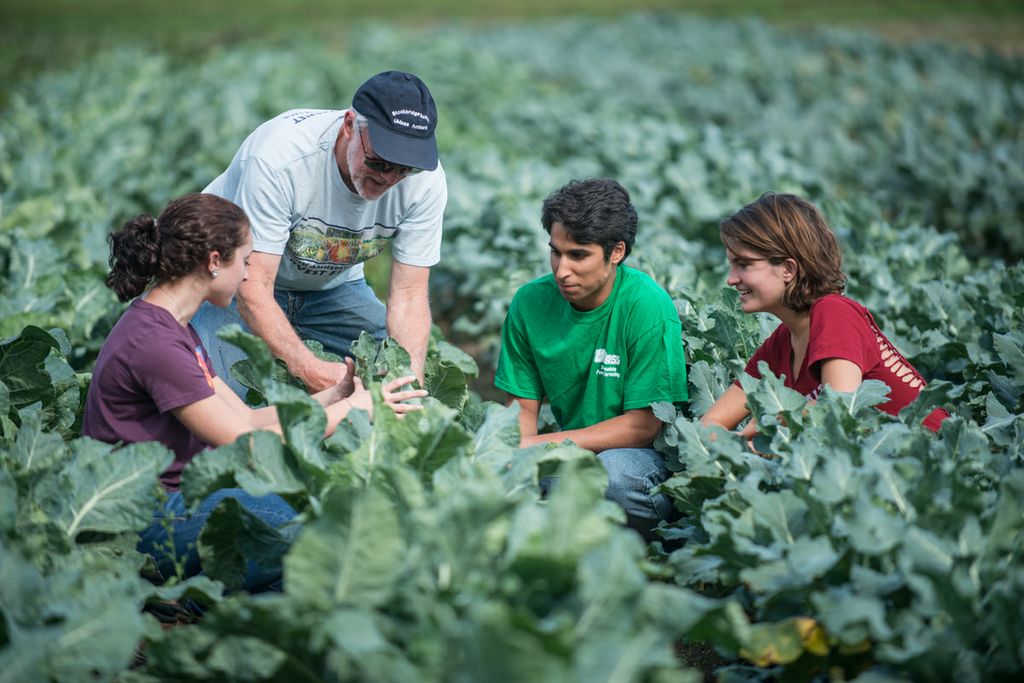
In this photo, Derek and other Sustainable Food and Farming students learn how to prepare cauliflower for harvest at Simple Gifts Farm In North Amherst, MA.   

Derek, who comes from Lowell, MA, hopes to pursue a career in advocacy for sustainable issues including local farming.  He is currently studying sustainable food and farming and will focus on public policy and advocacy in his degree.  His family originally comes from a farming community in the Azores and Derek’s grandfather is an avid gardener.

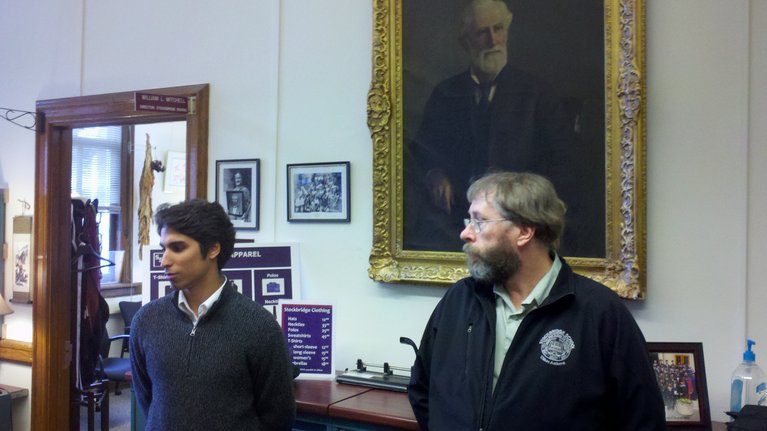
As part of the presentation, Dr. Wesley Autio (pictured above), Director of the Stockbridge School of Agriculture, met with Derek and Robert Keller to talk about the rich history of the school and its recent elevation to an academic unit in the College of Natural Sciences.

————————————————————

Special thanks to the National Grid Foundation and congratulations to Derek Silva from the faculty in the University of Massachusetts College of Natural Sciences.


Amherst All Things Community Meeting – October 13, 2012

You are invited to join in a gathering of Amherst residents interested in making things a little bit better in our town today and into the future.  All Things Community will provide us with an opportunity to share our favorite ideas with our neighbors and ask them to join us to work for a better tomorrow.  Please plan on attending…

All Things Community

Celebrating Amherst in Transition

Saturday, October 13, 2012, 12:30 p.m. – 5:30 p.m.

Amherst Regional Middle School
170 Chestnut St., Amherst MA

——————————————————————–

Following a brief introduction, participants will be encouraged to develop their personal and collective vision of what it takes to create a resilient community.  As the afternoon progresses, ideas will emerge and networks will form around specific action steps using an Open Space process depicted in the following video:

For a schedule, go to: All Things Community.

Please join us (and bring a friend)!

This community event is sponsored by Transition Amherst whose purpose is  to…

foster vibrant and resilient community—in the face of rising energy-prices, climate change, and economic instability—by empowering one another to share our skills and gifts, and create a better life for all.”

New UN Report Illustrates the Potential of Agroecology to Feed the Hungry | Nourishing the Planet

By Evelyn Drawec

Olivier De Schutter, the UN Special Rapporteur on the right to food and the author of the foreword for State of the World 2011: Innovations that Nourish the Planet, is calling for some new thinking—and action—regarding world hunger. In his new report, Agroecology and the Right to Food, De Schutter argues that agroecology is the best strategy for tackling hunger.

Olivier-de-Schutter-UN-Special-Rapporteur-on-the-right-to-food-State-of-the-World-2011-Innovations-that-Nourish-the-Planet-agroecology-climate-change-hunger-agriculture-innovation-rural-development

De Schutter argues that agroecology is the best strategy for tackling hunger. (Photo credit: Bernard Pollack)

The twenty-one page report details agroecology’s ability to provide food for the world’s hungry, outlining policy recommendations that nations can implement in order to help shift their agriculture systems to more sustainable methods.  According to De Schutter, agroecological methods will be increasingly important as climate change takes a bigger hold on sub-Saharan Africa and other parts of the developing world. “Agroecology also contributes to mitigating climate change, both by increasing carbon sinks in soil organic matter and above-ground biomass, and by avoiding carbon dioxide or other greenhouse gas emissions from farms by reducing direct and indirect energy use,” says De Schutter.

De Schutter also calls for incorporating individual small-scale farmers into the policy process as a way to disseminate their knowledge and help lift them out of poverty. As illustrated by De Schutter, “We won’t solve hunger and stop climate change with industrial farming on large plantations. The solution lies in supporting small-scale farmers’ knowledge and experimentation, and in raising incomes of smallholders so as to contribute to rural development.”

How Local is the Future of Food

Today, never before has so much of the worlds food supply been controlled by so few people, giving a handful of elite executives an incredible amount of power over the rest of us.Along with this unprecedented vulnerability, our centralized food system also brings many other problems including…

  1. major depletion of our soils and eco-systems caused by mega-scale monocrops.
  2. the extreme carbon footprints caused by chemical fertilizers and extraordinary food Continue reading How Local is the Future of Food

Horses power equipment, operations at Amherst farm

By By SCOTT MERZBACH Staff Writer

Thursday, October 4, 2012

Monty and Rose, two dark-brown Percheron draft horses, provide the muscle at Amethyst Farm on North East Street.

They do the work tractors used to do: preparing cut hay in the fields, hauling manure to fertilize crops, even plowing the farm’s driveway during the winter.

“I love being able to hear and not have the noise and pollution while I’m going in the field,” said Bernard Brennan, the co-owner of Amethyst Farm, which boards and trains horses. “Any time I’m taking the horses out I’m not burning fossil fuels.”

Brennan, 42, a former professor of evolutionary biology at Yale University, is one of a small Continue reading Horses power equipment, operations at Amherst farm

UN expert makes case for ecological farming practices to boost food production

Small-scale farmers can double food production in a decade by using simple ecological methods, according to the findings of a new United Nations study released today, which calls for a fundamental shift towards agroecology as a poverty alleviation measure.

“To feed 9 billion people in 2050, we urgently need to adopt the most efficient farming techniques available,” says Olivier De Schutter, the UN Special Rapporteur on the right to food and author of the report, entitled “Agro-ecology and the right Continue reading UN expert makes case for ecological farming practices to boost food production

Beyond Farmers Markets: Why Local Food Belongs on Grocery Shelves

By Kathleen Merrigan, deputy secretary of the U.S. Department of Agriculture

When South Carolinians buy South Carolina peaches, there are unique regional benefits. Here’s how the USDA is helping make that happen.

farm-wide.jpgFood hub Keewayden Farms sells organic Wisconsin-grown products to grocers in the Midwest. (rufushau)

Several years ago, South Carolina dairyman Tom Trantham presented me with a conundrum. “We grow great peaches here,” he said, “some of the best in the country. But Continue reading Beyond Farmers Markets: Why Local Food Belongs on Grocery Shelves