All posts by jgerber123

I teach sustainable food and farming at the University of Massachusetts and try to contribute to my local community without causing too much harm....

Saving the world…… (one clothespin at a time)

A few years ago, Michael Pollan wrote a piece for the NY Times Magazine called “Why Bother?”  Pollan noted that with all of the problems in the world, any one person’s behavior makes little difference – so why bother recycling, gardening, walking instead of driving, changing an incandescent lightbulb to a compact florescent – you get the picture).

———–

I was inspired by this article to write up some ideas that I often share in my Sustainable Living class at UMass about “why I bother” (to bike, raise chickens, invest in solar hot water, garden, and yes – use solar power to dry our clothes).  The article is here.

The story begins by talking about our current situation, which I present as “a perfect storm” of global problems.

The story continues by examining what could possibly motivate us to change the way we live.  For me it is an expanded sense of “self interest” which recognizes that I am “a part of – rather than apart from nature.”

Finally, I conclude by suggesting that simple actions, the ones we can all do on a daily basis, need to obey “Mother Nature’s Rules” if we are to be sustainable.  They are:

  1. Rely as much as possible on current solar income

  2. Cycle everything possible (waste=food)

  3. Enhance biological diversity (it makes 1 & 2 work)

I share this essay in class and it often results in lots of feedback (some of it full of praise – and some of it pretty angry and cynical).  I appreciate it all and continue to ask us to think about the question “why bother?”

————-

Perhaps you will share this essay with friends and ask the same question – and maybe then share your thoughts below?

In any case, thank you for reading this far……..

Namaste.

Lets all raise hens (for the eggs)… and what else?

The “blogosphere” has been rampant with stories about chickens and salmonella this week.  My hope is that we don’t forget about this problem after the news dies down.  Today’s local paper covered our attempts in my own hometown to change the zoning laws to make raising a few backyard hens easier (and legal).  Nice (and accurate) story here.

But what’s next?  What do we do when the chickens are no longer making headlines?  I”ve got three suggestions:

  1. Raise your own hens (for he eggs of course).  It is really not that difficult and can be a satisfying experience.   Many of the links on my “backyardhens” web page will help you get started.

  2. Support  the Food Safety bill, S 510 in the U.S. Senate (a similar bill already passed the House).  This will give the FDA more authority and hopefully reduce the liklihood of another outbreak of salmonella.  Here is a recent post.

  3. Help us tell the FDA that we need to ban antibiotics from factory farms.  The FDA is accepting public comments on new draft guidlines (which are NOT adequate) until August 28 (Saturday). Here is a post explaining the deal. Or read the Johns Hopkins report below.

It is most important that we become more aware of the sorry state of the industrial food system that we depend on for our survival.  Get involved by reading Just Food Now and taking whatever small action makes sense to you! 

Its not just the chickens that are sick…. stop antibiotic use in factory farms!

Antibiotics fed routinely to livestock in their food and water can promote faster growth, but the practice is also used as a way to compensate for the effects of extreme overcrowding and unsanitary conditions in factory farms.  This practice is dangerous to humans as it serves as a petri dish which selects for antibiotic resistant bacteria. 

Johns Hopkins researcher, Kellogg Schwab, says he’s more than just concerned: “This development of drug resistance scares the hell out of me. If we continue on and we lose the ability to fight these microorganisms, a robust, healthy individual has a chance of dying, where before we would be able to prevent that death.” Schwab says that if he tried, he could not build a better incubator of resistant pathogens than a factory farm.

The American Medical Association has called for a ban on this practice, and the FDA is considering new guidelines, but they are non-binding and not adequate to protect human health.   To see a full report from John Hopkins, click here or on the picture below.

The FDA is accepting public comments on their draft guidlines until August 28 (Saturday). Will you join me and tell them it’s time to enact real regulations that protect public health and ensure responsible use of antibiotics in animals?  A web based (simple) means of sending them comments is available here.  Or write your own!

How do we respond to the egg recall?

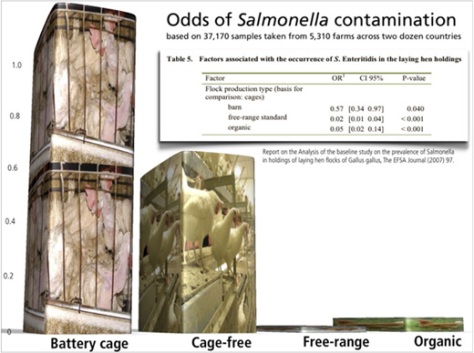
While the recall of a half billion eggs seems to be impacting the Midwest and South direclty, we all should be thinking about the reason that food is making people sick.  A recent article in the Huffington Post traces the root cause of the problem to the industrial food system and the nature of factory farms.  I agree – and here is why.  And here is a graph depicting the relative number of salmonella cases in different hen raising systems.  Big factory farms use battery cages.

It is difficult to know how to respond however, when almost all of the eggs we see in our supermarkets are from big factory farms using battery cages.  But….. WE DO HAVE CHOICES!

Today’s press reported several stories about how the egg recall was stimulating interest in local eggs (mostly free-range).  But you need to make sure  your “local” eggs are really grown locally – not just repacked with a local label.  To find a local egg producer in Western Massachusetts check the CISA website.  Lots of local hens!  Or even better…..

Raise your own hens!

———————————————————

Backyard hens……. one of the reasons we don’t see more hens in the towns and cities of Western Massachusetts is the local zoning ordinances.  But that is changing!  For more on zoning laws in one town and on raising hens in general, click here.

And finally, click here to join a listserve of “backyard chicken folks” – there are lots of us in Western Massachusetts!  Join us!

How with the new Food Safety Bill impact small farms?

The recall of a half million eggs is likely to help move the Food Safety bill, S 510,  through the U.S. Senate (a similar bill already passed the House) more quickly.   Small farm advocates have been suspicious of the intent (or at least the impact) of the proposed legislation.  While I certainly understand why we might be suspicious of anything coming from the federal government, in this case – I believe we need this legislation.

A recent brief from the Senate staff suggests that the legislation is NOT aimed at small farms. Specifically it states:

  • Regulatory Flexibility for Organic Foods
    Throughout the bill, consideration is given to the unique agricultural practices and requirements of organic foods under the Organic Foods Production Act of 1990.

  • Protections for Farmers Markets, Cottage Industries and Direct Farm-to-Market Sales
    Small entities that produce food for their own consumption or market the majority of their food directly to consumers or restaurants are not subject to registration or new record keeping requirements under S. 510. This includes food sold through farmers’ markets, bake sales, public events and organizational fundraisers.

For details, here is a summary of the amendments that have been filed to protect small farms from being unfairly disadvantaged.  Personally, I can support this bill – BUT it is not a cure all.  There are bigger, more systemic problems associated with the industrial food system, such as:

1.  Factory farms that produce virulent forms of E. coli

2. The exploitation of people, the land and community.

3. The dependency of industrial agriculture on rapidly diminishing supplies of fossil fuel.

I believe the most effective action we can take s individuals and families is to grow food justly”

For more on solutions see; Just Food Now.