Category Archives: Education

Growing Together: UMass Stockbridge School of Agriculture works for social justice

Sarah Berquist, left, and Cate Elliott manage the Food For All garden that provides food for Not Bread Alone and the Amherst Survival Center. The garden is located at the University of Massachusetts Agricultural Learning Center on N. Pleasant St. in Amherst. Purchase photo reprints »

 Join Cate and Sarah during their volunteer hours: Tuesdays from 9-12 and Wednesdays 11-2 all summer long behind the Wysocki House at 911 North Pleasant St., Amherst, MA.

By DEBRA SCHERBAN in the Daily Hampshire Gazette and the Amherst Bulletin –  August 14, 2014

It was a grim task, pulling up 400 tomato plants tainted by blight’s black, contagious lesions. Seven 20-something men and women at a garden at the University of Massachusetts in Amherst were untying the strings holding the fruit-laden vines to their stakes and stuffing them into big plastic bags.

“It’s heartbreaking,” said Sarah Berquist, as she watched one of her co-workers close up a full bag. “But it’s pretty prominent around here.” Blight, which spreads through the air, can wipe out acres of tomatoes. Protocol dictates that infected plants be removed and discarded as soon as the condition is detected. “We don’t want to be in incubator for the disease,” she said.

The tomatoes are just one of a number of crops UMass students Berquist and Cate Elliott, managers of the one-acre plot, are growing to donate to Amherst’s Survival Center and the Not Bread Alone soup kitchen in town. So, they were taking the task philosophically — more room now for fall beets, carrots and cabbage. They were out that recent Tuesday morning with five members of the UMass permaculture team tending the crops during a time slot reserved for community members to pitch in, too. None, though, had shown up that day.
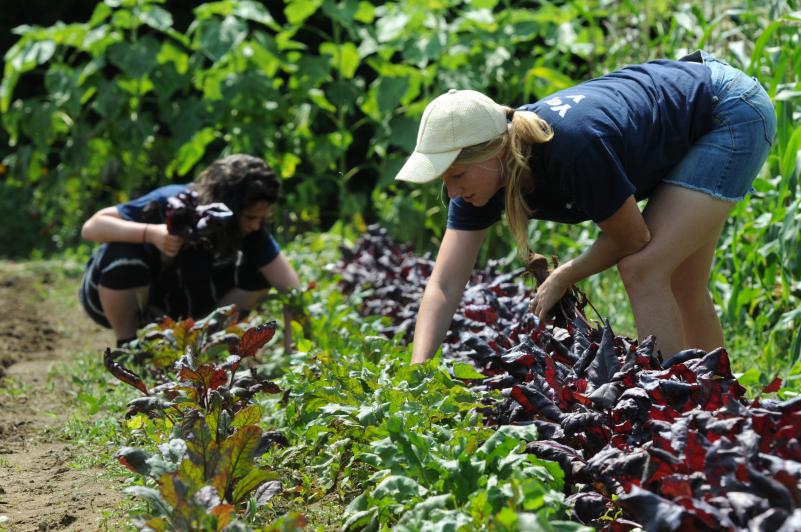
Cate Elliott and Sarah Berquist harvest vegetables in the Food For All garden at the University of Massachusetts Agricultural Learning Center. They manage the garden, which provides food for Not Bread Alone and the Amherst Survival Center. The garden is located at the University of Massachusetts Agricultural Learning Center on N. Pleasant St. in Amherst. Purchase photo reprints »

The project is called Food For All, and Berquist and Elliott had already turned over kale, basil, lettuce, celery, broccoli and cucumbers to the two programs which provide free community meals, as well as groceries, to those in need. They also have spinach, beans, corn, squash, onions, beets, potatoes, herbs — medicinal and culinary — and pumpkins growing.

They are proud of the step they’ve in the effort to promote local crops.
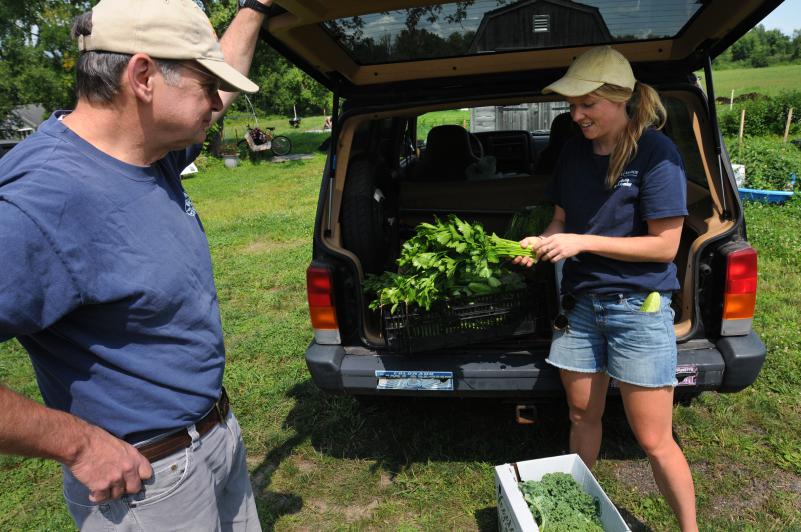
Bob Stover of Not Bread Alone takes a delivery of cucumbers, celery and cale from Sarah Berquist at the Food For All garden at the University of Massachusetts Agricultural Learning Center. Some of the vegetables are grown at Food For All and some are grown at other plots at the ALC and brought to the Food For All site for easier pick up. Purchase photo reprints »

“It’s rare to be growing food specifically for donation centers, so it’s kind of an innovative twist,” said Elliott.

She and Berquist met with folks from the Survival Center and Not Bread Alone at the beginning of the growing season to make their plans. Knowing both places get donations from various sources, they asked where the gaps were: why grow turnips if they already get plenty?

Tracey Levy, program director for the Amherst Survival Center, is pleased with the results.

“It’s been great,” she said in a telephone interview. “We’ve received some incredible produce.”

But there is a second part to the project that she likes just as much.

“It gives people who have an interest in growing a chance to garden with others,” she said. “They might not have the land or the skills, but this gives them an incredible opportunity.”

Cate Elliott pulls weeds in the Food For All garden at the University of Massachusetts Agricultural Learning Center. Purchase photo reprints »

There are hours set aside each week, like that Tuesday morning slot, for volunteers to come to the garden behind the former Wysocki farmhouse at 911 North Pleasant St., and work alongside Berquist and Elliott. Or they can just sit at a table shaded by an umbrella and watch.

“You can see it’s beautiful here,” said Berquist, her blond hair pulled back under a beige ball cap. “Two red hawks live here,” she said squinting up at one flying over head.

Elliott, dressed in blue shorts, a green T-shirt and sneakers with purple laces agreed. “We always tell volunteers that they are welcome to work in the fields, but they are just as warmly invited to sit under the umbrella and enjoy the garden.”

Visitors can park in the lot there near the farmhouse, now used for office and meeting space, and walk up a short gravel path which leads to the lush fields known as the UMass Agricultural Learning Center.

There are experimental gardens — one USDA project on Japanese Knotweed is on the right. Displays for urban gardening are on the left side where vegetables grow in blue plastic wading pools and ceramic containers. In the distance you can see a UMass student garden, a large plot of vegetables which are sold at a campus farmers market.

The Food For All garden is on the right and visitors are greeted by a sign which posts the volunteer hours — Tuesdays and Thursdays, 9 a.m. to noon and Wednesdays, 11 a.m. to 2 p.m. But Berquist and Elliott say they are glad to try to arrange alternative hours, too.

“Anybody can come,” said Berquist. “The hands-on piece is the most fun.”

Elliott, 21, a senior in the sustainable food and farming program that Berquist, 25, finished before starting graduate studies, got college credit to design the garden.

It was the idea of John Gerber, a professor at the UMass Stockbridge School of Agriculture, and Shelly Beck, pantry coordinator at the Survival Center, took part in the planning, said Berquist. Beck was involved in a similar garden in Greenfield.

Aside from Food For All, UMass has five campus permaculture gardens — plots of crops that thrive off one another in a variety of ways — supplying the dining commonses, and the idea was to create one aimed at the broader community.

Helping to stock programs like the Survival Center and Not Bread Alone also gives students a chance to see a side of the food system that is new to them, said Berquist. “You can be at the university for four years and never set food in the community that you are a part of,” said Berquist, who also works in educational gardens at two of Amherst’s elementary schools — Wildwood and Fort River.

“I think it’s the coolest thing that Stockbridge is reaching out.”

The Food For All project includes free workshops and events for the public. There was a kick-off celebration July 27, when about 20 people showed up on a rainy Sunday to tour the garden and help plant late-season eggplant and peppers. On July 30 there was a potluck supper at the Hitchcock Center for the Environment in Amherst during which a panel of educators, farmers and community organizers discussed local food sources. Next up is a session on food preservation at the kitchen used by Not Bread Alone at 165 Main St., Amherst Aug. 18 from 5 to 7 p.m.

Berquist and Elliott brim with enthusiasm when they talk about piquing public interest. They point out that people can help themselves to produce when they come — they urged me to do a half-dozen times: “Take some kale. Take cucumbers. We have some yummy basil, too.”

“We just want people to take advantage of the opportunity to come together and grow food and share food,” said Berquist.

And that means everybody.

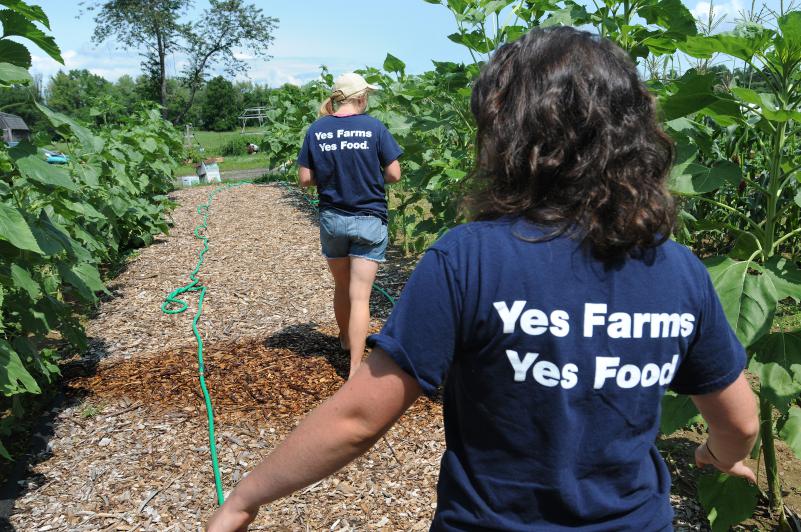
The garden that Elliott designed has an 8-foot wide path, covered with woodchips, running down the middle. It’s wide enough for two wheelchairs to pass one another. Lined by a thick border of sunflowers, it leads to three folding tables on one side that contain pots filled with onion, thyme, basil, squash and cherry tomato plants for people to tend without having to walk or bend over.

“Our mission was to make this as accessible as possible,” said Elliott. “We want people of all abilities to enjoy the garden.”

As Berquist and Elliott gave me the tour, Lilly Israel, Sammi Gay, Sara Hopps, Nathan Aldrich, Eric Pepperell, Erik Cullen and Matt Lee loaded the bags filled with uprooted tomato plants into a pickup truck for safe disposal. Then they turned their attention to weeding cucumber and pumpkin patches. Israel was leading a cluster of voices in a rendition of the song “Do, Re, Mi” from the “Sound of Music.”

“Gotta sing while you work,” she said, the sides of her head shaved with a pile of blond hair pulled up on top. “Keeps the morale up.”

The workers had been at it since 9 a.m. and shortly after 11, Berquist called them to the side of the garden for a stretching break and then a snack of pomegranate and black pepper chips. The chips got mixed reviews, but spirits were high.

“This is a beautiful office. I love being here,” said Berquist as I said goodbye. “Take some kale with you. We have plenty.”

Debra Scherban can be reached at DScherban@Gazettenet.com.

Source URL:http://www.gazettenet.com/home/13144451-95/growing-together-harvests-from-food-for-all-plots-in-amherst-take-novel-route-to


For more information!

Click here for information on the Bachelor of Sciences degrees in Sustainable Food and Farming at the University of Massachusetts Stockbridge School of Agriculture.

Or… take ONLINE classes in Sustainable Food and Farming and earn a UMass Certificate.
Workshop series focuses on access to local food and food justice

By SCOTT MERZBACH – Staff Writer- Thursday, July 24, 2014

AMHERST — Ensuring all residents have access to locally grown organic food will be the subject of a series of workshops that begins with a kickoff celebration at the “Food for All” garden at the University of Massachusetts Sunday afternoon.

This garden, which is in its first season, is designed to fill gaps in food donations for places like the Amherst Survival Center and the Not Bread Alone soup kitchen.

The produce grown and harvested aims to meets the needs of the community based on projections from both meal sites, said Sarah Berquist, who co-manages the garden with Cate Elliott.

“Our hope is to serve as a space for people from the Not Bread Alone and Amherst Survival Center communities, as well as the general public who like to garden but don’t have space, and/or people who are looking to learn more about growing organic food through hands-on experience,” Berquist said in an email.

The event takes place at 1 p.m. at the garden, located at the UMass Agricultural Learning Center, 911 North Pleasant St. Continue reading Workshop series focuses on access to local food and food justice

UMass research farm aims to teach latest innovations

By RICHIE DAVIS – Recorder Staff – Sunday, August 3, 2014

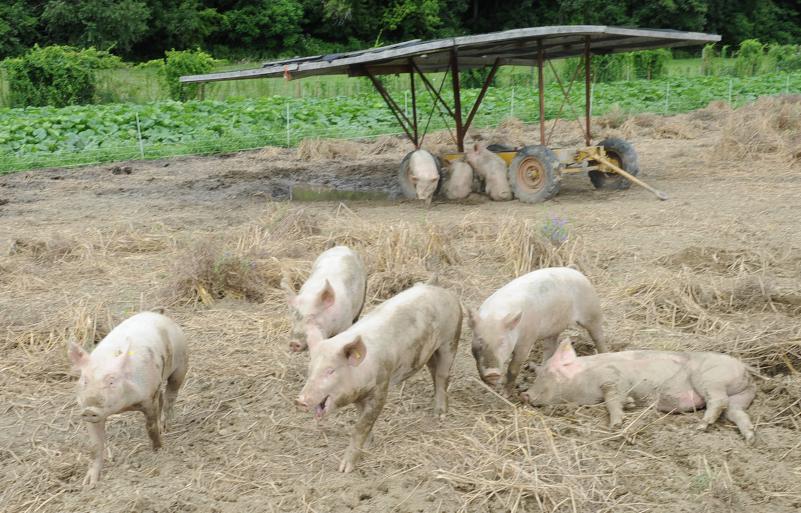
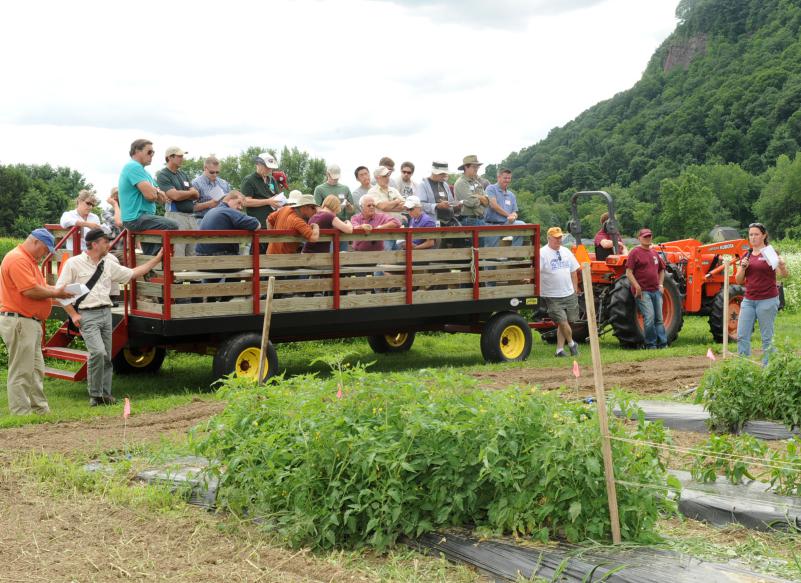
fielddayAgricultural field day at the University of Massachusetts Crop and Animal Research Farm is an annual chance for farmers to see the latest innovations in crop research, and the event last Tuesday event drew more than 60 people to view 18 ongoing trials, including one that integrated pig and vegetable production.

With an increased demand for locally raised meat and a growing demand by vegetable growers for manure, the strategy of having a test crew of 10 pigs eat hairy vetch and winter rye as cover crops before letting them loose in a harvested squash field was what Frank Mangan, a vegetable researcher, was looking into.

pige“Working with vegetables for 30 years, I wanted to work with a crop that you can actually harvest year-round,” Mangan told onlookers as an assistant whistled to 10 four-month-old pigs that come running across what had been “a very lush field of vetch and rye” that they continue to trample and eat.

The farm is going through the process of applying for certification from the federal Good Agricultural Practices and state Commonwealth Quality programs, under which manure is becoming heavily regulated.

“We’re trying to make the case that manure is an important part of our system here in New England, with smaller farms, and we want to encourage that kind of rotation,” he said. Current GAP rules require a 120-day wait period from the time manure is applied until a vegetable crop that “touches the ground” can be harvested. “They’re still negotiating this, and we want to make the case that this is a viable system, and we can do it safely.”

The pigs are scheduled to be slaughtered in late September, at about 200 pounds each, to provide one dinner for one of UMass’s four dining commons.

“We serve 45,000 meals a day,” he said. “I hear that and I think ‘market,’” especially since the Amherst campus is signed up for the Real Food Challenge to serve 30 percent of its meals with local, non-genetically- modified foods.

Feasting on the cover crop, he said, the pigs are eating half their normal volume of grain as part of a diversified, low-labor system providing a vegetable as well as meat.

Years ago, when farmers were encouraged to plant cover crops, they said the land was too valuable to be used for that purpose, Mangan said. “Here instead of just raising pigs on an acre or growing a vegetable, we split it in half, so the full acre is ‘in production,’” with the squash harvest planned in September, 120 days after the manure was applied.

Another example of mixed crop was what agronomy professor Stephen Herbert called “the first installation of dual-use grazing land and solar panels” in the country, with 90 to 95 percent of normal hay yields. “What you see around the country, and around Massachusetts is farmers giving up land for solar panels,” said Herbert. “We need every acre of farmland we have for food.”

The UMass system, with 70 panels 7 feet off the ground and arranged on posts at different distances apart, generates 26 kilowatts of electricity on less than a quarter-acre, and includes small plantings of tomatoes, kale, broccoli and lettuce. A larger system is also planned.

2steve“It’s a no-brainer,” he said of the systems, plotted so the panels shade out little of the crops. “You just have to be crazy enough to imagine what you might do.”

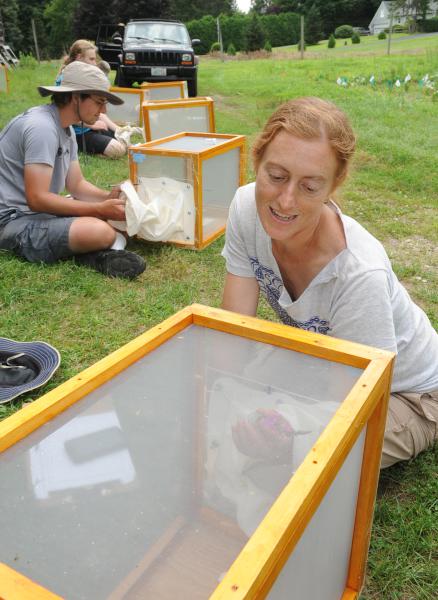
On a demonstration plot on one-half acre, biologist Lynn Adler pointed to 1,500 flowering plants of 15 varieties which researchers are inoculating with laboratory-raised parasites, crithidia. The crithidia are placed in large screen cages with common Eastern bumblebees to study the effect of different defensive plant chemicals on transmission of disease to the bees. The research is part of a broader study of diseases that are weakening native bee populations.

lynn“We’re recording how many flowers they forage on … and how much total foraging time,” said Adler, explaining that after each afternoon’s trial, the bees are returned to the lab and dissected after a week to see whether they are infected and what the extent of the infection is.

It’s far too early to know whether it’s the bee balm, foxglove, snapdragons, sunflowers or other varieties that are most likely to transmit the pathogen left in the feces of other infected bees, and to discover what kind of floral traits might predict odds of transmitting disease.

“Is it species that make lots of flowers, is it species that make lots of nectar, is it flowers of a certain shape, or flowers with a defense chemistry in their nectar?” said Adler. “Can I make some more general predictions that would help us be able to predict in a landscape which species are likely to be the hub of transmission?” That kind of research is a far cry from testing the use of a humidifier with air-cooled food storage systems that try to boost energy efficiency and also the freshness of stored fall crops like carrots, or a test to improve soil fertility by using mineral-rich rock dust and biochar from burning plant matter with limited oxygen.

But each of the experiments, Herbert said, could potentially have import applications in helping to make agriculture in the region more viable.

For information on majoring in Sustainable Food and Farming in the UMass Stockbridge School of Agriculture, see: Bachelor of Sciences in Sustainable Food and Farming.


Source URL:http://www.gazettenet.com/home/12954382-95/field-day-at-the-umass-research-farm-aims-to-teach-area-farmers-about-latest

The Pioneer Valley is all about farming

Trailer for new documentary on PV Farming

Western New England’s agricultural legacy has persisted for more than three centuries, through waves of migration, technological innovation and economic uncertainty. In many ways it is the birthplace of American agriculture that exists to this day.  A new WGBY production examines the history and present day status of agriculture in the region.  The documentary, produced by Emmy Award-nominated WGBY producer Dave Fraser, will premiere on WGBY on Wednesday, July 9, at 8pm.

The Connecticut River Valley is home to New England’s longest river, a remnant of the last Ice Age. But the receding glaciers also left behind another gift—some of the richest soil on Earth. This fertile valley has attracted Native Americans and settlers since the early 1600s. It remains a commercial provider of products such as tobacco, tomatoes and corn.  More recently, the idea of Community Supported Agriculture—community members and farmers in a relationship of mutual support based on an annual commitment to one another—was born in the Berkshires of western Massachusetts.

Interviews with a number of farmers, land preservationists and agricultural scholars from Deerfield to Great Barrington help provide a comprehensive view of this treasured resource and illuminate the complex story of the land, its people, its culture, and its agriculture. This WGBY production begins to tell that story.

Contributing to the program are John Brady, geology professor at Smith College; Kristin DeBoer, executive director of the Kestrel Land Trust; Joanna Ballantine, regional director for the West Division of the Trustees of Reservations; Phil Korman, executive director of CISA (Community Involved in Sustaining Agriculture); and Rich Hubbard, executive director of the Franklin Land Trust.

Local producers featured in the program include Clarkdale Fruit Farm in Deerfield, Luther Beldon Farm in Hatfield, Winter Moon Farm in Hadley, Szawlowski Potato Farms in Hatfield, Red Fire Farm in Montague and Indian Line Farm in South Egremont, the first CSA farm in the country.

Original Post from WGBY

Massachusetts Envirothon focuses on sustainable agriculture

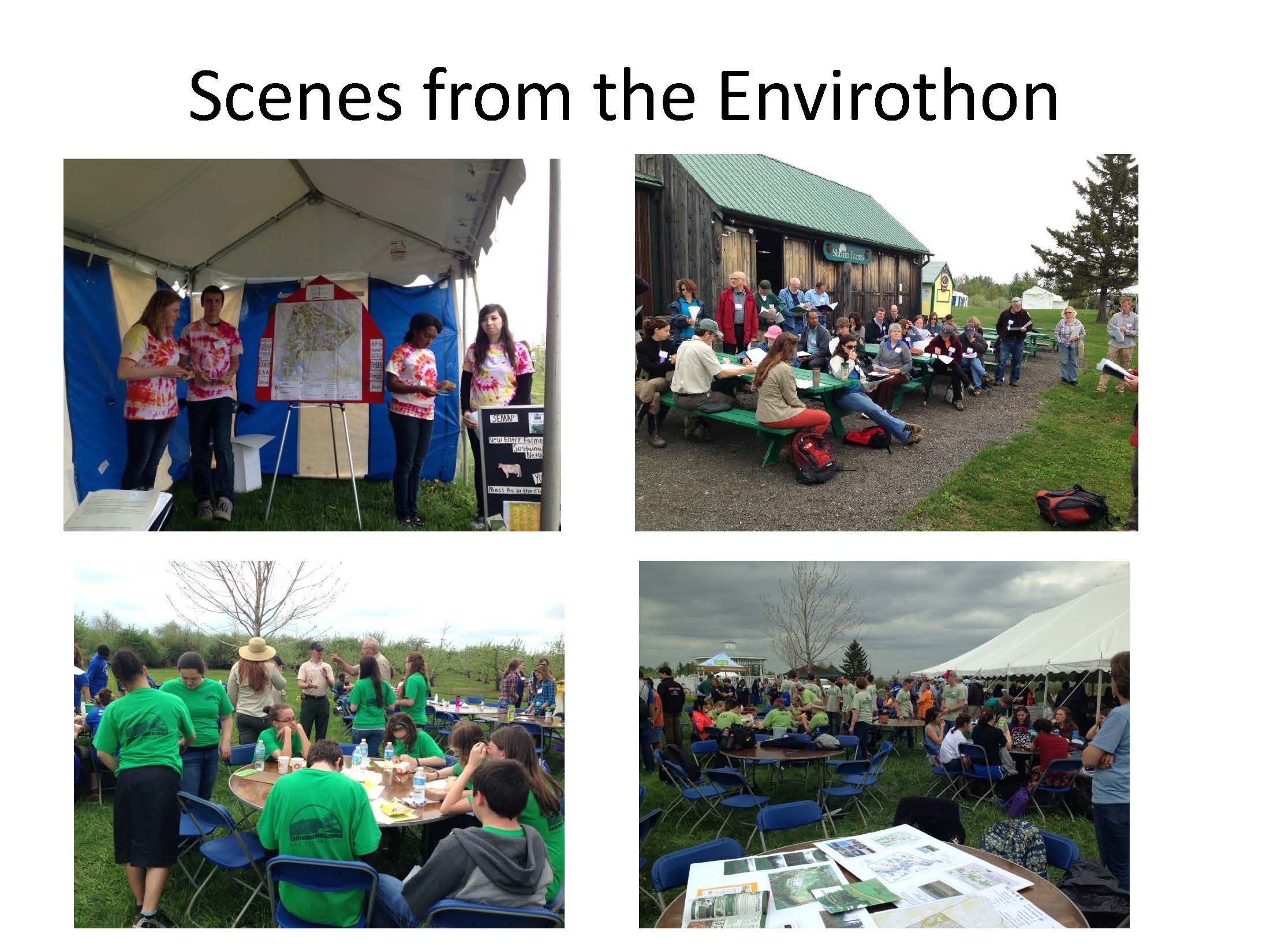
When it comes to promoting sustainable local agriculture, what could be more sustainable than preparing the next generation to understand and act on issues that affect local farms? That’s exactly what the Massachusetts Envirothon environmental education program for high school students has been doing this school year. And those students headed to Leominster on Thursday, May 15th to show how much they’ve learned.

After preparing for the entire school year, 250 high school students from more than 30 Massachusetts communities from Boston to the Berkshires were ready to show how much they know about the environment and this year’s Current Issue – Sustainable Local Agriculture – when they descended on Sholan to compete in the 27th annual Massachusetts Envirothon.

envirothonscenes

At the outdoor field competition event, teams rotated through four “ecostations” where they answered written questions and engaged Continue reading Massachusetts Envirothon focuses on sustainable agriculture

Graduating College (and other transitions in life)

Transitions

Its the time of year when “change is in the air.”   Days are getting warmer and longer, and we’ve even even been threatened by thunderclouds  recently.  Of course, the annual change of seasons is dwarfed by the significant life change that those of you who are graduating  college are experiencing right now!

transitoinsLeaving college is a big deal – right up there with going to college, getting married, having children, changing jobs or careers, retirement, etc. – you know, the big changes.  Transitions.

This time of the year, I get to talk to a lot of students facing graduation – which makes me think about the last day of my own college career.  I took a final exam in the morning, packed my car to drive home and was working at my first post-college job that same night – pumping gasoline (39 cents a gallon) at a gas station Continue reading Graduating College (and other transitions in life)

Annual HerbFest at UMass

HerbFest is a celebration of medicinal and aromatic plants presented by students in the Stockbridge School of Agriculture class, STOCKSCH 280 – Herbs, Spices and Medicinal Plants.  It is part of the Stockbridge School Medicinal Plants Program.

Congratulations to Professor Craker and the many Sustainable Food and Farming students who presented the results of their projects at the Annual UMass HerbFest this week!  Here are a few photos from the event! Continue reading Annual HerbFest at UMass

UMass Student Farm kicks off season

Daily Collegian – April 10, 2014 –

As the spring semester comes to a close, most classes begin to wind down and prepare for finals. For students enrolled in the Stockbridge School of Agriculture’s Farm Enterprise Practicum course, however, this is far from the case.

With a 1 to 6 credit course in which students plan the farming process for a 6 acre organic farm located in South Deerfield, the students enrolled in Farm Enterprise Practicum are just beginning the implementation of their work.

Their first major public activity for the new student farmers is a Special Topics Fair in which students present the results of their research.

During the spring semester course, students partake in the planning process for the farm work that will take place over the summer. Following the summer, students enroll in Stockbridge 498E, the second half of the Farm Enterprise Practicum.

“About half of the class stays in the summer to work on the farm,” said Amanda Brown, the instructor of the Farm Enterprise Practicum.

“Not only are students planning for the crops; they also each take on an area of interest and they create a research project about how they can implement this on the farm,” explained Jason Silverman, assistant manager of the University of Massachusetts Student Farm.

Among the 12 students enrolled in the course, projects covered topics such as seed saving, record keeping and farm planning, organic disease management, animal rotation, flea beetle management and draft horse husbandry.

Chris Raabe, a student enrolled in the Farm Enterprise Practicum, completed his project on the use of biodiesel. After completing research on biodiesel use at Kansas State University, Raabe was inspired to complete further work on the topic at UMass.

Raabe proposed an implementation plan that would convert cooking oil from the dining halls to biodiesel that could be used for tractors on the University farms and other resource-fueling needs across campus, such as the Physical Plant.

“It’s a compelling project with a lot of hoops you have to jump through,” Raabe explained of his implementation plan. “I’m hoping to build a task force working with different departments in order to get this project going.”

On Wednesday, students in the Farm Enterprise Practicum course showcased the projects they had completed and their plans for implementation at the Special Topics Fair, which took place in room 165 in the Campus Center basement.

“This is great because it is sort of like a big kick-off and allows students to talk to the farmers,” Brown explained.

In the fall, the students will work on marketing the crops that are being produced during the summer. In addition, students will share their research on their special topics and implementation in a student handbook that is published each year and given to the next semester’s students to serve as guidance.

“They sort of write their own textbook,” Brown said. “This is our third year doing this.”

Brown hopes to see a large collection of these handbooks for students to use as resources in the future.

The crops produced over the summer are sold through the Campus Supported Agriculture program, where students at the University can pay ahead and receive weekly shares of produce from the Student Farm.

In addition to the farm located in South Deerfield, students will also be working at the Agricultural Learning Center in North Amherst this summer, located just off of the UMass campus.

“Hopefully, this will increase visibility to other students,” said James Silverman, who graduated with a degree in Sustainable Food and Farming from the University and continues to work with the program today.

Members of the UMass Student Farm recognize the benefits of working with this program. Most specifically, Brown noted the business experience and knowledge that students gain from taking these two courses and participating on the farm.

“Each year’s success keeps it going,” Brown explained. “Half the money we make goes towards supplies and production, while half goes towards labor costs. It’s sort of like a non-profit organization.”

“Everything that we do is applicable to real life,” she said.

“This really was the capstone of my education,” added Silverman, who hopes to see a larger awareness of student farming on campus.

Katrina Borofski can be reached at kborofski@umass.edu.

—————————————————————————–

There are a few openings in this class for Fall 2014.  For information, see: UMass Student Farm Enterprise Class.

Massachusetts Envirothon Resources

Having had the pleasure of speaking with some of the participants in this year’s Massachusetts Envirothon on the issue of Sustainable Local Agriculture in Massachusetts, I thought this list of blog posts might be useful to the participants.

LOCAL AND SUSTAINABLE FOOD AND FARMING BLOGS by Dr. John Gerber, UMass Professor of Sustainable Food and Farming

Is Sustainable Agriculture Sustainable?


Symbols and Perspectives Matter


Lets Get Practical


Why do I Care?


Is Walmart’s Version of Sustainable Agriculture Really Sustainable?


Social Equity Must Remain One of the Three Pillars of Sustainable Agriculture


Reflections on Sustainable Agriculture


Education for a Sustainable Agriculture


Sustainable Agriculture Education – A Story?


Reflections on the Early Days


Is the Modern Food System in Collapse?


Dealing with Food Systems Collapse


Just Food Now: Public Opportunities and Responsibilities


Just Food Now: Taking Personal Responsibility


Local Food: Lets Get Serious Now


The Future of Sustainable Food and Farming


Sustainable Agriculture and the Public University


Sustainable Agriculture Jobs after College


Agroecology – Science for a Sustainable Agriculture


Sustainable Agriculture 2011: A Year in Review


Want to help design a local food hub?


Occupy the Food System: Education and Policy


Occupy the Food System: A Sermon


Its the U.N. International Year of the Cooperative in Western Massachusetts


Agriculture is a business… AND a way to connect with the divine


Industrial Agriculture is a “Fix that Failed”


The U.S. needs 50 million new farmers – including home gardeners and homesteaders