Category Archives: Education

$1.7M in federal grants to bolster food-related research at UMass

Congressman James McGovern visits with Stockbridge School of Agriculture students

The money will be directed to programs detecting harmful bacteria and minerals on food, developing a new safer type of food packaging and working with Massachusetts farmers to produce different crops popular with immigrant groups in the state.

“I’m proud to be a strong supporter of science and research and of this incredible university,” McGovern said. “I’m excited about the positive impact your research can have in our society.”

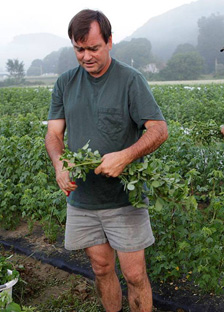
Bio-Frank_Mangan
Dr. Frank Mangan

(In addition to support for the Food Science Department)….  the final grant is $250,000 from the USDA’s Food Insecurity Incentive program that will support Frank Mangan and Zoraia Barros of the ethnic crops program at the Stockbridge School of Agriculture at UMass. That program teaches local farmers to grow healthy foods popular with some low-income, immigrant groups in the state.

McGovern expressed a personal commitment to the grant supporting crop development for immigrants, which is a part of a larger $3.4 million grant supporting the state’s low-income food program and other issues addressed by the state Department of Transitional Assistance.

“I sit on the agriculture committee because I am very concerned about the issue of hunger and food insecurity in this country,” McGovern said. “I believe hunger is a solvable problem.”

Barros, an urban agriculture specialist at the Stockbridge School, said the supported program would promote “weird-looking” vegetables among local farmers.

“In immigrant communities, they want what they want — they want the vegetables they are used to and that they used to eat in their country,” Barros said.

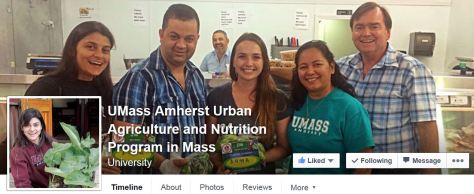
urbanagStockbridge does research on those vegetables, including red and green Brazilian eggplants, and passes advice on to growers so they can do it themselves and then sell the produce at farmers markets where immigrants shop. That way, they have access to fresh fruits and vegetables with which they are familiar, Barros said.

Different growers are near different immigrant populations, and the Stockbridge School works to connect those growers with foods in demand by those immigrant communities, she said.

Mangan, also of the Stockbridge School, said $1.25 million of the $3.4 million Food Insecurity Incentive grant will go toward the state’s SNAP program, formerly known as food stamps, and will help low-income people buy food at places like farmers’ markets.

Latinos make up 62 percent of the public school population in Springfield and 80 percent in Holyoke, Mangan said. Finding nutritious foods that are popular with these populations is important work, he said.

Lili He, the project leader on the programs to detect pathogens and harmful chemicals in food, said the grants announced Wednesday would go toward buying equipment and hiring student researchers to complete her research.

“This is the first time we have people here to broadcast our work,” she said. “It feels very great, very honorable.”

Steve Goodwin, dean of the College of Natural Sciences, said the UMass food science department is the best in the world, and that its research touched on food production, distribution, safety and security.

“All are issues becoming increasingly important on our campus,” he said. “The future of food science at the university is really bright.”

Original Post.  Dave Eisenstadter can be reached at deisen@gazettenet.com.

Food Solutions New England Celebration

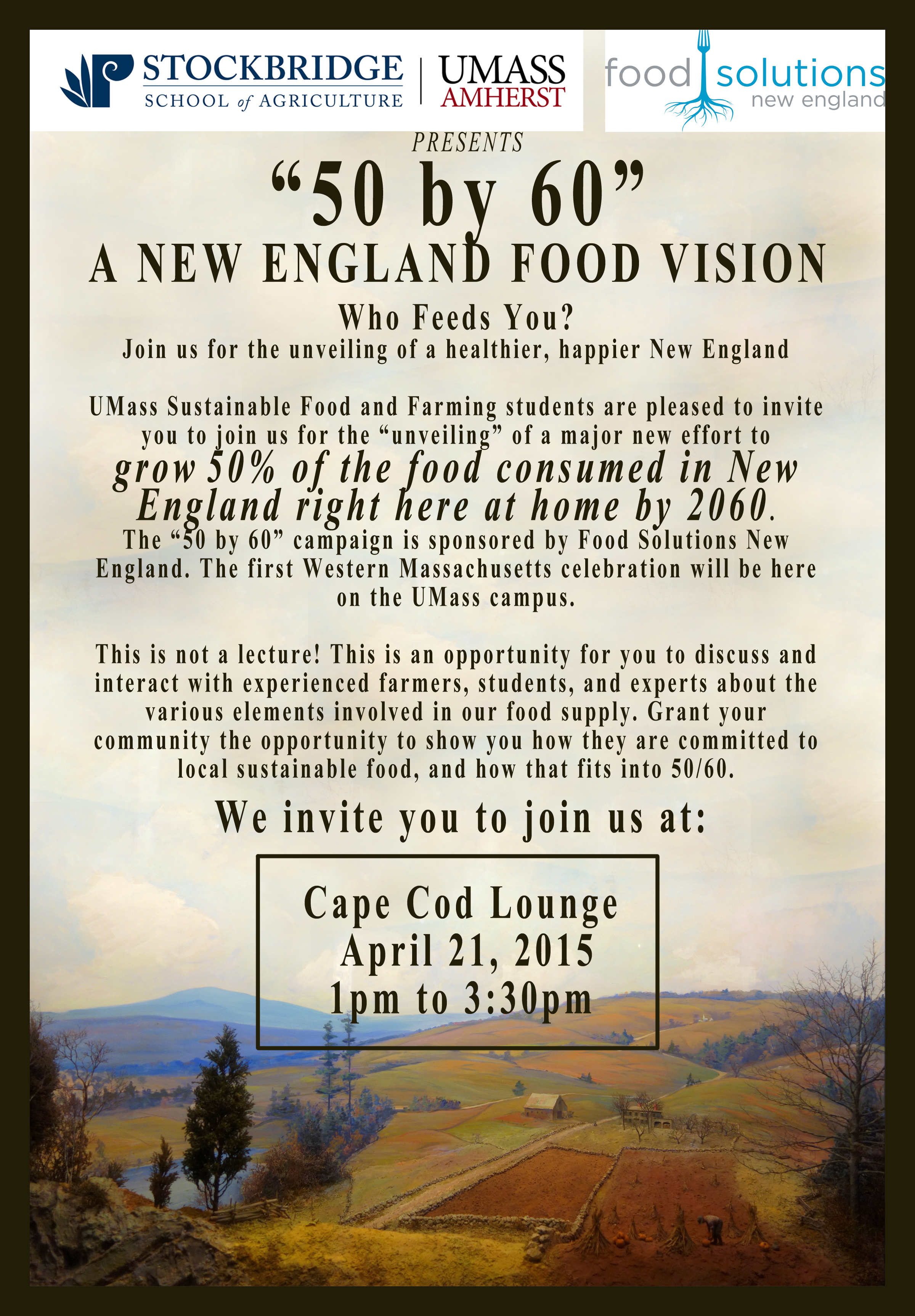
5060poster

Join us to celebrate a healthier, happier New England

 April 21 at 1:00 pm – 3;30pm

PRESENTATIONS AT 1:30 pm

UMass Student Center Cape Cod Lounge

 UMass Sustainable Food and Farming students have organized an event for the “unveiling” of a major new effort to grow 50% of the food consumed in New England right here at home by 2060. The “50 by 60” campaign is sponsored by Food Solutions New England.  The first Western Massachusetts celebration will at UMass on Tuesday April 21.

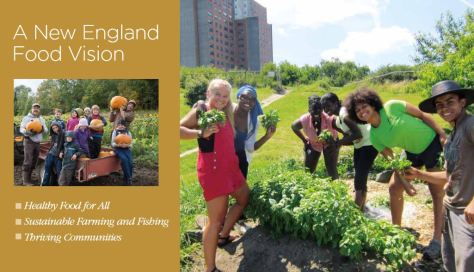
fsstockAlthough a leader in the local food movement, New England is currently sourcing more than ninety percent of its food from outside of the region. That means more than ninety percent of the money spent on food in New England is not circulating through our own economy.  Campaigns such as “Be a Local Hero” and “No Farms No Food” have been vital to promoting the benefits of purchasing local food. We think the “50 by 60” campaign raises the bar and sets a bold new vision for what we can achieve

 This is not a lecture!  This is an opportunity for citizens to discuss and interact with experienced farmers, students, and experts about the various elements involved in our food supply. The event is being offered to grant our community the opportunity to illustrate their commitment to local sustainable food, and how that fits into 50/60.

 Please join us!   And read the report here:

foodsolutions===================================================

“On the Bus” for the Coalition of Immokalee Workers

fairfoodBy Anna Hankins – UMass Sustainable Food and Farming Student

The Coalition of Immokalee Workers is a group of tomato pickers who have been organizing for the past twenty years in Immokalee FL, where 90% of all winter tomatoes are grown in the U.S.  The CIW has created the Fair Food Program; an accountability structure that ensures workers dignity and justice in the fields. To learn more http://ciw-online.org/

In October 2013 I attended my first action with the Coalition of Immokalee Workers. We marched outside a Wendy’s in Minneapolis, Minnesota. Chanting words like “Up up with the fair food nation, down-down with the exploitation.” I didn’t know that much about the Coalition of Immokalee Workers at that point, but I didn’t question what it meant to stand with them. Their work quickly became common conversation within the realm of the UMass Real Food Challenge (RFC). There’s a great deal of overlap between young people involved in RFC and the Student Farmworker Alliance who work directly with the CIW.

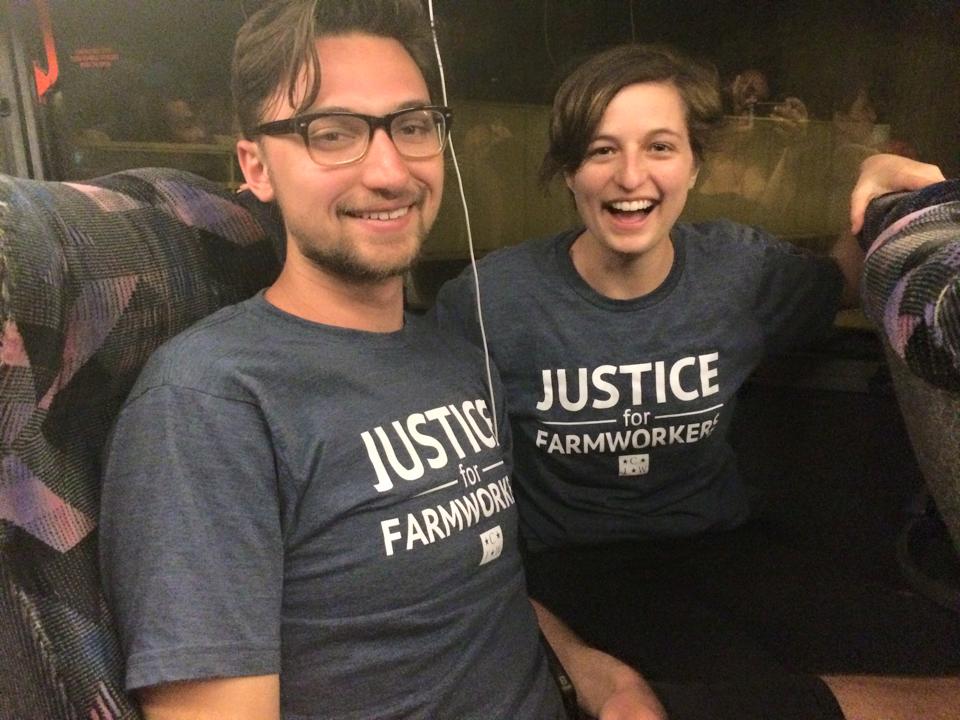
Anna Hankins and Chris Raabe, UMass SFF students "on the bus"
Anna Hankins and Chris Raabe, UMass SFF students on the bus

A year and a half after that first march I found myself getting on a bus in New York City, destined for St. Petersburg, Florida. A mere 25 hours didn’t even seem daunting. I got on this packed bus with students from Boston, Providence, NYC, and five familiar faces from UMass. There were folks who are involved with the Student Farmworker Alliance, Real Food Challenge, the Audre Lorde Project, Make the Road New York, amongst others. We went around the whole bus introducing ourselves in English and Spanish as we began driving through the night.

immokaleeWe arrived in Florida the next evening. It was already dark out when we got off the bus, but we did pull up to a circle of trees lit with white lights, a warm meal, new, and familiar faces. We were quickly welcomed in and spent the evening painting signs, making music, and sharing the warm air that many of us from the Northeast hadn’t felt in months.

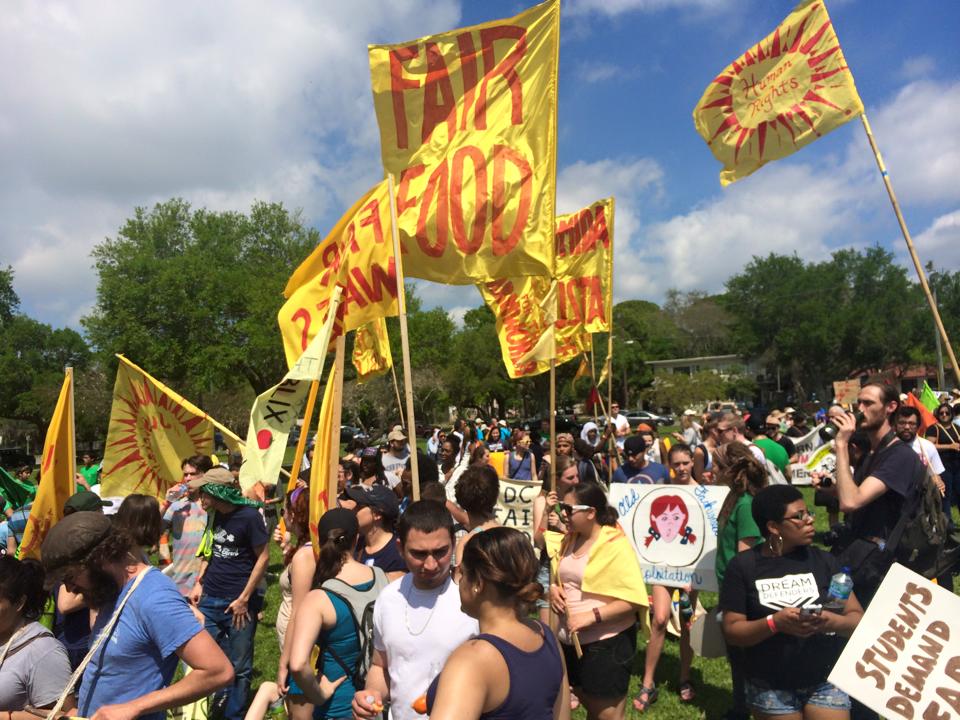
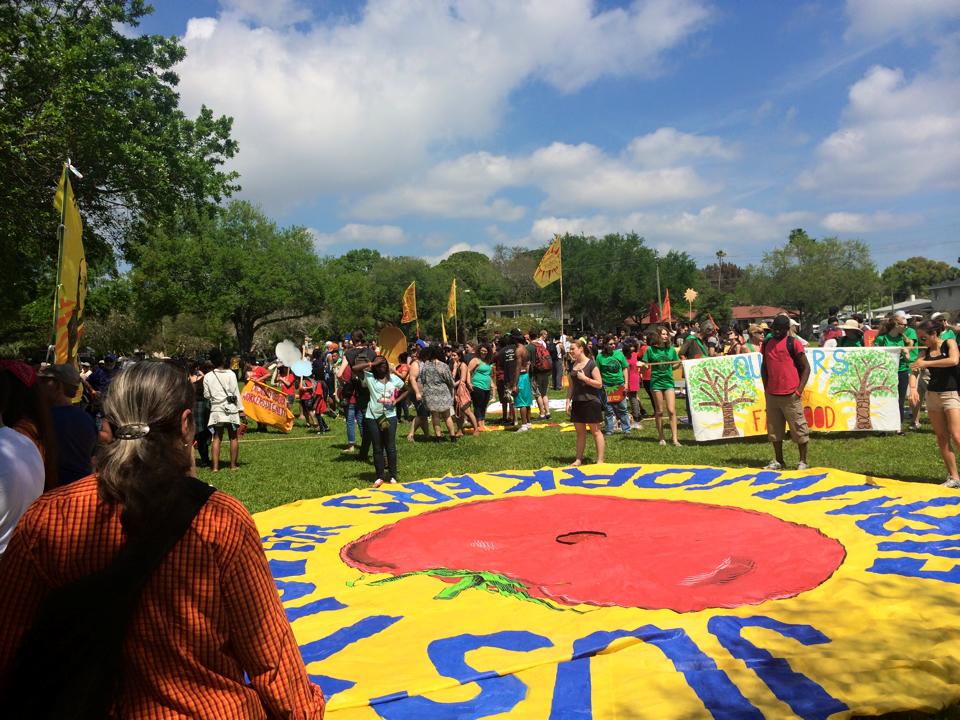
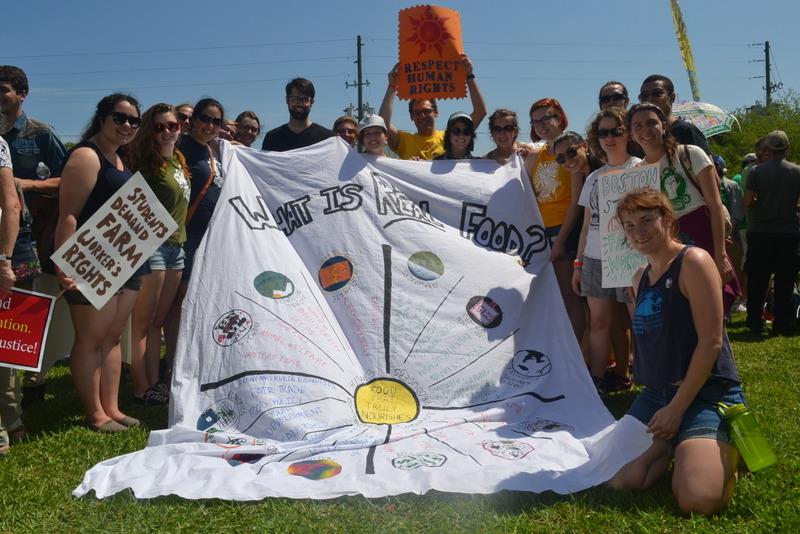
The next morning we were greeted by a breakfast cooked and donated by a local community group. Then we headed over to the park where the march would begin. When we arrived there were already floats being set up, flags being raised, puppets being set up, and signs being painted. There is almost no way to describe it. For the next few hours’ people began arriving. There was a huge range of people gathering around this park, carrying their own signs, their own stories. About a hundred members of the Coalition of Immokalee Workers attended, along side many of their kids, family members, and friends. Faith based communities came in full force, as well as student constituencies from around the east coast and Midwest.

We began our 3-mile march that afternoon. There were vans being driven to ensure accessibility of the parade. We yelled, sang, danced, cried (maybe that was just me). We went to Wendy’s and Publix, once again demanding that they sign onto the Fair Food Program. The workers led the march, followed by others who are on the front lines, and then allies followed behind.

The CIW has a powerful model for solidarity and partnership. The Student Farmworkers Alliance works closely with the CIW in order to effectively organize campaigns that are based at colleges and universities. For example when the CIW was targeting Taco Bell to sign the Fair Food Agreement, students were able to target Taco Bell by pressuring their universities to cut their contracts.

When we reached the end of the march, the celebration was just beginning. We struggled together that morning – we demanded that these corporations step up their practices. We acknowledged that there is still so much work to be done. But by that evening was about using art, music, and land to tell the story of the work the CIW has done and to celebrate the power they will continue to build.

To start the evening, members of the coalition put on a theater piece that illustrated the story of their struggle. Then the Student Farmworker Alliance announced the national boycott of Wendy’s and the #bootthebraids campaign. I ended up sitting and talking with RFC folks and a farmworker for the Vermont dairy industry. These conversations are not only important, but they are absolutely essential.

One member of the Coalition of Immokalee Workers stood on the stage and said, “We must fight together and we must also dance together.”

realfodIt is essential that we are centering the narratives of those at the front lines of our food system. It is essential that we are recognizing the intersection of immigration, race, labor and the ways in which our modern day food system is still deeply rooted in the logic of violent colonization and the plantation model. No matter how many classes I take at UMass, I will never understand what it means to pick 90% of the tomatoes that are produced in the U.S. But I am in a position to listen, to build connections, to march, and to follow the lead of those who do know. Perhaps the most important lesson I have learned from the Coalition of Immokalee Workers has been to show up.

Amherst Sustainable Ag Expo: April 12: 2:00-4:00pm

SUSTAINABLE AGRICULTURE EXPO

Learn, Discuss, and Explore the World of Sustainable Agriculture

mapAn expo on sustainable agriculture is being held at the Unitarian Universalist Society of Amherst (121 North Pleasant St.) on Sunday April 12 from 2PM to 4PM. Events will include activities for children, informational tables, and a raffle with goods donated by local farms and vendors. Hosted by Sustainable Food & Farming students of UMass Amherst, the League of Women Voters, and the Green Sanctuary, this is a free, family-friendly event. Designed to educate the public on the meaning of sustainable agriculture, this expo will provide concrete answers to questions surrounding how to live a more sustainable life.

The Expo will address sustainability from multiple angles: history of sustainable agriculture, soil health, legislation, local food, food justice, and methods of sustainable agriculture. Each topic will have its own table, complete with visual aids, pamphlets, and students of the Sustainable Food & Farming major at UMass who are there to educate and inform. Collectively, the students at UMass have studied these topics and will be ready and excited to engage the public in open dialogues aimed at educating the local community on issues that are of significant importance, locally and globally.

localsustainable Participants will be welcome to peruse the expo, partaking in different activities, conversations, and locally grown and prepared snacks donated by local farms. The goal is not to preach about a right and wrong way to live, but rather, to actively engage the local community through an educated discussion on sustainability.

UMass Amherst is a state university and is one of the major public research universities in America. Students majoring in Sustainable Food and Farming are gravitating toward careers in local food and green businesses, urban agriculture, permaculture, herbal medicine, and related jobs in farm-based education, public policy, community development and advocacy. The League of Women Voters is a citizen’s organization that has fought since 1920 to improve our government and engage all citizens in the decisions that impact their lives. The Green Sanctuary Program provides a path for congregational study, reflection, and action in response to environmental changes.

flyer 1-5###

If you’d like more information about this topic, or to schedule an interview with the UMass Sustainable Food & Farming group, please call Jason De Pecol at 203.617.7292 or email Jason at jdepecol@umass.edu.

Want to Major in Sustainable Food and Farming?

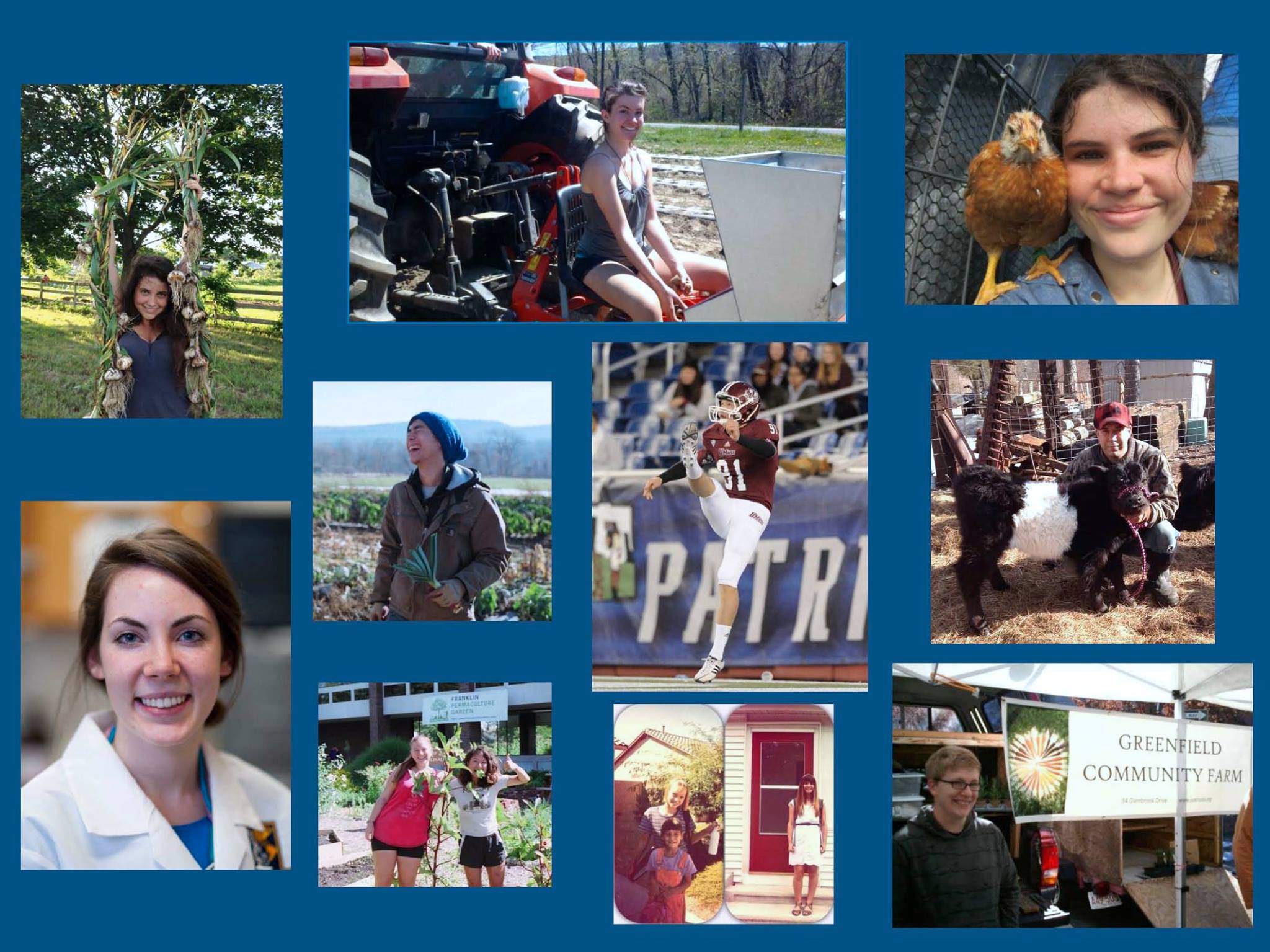
The Bachelor of Sciences degree in Sustainable Food and Farming is a welcoming home for those students who want to apply their knowledge of biology, environmental science, sociology, anthropology, policy, health and education to the real world!

Our students get involved in the world!

Sustainable Food and Farming Graduates 2014

Many students at UMass find that while they have a desire to be useful in the world, their area of study turns out to be a bit abstract and they are disappointed when their classes seem to be disconnected from the real world.  If this is the case…..

the Stockbridge School of Agriculture welcomes you!

Our major in Sustainable Food and Farming allows students to create their own degree plan, while earning a B.S. degree from UMass.   Working closely with an adviser, our students select courses from a diverse set of interest areas at UMass and the Five Colleges.  They are encouraged to get involved in internships which count toward their major.   And each academic plan is custom designed based on the student’s personal passion and career goals.

This major is about growing food….. and much, much more!  Our students are headed for careers in:

  • local ecological farming and marketing
  • community-based education for sustainability
  • public policy, advocacy and community development
  • permaculture and community gardening
  • food justice
  • medicinal herbals
  • and more…

If you are struggling with your current major and would like to explore your options in the Stockbridge School of Agriculture, please contact Dr. John M. Gerber for an appointment.

A few fall classes that may be of interest are:

STOCKSCH 197D – Draft Horse Husbandry (get up close and personal with some really big horses.  Meets at the AG Learning Center.  Very hands-on!)

STOCKSCH 197G – Intro to Permaculture (both the application and ethics of ecological living)

STOCKSCH 197 MC – Intro to Mushroom Culture (practical class that fills up fast)

STOCKSCH 211 – Pasture Management (for the serious farming student who wants to work with livestock)

STOCKSCH 265 – Sustainable Agriculture (field trips to local farms every Tuesday afternoon)

STOCKSCH 281 – Topics in Herbalism I (Chris Marano is the guy to know on local herbalism)

STOCKSCH 297 AL – Ag Leadership and Community Education (Sarah Berquist will teach you how to be an effective community leader)

STOCKSCH 297P – Small Farm Husbandry II – Pigs and Poultry (small class, very practical – fills fast)

STOCKSCH  300 – Deciduous Orchard Science (field trips to local orchards every Wednesday afternoon)

STOCKSCH 350 – Sustainable Soil and Crop Management (for the serious farming student)

STOCKSCH 397C – Community Food Systems (best local food systems class on campus)

STOCKSCH 397 GB – Grapevine Biology (new class on growing grapes)

STOCKSCH 397 PB – Pollinator Biology and Habitat (very practical science class with lots of work outdoors)

For more classes, see: Requirements for the Major

Stockbridge School of Ag Students Serve the Local Community

amherstbulleJohn M. Gerber      –     Friday, February 27, 2015

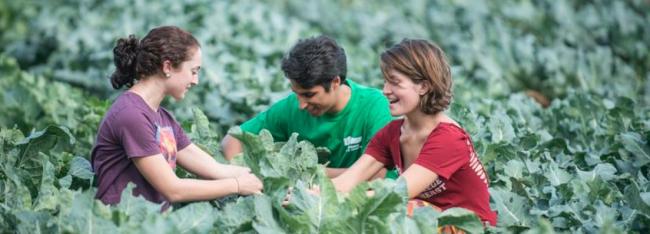
One of the most exciting programs at the University of Massachusetts Amherst today is an undergraduate major that serves the citizens of Amherst and surrounding towns by growing food, growing community and “growing” new farmers.

As local and regional food production expands in New England, so does enrollment in the Stockbridge School of Agriculture’s Sustainable Food and Farming program. UMass graduates are engaged in creating ventures to relocalize the food system to create more community and to reduce the carbon cost of shipping food long distances.

UMass began as the Massachusetts Agricultural College in 1863 and recently the former “Mass Aggie” was recognized as having the third-best agricultural science program in the U.S. and the eighth best in the world. Levi Stockbridge, Hadley farmer and one of the first teachers at Mass Aggie, would be proud. Building on its historic mission of practical research, outreach to the community and hands-on education, today’s Stockbridge School helps educate young women and men in ecological landscape management and sustainable food systems — crucial training in an era threatened by the impact of radical climate change.

Many Stockbridge students and grads are committed to implementing the Food Solutions New England vision of producing at least half of New England’s food by 2060. They contribute to this goal by working toward careers in local food and farming, urban agriculture, permaculture, herbal medicine, community education and advocacy for a more sustainable and just world.

An example of a local business providing students with valuable experience is the All Things Local Cooperative Market in downtown Amherst, started by area people committed to the relocalization vision. Stockbridge students and graduates volunteer at this year-round farmers’ market, some selling products they produced themselves, such as organic eggs, milk, artisan tea, blueberries, fermented kombucha, mushrooms and other vegetables.

Other Stockbridge students engage with their local community by working with Grow Food Amherst, a network of neighbors and students uniting town and gown. Amherst Development and Conservation Director David Ziomek planted the seed, and Sustainability Coordinator Stephanie Ciccarello nurtures the project with monthly meetings that engage over 450 residents helping to move Amherst towards greater food-resiliency.

Many students gain valuable experience by working on local farms, nonprofit organizations, co-ops, local businesses and community groups. The vibrant local food economy of the Pioneer Valley provides a supportive environment for food entrepreneurs, and Stockbridge is closely tied to this rapidly growing community of young people.

Building on Levi Stockbridge’s commitment to experiential learning, students in the Sustainable Food and Farming major are actively engaged in hands-on learning projects that contribute both to their own education as well as to the local community. For example: The UMass Student Farm is a year-round class where students manage a small organic farm and sell their produce through food service and retail markets — including a popular on-campus farmers’ market.

The Permaculture Initiative has converted underused grass lawns on campus into edible, low-maintenance food gardens, winning the White House Champions of Change competition in 2012.

The Massachusetts Renaissance Center Garden is a demonstration garden open to the public, featuring the herbs and vegetables grown during Shakespeare’s time.

The Student Food Advocacy group and Chancellor Subbaswamy signed the Real Food Commitment, which ensures that by 2020, at least 20 percent of the food purchased for the dining halls will be local, organic, fair trade and animal-friendly.

The School Garden Project helps K-6 teachers at Amherst elementary schools create vegetable and herb gardens as living classrooms.

The Food for All Garden at the new Undergraduate Agricultural Learning Center is a student-led project that grows food with the help of Amherst community members, and distributes the food through Not Bread Alone and the Amherst Survival Center.

Stockbridge students and alums are committed to building a more sustainable food system focused on environmental quality, social justice and economic vitality. These young visionaries imagine a world where the bulk of one’s food comes from local and regional farms. They believe that a consciousness rooted in sustainability will deepen as producers and consumers become more self-aware members of a community of caring for each other and the earth.

But these young entrepreneurs need our help. We buy food from local farmers at a rate far greater than the national average, yet these purchases represent less than 10 percent of total agricultural sales. We can do better. We can support these young people by buying their products from local farms, at our new All Things Local Cooperative, and at our weekly farmers’ markets.

At the same time we can invest in one of the key economic development objectives of the Amherst Master Plan, relocalization, and help the UMass Stockbridge School of Agriculture grow local food, grow community and grow more local farmers.

John Gerber is a member of the Pioneer Valley Relocalization Project, a professor in the University of Massachusetts Stockbridge School of Agriculture and founding member of Grow Food Amherst.


Source URL: http://www.amherstbulletin.com/commentary/15821972-95/john-gerber-new-life-for-an-old-school-the-stockbridge-school-of-agriculture

Praying for an Indepdendent Life for Chloe Rombach

Family and friends of Chloe Rombach have learned to find hope in the smallest signs since the 22-year-old suffered a severe brain injury when she was struck by a car in December.

She can breathe on her own now. She opens her eyes. The family believes there are times when she might be making eye contact. Other times she moves her fingers or an arm a little when asked.

“We don’t know what level she’ll eventually reach,” said her father, Edward Rombach, 62, of Marblehead. “We’re just praying for the best possible outcome.”

He says the family is well aware they are in this for the long haul.

“The doctors keep saying, ‘this isn’t a sprint, it’s a marathon,’” Rombach said. “I fully expect to be deeply engaged in this for the rest of my life.”

Rombach said he and his family take heart from even the slightest indication of improvement.

“Whenever we have a toast,” Rombach said, pausing a moment to control his emotions, “we raise a glass and say, ‘To an independent life.’”

Chloe Rombach moved to western Massachusetts to attend UMass Amherst, graduating two years ago. Most recently, she lived on Bridge Street in Northampton. She was crossing the street in a crosswalk near her home when she was struck by a car on the night of Dec. 9.

No charges have been filed against the driver, Kenzie Kimble-Badgett, 18, of 8 Button Road in Easthampton. Police said after the accident that the dark and rain likely made for poor visibility, and that drugs and alcohol do not appear to have been factors in the accident.

Rombach was dragged by the car and pinned underneath for about 20 minutes while firefighters worked to move the vehicle. She was rushed to Baystate Medical Center in Springfield.

“The evening of Dec. 9 and my wife and I were just finishing up dinner and there was a knock on the door. It was Marblehead police,” said her father. The officers communicated the information about the accident that Northampton Police had told them.

A nor’easter was dumping torrential rain on the state that night. “It was a three-hour drive in the driving rain, not knowing what we were going to find,” he said. “That was a horrific night.”

His daughter suffered third-degree burns and cuts in the accident, but her most serious injury is a diffuse axonal brain injury, according to her father. It is an injury affecting a large area of the brain that is caused by the brain moving back and forth inside the skull. In Chloe Rombach’s case, it caused life-threatening brain swelling.

Modest progress

In the days immediately after the accident, doctors at Baystate Medical Center performed a craniectomy to remove two sizable skull plates over her frontal cortex to relieve the pressure from the swelling, according to her father. Doctors also said it is likely her brain was further injured by oxygen deprivation while she was pinned under the car.

On Saturday, a neurological examination at Massachusetts General Hospital determined that Chloe Rombach is ready to have the surgery to put the skull plates back in, probably sometime in March. It’s another good sign, her parents believe.

“She’s making modest progress,” her father said.

She breathes on her own, though through a tracheotomy tube. She also has a feeding tube, and infections are always a risk, he said. She is visited by physical therapists, respiratory therapists, and many more specialists who try to help her along.

Rombach and his wife, Jeannie, visit Chloe every day at the rehabilitation hospital 10 minutes from their home. Edward Rombach, who is unemployed, said being at the hospital with his daughter is “my job now.”

Jeannie Rombach, 60, has been taking time off from her job as a special education teacher in Marblehead, though she will have to go back to work soon, according to her husband. Their older daughter, A.J. Rombach, an artist in Philadelphia, came back to Massachusetts the day after the accident and spent nine weeks with her sister, though she is now back home.

Community support

The family created a CaringBridge website where they post daily updates about Chloe’s condition for loved ones to read. Rombach said there seems to be an infinite number of sympathetic people, from friends of friends and co-workers to extended family members, who have offered “support, prayers, intentions and thoughts.” A friend started a crowdfunding website to collect donations for the family’s medical expenses, and it has raised over $33,207.

Rombach said he feels thankful to all the people who have extended help to the family. “That’s really what’s sustained us,” he said.

“When this happened I felt like I was pushed out the window of a high building and I was falling to my death. All the prayers, the meals that showed up, the people lending us cars and making donations, it was like a safety net keeping me from falling,” he said. “They were like angels lifting me up.”

Rombach said that one of the many reasons it is so hard to see his daughter in bed is that she was always so full of life.

“She was a very adventurous gal — sometimes enough to make us nervous,” he said.

After high school, she took a year off to spend time on ecosystem farms in Spain, Costa Rica and Brazil. Agriculture, especially organic and sustainable vegetable and fruit farming, was her passion.

“She saw this as an interesting possible career path,” Rombach said.

‘All things agriculture’

In 2013, she earned a degree in sustainable food and farming from UMass Amherst after only three years. Rombach said that when he and his wife would visit, her kitchen was full of greens she grew herself.

Chloe Rombach was a leader in two agricultural projects at UMass, the Student Farm Enterprise project and the Garden Share Club. Amanda Brown, a lecturer in the Stockbridge School of Agriculture and director of the UMass Student Farm, said Rombach spent a year working on the farm.

“She was involved in all things agriculture at UMass,” Brown said Monday. “She did a little bit of everything. She worked in the fields with us in all kinds of weather, and she was involved with the farmers market and the CSA pick-ups on campus.”

She said Rombach has a “huge heart,” a talent for farming and a contagious laugh. When they worked together several years ago, Brown said, Rombach was always upbeat and never complained.

“She was well-liked and respected by her peers right away,” Brown said. “She was just great to be around.”

Brown said everyone in Stockbridge and the farm was devastated to learn of the accident. Many have kept abreast of her progress through the CaringBridge website and through other classmates who are connected to her family. “We’ve kind of been supporting each other,” she said.

Rombach was also an actor and had “a hell of a set of pipes,” her father said. In middle school, she played Dorothy in the “Wizard of Oz,” he said, and in high school, she played Maria in “West Side Story” and sang in an a capella group.

Her interest in natural healing methods drew her to another passion: yoga. After taking classes at the Karuna Center for Yoga & Healing Arts for six months to a year, she became an instructor in November.

Karuna director Eileen Muir called Rombach “the shining star” of the yoga teacher training program.

“She has an incredibly bright disposition. She was always enthusiastic and just shone her way through the training,” Muir said. “She was an integral part of our community — and still is.”

Staff and students at the center have been deeply affected by Chloe’s accident, Muir said. She keeps in touch with the Rombach family, she said, and she and another staff member send weekly updates to the Karuna community based on the information on her CaringBridge site.

“I send healing energy her way every day,” Muir said.

The family believes she was walking to the yoga center at 25 Main St. when she was stuck by the car.

Practical help

Jake Clough of Northampton said he became friends with Chloe after he got to know her last summer when they were both students at the Karuna Center. He said there is a “huge community” in the Northampton area that is pulling for Chloe and checking her CaringBridge site religiously for updates.

“She’s one of the strongest people I’ve met, so that’s what’s getting me through it,” he said. “I just trust in her and her strength.”

Clough, 24, a musician, said he and other friends are planning a fundraising concert to help the Rombach family with the staggering medical expenses, though a date has not been set.

“Raising money is the most practical thing we can do right now,” he said. “We’d all just like to be able to help.”

For his part, Rombach said his family is touched by the support — and they do need the money. “It’s only going to scratch the surface of what it will cost for long-term recovery,” he said. For instance, just her ambulance ride to Mass General for the exam Saturday cost $3,000 to $4,000, he said.

A friend initially started a fundraising effort on the GoFundMe website, but Rombach later took over and started a new campaign with a fundraising goal of $100,000 at http://www.gofundme.com/n1a53s. He said his daughter’s health care costs may one day reach several million dollars.

For now, Rombach said, he and his family will keep praying while they sit by Chloe’s bed, massaging her and looking for any sign of recovery. They hope one day — though it might be years from now — she will walk again and live an independent life.

At the same time, Rombach said, even as he and his wife care for their daughter now, they are concerned about who would continue to care for her when they no longer can.

“Most people go through seeing their parents die or get sick,” Rombach said. “I wouldn’t wish this on my worst enemy. It’s the hardest thing for a parent.”

For updates on Chloe Rombach’s condition, visit www.caringbridge.org/visit/chloerombach.

Continue reading Praying for an Indepdendent Life for Chloe Rombach

UMass Students Can Get Academic Help Here

 Student Resources at UMass

help

  1. The Learning Resource Center (LRC) is located on the 10th floor of DuBois Library, and offers FREE peer-supported academic tutoring and supplemental instruction for over 180 courses at UMass. Tutoring support at the LRC is available for individual or small group sessions on a walk-in basis.They also assist students with learning workshops to improve your note-taking, studying, time-management or problem-solving skills. Its important to be proactive about your academic goals, so if you think you might need some additional support, feel free to stop by the Learning Resource Center or visit their webpage for more information.
  2. The Writing Center can be found in the Learning Commons within the basement of DuBois Library. At the Writing Center, students can receive one-on-one support with all aspects of the writing process from beginning to end. The Writing Center tutors meet with writers in 45 minute face-to-face or online consultations. If you need help with anything from getting your ideas onto paper to revising your last draft, then check out their website to schedule an appointment with a Writing Center tutor.
  1. Also located in the basement of DuBois Library is the  Academic Advising Link, where Peer Advisors like me are ready for anything! These Peer Advisors from Undergraduate Advising can assist you with the course selection process, answer questions about academic requirements, promote major exploration, and much more. Swing by the Academic Advising Link in the library Sunday-Thursday from 4-8pm to have an awesome Peer Advisor assist you.
  1. Check out the Tutoring Centers available in the Lederle Graduate Research Tower if you need some assistance with various Math or Stats department courses. These centers are staffed by instructors, graduate TAs, and undergraduate peer TAs who are always happy to provide some assistance and math review. For the most up-to-date information regarding the time and room numbers for each tutoring session, please review the Tutoring Centers website.
  1. The DuBois Library offers an Ask a Librarian service to assist students with both understanding the borrowing or inter-library loan process, and locating the materials they need. They can also teach students how to utilize the library equipment, learn to use RefWorks, and more. Students can email, phone, IM, text, or visit the reference desk in the basement of the library within the Learning Commons in order to Ask these Librarians anything. Feel free to visit their website for more information.

Summer Pre-College for High School Students in Sustainable Farming and Food Systems

UMass Pre-college Summer Program

Sustainable Farming and Food Systems

July 9 – 15, 2017

Apply Here

summer college flyer 2017 (2)

or for more information click!

Are you interested in learning more about where your food comes from? Or how does your food get to your plate? And where does the waste go afterwards?

2015-07-28 10.29.58Join one of the leading university Sustainable Food and Farming programs in the nation for an immersion in sustainability and food systems. In this one-week course, students will gain hands-on experience in the local food system as well as comprehensive understanding of the U.S. Food System. This program will focus on three areas in our food system:

  1. sustainability and systems thinking,
  2. social justice, and
  3. agricultural leadership.

This week will include at least 2 field trips and hands-on experience at local farms.

2015-07-30 10.32.01
Students from 2015 working in the field

With a focus on sustainability, students will explore and analyze inequities present in our food system using systems thinking tools like concept mapping and iceberg models. Students will simultaneously participate in a UMass project growing organic food for local food relief organizations, such as Not Bread Alone soup kitchen and Amherst Survival Center, exploring both the food production and community engagement subsystems necessary to have a successful partnership addressing equity in our food system.

2015-07-30 10.18.18Finally, students will have an opportunity to explore their personal relationships to food, and lead each other in activities to deepen understanding how to change personal actions to impact our food system. This practice is important for students interested in leading, managing, teaching, and articulating various perspectives in sustainability.

Program Fees

Contact the instructor, Sarah Berquist at sbberqui@umass.edu …  for more information.

Apply Here

2015-07-30 12.07.34
Summer College Class 2015

Free food safety course offered by UMass

TO:  UMass Sustainable Food and Farming students

Please get certified! nancyc

Through a grant from the U.S. Department of Agriculture (USDA), the UMass Department of Nutrition has launched the Food Safety from Farm and Garden to Preschool online training program. The department has partnered with the University of New Hampshire Cooperative Extension to develop this free, online, interactive food safety program for early child care educators, foodservice staff, and parents.

The program is now available online at; www.umass.edu/safefoodfarm2kid

The program takes about 2-hours.  It is self-paced  and was created to help early childcare educators, foodservice staff, volunteers, and parents understand the importance of reducing the risk of food safety related to fresh fruits and vegetables in young children. The program includes five units:

  1. Farm to Preschool Benefits
  2. Fresh Produce and Foodborne Illness Risks
  3. Food Safety Basics for the Classroom and the Kitchen
  4. Food Safety and Gardening Activities
  5. Food Safety on Field Trips to Farms and Farmers’ Market.

Online discussion boards and printable resources such as Best Practices Planning Tools, resources, and Certificates of Completion are available and may be able to be used towards Professional Development requirements. The program is also offered as an in-person training workshop in Massachusetts and New Hampshire.

Nancy Cohen, Professor and Head of the Department of Nutrition and the Principal Investigator on the USDA grant, expects that through increased food safety knowledge and increased adoption of safe and healthy practices in Farm to Preschool (F2P) programs, that food safety risk will be reduced considerably for the hundreds of preschool children who participate in expanding F2P programs throughout New England.

“Over 400 participants from across the U.S. participated in the program in the first five weeks,” says Cohen. “Early indications show improved knowledge and planned behavior changes, not only in food safety practices, but in plans to increase gardens and fresh fruits and vegetables served. Research will continue to determine behavior changes as a result of the program.”

Original Post at: http://www.umass.edu/sphhs/news-events/nutrition-department-launches-farm-preschool-food-safety-program#sthash.g0O0TsHe.dpuf