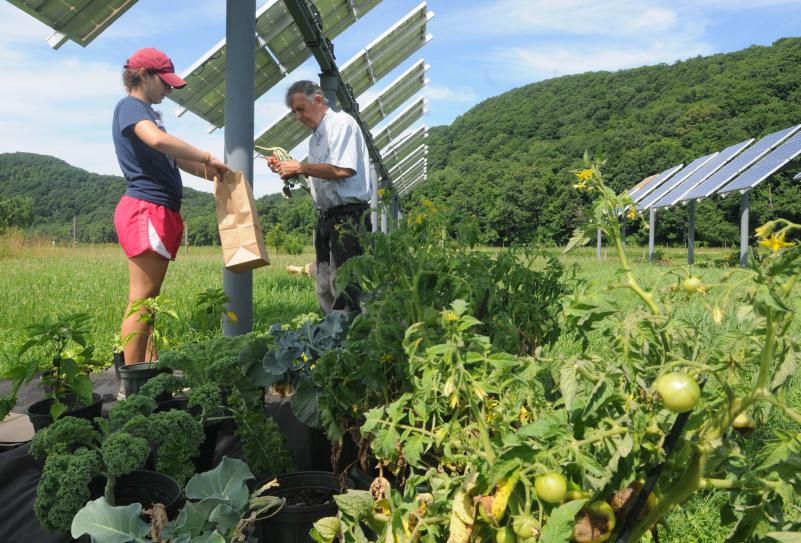
Phaedra Ghazi, research assistant, and Stephan Herbert, a Umass professor at the Stockbridge school of Agriculture, bags vegetable samples part of a dual use of land study for agriculture and solar PV. Photo by Carol Lollis.
ERIC GOLDSCHEIDER – Daily Hampshire Gazette – July 15, 2014
SOUTH DEERFIELD — What if you could use open space to generate solar electricity and farm it at the same time?
Stephen Herbert, a professor of agronomy at the University of Massachusetts Amherst Stockbridge School of Agriculture, says this is more than a pipedream.
A demonstration plot at a research station in South Deerfield is doing just that.
“We have shown that we can get 90 percent of the yield of a pasture with solar panels compared with not having them as long as we leave enough space between clusters of panels,” he said.
Cattle and sheep graze beneath them. The animals also benefit from the shady spots the panels create.
The initial installation was 70 panels, which generate 26 kilowatts of electricity on less than a quarter acre. They are seven feet off the ground and are mounted on individual posts. The wiring connecting them is above ground.
Herbert said the demonstration plot experiments with spacing and configuration to find the sweet spot that allows maximum sun to reach the ground so the vegetation gets what it needs while the rest is captured for generating electricity. He also experiments with ways of driving poles into the ground to support the panels while minimally disturbing the soil.
“It’s a simple thing, but nobody is doing it,” according to Herbert, who said the demonstration plot, which has been up for almost four years, is the only one of its kind in the country.
Herbert believes that ideas like this one will get more attention in the years ahead as dilemmas around the balance between using land to grow food while generating significant amounts of alternative energy become more acute.
“My position is that we should make solar panels compatible with agriculture,” said Herbert. He thinks that in the future we will see dual use solar installations that can also be used for growing vegetables.
According to a description of this work on Herbert’s website, “only solar has the potential to substantially power the state while only using a reasonable amount of the state’s landmass.”
Herbert said he understands the benefits to farmers of leasing out land for a couple of decades to host solar arrays on fields they might otherwise sell to developers.
But he doesn’t think growing crops and generating electricity should be mutually exclusive.
By Alice Waters – July 7, 2014 – Wall Street Journal
Ms. Waters is a chef, author and founder of Chez Panisse restaurant and the Edible Schoolyard Project.
Over the past half-century, the fast-food industry, aided by government subsidies, has come to dominate the food marketplace. That development has given us an obesity epidemic and, with the growth of so-called factory farms, has degraded the environment.
More recently, in a reaction against fast food and Big Ag, the sustainable-food movement, with a focus on local food networks and healthy eating, has gained a foothold in restaurants and farms across the country. What began as an underground movement has now gone mainstream.
Looking forward, I believe that ever-growing numbers of Americans—led by passionate chefs, farmers and activists—will choose the latter of these two paths: a sustainable food future. Let me describe how I believe, ideally, that future will look.
Farmers’ Markets
The number of farmers’ markets and young people taking up farming will multiply geometrically. As such, we will see at least one farmers’ market in every town in the country and, in turn, the revitalization of many areas.
At the same time, small mom-and-pop restaurants will enjoy a resurgence. These owners—with little enthusiasm for franchises—will be interested primarily in quality of life and in building a community around their businesses. These restaurants will build relationships directly with farms and will want to increase the quality and variety of their produce. As a result, I expect to see a greater variety of fruits and vegetables becoming available in the market.
Growing demand will push farmers to be innovative, as will climate change. That will mean more greenhouses in the colder parts of the country, growing food in urban areas and choosing crops that can withstand extreme weather.
This movement poses a threat to fast-food businesses and industrial food companies, both of which I predict will continue to shape-shift and co-opt their values for profit. As long as their products continue to be supported by government subsidies, they will be successful. The reality is that the sustainable-food movement’s reach will grow only to a point and ultimately will be limited to those with access, means and education—unless legislators dramatically change food and agriculture policy.
I think that those in government will come back to their senses in the coming years and begin to subsidize farms instead of factories. As access to real food becomes increasingly divided between the haves and the have-nots, food security will become even more of a social-justice issue.
Back to School
I am confident that we will see a growing consensus about the most effective way to transform food in America: building a real, sustainable and free school-lunch program. Decision makers will agree that the most sensible place to reach every child and to have the most lasting impact is with a program of “edible education.” Having worked in that field for more than 20 years via the Edible Schoolyard Project, I know what’s possible: Providing children with delicious meals made from organic ingredients transforms their attitudes about, and behavior toward, food for life.
Beyond the individual nutrition outcome of each child, an institutional food program with principled buying criteria (food that is locally sourced and organic) becomes a subsidy system for real food—a subsidy system that sees schools become the engine for sustainability.
I know that those on both sides of the political aisle finally realize that in food we find the root problem of many of our nation’s ills. I am not sure yet that they realize that food has the solution.
When droughts or crop failures cause food prices to spike, many Americans barely notice. The average American, after all, spends just 6.6 percent of his or her household budget on food consumed at home. (If you include eating out, that rises to around 11 percent.)
In Pakistan, by contrast, the average person spends 47.7 percent of his or her household budget on food consumed at home. In that situation, those price spikes become a lot more noticeable.
The US Department of Agriculture’s Economic Research Service keeps tabs on household expenditures for food, alcohol, and tobacco around the world.
Americans, it turns out, spend a smaller share of their income on food than anyone else — less even than Canadians or Europeans or Australians:
Note that the map above is based on data for food consumed at home — the USDA doesn’t offer international comparisons for eating out, unfortunately. Still, even if you do include food consumed at restaurants, Americans devote just 11 percent of their household spending to food, a smaller share than nearly every other country spends on food at home alone.*
Below is a chart showing numbers for a handful of select countries. Note that this doesn’t include spending on subsidies and the like — it’s just a measure of the fraction of household expenditures devoted to food consumed at home:
There are a few notable points here:
1) Richer countries spend a smaller fraction of their income on food. This makes intuitive sense. There’s an upper limit on how much food a person can physically eat. So as countries get richer, they start spending more of their money on other things — like health care, or entertainment, or alcohol. South Koreans spent one-third of their budget on food in 1975; today that’s down to just 12 percent.
That said, this relationship doesn’t always hold. It depends, at least in part, on what kind of food people favor, patterns of eating out, and the specific food prices and subsidy schemes in their country. Note that India spends a smaller fraction of its budget on food consumed at home than Russia, which is much richer. Likewise, South Korea spends a smaller share of its budget on food than wealthier Japan does.
2) Americans spend less than Europeans on food. The fact that Americans spend a smaller portion of their budgets on food than Europeans do is partly a consequence of the fact that Americans are richer. But Americans spend less on an absolute level, too.
The average American spends $2,273 per year on food consumed at home, the USDA notes. The average German spends $2,481 per year. The average French person spends $3,037 per year. The average Norwegian spends a whopping $4,485 per year on food.
The USDA doesn’t explain the variation. Some of it likely has to do with different tax systems in Europe (here’s a comparison of food prices in Europe), as well as differences in eating out. But there are also dozens of forces making food in the United States so cheap — from farm subsidies to advancements in industrial agriculture that have pushed down the price of food. (Over the years, the price of meat, poultry, sweets, fats, and oils in the United States have fallen, although the price of fresh produce has risen.)
There are fierce debates about the downsides of industrial agriculture — as well as the desirability of subsidizing agriculture. But one thing this system has done fairly well is keep the sticker price of food at the grocery store down.
3) High spending on food and malnutrition seem to go hand in hand. This is another perhaps obvious point, but worth highlighting. Poorer countries that have to spend a much larger share of their budget on food also end up with much higher malnutrition rates.
Western New England’s agricultural legacy has persisted for more than three centuries, through waves of migration, technological innovation and economic uncertainty. In many ways it is the birthplace of American agriculture that exists to this day. A new WGBY production examines the history and present day status of agriculture in the region. The documentary, produced by Emmy Award-nominated WGBY producer Dave Fraser, will premiere on WGBY on Wednesday, July 9, at 8pm.
The Connecticut River Valley is home to New England’s longest river, a remnant of the last Ice Age. But the receding glaciers also left behind another gift—some of the richest soil on Earth. This fertile valley has attracted Native Americans and settlers since the early 1600s. It remains a commercial provider of products such as tobacco, tomatoes and corn. More recently, the idea of Community Supported Agriculture—community members and farmers in a relationship of mutual support based on an annual commitment to one another—was born in the Berkshires of western Massachusetts.
Interviews with a number of farmers, land preservationists and agricultural scholars from Deerfield to Great Barrington help provide a comprehensive view of this treasured resource and illuminate the complex story of the land, its people, its culture, and its agriculture. This WGBY production begins to tell that story.
Contributing to the program are John Brady, geology professor at Smith College; Kristin DeBoer, executive director of the Kestrel Land Trust; Joanna Ballantine, regional director for the West Division of the Trustees of Reservations; Phil Korman, executive director of CISA (Community Involved in Sustaining Agriculture); and Rich Hubbard, executive director of the Franklin Land Trust.
Local producers featured in the program include Clarkdale Fruit Farm in Deerfield, Luther Beldon Farm in Hatfield, Winter Moon Farm in Hadley, Szawlowski Potato Farms in Hatfield, Red Fire Farm in Montague and Indian Line Farm in South Egremont, the first CSA farm in the country.
The Census of Agriculture is the most complete account of U.S. farms and ranches and the people who operate them. Every Thursday USDA’s National Agricultural Statistics Service will highlight new Census data and the power of the information to shape the future of American agriculture.
According to the 2012 Census of Agriculture, Massachusetts agriculture defies national trends in more ways than one. For example, while across the country the number of farms decreased four percent since the 2007 Census, Massachusetts was one of only 10 states that saw an increase in both the number of farms and land in farms in the same time period. In addition, while women make up 31 percent of all operators across the country, they make up 41 percent of all operators in the Bay State. Similarly, while the number of female principal operators decreased nationally since the last census, that number increased from 2,226 to 2,507 in our state. In fact, female principal operators compose 32 percent of all of our state’s principal operators, the highest percentage among the New England states and the third highest nationwide.
We also have a growing number of beginning farmers in Massachusetts. Although the proportion of all beginning farmers in our state is down slightly since 2007, it is still higher than in other parts of the country. In Massachusetts, 29 percent of all operators and 25 percent of principal operators began farming in the last decade, while nationwide, 26 percent of all operators and 22 percent of principal operators fall in that category.
Massachusetts’s agriculture has developed to meet the needs the needs of metropolitan area that stretches from Boston to New York City. To meet the needs of East Coast home owners and landscapers, in 2012, 1,039 of Massachusetts’s nurseries, greenhouses, floriculture, and sod farms grew and sold over $144 million worth of those crops. Sales of these crops accounted for almost 30 percent of agriculture sales. Also, 1,223 farms produced just over $125 million of fruits, nuts, and berries. Our state ranks eighth in berry acreage in the nation, at 15,727 acres, and 89 percent of that is dedicated to what many consider to be Massachusetts’s signature crop, the cranberry. Massachusetts is the birthplace of the cranberry industry and currently has the second highest cranberry acreage in the nation, at 14,070 acres.
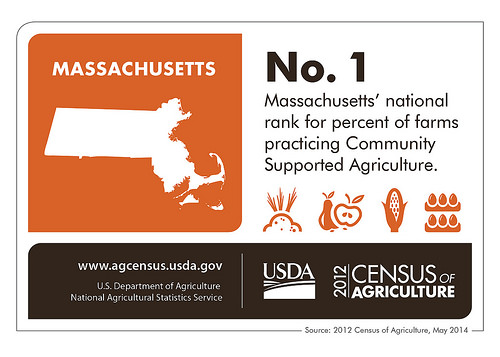
But what makes Massachusetts agriculture particularly unique is our direct- to-consumer sales, direct sales to retail outlets (such as stores, restaurants, and institutions), and community supported agriculture (CSA) arrangements. More than 28 percent of the Bay State operations engage in direct market sales, and our state ranks third in the nation for value of direct market sales per operation. In addition, Worcester and Middlesex counties are in the top ten counties nationwide for value of direct market sales. Over 13 percent of our sold to retail outlets which ranks 6th nationally. CSA arrangements are also very prevalent in our farming industry. In fact, nearly six percent of farms in our state market products through a CSA arrangement, up from three percent in 2007. We rank sixth nationally for number of farms and first nationally by percent of farms using CSA arrangements. In addition, four Massachusetts counties – Middlesex, Hampshire, Worcester, and Franklin – rank in the top 10 nationwide for number of CSA arrangements.
As you can see, Massachusetts agriculture stands out in multiple ways, and it’s clear that we will remain unique and continue to grow.
If you want to learn how to get involved in agriculture in Massachusetts, you might be interested in the B.S. degree or the ONLINE Certificate in Sustainable Food and Farming offered by the University of Massachusetts Amherst. Or at least, stay connected with whats happening at Just Food Now in Western Massachusetts.
A Second Career, Happily in the Weeds – New York Times – JUNE 20, 2014
Charles Nobel, a retired school administrator turned rancher, produces grass-fed beef in Stone Ridge, N.Y., for direct sale to customers. Credit Phil Mansfield for The New York Times
When Mr. Noble, a retired actuary and school administrator, started Movable Beast Farm with his wife in 2006, he would “get totally freaked out and have a battle of wills with the cows.” Now he reacts with calm and temporarily stops herding to avoid upsetting the animals.
“Stress is the worst thing you can do for them in terms of quality” of meat, said Mr. Noble, a trim, tanned man with a white goatee. He sells grass-fed beef primarily by word of mouth. “In order to make any money in agriculture at this scale, you really need to be direct marketing,” said Mr. Noble, whose company earned a profit for the first time last year.
But money is not his primary motivation. Mr. Noble waited much of his life to realize his cowboy dreams. “When I was younger,” he said, “I never wanted to work inside at a desk,” so, of course, he said, he spent “30 years working inside, at a desk.”
After her position at Cisco Systems was eliminated, Debra Sloane started a one-woman farm in Washington, Conn., for which she is seeking organic certification.Credit Wendy Carlson for The NYT.
Though new agricultural enterprises typically demand long hours and physical stamina, many retirees turn to farming as a way to keep active and earn an income — or, like Mr. Noble, to at least supplement Social Security. The White House’s 2013 Economic Report of the President notes that “the average age of U.S. farmers and ranchers has been increasing over time.” One-third of beginning farmers — defined by the federal government as having been in business fewer than 10 years — “are over age 55, indicating that many farmers move into agriculture only after retiring from a different career.”
Brett Olson, co-founder of Renewing the Countryside, a nonprofit in Minneapolis, has noticed more gray hair at the New Farmer Summit, a conference for aspiring agrarians. Mr. Olson’s organization offers a workshop at the annual event that it used to call Young Organic Stewards but renamed New Organic Stewards in 2012 to “be more inclusive,” he said.
Local, state and federal programs devote considerable resources to promoting agricultural start-ups. Many states offer preferential tax treatment of farmland. The Lincoln Institute of Land Policy, a nonprofit in Cambridge, Mass., compiles the various tax breaks on its online database.
The Agriculture Department’s Farm Service Agency recently reduced the paperwork required to apply for its microloan program, which provides recipients with low-interest loans of up to $35,000.
The federally financed Cooperative Extension System provides farmers and others with access to advisers, classes and research, often free.
Age, suggests Krysta Harden, deputy secretary of the federal Agriculture Department, can be a benefit rather than a barrier. She says she believes new farmers can use business skills, like management and marketing, developed during other careers. “My mother always told me we’re a family business, but we’re a business,” Ms. Harden said.
Lisa Kivirist, who coaches novice farmers as coordinator of the Rural Women’s Project at the Midwest Organic and Sustainable Education Service, notes that many of her older students are poised for success. “When they come into farming at midlife or early retirement, they know there’s only so many years left,” Ms. Kivirist said. “There’s a stronger focus and a more realistic sense of a plan.”
Saundra C. Winokur, 74, acknowledges that she lacked a formal plan when she founded Sandy Oaks Olive Orchard in Elmendorf, Tex., in 1997. “I just threw myself into it and learned on the job, though I probably would have not made as many mistakes as I did had I written a business plan,” Ms. Winokur said. If she had written a business plan, however, she might have become discouraged. “There were no olive orchards at the time in Texas,” she said. “It was thought that it couldn’t be done.”
Ms. Winokur, a native Texan who worked as an elementary-school teacher and earned a doctorate in developmental psychology, traveled extensively to research olive production. She noticed that renowned olive-producing regions — southern Spain, southern Italy and Egypt — “looked a lot like Texas.” In 1997, she bought 276 acres of sandy land, which she describes as “oceanfront property without the ocean.”
She planted 450 trees, but lost about half in the first winter because she had yet to master irrigation. Despite that setback, her business has flourished. In addition to producing olive oil, she owns a nursery and a restaurant. Ms. Winokur has had considerable help along the way. Experienced farmers in the area served as mentors. One neighbor briefed her on the history of her land, which had long been fallow when she bought it.
She later received a $98,000 Agriculture Department Value-Added Producer Grant, which helps farmers create derivative products from crops. Ms. Winokur used the money to market her olive-leaf jelly and hire a chef. The grant “gave me that kick-start I needed to move the business to the next level,” she said.
When she started her orchard, Ms. Winokur could hoist 80-pound bags on her own, but she now must rely on employees to handle strenuous chores. She estimates that it took her 13 years to recruit a “first rate” team and advises new farmers to pay well but hire carefully: “Don’t hire because you’re desperate, the first person who comes through the door. Really take your time.”
Ms. Winokur considers her teaching background a training ground for farming. When she encountered confused children, “I could see that they were looking at me with a blank look,” she said, “then I would have to shift gears, another avenue to explain a concept to them. And I think that’s what you have to do in farming: If something doesn’t work, you have to be willing to shift.”
That lesson is not lost on Debra Sloane, who recently started a backyard farm in Washington, Conn. She suffered a blow to her self-esteem last year when Cisco Systems eliminated her position as director of global health care. “I went through a grieving process,” said Ms. Sloane, who still uses corporate jargon like “customer interface” when discussing farming. After Cisco, she planned to grow exotic mushrooms, having received encouragement from several farm market managers. She then took two seminars for “mushroom nerds” and scrapped the idea because of the capital investment required and her desire to work outdoors. “You need a lab,” Ms. Sloane said of mushroom production. “You need to have a grow room with the right temperature, humidity, air circulation, and I said, ‘Uh-uh.’ ”
Instead, Ms. Sloane, a petite woman in a gray long-sleeve T-shirt, jeans and bright blue plastic shoes covered in grass clippings, decided to sell produce at several farmers’ markets, manufacture a vegan cereal and start a C.S.A. — a community-supported agriculture program. Her 11 customers pay in advance for weekly allotments of fruit and vegetables, easing her company’s cash flow.
Ms. Sloane, who declined to give her age, also started working out more, because while she once managed a small staff, she now must count on herself to plant, weed and harvest. She runs twice a week and trains at a nearby CrossFit gym four times a week. Her biggest challenge, she predicts, “is actually not physical but mental. It’s really figuring out how to be exact enough to know that I’m going to have enough to fill 11 bags all summer.”
She forecasts a “four-figure” profit in her first year and, like most farmers, will supplement her agricultural income with a second job; she is working part time as a consultant for Avizia Inc., a telemedicine technology company.
She acknowledges that working for a giant multinational corporation was “ego satisfying,” but she finds that life on the farm is “soul satisfying” — and humbling, especially when she must ask for help from more experienced colleagues. “I can tell you this,” she said near her raised beds of asparagus and strawberries. “I wasn’t humble at Cisco. My daughters have said, ‘You are so much nicer now.’ ”
Parasites, Killing Their Host – The Food Industry’s Solution to Obesity
Mark Bitman – New York Times – June 17, 2014
You can buy food from farmers — directly, through markets, any way you can find — and I hope you do. But unless you’re radically different from most of us, much of what you eat comes from corporations that process, market, deliver and sell “food,” a majority of which is processed beyond recognition.
The problem is that real food isn’t real profitable. “It’s hard to market fruit and vegetables without adding value,” says Marion Nestle, a professor of nutrition, food studies and public health at New York University. “If you turn a potato into a potato chip you not only make more money — you create a product with a long shelf life.” Potatoes into chips and frozen fries; wheat into soft, “enriched” bread; soybeans into oil and meat; corn into meat and a staggering variety of junk.
How do we break this cycle? You can’t blame corporations for trying to profit by any means necessary, even immoral ones: It’s their nature.
You can possibly blame them for stupidity: Even a mindless parasite knows that if it kills its host the party’s over, and by pushing products that promote “illth” — the opposite of health — Big Food is unwittingly destroying its own market. Diet-related Type 2 diabetes and cardiovascular disease disable and kill people, and undoubtedly we’ll be hearing more about nonalcoholic steatohepatitis, or NASH, an increasingly prevalent fatty liver disease that’s brought on by diet and may lead to liver failure.
Food companies are well aware of the health crisis their products cause, and recognize that the situation is unsustainable. But one theory has it that as long as even one of the big food companies remains cynical and uncaring about its market, they all must remain so.
Chief among the hopeful arguments is one that goes something like this: The first big food outfit to recognize that its future lies in creating a market for healthy and even environmentally neutral food (let’s throw in justice for workers and animal welfare while we’re at it!) may show the way to the future of healthy food as a sound business model. Some profitable corporations nibble at the edges of this already, but — as a piece in the current Harvard Business Review points out — American capitalists have become poor innovators.
Only the naïve, however, would believe that Big Food is generally working toward this. As Nestle and Michele Simon, author of “Appetite for Profit,” have been saying for years, these organizations represent not the public interest but the corporate one, and since they haven’t devised a way to improve or even maintain their bottom lines selling real food, they have to appear to be selling “better” food.
But the key remains selling. A new paper in the journal Social Currents by Ivy Ken, an associate professor of sociology at George Washington University, discusses Big Food’s strategy of “working together” with communities to fight the obesity crisis. The goal is threefold, according to Ken: Corporations want us to focus on the importance of their role in “solving” childhood obesity and presenting themselves as part of the solution. “Their part of working together is re-engineering their products; our part of working together is to buy more and more of this food that’s not real,” Ken said to me.
The food industry also wants us to ignore its use of that strategy to increase its market share and profits; and it wants to maintain legitimacy at a time when community groups and public health officials are, writes Ken, “demanding limits to their involvement” in supplying food to children.
Our efforts to demand limits on the sale of junk to children are a threat to Big Food. If we succeed, it fails, or at least suffers. But if industry succeeds, whether in selling blatant junk or re-engineered versions that are low in fat or sodium or gluten- or sugar-free or reduced-calorie or high fiber or whatever — companies can create any frankenfood they feel will sell — we will continue to suffer. (Nestle often says, “A slightly-better-for-you junk food is still junk food.”) Our health will decline further, the environment will be further degraded, and our health care system (and therefore economy) will spend an increasingly disproportionate amount of money on diet-generated chronic disease.
If the most profitable scenario means that most food choices are essentially toxic — in the sense that overconsumption will cause illness — that’s a failure of the market, not of individual choice. And government’s rightful role is not to form partnerships with industry so that the latter can voluntarily “solve” the problem, but to oversee and regulate industry. Its mandate is to protect public health, and one good step toward fulfilling that right now would be to regulate the marketing of junk to children. Anything short of that is a failure.
WHEN we began our Let’s Move! initiative four years ago, we set one simple but ambitious goal: to end the epidemic of childhood obesity in a generation so that kids born today will grow up healthy.
To achieve this goal, we have adhered to one clear standard: what works. The initiatives we undertake are evidence-based, and we rely on the most current science. Research indicated that kids needed less sugar, salt and fat in their diets, so we revamped school lunch menus accordingly. When data showed that the lack of nearby grocery stores negatively affected people’s eating habits, we worked to get more fresh-food retailers into underserved areas. Studies on habit formation in young children drove our efforts to get healthier food and more physical activity into child care centers.
Today, we are seeing glimmers of progress. Tens of millions of kids are getting better nutrition in school; families are thinking more carefully about food they eat, cook and buy; companies are rushing to create healthier products to meet the growing demand; and the obesity rate is finally beginning to fall from its peak among our youngest children.
So we know that when we rely on sound science, we can actually begin to turn the tide on childhood obesity.
But unfortunately, we’re now seeing attempts in Congress to undo so much of what we’ve accomplished on behalf of our children. Take, for example, what’s going on now with the Women, Infants and Children program, known as WIC. This is a federal program designed to provide supplemental nutrition to low-income women and their babies and toddlers. The idea is to fill in the gaps in their diets — to help them buy items like fresh produce that they can’t afford on their own — and give them the nutrition they’re missing.
Right now, the House of Representatives is considering a bill to override science by mandating that white potatoes be included on the list of foods that women can purchase using WIC dollars. Now, there is nothing wrong with potatoes. The problem is that many women and children already consume enough potatoes and not enough of the nutrient-dense fruits and vegetables they need. That’s why the Institute of Medicine — the nonpartisan, scientific body that advises on the standards for WIC — has said that potatoes should not be part of the WIC program.
Unfortunately, this isn’t an isolated occurrence. We’re seeing the same kind of scenario unfold with our school lunch program. Back in 2010, Congress passed the Healthy, Hunger-Free Kids Act, which set higher nutritional standards for school lunches, also based on recommendations from the Institute of Medicine. Today, 90 percent of schools report that they are meeting these new standards. As a result, kids are now getting more fruits, vegetables, whole grains and other foods they need to be healthy.
This is a big win for parents who are working hard to serve their kids balanced meals at home and don’t want their efforts undermined during the day at school. And it’s a big win for all of us since we spend more than $10 billion a year on school lunches and should not be spending those hard-earned taxpayer dollars on junk food for our children.
Yet some members of the House of Representatives are now threatening to roll back these new standards and lower the quality of food our kids get in school. They want to make it optional, not mandatory, for schools to serve fruits and vegetables to our kids. They also want to allow more sodium and fewer whole grains than recommended into school lunches. These issues will be considered when the House Appropriations Committee takes up the annual spending bill for the Agriculture Department on Thursday.
Remember a few years ago when Congress declared that the sauce on a slice of pizza should count as a vegetable in school lunches? You don’t have to be a nutritionist to know that this doesn’t make much sense. Yet we’re seeing the same thing happening again with these new efforts to lower nutrition standards in our schools.
Our children deserve so much better than this. Even with the progress we have made, one in three children in this country is still overweight or obese. One in three is expected to develop diabetes in his or her lifetime. And this isn’t just about our children’s health; it’s about the health of our economy as well. We already spend an estimated $190 billion a year treating obesity-related conditions. Just think about what those numbers will look like in a decade or two if we don’t start solving this problem now.
The bottom line is very simple: As parents, we always put our children’s interests first. We wake up every morning and go to bed every night worrying about their well-being and their futures. And when we make decisions about our kids’ health, we rely on doctors and experts who can give us accurate information based on sound science. Our leaders in Washington should do the same.
Walmart, the largest grocery store in the world, is often presented as a solution to poverty because of its low prices. There is a reason for those low prices however and it is because they put ever-increasing pressure on suppliers (including those that supply food) to drive down their costs. This drives down wages, both for the Associates who work in the stores as well as all across the manufacturing and food production chain. Walmart’s death grip on groceries is making life worse for millions of people!
The following is a call for action from the Food Chain Workers Alliance. We need to recognize that food is cheap in the U.S. because we allow people to be exploited. When we shop at Walmart (and other “big box” stores for food) we participate and benefit from this exploitative system.
On June 4th Walmart Associates, faith communities, union members, community groups, allied groups and students are coming together to take action against inequality.
OUR Walmart members will be striking in key locations across the country to protest Walmart’s illegal retaliation against Associates who have spoken up about inequality and have struck. Associates have been calling for Walmart wages to be raised to $25,000. Faith communities, union members, community groups, allied groups and students will be taking action in solidarity with Associates who are standing up against inequality. These actions will be happening at stores across the country and online.
I wish Olivier de Schutter had the power to match the acuity of his analysis, but it’s great that we’ve had an advocate whose vision is as broad as that of the corporations who have for the last 50 years determined global food policy. Since 2008, the human rights lawyer has had the title of United Nations special rapporteur on the right to food. (His second three-year term ends this week.) This is obviously not a genius marketing title and, even worse, the position carries no real power.
Still, the notion of an impartial observer who can see trends as corporations do — across political borders, and agnostic to them — is a valuable one. It’s easy enough for individual Americans to see how our problems may resemble Canada’s; it’s much more difficult to imagine ourselves struggling the way Indonesians do. That’s what De Schutter has done: shown us that the issues with the food system are as global as trade.
With increasing depth, De Schutter has analyzed a food crisis that is international and systemic, with common threads in countries rich and poor. He’s revealed how we can change things, how the will of the citizens and countries of the world can be powerful tools in making a new food system, one that is smart and sustainable and fair. “All over the world,” he says, “food systems are being rebuilt from the bottom up, often on a small, city-wide scale. That’s food democracy, which should be promoted just as in the early 20th century people dreamt of workplace democracy.”
Olivier de Schutter at the United Nations in Geneva in 2008.Credit Fabrice Coffrini/Agence France-Presse — Getty Images
De Schutter’s job has been to travel the world, observe and report. He’s spent time in countries as disparate as Malaysia and Mexico. During his term, he says, the “entire discourse” about food has changed (these quotes are from conversations we’ve had over the years and a phone interview this past Monday), and that more and more the solutions are seen to be moving away from what he calls “productivism”: the focus on chemically intensive monocrop agriculture with high yields and cash profits as the main goals.
The way of the future, he believes, is agroecology, a sustainable form of agriculture that draws on science, tradition and wisdom to treat farmers, earth and consumers respectfully. (In other words, it’s sustainable. I wrote about it three years ago.)
“We’ve learned,” he says, “that investing in the monocrop growth of cereal or soybeans may produce a lot of calories but it does not contribute to adequate diets.” This linking of nutrition to agricultural policies — what you grow determines to a large extent what you eat — is a big shift.
Put another way, producing an adequate number of calories to feed the world has not resulted in either feeding the world completely or well: People still go hungry, and dietary diseases among seemingly well-fed people are the result of failed agricultural policies and malevolent marketing practices. Productivism, of course, has also pushed against ecological limits that were not imagined 50 years ago.
Even if De Schutter’s focus on “the right to food” had been interpreted narrowly, his analysis is damning: “Poor countries should be supported not by dumping food on their local markets but by helping them reinvest in their own local food systems, by investing in their helping them feed themselves.” This is especially true of poor farmers who may be driven off the land by an inability to compete with food sold at international commodity prices, people who subsequently cannot afford that commoditized food. Think, please, about the horrible irony of that situation, and of what food justice actually means.
The above paragraphs will serve as a crude and barely adequate summary of some of De Schutter’s overview. As usual, however, solutions or at least positive maneuvers are harder to come by, and this is where I focused the most recent of my conversations with him. The major surprise here is how mainstream and international what once seemed like radical thinking about diet has become, especially in our anti-regulatory climate.
Because when I asked De Schutter where we are going now, he promptly said, “Many of us have arrived at the conviction that junk food and sugary drinks are like tobacco and deserve to be treated in the same way.”
This is significant because the United Nations has acted meaningfully and powerfully regarding tobacco. About 10 years ago, the World Health Organization (W.H.O.) sponsored the Framework Convention on Tobacco Control, which was then adopted by the World Health Assembly. (Nothing describing the machinations of the United Nations is simple.) It uses language such as “the right of all people to the highest standard of health,” which like much United Nations language is self-evident but rarely gets said in daily conversation and is often overlooked in government policy.







 NY Times Editorial
 UMass Sustainable Food and Farming