All posts by jgerber123

I teach sustainable food and farming at the University of Massachusetts and try to contribute to my local community without causing too much harm....

The Amherst Winter Market features a diversity of local products

If you have not yet visited the Amherst Winter Market on Saturday mornings at the Amherst Middle School, you are missing out on a wonderful community meeting place.  Lots of vendors of local food and crafts. Good coffee and baked goods, a place to sit and chat with your neighbors on a cold, wintry morning, and a play area for young children.  Please join us between 10:00am and 2:00pm (although the fresh eggs usually sell out by 11:00am).

To meet Angie with Mother Herb Diaper Service , Bobbie with Bobbie’s Beebalms, and Stella with Stillmans at the Turkey Farm local meat, see:

Brian Donahue on the future of New England farming

Professor Brian Donahue knew from a relatively young age that he wanted to have an impact on the world and he was gonna to do it his way.

Having left school after sophomore year to pursue a life more “interesting,” he started making it on his own. From logging to starting a non-profit to teaching and writing, Mr. Donahue has become well versed in the art of raison d’être, finding his “reason to be.”

One of Mr. Donahue’s more important involvements comes from a 2005 report titled, Wildlands and Woodlands . In this is an outlined vision pertaining to New England’s forest lands that calls for 70% of it to be put aside for conservation within the next 50 years. The report also summarizes a plan for New England growing a large chunk of its food supply.

In his latest pursuit of happiness him and a few friends are working on a start-up pasture based family farm in Gill, Ma called Bascom Hollow Farm.

According to a recent article in the Hampshire Gazette…

Brian Donahue has done the talk, he’s done the walk, and now he’s doing the math. And for him, it all adds up:

  • his work as an associate professor at Brandeis University,
  • his three decades of working on a community farm in Weston and now,
  • the 170-acre farm he recently bought off Bascom Road (in Gill, MA) where he’s begun putting down roots with friends.

To read the article, go to Gill professor-farmer sees food as more than academic.

Professor Donahue spoke to a group of local citizens in the Amherst Town Hall last winter on the future of farming in New England.  It was an inspiring and thoughtful presentation.

Here is a synopsis of his presentation on “Leading a New England Home-Grown Food Revolution”

Lets look fifty years into the future and ask, if New England were to do about as well as we can imagine at providing its own food through sustainable farming, what might we best grow here? Let us say that we were to triple the amount of farmland in New England to 6 million acres—close to where it stood in 1945. That would return about 15% of New England to agriculture. If we assume ‘smart growth,’ that could be done while leaving 70% of New England still covered in sustainably harvested woodlands and wild reserves. Given 15 or 16 million New Englanders to feed (and presuming they were eating more healthily), we could envision five major building blocks of a sustainable New England food system:

  1. New England could produce the great bulk of its own vegetables and a substantial part of its fruit, and from that fruit a significant portion of its own beverages. This might require on the order of 1 million acres: about 250,000 acres devoted to fresh and storage vegetables; 250,000 acres devoted to fruit (notably apples, cranberries, blueberries, and grapes); and 500,000 acres devoted to dry beans, which would replace some meat in the diet. While much of this produce might be intensively grown on small acreages near cities, some vegetable crops such as potatoes and other root crops, winter squash, and beans might be grown in rotation with hay and grain on more diversified rural farms.
  2. New England could once again produce the great bulk of its own dairy products, and alongside that most of its own beef, almost entirely on grass (with some supplemental grain). This assumes dairy consumption about as it is today, but red meat consumption cut in half. Most of the farmland reclaimed from New England forest would be devoted to pasture and hay, for which our soils and climate are well suited. This defining element of our pastoral landscape might require as much as 4 million acres: about 1.5 million for dairy cows and 2.5 million for beef, along with some sheep and goats.
  3. That would leave on the order of 1 million acres of cropland that could be devoted to some combination of grain for direct human consumption, grain for livestock feed, or oil crops (such as canola, sunflower, or soy) which could provide protein meal for stock feed as well. If most of that million acres were to grow grain for human consumption (flour, pasta, beer, and so forth), for example, we could about cover those needs; but that would not leave much for feed or oil. Grain and oil crops could be grown mostly in rotation with hay.
  4. New England could produce the great bulk of its own pork, chicken, turkey, and eggs. These animals could be integrated into grazing systems without requiring much additional pasture acreage, as most of their feed doesn’t really come from grass. However, their feed grain requirements would amount to more than a million additional acres, which is probably far more than New England could supply. But importing grain is not a bad thing (presuming the grain were to come from sustainable farms elsewhere)—it is one very effective way to import fertility into intensive grazing systems.
  5. A restored and thriving regional fishery would be another crucial building

We wish Brian well and are delighted to have him joining the local food movement in Western Massachusetts.  To stay linked to some of the activities and thinking on local food in this region, please join the Facebook Group – Just Food Now in Western Massachusetts.

And for resources on sustainable food and farming, go to Just Food Now.

Written by Steven Cognac and John Gerber, January 2012.


Jobs, Jobs, Jobs in Sustainable Food and Farming

This is the time of year students planning on graduating from our Sustainable Food and Farming major in May are busy looking for employment opportunities.  I’ve posted some general advice on finding good work, including some links to useful jobs sites.

I also post jobs and internships on occasion to my Just Food Now blog page if they are in Western Massachusetts.

To see what some of our recent graduates are up to , check out the “graduates” link above.

Students in the major generally focus on growing good food, farm education, advocacy and public policy. They study topics from permaculture and organic farming to medicinal herbs and community food systems.

Our Sustainable Food and Farming major helps to prepare students for careers with small, organic and community farms, non-profit advocacy and policy agencies, government organizations, and food and farm related educational institutions.  SF&F offers students flexibility in choice of courses and therefore requires a close working relationship with an academic advisor.

For a few thoughts on employment in this area, please see; Yes, but are there jobs?


Stop Criminalizing the Family Farm

OpEd (1/9/12)

By: John Kinsman, President of Family Farm Defenders

On Wed. Jan. 11th dairy farmer, Vernon Herschberger must appear before
a county judge in Baraboo, WI – his crime, providing unpasteurized
dairy products from his small herd of about twenty pastured cows to
members of his own buying club. Half way across the continent in ME,
Daniel Brown, another family farmer with a small livestock herd was
notified on Nov. 8th that he was being sued by the state for selling
food and milk without a license. At the time he was milking one
Jersey cow.

In Valencio County, NM, the Hispano Chamber of Commerce was forced to
cancel its popular Matanza Festival set for Jan. 28th under pressure
from the USDA which said the centuries old tradition of processing and
serving pigs on site could no longer be done outside of a federally
certified slaughter facility. Last July in Oak Park, MI bureaucrats
threatened Julie Bass with up to three months in jail for daring to
grow vegetables in her own front yard. In Sept. Adam Guerroro, was
ordered to remove his kitchen garden because it was deemed a “public
nuisance” by Memphis, TN officials. Apparently, Michelle Obama’s
victory garden at the White House falls under a different jurisdiction.

This government crackdown on family farmers is absurd given the
current sordid state of our food/farm system and the urgent need to
relocalize agriculture for the sake of our health, as well as that of
the planet. Study after study has shown that the most dangerous food
is usually that which has endured the most processing and traveled the
furthest.

“With millions of Americans contracting food borne illnesses each
year, the USDA is committed to supporting research that improves the
safety of our nation’s food system,” – this was the comment of USDA
Deputy Secretary, Kathleen Merrigan, in a Dec. 15th, 2011 article in
Agriview. In the same issue, it was also revealed that U.S. meat and
milk exports had failed to pass the European Union’s standard for drug
residues. Deborah Cera, leader of the drug compliance team at the
FDA’s Center for Veterinary Medicine, admitted there were many
violations involving scores of drugs in U.S. livestock. In a Nov.
17th 2011 article in the Wisconsin State Farmer, Kim Brown-Pokorny of
the WI Veterinary Medical Association, warned that Wisconsin was the
worst violator nationwide in terms of illegal drug residues in the
meat of culled dairy cows. Yet, there was no mention in either
article of prosecuting or penalizing these drug users or even
informing U.S. consumers of this obvious food safety threat.

On Wed. Jan. 4th 2012 the FDA announced it would finally ban the use
of cephalosporins in livestock by April. Of course, this is but one
small group of antibiotics representing less than .00032% of the 29
million pounds fed to livestock each year. Doctors use barely 20% of
antibiotics in the U.S. to treat human disease – the other 80% are
used on livestock to make them grow faster, and this reckless
application is driving the evolution of antibiotic resistant pathogens
that now plague our hospitals.

Meanwhile, the USDA, FDA, and various state agricultural agencies are
squandering millions in scarce taxpayer dollars to criminalize small
family farmers who are at the forefront of providing healthy
nutritious fresh food to their communities. For instance, according
to an Aug. 25th, 2011 Natural News story, the WI Dept of Agriculture
and Consumer Protection (DATCP) receives up to $80,000 a month from
the FDA to wage its current crackdown on raw milk. The FDA even flew
several of its officials out to Wisconsin to join DATCP colleagues for
surveillance operations of local farmers’ markets. This taxpayer
subsidized harassment is reminiscent of the discredited National
Animal Identification System (NAIS) which was also fueled by millions
in USDA dollars funneled to DATCP for the unapproved registration and
“identity theft” of family farmers simply to meet compliance quotas.

It is time citizens told elected officials and the public servants
within government agencies whose supposed mission is to safeguard our
nation’s food supply that enough is enough. Producing and consuming
fresh local food is not a crime. In fact, every community should have
the right to determine what they grow, raise, and eat – this is the
underlying principle behind food sovereignty, first elaborated in 1996
by La Via Campesina, the largest umbrella organization for small
family farmers in the world.

In March 2011 the citizens of Sedgwick ME, passed the first Local Food
and Community Self-Governance Ordinance. The ordinance states in part
that “producers and processors of local foods are exempt from
licensure and inspection when the producer is selling directly to a
consumer intending to use the product for home consumption, or if the
foods are sold at a community social event. Citizens have the right to
produce, process, purchase and consume local foods of their choosing,
and it shall be unlawful for any law or regulation adopted by the
state or federal government to interfere with these rights.” Since
then similar local food ordinances have been adopted by other towns in
ME, CA, VT, and MA.

If people in Wisconsin want to enjoy access to fresh local food from
family farmers in the future they may need to pass similar ordinances
here. Otherwise, corrupt government under the sway of corporate
agribusiness will make sure they have no choice at all.

Poster on ComFood listserv by
John E. Peck
Executive Director
Family Farm Defenders,
P.O. Box 1772, Madison, WI 53701
tel./fax. 608-260-0900
http://www.familyfarmdefenders.org

Race and Food: Journal Exposes the Racial Structure of the Food System

The Kirwan Institute for the Study of Race and Ethnicity, the Center for New Community, and Indiana University Press today announce the publication of “Food Justice,” a new issue of the journal Race/Ethnicity: Multidisciplinary Global Contextsthat explores the intersection of race and food in the national and global food systems.

With a wide range of academic- and activist-authored papers, the issue takes readers through the entire food chain from—“field to fork”—in an examination of the challenging intersections between race, sustainability, food safety, access to healthy food, land ethics, food worker justice, and food sovereignty.

Wherever food is produced, picked, processed, packed, or purveyed low-wage workers of color predominate in the hard, dangerous jobs that feed the world on cheap labor and rampant exploitation of food workers within a toxic framework of abiding racial structures spanning the global community.  And wherever food is sought by those who can least afford it, those same racial structures prevent or prohibit access to decent, nutritious, and affordable food.  If all people are to be well-fed with good, healthy, affordable food there can be no avoidance of addressing the fundamental, structural racism at the heart of the food system.  In short, race and food are inextricably related.

According to Charlotte Williams, Field Organizer for Food Justice Initiative, Center for New Community, “A just food movement must be grounded within the framework of racial justice. With a renewed sense of urgency, food workers, urban and rural organizations and communities, and neighborhood leaders are working together to dismantle the racial structure of the food system that continues its defeat of the average citizen through low-wage jobs, harsh working conditions, and poor quality, high-cost food.”

“At every level in the food system,” Andrew Grant-Thomas, Editor-in-Chief, Kirwan Journal said, “people and communities of color are deeply impacted by this racial structure.”

The special issue was a collaboration between the Kirwan Institute for the Study of Race and Ethnicity at The Ohio State University (Columbus) and the Chicago-based Center for New Community and its Food Justice Initiative and is published by Indiana University Press.

Food Hub Proposal – Your Thoughts are Needed!

On December 1st, 2011, Brian Downes, Jennifer Christian, and Tabbitha Greenough gave a presentation at the Greenfield Community College (GCC) downtown center on creating a town food hub as part of their work for the Introduction to Food Systems Course.  The very next day, an article about starting the Greenfield Food Hub was published in the Greenfield town Recorder.  The article was written by Kyle Bostrom, a Greenfield farmer and member of the town agricultural commission.

Please view the recording by the GCC students and read the article by Kyle Bostrom.   Then join us in a dialogue  about the Greenfield Food Hub (even if you don’t live in Greenfield, Massachusetts) by responding in the comments box below to these two questions – or just add your own thoughts:

1) Are you aware of other Food Hub examples in the U.S. or around the World?  Please share them here and let us know if there is anything that can be added or changed to make the Greenfield Food Hub most effective.

2)  Please share your knowledge of:

a. Laws, accreditations, compliances, etc. required to make the parts of the Greenfield Food Hub a reality

b. Infrastructure:
– Design Firms
– Contractors
– Transportation businesses for farm products
c. Equipment needed to make parts of the Food Hub function and where to get it
d. Sources of funding

As you give feedback on each of these questions, please identify yourself and describe your expertise or interest in the Greenfield Food Hub.

Sarah Berquist: Creating ‘Good Work’ at a Young Age

“ We couldn’t have done it without you!” resounded in Amherst Chinese Restaurant from the farmers in the Saturday Amherst Farmer’s Market. It was the end of the market dinner for the Amherst Farmer’s Market family, a group of dedicated farmers and volunteers linked by the market manager Sarah Berquist, to provide local goods to the community of Amherst.

Saturday Amherst Farmer's Market


Sarah Berquist is a recent graduate from Umass Amherst and the Sustainable Food and Farming concentration, but has since continued new learning opportunities into our larger Pioneer Valley Community. Entering into school as an Environmental Science major, Sarah realized she thrived while working with her hands. After switching to Sustainable Food andarming, Sarah immediately got the hands- on experience she was looking for at Astarte Farm, securing her passion and interest for agriculture. Sarah is always exploring challenging opportunities and looking to provide her friends and family with healthy food choices.

Sarah and Professor John Gerber of the UMass Sustainable Food and Farming Program

Most recently, Sarah was the Teachers Assistant and researcher for the Student Farm as well as The Saturday Amherst Farmer’s Market Manager. Sarah was an integral part in ensuring that the Farmer’s Market exceeded the expectations of the community in providing an accessible outlet for healthy food to our community. Sarah woke up at 5:30 every morning with the farm vendors, always conscious of connecting the market to the wider community. Personally as a volunteer, by the time I came to the market, Sarah was wide awake conversing with patrons and vendors, dealing with market logistics, and checking in with everyone’s needs, with a friendly and concerned attitude.

Sarah and intern Andrea Colbert working the SNAP/EBT machine

Going beyond the conventional market structure, Sarah searched for opportunities to make the market more widely accessible to a broader socio-economic base. Driven by her frustration with the lack of accessible locally made products, she pursued a grant that would increase the markets availability to a variety of economic statuses. The grant allowed individuals receiving Supplemental Nutrition Assistance Program(SNAP) benefits incentives to buy from the farmer’s market. The Electronic Benefits Transfer machine matched the amount of money the person would receive from their SNAP benefits(If the card was charged $10 the customer would receive $20). Sarah wants to address the affordability of healthy options for the Amherst community and the environment.Sarah has responded to the communities demand for products that benefit the entire community by extending the accessibility and incentives to frequent the market. The SNAP/EBT machine is great for any customer who forgets cash for the market, but most importantly diversifies the economic base for those who wish to benefit from the great food that their neighbor farmer’s provide. It is all part of a closed loop system of relationships and resources that helps the community thrive. Inspirational, dedicated, young individuals like Sarah are integral to a community that must develop cooperation and resilience in the face of uncertainty with our resources.

Sarah has experienced the importance of reaching beyond the classroom walls to apply her knowledge and accept the learning opportunities from trying. During her time at Umass Amherst, Sarah created a home for herself in the Valley away from her home of Scranton, Pennsylvania. Sarah immersed herself in a community where she feels at home, while she continues to push herself to improve the community she loves. In the time I have known Sarah she has inspired me as an undergraduate and her other friends at the university to experience and engage in the community for the happiness of everyone. Sarah has created a close network of people while working in agriculture, including Sunset Farm,The Umass Student Farming Enterprise, Umass Ethnic Crops Program and Winter Moon Farm. There are no limitations in her interests to explore and only furthers her diverse contribution to the Pioneer Valley. Hosting regular potlucks with friends, playing music and speaking Spanish accompany her talents in producing, educating, researching and marketing sustainable agriculture. With intentions of returning to the place and people she learned from, Sarah is beginning a new adventure to Costa Rica where she will travel and learn farming techniques to return home with.

Sarah is a great friend to many, who made me a part of the market family, even as an occasional volunteer. Volunteering at the SNAP machine for me was a time to hang out with great friends and learn new things about a town I spend a majority of my time in during the year. Sarah taught me the importance of integrating oneself into a community that will help me grow and give back to my community that has given me knowledge and support in a place away from home.

By: Sara Hopps

Laughing Dog Farm

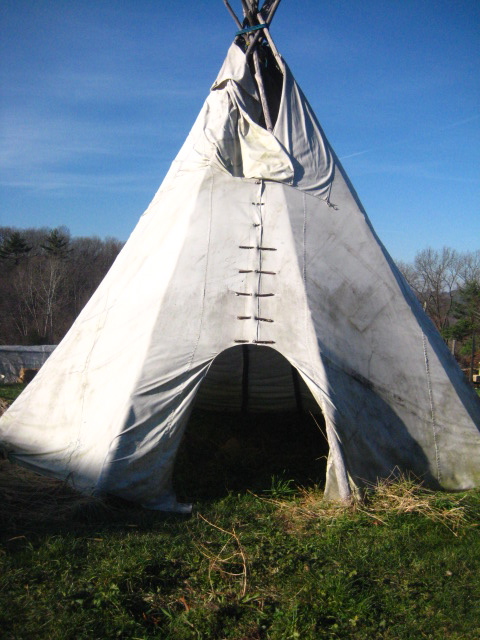
Daniel and Divya Botkin, of Laughing Dog Farm, live on a 3+ acre permaculture-inspired farm in Gill, MA with their children, one other couple, and ten goats. They currently have one housemate, although there are usually several seasonal helpers. The property does not look like a traditional farm, but instead is on a hill scattered with a number of beds and greenhouses, a teepee, and structures created out of found wood.

Teepee at the farm
The house

They live in a unique, angular house that was built by members of the commune that previously existed on the land. We visited Laughing Dog Farm for a workshop that they led on winter gardening. Danny and Divya welcomed us into their cozy living room, heated by a wood stove, and began the workshop with an icebreaker for the ten of us to learn about each other. Danny taught us about the technical aspects of greenhouse structures, but also stressed the “psychological benefits” of being able to plant all season long. Being able to seed vegetables in December and January is how he stays motivated through the winter months. Although we couldn’t see the full potential of the property on the late fall day, the greenhouse was filled to maximum capacity and in peak season every planting space looks that way. Each greenhouse bed was interspersed with different vegetables, including lettuce, spinach, leeks, tomatoes, and beets. He calls himself a “carpet installer” instead of a gardener, and makes sure that there are no spots of bare ground.

One side of the greenhouse
Danny showing us a bed in the greenhouse

Danny spent twenty years teaching and counseling, but had a love for gardening and homesteading and was always searching for more community involvement. It seems that he connected them well when he left to start Laughing Dog Farm, where he is able grow food with loved ones and use the farm to educate others. The goat products and food produced on the farm provide more than enough for the residents. The excess is sold through a small CSA and some direct sales. However, it is clear that selling at markets and making money is not the point of this farm. Spreading knowledge is the community service that Danny and Divya value most. Their primary source of income is from workshops for the public, like the one we attended. They also host many WWOOFers to learn on the farm in return for food and board. Inspiring people to grow their own food, teaching them the necessary skills, and attempting to instill the correct mental models to do so are the values that stand out at Laughing Dog Farm.

Divya and Danny demonstrating how to bend hoops for winter hoophouses


– Maria Superti and Nora Seymour

Draft Horse Power at Amethyst Farm

Bernard Brennan

Amethyst Farm was started over a century ago by settlers who wanted to farm in the fertile valley that has become the progressive town of Amherst, Massachusetts. It has always been a family farm, changing hands over the generations, while maintaining the charming qualities of a rural homestead. The property has offered its residents the resources to establish a quality of life that produces self-sufficient results, with a horse-boarding business and an indoor equestrian arena that pays the bills, while an extensive acreage of hayfields lays the bedding to comfort both the two-legged and four-legged residents. This land has provided the good life to many generations of Amherst agriculturists.
Now, a new generation of sustainable-minded farmers has moved into the old farmhouse, with goals of returning to a simpler way of living.
Bernard Brennan and his wife and children moved to Amherst from Connecticut last year, with plans of revitalizing the old farm and making it produce more than just shelter for purebred show horses. The Brennans want to construct a local economy using Amethyst farm as a community center for the families of Amherst seeking more than the intellectual rigors of academia. Coming from Yale where he was a Professor of Behavioral Ecology, Bernard wants to put the horses to work and reclaim the land. He sees this stretch of open pasture and small woodlot as an investment for his children’s generation, and his goal is to correct the incongruities caused by the elder generations whose cultural norms have led to peak oil concerns and social disparities that threaten future generations enjoyment of natural habitats.

Making Hay in May 2012

When he bought the 120 acre property, Bernard had never worked with horses before, although he did extensive research on the behavioral patterns of wasp species, that led him to appreciate the diverse mysteries of animals and their relationship with humans. When he came to Amethyst Farm, he decided that draft horses would be a key element to creating an alternative lifestyle that answered the problems of our dependence on fossil fuel. Horses have played a significant role in the founding of this country, and Bernard plans to reform this relationship with his own two hands on the reins. He bought two beautiful gray Percheron geldings which he harnessed up and hitched to a fleet of horsedrawn equipment that would otherwise be pulled by antique tractors. Pioneer welding is a company that produces modern farming implements for draft animal power, and Bernard has used his equipment budget wisely in purchasing quality-built equipment that will work the land without dependence on gasoline or diesel tractors. Last year, he plowed his garden beds with the team of Percherons and planted his family’s vegetable garden in that horse-tilled plot. Instead of planting the ordinary broccoli and carrots, he plans to grow crops that will feed his family in a holistic way. His first crop of rice was successful, and he plans to grow nut trees and shrubs along a one hundred foot long hedge row which will develop into a self-maintaining edible forest garden.
This winter, Bernard plans to drive the horses into the twenty acre woodlot and harvest enough firewood to heat the old farmhouse, instead of filling the tank with expensive, imported oil.

An important aspect of the Brennan’s farming enterprise is trading and bartering with their neighbors.  They believe that modern citizens of the world have grown away from our neighbors, and that in order to create a healthier world, we must befriend the folks on the other side of the fence, and share the bounties of our harvest.  Part of this mission has been the regular monthly potluck dinners that the Brennans have shared with other families and friends in Amherst.  They share homemade bread, meats, vegetables, and skills with each other, in hopes of building longlasting relationships that will heal the wounds of our alienating society.  Another huge philanthropic contribution that Bernard has made within his short residence in Amherst, has been the provision of land to the newly established Many Hands Farm Corps founded by Ryan Karb, Eric Day, and George Daniel Vest just this past year.  All he asks from Many Hands is a share in their organic vegetable CSA and some help from their crew weeding the garden.  Bernard hopes to incorporate the Many Hands apprentice program into his draft horse operations within the next few seasons, by offering some training and hands-on experience with the draft horses.  This would be a huge contribution to the farm corps that uses tractors on a minimal basis and depends on human labor as the primary source of energy in their growing of high quality fresh local produce.

Bernard shares a philosophy with Blue Star Equiculture founders, Pamela Rickenbach and Paul Moshimer, who believe that this country was built by humans and horses together.  Horses pulled the stoneboats that built the iconic stonewalls of New England.  Horses pulled the wagons loaded with supplies and equipment that settlers used to establish new towns and societies.  We owe horses as much respect and gratitude as our founding fathers and mothers.  Without them, we would still be gardening in our backyards with our hands, and we would not even be able to refer to tractors and trucks in measures of horsepower.

When I think of sustainable farming, I don’t think of John Deere and International Harvester.  I think of sweating and backbreaking work, and plows pulled by stoic equines.  Only when we as humans learn to appreciate our animal friends and take as much care of them as we take of ourselves, will we be on the right course to repairing the damage we’ve done to this world in the last one hundred years – and that’s a pretty short period of time, since we invented machines.  Horses have been working with us for six thousand years.  It’s time we remember that and follow in their hoof prints.

I want to thank Bernard Brennan for showing me around his barnyard and stables, and for taking on the hard work of reestablishing the great occupation of horsemanship.  One farmer and two horses can plow our fields back to the health of pre-European settlement.  And I think that is a utopian future to work toward.

CHICKEN GROUP

After a grueling in-class test on the anatomy and physiology of animals, I got into my friend Amanda’s black Pontiac Grand Prix with her, and our friends Jocelyn and Dylan and did this fantastic interview in the car. Amanda, Dylan, and Jocelyn, and their friend Lila who could not make the interview are the founders of UMass Chicken Group. They are a student run club that teaches students how to raise poultry for meat. This semester they started with 15 chickens, which they hope will become 40 next semester, and raised them in a free range, pasture rotation, sustainable manner. It is a completely student run organization where students bring in guest lecturers, do all the labor themselves, and make all the managerial decisions. The group had a rocky start with a freak snowstorm and inexperience causing several deaths, with the help of the barn managers the group took off. By the end of this semester they had processed twelve birds and sold them to group members. They hope to one-day raise enough birds each semester to become part of the student run CSA’s and Farmers markets in the area. The one thing I could not understand, as a very inactive member of chicken group was what kept them going, for the 4 am barn checks in the freezing cold, and the daily maintenance that the chickens need. For each of them it was a different answer, Dylan loved the interaction with the chickens, and raising them, Amanda loved what a learning experience it ended up being, and Jocelyn thought that following your food from beginning to end, and seeing every step it went through was enlightening and fun. All in all Chicken group is a great, jusdgement free place to go and learn a little about meat production for those who want it. (pictured from left to right: Lila, Amanda, Jocelyn, and Dylan)

Chicken Group Founders learning the basics of chicken processing