Category Archives: Food Policy and Advocacy

Industrial Agriculture is Really Good at “Public Relations”

By Jonathan Latham, PhD

By conventional wisdom it is excellent news. Researchers from Iowa have shown that organic farming methods can yield almost as highly as pesticide-intensive methods. Other researchers, from Berkeley, California, have reached a similar conclusion. Indeed, both findings met with a very enthusiastic reception. The enthusiasm is appropriate, but only if one misses a deep and fundamental point: that even to participate in such a conversation is to fall into a carefully laid trap.

The strategic centrepiece of Monsanto’s PR, and also that of just about every major commercial participant in the industrialised food system, is to focus on the promotion of one single overarching idea. The big idea that industrial producers in the food system want you to believe is that only they can produce enough for the future population (Peekhaus 2010). Thus non-industrial systems of farming, such as all those which use agroecological methods, or SRI, or are localised and family-oriented, or which use organic methods, or non-GMO seeds, cannot feed the world.

Dustbowl and soil erosion USA, 1935's

To be sure, agribusiness has other PR strategies. Agribusiness is “pro-science”, its opponents are “anti-science”, and so on. But the main plank has for decades been to create a cast-iron moral framing around the need to produce more food (Stone and Glover 2011).

Therefore, if you go to the websites of Monsanto and Cargill and Syngenta and Bayer, and their bedfellows: the US Farm Bureau, the UK National Farmers Union, and the American Soybean Association, and CropLife International, or The Bill and Melinda Gates Foundation, The Rockefeller Foundation, USAID, or the international research system (CGIAR), and now even NASA, they very early (if not instantaneously) raise the “urgent problem” of who will feed the expected global population of 9 or 10 billion in 2050.

Likewise, whenever these same organisations compose speeches or press releases, or videos, or make any pronouncement designed for policymakers or the populace, they devote precious space to the same urgent problem. It is even in their job advertisements. It is their Golden Fact and their universal calling card. And as far as neutrals are concerned it wins the food system debate hands down, because it says, if any other farming system cannot feed the world, it is irrelevant. Only agribusiness can do that.

The real food crisis is of overproduction
Yet this strategy has a disastrous foundational weakness. There is no global or regional shortage of food. There never has been and nor is there ever likely to be. India has a superabundance of food. South America is swamped in food. The US, Australia, New Zealand and Europe are swamped in food (e.g. Billen et al 2011). In Britain, like in many wealthy countries, nearly half of all row crop food production now goes to biofuels, which at bottom are an attempt to dispose of surplus agricultural products. China isn’t quite swamped but it still exports food (see Fig 1.); and it grows 30% of the world’s cotton. No foodpocalypse there either.

Of all the populous nations, Bangladesh comes closest to not being swamped in food. Its situation is complex. Its government says it is self-sufficient. The UN world Food Program says it is not, but the truth appears to be that Bangladeshi farmers do not produce the rice they could because prices are too low, because of persistent gluts (1).

Chinese net food exports

Even some establishment institutions will occasionally admit that the food shortage concept – now and in any reasonably conceivable future – is bankrupt. According to experts consulted by the World Bank Institute there is already sufficient food production for 14 billion people – more food than will ever be needed. The Golden Fact of agribusiness is a lie.

Truth restoration
So, if the agribusiness PR experts are correct that food crisis fears are pivotal to their industry, then it follows that those who oppose the industrialization of food and agriculture should make dismantling that lie their top priority.

Anyone who wants a sustainable, pesticide-free, or non-GMO food future, or who wants to swim in a healthy river or lake again, or wants to avoid climate chaos, needs to know all this. Anyone who would like to rebuild the rural economy or who appreciates cultural, biological, or agricultural diversity of any meaningful kind should take every possible opportunity to point out the evidence that refutes it. Granaries are bulging, crops are being burned as biofuels or dumped, prices are low, farmers are abandoning farming for slums and cities, all because of massive oversupply. Anyone could also point out that probably the least important criterion for growing food, is how much it yields. Even just to acknowledge crop yield, as an issue for anyone other than the individual farmer, is to reinforce the framing of the industry they oppose.

The project to fully industrialise global food production is far from complete, yet already it is responsible for most deforestation, most marine pollution, most coral reef destruction, much of greenhouse gas emissions, most habitat loss, most of the degradation of streams and rivers, most food insecurity, most immigration, most water depletion, massive human health problems, and so on (Foley et al 2005; Foley et al 2011). Therefore, it is not an exaggeration to say that if the industrialisation of food is not reversed our planet will be made unlivable for multi-cellular organisms. Our planet is becoming literally uninhabitable solely as a result of the social and ecological consequences of industrialising agriculture. All these problems are without even mentioning the trillions of dollars in annual externalised costs and subsidies (Pretty et al. 2000).

So, if one were to devise a strategy for the food movement, it would be this. The public already knows (mostly) that pesticides are dangerous. They also know that organic food is higher quality, and is far more environmentally friendly. It knows that GMOs should be labeled, are largely untested, and may be harmful. That is why the leaders of most major countries, including China, dine on organic food. The immense scale of the problems created by industrial agriculture should, of course, be understood better, but the main facts are hardly in dispute.

But what industry understands, and the food movement does not, is that what prevents total rejection of bland, industrialised, pesticide-laden, GMO food is the standard acceptance, especially in Western countries, of the overarching agribusiness argument that such food is necessary. It is necessary to feed the world.

But, if the food movement could show that famine is an empty threat then it would also have shown, by clear implication, that the chemical health risks and the ecological devastation that these technologies represent are what is unnecessary. The movement would have shown that pesticides and GMOs exist solely to extract profit from the food chain. They have no other purpose. Therefore, every project of the food movement should aim to spread the truth of oversupply, until mention of the Golden Fact invites ridicule and embarrassment rather than fear.

Divide and Confuse
Food campaigners might also consider that a strategy to combat the food scarcity myth can unite a potent mix of causes. Just as an understanding of food abundance destroys the argument for pesticide use and GMOs simultaneously, it also creates the potential for common ground within and between constituencies that do not currently associate much: health advocates, food system workers, climate campaigners, wildlife conservationists and international development campaigners. None of these constituencies inherently like chemical poisons, and they are hardly natural allies of agribusiness, but the pressure of the food crisis lie has driven many of them to ignore what could be the best solution to their mutual problems: small scale farming and pesticide-free agriculture. This is exactly what the companies intended.

So divisive has the Golden Fact been that some non-profits have entered into perverse partnerships with agribusiness and others support inadequate or positively fraudulent sustainability labels. Another consequence has been mass confusion over the observation that almost all the threats to the food supply (salinisation, water depletion, soil erosion, climate change and chemical pollution) come from the supposed solution–the industrialisation of food production. These contradictions are not real. When the smoke is blown away and the mirrors are taken down the choices within the food system become crystal clear. They fall broadly into two camps.

Vegetables growing

On the one side lie family farms and ecological methods. These support farmer and consumer health, resilience, financial and democratic independence, community, cultural and biological diversity, and long term sustainability. Opposing them is control of the food system by corporate agribusiness. Agribusiness domination leads invariantly to dependence, uniformity, poisoning and ecological degradation, inequality, land grabbing, and, not so far off, to climate chaos.

One is a vision, the other is a nightmare: in every single case where industrial agriculture is implemented it leaves landscapes progressively emptier of life. Eventually, the soil turns either into mud that washes into the rivers or into dust that blows away on the wind. Industrial agriculture has no long term future; it is ecological suicide. But for obvious reasons those who profit from it cannot allow all this to become broadly understood.  That is why the food scarcity lie is so fundamental to them. They absolutely depend on it, since it alone can camouflage the simplicity of the underlying issues.

Soil erosion, USA, 1935

Reverse PR?
Despite all this, the food and environmental movements have never seriously contested the reality of a food crisis. Perhaps that is because it is a narrative with a long history. As early as the 1940s the chemical and oil industries sent the Rockefeller Foundation to Mexico to “fix” agriculture there. Despite evidence to the contrary, the Rockefeller scientists derived a now-familiar narrative: Mexican agriculture was obviously gripped by a production deficit that could be fixed by “modern” agribusiness products (The Hungry World, 2010). This story later became the uncontested “truth” that legitimised the green revolution and still propels the proliferation of pesticides, fertilizers, GMOs and other agribusiness methods into every part of the globe.

Yet in the age of the internet it is no longer necessary to let an industry decide where the truth resides. It is possible to restore reality to the global discussion about food so that all potential production methods can have their merits fairly evaluated (IAASTD, 2007). Until this is done agribusiness and chemical industry solutions will always be the default winner, alternative agriculture will always be alternative, if it exists at all.

The evidence with which to contradict the lie is everywhere; but in an unequal and unjust system truth never speaks for itself. It is a specific task that requires a refusal to be intimidated by the torrents of official misinformation and a willingness to unembed oneself from the intellectual web of industry thinking. (That will often mean ordinary people acting alone.)

The task requires two things; the first is familiarity with the basic facts of the food system. Good starting points (apart from the links in this article) are Good Food for Everyone Forever by Colin Tudge or World Hunger: Twelve Myths by Joseph Collins, Peter Rosset and Frances Moore Lappe.

Power, lies, and consent
The second requirement is a shift in perception. The shift is to move beyond considering only physical goals, such as saving individual species, or specific political achievements, and to move towards considering the significance of the underlying mental state of the citizenry.

Companies and industries pay huge sums of money for public relations (PR). PR is predicated on the idea that all human behaviour is governed by belief systems. PR is therefore the discovery of the structure of those belief systems, mainly through focus groups, and the subsequent manipulation of those belief structures with respect to particular products or other goals.

Thus human reasoning, which asks questions like: Is it fair? What will the neighbours think? can be accessed and diverted to make individuals and groups act often against their own self-interests. Two important general rules are that it works best when people don’t know they are being influenced, and that it comes best from a “friendly” source. PR is therefore always concealed which creates the widespread misunderstanding that it is rare or ineffective.

Anyone who desires social change on a significant scale should seek to understand this, and its corollary, that the food crisis lie is far from the only lie. As philosopher Michel Foucault documented for madness and also criminality, many assertions constituting supposed “reality” are best understood as establishment fabrications. Those described by Foucault mostly have deep historical roots; but others, such as the genetic origin of disease, or the validity of animal experiments, are untruths of recent origin. The function of these fabrications is always social control. As Edward Bernays, the father of modern PR, long ago wrote:

“The conscious and intelligent manipulation of the organized habits and opinions of the masses is an important element in democratic society. Those who manipulate this unseen mechanism of society constitute an invisible government which is the true ruling power of our country.”

The possibility of manipulating habits and opinions, which he also called “the engineering of consent” was not an idle boast.

Foucault, who was concerned mostly with the power held by governments, considered that the fabrications he had identified were not conspiracies. They were emergent properties of power. Power and knowledge grow together in an intertwined and mutually supportive fashion. He argued that knowledge creates power but is also deferential to power and so is deformed by it. An example is when US newspapers decline to use the word “torture” for when torture is used by the US government. These newspapers and the US government are together doing what Foucault theorised. The US government gets to torture and gains power in the process while the public is simultaneously deceived and disempowered. In this way the preferred language of the powerful has historically and continuously evolved into the established public truth, to the disadvantage of the people.

Bernays, however, worked mainly for corporations. He knew, since some of them were his own ideas, that many of the more recent fabrications were not emergent properties but were intentionally planted.

The essential point, however, is to appreciate not only that companies and others deliberately engineer social change; but also that when they do so it begins with the reordering of the “reality” perceived by the people. The companies first create a reality (such as Mexican hunger) for which their desired change seems to the people either obvious, or beneficial, or natural. When it comes, the people therefore do not resist the solution, many welcome it.

The structure of “reality”
Dictators and revolutionaries provide an interesting lesson in this. The successful ones have achieved sometimes extraordinary power. As always, they have done so first by changing the opinions of the people. The dictator, like any corporation, must make the people want them. As a general rule, dictators do this by creating new and more compelling false realities on top of older ones.

Hitler, to take a familiar example, harnessed a newly synthesised idea (German nationalism) to a baseless scientific theory (of racial genetics) and welded this to pre-existing “realities” of elitism and impugned manhood (the loss of WWI). These ideas were instrumental in his rise to power. But the important lesson for social change is that none of the ideas used by him possessed (now or then) any objective or empirical reality. They were all fabrications. It is true Hitler also had secret money, bodyguards, and so on, but so did others. Only Hitler found the appropriate combination of concepts able to colonise the minds of enough German people.

But Hitler is not known now for being just another leader of Germany. He is infamous for two events, the holocaust and World War II. The same lessons apply. Millions fought and died for almost a decade in a struggle to assert ideas that could have been destroyed by the intellectual equivalent of a feather. But that is how powerful ideas are.

The lies told in more democratic societies are not so very different to those used by Hitler in the sense that the important ones have predictable properties that can be categorised and sorted. What the food scarcity lie has in common with Hitler’s use of race, and with myths of nationalism, or of modern terrorism, and many others, is the creation of a threat, in this case of famine and possible social breakdown. The creation of an internal or external threat is thus the first category of lies.

The second category recognises the necessity of “efficient government”. No government can issue direct and separate orders to all the people all the time. Nor can it possess the resources for physical enforcement of those orders. It must therefore find ways to cause the people to govern, order, and regiment themselves, in exquisite detail. Therefore, governments supply and support guiding principles in the form of artificial unifying aspirations, such as “progress” or “civilisation”. Typically, they also strongly encourage the desirability of being “normal”; and especially they reinforce elitism (follow the leader), and so on.

Anther structural category follows from the recognition that the effective operation of power over others, unless it is based on pure physical force or intimidation, usually requires an authoritative source of ostensibly unbiased knowledge. The population must be “convinced” by an unimpeachable third party. This function is typically fulfilled by either organised religion or by organised science. Scientific or religious institutions thus legitimate the ideas (progress, hierarchy, normality, inequality, etc.) of the rulers. These sources conceal the use of power because they combine the appearance of authority, independence and disinterestedness. These qualities are all or partly fictions.

Another category are fabrications intended to foster dependence on the state and the formal economy. These aim to undermine the ancient dependence of individuals on the land and each other, and transfer that dependence to the state. Thus the worship of competition, the exaggeration of gender differences, and genetic determinism (the theory that your health, personality, and success derive only from within) are examples of fabrications that sow enmity and isolation among the population.

Another important category, which include the myths of papal infallibility, or scientific and journalistic objectivity, exist to reinforce the power of authority itself. These fabrications act to bolster the influence of other myths.

The above list is not exhaustive, but it serves to introduce the idea that the organising of detailed control over populations of millions, achieved mostly without resorting to any physical force, requires the establishing and perpetual reinforcement of multiple interlocking untruths. This itself has important implications.

The first and most important implication is that if the lies and fabrications exist to concentrate and exercise power over others (and then conceal its use), then it also follows that genuinely beneficial and humanitarian goals such as harmony, justice, and equity, require retrieval of the truth and the goals will follow naturally from that retrieval.

The task of anyone who wants harmony, justice, peace, etc to prevail therefore becomes primarily to free the people from believing in lies and thus allowing them to attain mastery over their own minds. At that point they will know their own true needs and desires; they will no longer “want” to be oppressed or exploited.

The second implication of this entwining of knowledge with power is that, when properly understood, goals of harmony, understanding, health, diversity, justice, sustainability, opportunity, etc., are not contradictory or mutually exclusive. Rather, they are necessarily interconnected.

The third implication is that an empire built on lies is much more vulnerable than it seems. It can rapidly unravel.

Given that resources are limited, the problems of achieving broad social justice, of providing for the people, and of restoring environmental harms consequently become that of discerning which of the lies (since there are many) are most in need of exposing; and perhaps in what order.

Conclusion
Thus the necessary shift in perception is to see that, as in most wars, the crucial struggle in the food war is the one inside people’s heads. And that the great food war will be won by the side that understands that and uses it best.

This food war can be won by either side. The natural advantages of the grassroots in this realm are many. They include the power of the internet–which represents a historic opportunity to connect with others; second, that it takes a lot less effort to assert the truth than it does to build a lie-many people only need to hear the truth once; and thirdly, that in this particular battle the non-profit public-interest side doesn’t necessarily need a bigger megaphone because, unlike the industry, they are (broadly) trusted by the public.

Consequently, it is perfectly possible that a lie that took several powerful industries many decades to build up could be dismantled in months. It is necessary only to unleash the power of the truth and to constantly remember the hidden power of the people: that all the effort industries put into misleading them is an accurate acknowledgement of the potential of that power.

There are many writers and NGOs, such as Pesticides Action Network, IATP, the EWG, the Organic Consumers Association, the Center for Food Safety, and others, who are aligned with the grassroots, and who are doing a good and necessary job of explaining the problems and costs of industrial agriculture. But these arguments have so far proven inadequate. Agribusiness knows why that is.

But by combining these arguments with a refutation of the food crisis they can help destroy the industrial model of agriculture forever. And when that happens many of our worst global problems, from climate change and rainforest destruction down, will become either manageable or even negligible.

It is all in the mind.

Footnotes
(1) Thanks to Prof J Duxbury, Cornell University.

References
Billen et al (2011) Localising the Nitrogen Imprint of the Paris Food Supply: the Potential of Organic Farming and Changes in Human Diet. Biogeosciences Discuss 8: 10979-11002.

Cullather, N. (2010) The Hungry World: America’s Cold War Battle against Poverty in Asia (Harvard)

Foley et al (2005) Global Consequences of Land use. Science 309: 570.

Foley et al (2011) Solutions for a cultivated planet. Nature 478: 337–342.

Peekhaus W. (2010) Monsanto Discovers New Social Media. International Journal of Communication 4: 955–976.

Pretty J. et al., (2000) An Assessment of the Total External Costs of UK Agriculture Agricultural Systems 65: 113-136.

Stone GD and Glover D. (2011) Genetically modified crops and the ‘food crisis’: discourse and material impacts. Development in Practice 21: DOI: 10.1080/09614524.2011.562876
Original Post

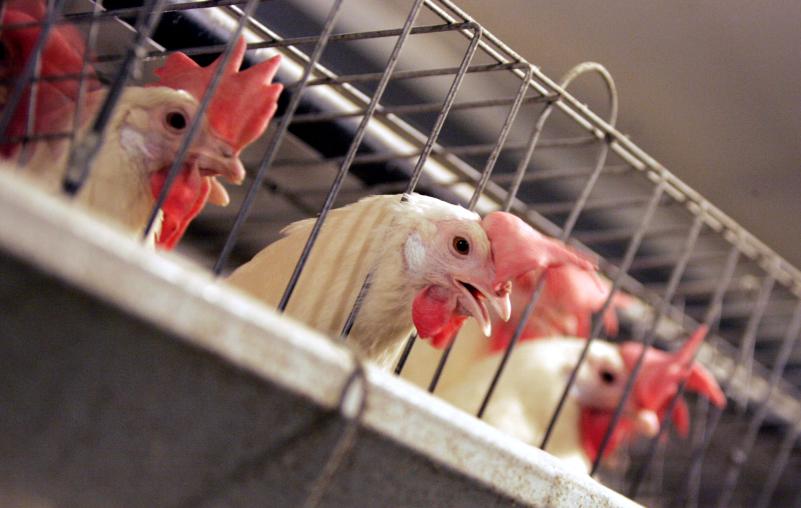
Subjecting animals to torturous conditions is not acceptable

FILE-This Sept. 10, 2008 file photo, chickens huddle in their cages at an egg processing plant at the Dwight Bell Farm in Atwater, Calif. The New Year is bringing rising chicken egg prices across the country as California starts requiring farmers to house hens in cages with enough space to move around and stretch their wings. The new standard backed by animal rights advocates has drawn fire nationwide because farmers in Iowa, Ohio and other states who sell eggs in California have to abide by the same requirements. (AP Photo/Marcio Jose Sanchez,File)

The headlines in the mainstream Associated Press about the change in the California Chicken laws was:

chickenThe story which appeared in local papers nationwide focuses on how eggs will cost more because California now requires a minimum amount of space per bird.  The “big news” is all about dollars and sense!  The average retail price nationwide ranges from 15 cents to 20 cents per egg and economists predict the new California law will cause a jump in price from 10 to 40% making the highest price it may reach is close to 28 cents!

We know that from the perspectives of pure economics it makes sense to mistreat animals to squeeze as much profit as possible from the enterprse.  Thanks to Mark Bitman for printing “another side of this story.” 

nytBy Mark Bitman – December 31, 2014 – New York Times Editorial

The most significant animal welfare law in recent history — California’s Prop 2 — takes effect today. The measure, which passed by a landslide vote in 2008, requires egg and some meat producers to confine their animals in far more humane conditions than they did before. No longer will baby calves (veal) or gestational pigs be kept in crates so small they cannot turn around and, perhaps more significantly, egg-laying hens may not be held in “battery” cages that prevent them from spreading their wings.

The regulations don’t affect only hens kept in California. In 2010, Gov. Arnold Schwarzenegger signed into law a bill that extended the protections of Prop 2 to out-of-state birds: You cannot sell an egg in California from a hen kept in extreme confinement anywhere. For an industry that has been able to do pretty much what it wants, this is a big deal: It bans some of the most egregious practices.

Does limiting confinement for hens mean the end of cages? Maybe. It might become impractical for growers to build bigger cages; that is, it might be easier simply to keep hens in groups that meet the new minimum area required per bird, and so keep the hens “cage free.” That’s not a panacea, but it is an improvement.

The new minimum is not specified in numbers, but the courts have said that it “establishes a clear test that any law enforcement officer can apply, and that test does not require the law enforcement officer to have the investigative acumen of Columbo to determine if an egg farmer is in violation.” Hens must be able to spread their wings without touching a cage or another bird.

There is, however, another new state regulation — the so-called shell egg food safety regulation, aimed at reducing salmonella — enacted by the California Department of Food and Agriculture. This requires a minimum of 116 square inches per bird, compared with the current 67 square inches, which is less space than an 8-by-10 photo, and just a tad more than a standard iPad.

Prop 2 trumps this rule, and birds probably need more than 116 square inches to spread their wings. In fact, many experts think something closer to 200 square inches is more realistic. But some farmers may think they can get away with 116; law enforcement will determine whether they’re right, and noncompliance is a criminal offense.

The new regulations will probably raise the price of eggs. Surprisingly, as producers in California switch production systems to comply with the new law, eggs raised by so-called conventional means sometimes cost more than cage-free eggs. This belies the arguments that the conversion process is difficult or prohibitively expensive; it just shows that many producers failed to take advantage of the five years between the extension of the new housing standards to all birds, and its taking effect, to adequately prepare. What have they been doing instead? Predictably, filing lawsuits fighting Prop 2, all of which have failed.

That Prop 2 is supported by a majority of people in the country’s biggest ag state, and that its legitimacy has been supported by courts, shows the direction in which the raising of animals is headed. Gestation crates are on their way out, and battery cages will soon join them. With this measure, the table is set for similar action in states all over the country.

“We’ve worked on passing anti-confinement laws in 10 states now,” says Paul Shapiro, a spokesperson at the Humane Society of the United States. At least three other states are to take up similar legislation in 2015.

The most important part of the new law may be that every whole egg sold in California must adhere to the standards set by Prop 2, regardless of where it’s from. And since California can’t raise all the eggs eaten by its citizens, millions of those eggs — perhaps as many as a third consumed in the state — will come from elsewhere. From Iowa, for example, where more than 14 billion eggs are produced each year. (Interesting: There are just over 3 million people in Iowa, and nearly 60 million laying hens.) There has been talk of shortages, but they would be short-lived.

So, in California, just as you had to meet higher emission standards than required by federal law if you wanted to sell cars, now you must meet higher welfare standards for hens if you want to sell eggs. Whether farmers comply, or disobey, or leave the business remains to be seen. But Prop 2 means a new norm; eventually it will be, well, normal.

Just how high are the standards set by Prop 2? “By itself, the law means that many millions of animals will no longer be held in cramped cages, and that’s huge,” says Mr. Shapiro. “But the message it sends to the factory farming industry is clear: Business as usual — that is, subjecting animals to torturous conditions for their entire lives — is no longer going to be acceptable.”

Original Post

Flower Power: changing the world with flower seeds

seedbombI’ve never thought of myself as much of a rebel. You generally won’t find me smashing car windows or setting garbage cans aflame. (Let’s get real: You probably won’t find me speeding. Such are the depths of my rule-following nature.) But I realize now that all along, I’ve just been waiting for the right weapon with which to battle The Man.

Wildflowers, of course. More precisely: ping-pong ball-size globs of clay and compost laced with wildflower seeds called seed bombs (or green grenades — military nomenclature is a must). The other day, I stood in front of a fenced-off lot on a busy stretch of asphalt, fingering the tiny seed arsenal I’d packed into a Ziploc bag. I looked back and forth, took a deep breath, and let one fly over the chain links; the ball came to rest on a scrubby patch of dirt in the sun. “Take that!” I muttered under my breath.

Finally, I was beginning to understand the rebel thrill. This must be what Marlon Brando felt like.

Lobbing that seed bomb was my first foray into the worldwide movement of “guerrilla gardening,” or reclaiming underused land — empty lots, vacant yards, alleys, and other areas you technically don’t have the right to plant — for lovely and/or productive gardens. In this case, the enemy takes the form of a disinterested, wasteful society that misses out on abundant opportunities to beautify the ugly and cultivate the barren.

Sometimes it’s as simple as taking over an adjacent lot with some extra pepper plants, but often there’s more at stake. Among guerrilla gardeners, you’ll hear plenty of chatter about “land use,” “re-creating space,” and “Who actually owns the earth, man?” Make no mistake: Those petunias are political.

eggsSome guerrilla gardening reportedly plays out like a scene from a spy movie: Black-clad growers sneak out to till and water vegetable patches in the dead of night. While that does sound fun, I had something a little less intense in mind for my first time out. Then my research uncovered seed bombs — perfect for inaccessible yards, tough-to-tend spaces, and ‘fraidy cats. Make a few green grenades, toss them all over town, and wait for the blooms to take over. This I could do.

And I did. Whipping up a batch of proto-wildflower balls is surprisingly simple — mine cost me about $10 (for seeds and clay; I grabbed the compost right from my worm bin) and 10 minutes. I picked up the native wildflower mix at my local grocery store and found the natural clay at an art-supply shop, where the clerk assured me “this is just what the Girl Scouts used to make their seed bombs last year.” (Fight the power, Brownies!) After letting the bombs sit out overnight to dry a bit, I was ready to sow some rebellion. (See below for step-by-step instructions on how to make them.)

ggsb1lExperienced guerrillas recommend seed-bombing right before rain is forecast. This usually wouldn’t be a problem in Seattle, but we were just about to enter an unusually warm and sunny period. Still, I couldn’t wait to dip a toe into the movement, so I loaded my bag with a handful of seed bombs and went out in search of abandoned space begging for wildflowers.

My destination was a busy thoroughfare near my apartment with a slightly, ahem, seedy reputation. Pocked with cheap motels and overgrown, weedy patches that don’t clearly belong to anybody, I figured it presented a prime opportunity for my “floral attack.” Plus, it’s close enough to let me check in on my gardens’ progress as the weeks go by.

I found my first site before I even reached the intended street: a plowed-over slope strewn with trash and construction detritus that’s lingered, untouched, for months. Nobody was around, so I chucked a seed ball into the expanse. (I don’t know who would object to a few blossoms here and there, but these days you never know when tossing an unidentified object — one you’re calling a bomb, no less — might get you tackled by a SWAT team.) “Good luck, little seeds,” I whispered.

Next up: A weedy patch near a lonely bus stop. Then a clear, empty dirt meadow. The fenced-in lot next to a boarded-up house. I strode along that eyesore of a road like a modern-day Janie Appleseed with safety pins in her ears, spreading flowers and righteous garden activism with every step.

I reserved the last ball in the bag for a quiet corner of my shared backyard. The lawn doesn’t need it, as neighbors have planted plenty of flowers, herbs, and veggies around the periphery, but I wanted to keep one seed bomb close so I could check on it every day. Hell, I might even water it. You might point out that cultivating flowers in my own backyard hardly counts as guerrilla gardening, but hey — like a true rebel, I totally did not ask my landlord first.

I’ll report back on my illicit wildflower patches and other excursions into guerrilla gardening as the spring goes on. ‘Til then, happy planting, everyone. Keep it on the downlow, and remember — if you get caught, you didn’t hear this from me. It was the Girl Scouts.

Homemade Seed Bombs

Materials:
5 parts clay soil/potter’s powder
1 part wildflower seeds
1 part compost/worm castings

1. Combine the seeds and compost in a large bowl; stir well.

2. Add the clay soil. If you’re using a dry clay, slowly add water, stirring as you go, until you have the consistency of thick mud (you don’t want it too watery to mold).

3. Shape the mixture into golf ball-size globs.

4. Set seed bombs in a tray and let them sit in the sun for a day or so to harden.

5. Get bombin’!

And for more instructions see: http://www.guerrillagardening.org/ggseedbombs.html

——————————————————————————————————

Original Post

Don’t Ask How to Feed the 9 Billion

nytlMark Bittman; NY Times Opinion – November 13, 2014

At dinner with a friend the other night, I mentioned that I was giving a talk this week debunking the idea that we need to grow more food on a large scale so we can “feed the nine billion” — the anticipated global population by 2050.

She looked at me, horrified, and said, “But how are you going to produce enough food to feed the hungry?”

I suggested she try this exercise: “Put yourself in the poorest place you can think of. Imagine yourself in the Democratic Republic of Congo, for example. Now. Are you hungry? Are you going to go hungry? Are you going to have a problem finding food?”

The answer, obviously, is “no.” Because she — and almost all of you reading this — would be standing in that country with some $20 bills and a wallet filled with credit cards. And you would go buy yourself something to eat.

The difference between you and the hungry is not production levels; it’s money. There are no hungry people with money; there isn’t a shortage of food, nor is there a distribution problem. There is an I-don’t-have-the-land-and-resources-to-produce-my-own-food, nor-can-I-afford-to-buy-food problem.

And poverty and the resulting hunger aren’t matters of bad luck; they are often a result of people buying the property of traditional farmers and displacing them, appropriating their water, energy and mineral resources, and even producing cash crops for export while reducing the people growing the food to menial and hungry laborers on their own land.

Poverty isn’t the only problem, of course. There is also the virtually unregulated food system that is geared toward making money rather than feeding people. (Look no further than the ethanol mandate or high fructose corn syrup for evidence.)

If poverty creates hunger, it teams up with the food system to create another form of malnourishment: obesity (and what’s called “hidden hunger,” a lack of micronutrients). If you define “hunger” as malnutrition, and you accept that overweight and obesity are forms of malnutrition as well, than almost half the world is malnourished.

The solution to malnourishment isn’t to produce more food. The solution is to eliminate poverty.

Look at the most agriculturally productive country in the world: the United States. Is there hunger here? Yes, quite a bit. We have the highest percentage of hungry people of any developed nation, a rate closer to that of Indonesia than that of Britain.

Is there a lack of food? You laugh at that question. It is, as the former Food and Drug Administration commissioner David Kessler likes to call it, “a food carnival.” It’s just that there’s a steep ticket price.

A majority of the world is fed by hundreds of millions of small-scale farmers, some of whom are themselves among the hungry. The rest of the hungry are underpaid or unemployed workers. But boosting yields does nothing for them.

So we should not be asking, “How will we feed the world?,” but “How can we help end poverty?” Claiming that increasing yield would feed the poor is like saying that producing more cars or private jets would guarantee that everyone had one.

That is, the kind of farming we can learn from people who still have a real relationship with the land and are focused on quality rather than yield.

The best method of farming for most people is probably traditional farming boosted by science. The best method of farming for those in highly productive agricultural societies would be farming made more intelligent and less rapacious. That is, the kind of farming we can learn from people who still have a real relationship with the land and are focused on quality rather than yield. The goal should be food that is green, fair, healthy and affordable.

It’s not news that the poor need money and justice. If there’s a bright side here, it’s that it might be easier to make the changes required to fix the problems created by industrial agriculture than those created by inequality.

There’s plenty of food. Too much of it is going to feed animals, too much of it is being converted to fuel and too much of it is being wasted.

We don’t have to increase yield to address any of those issues; we just have to grow food more smartly than with the brute force of industrial methods, and we need to address the circumstances of the poor.

Our slogan should not be “let’s feed the world,” but “let’s end poverty.”

Climate Action in Amherst

climate92614

The Climate March in New York City is over…

Now what?

In my last blog, I suggested that the big news coming out of the United Nations Climate Summit in N.Y. City –  following the largest climate change march in history is……. what WILL NOT happen.

Tonight I attended a meeting in Amherst to help think about “whats next?”  The organizers from 350Massachusetts and Climate Action Now in Western Massachusetts offered us several options for getting involved.  Here are a few:

1.  Divest UMass – The UMass Fossil Fuel Divestment Campaign (Divest UMass for short) is a dedicated student-led campaign organizing to confront the present and future issues created by climate change.  Here is how to GET INVOLVED.

2.  Divestment Massachusetts – College students, people of faith, environmentalists, economists, unions, mothers, and others converged on the State House on Sept. 10 to support S. 1225, a bill that requires MA to divest from fossil fuels!  To support the effort to divest sign here – Divest Massachusetts from Fossil Fuels.

3. Mothers Out Front are mothers, grandmothers, and other caregivers who can no longer be silent and still about the very real danger that climate change poses to our children’s and grandchildren’s future.  To connect to the Amherst group, go to; Amherst Mothers Out Front.

4. No Fracked Gas in Mass is working to stop the expansion of fossil fuel infrastructure in Massachusetts and to promote expanded efficiency and sustainable, renewable sources of energy and local, permanent jobs in a clean energy economy.  Here are some suggestions on what you can do!

5. Climate Action Plan in Springfield – support the community actions of our neighbor to the south (and the biggest polluter in Western Mass).  Help us to plan the march from the North End of Springfield to Springfield City Hall on October 20!  Join the planning meeting October 1, 2014 at 6:00 pm at the South Congregational Church, 45 Maple Street, in Springfield.

You-Control-Climate-Change-773583_1========================================================

Many people are motivated to take action around climate change out of anger or fear, and this is a powerful force.  For those of us who are motivated out of love for all of creation and concern for our sisters and brothers living in poverty, you are invited to join us on Saturday, October 4 from 2:00-4:00pm to learn from each other and ask…..

So…. what would Francis do?

For those of you who agree with Pope Francis, who tells us that environmental degradation is the “sin of our time,” join us to celebrate the Feast of St. Francis at the Newman Catholic Center at UMass on Saturday, October 4 from 2:00-4:00pmin the Burke Lounge for a program titled From St. Francis to Pope Francis to You – Creating a Climate for Solidarity.

This workshop and discussion will focus on climate change from the perspectives of “the two Francises” – St. Francis and Pope Francis.  If you are curious about the Catholic position on climate change and its impact on the poor, PLEASE JOIN US!

========================================================================

Here is something else you can do right now!

Write a letter or send and email to EPA Administrator Gina McCarthy like this one:

SUBJECT: Docket ID:  EPA-HQ-OAR-2013-0602 – Support Carbon Pollution Standards for Power Plants

Dear Administrator McCarthy:

As someone who takes climate change seriously, I have committed myself to advocate on behalf of the poor, the vulnerable, and all of Creation.  

Unfolding climate change caused primarily by our consumption of fossil fuels threatens both the planet and poor people. In light this,I believe that the Environmental Protection Agency’s proposed rule to regulate carbon pollution from existing power plants (Clean Power Plan Proposed Rule) can help limit damaging greenhouse gas emissions, uphold human life and dignity and demonstrate a greater respect for the planet.

At the same time, I urge the EPA to offer clear guidance to states on how to protect low-income individuals and families from undue suffering under potential energy rate hikes.  Additionally, I encourage the EPA to work with policymakers to help workers impacted by the Plan transition to other employment.

If such steps to protect poor and vulnerable populations are taken seriously, then I support the Clean Power Plan Proposed Rule, Docket ID: EPA-HQ-OAR-2013-0602.

Sincerely,

Send the email to: a-and-r-docket@epa.gov

Or send a letter to:

USEPA Headquarters
William Jefferson Clinton Building
1200 Pennsylvania Avenue, N. W.
Mail Code: 1101A
Washington, DC 2046

————————————————————————————————————————————-

Want to stay connected, please join the Climate Action Now Weekly Newsletter and update alerts: http://climateactionnowma.org/email-list-sign-up/

Catholics and Climate Change

Speculation to Advocacy: Reducing Carbon Pollution

In advance of a community conversation at the University of Massachusetts Catholic Newman Center on Saturday, October 4, 2014 from 2:00pm –  4:00pm, this article is being shared to help us think about “what would Francis do” about climate change?

For information on the public workshop and discussion,

From St. Francis to Pope Francis to You – Creating a Climate for Solidarity

see: Facebook Events Page.

poltheoPublished September 12, 2014 by Daniel DiLeo in Political Theology Today

In his Summa Theologiae, Thomas Aquinas distinguishes between two facets of human intellect: “speculative intellect which directs what it apprehends, not to operation, but to the consideration of truth; while the practical intellect is that which directs what it apprehends to operation” (I, q. 79, a. 11). Although each aspect has unique characteristics, Aquinas insists that the speculative and the practical “are not distinct powers” but together constitute the fullness of human intellect (I, q. 79, a. 11, s.c.). In other words, speculation and application are two sides of the same coin.

For political theologians, it is often a challenge to translate abstract speculation into concrete political advocacy. Although there are likely many reasons for this reality, it is a situation with which we should not be satisfied. It is always necessary, therefore, to identify and take action in situations where a direct connection between the speculative and the practical exists. One such opportunity arose earlier this summer with respect to climate change mitigation, and political theologians should now advocate around the proposed policy.

carbonClean Power Plan and U.S. Catholic Bishops

On June 2, 2014, the U.S. Environmental Protection Agency (EPA) proposed the Clean Power Plan by which to reduce carbon pollution from existing power plants. The EPA is accepting public comments about the Plan until mid-October, and Republicans in Congress are working to block, interfere with, and/or otherwise eviscerate the Agency’s proposed carbon pollution standards.

The Catholic Church has explicitly and repeatedly recognized climate change as a moral issue that threatens to compromise the commitments of Catholic Social Teaching (to learn more, visit the Catholic Climate Covenant). As such, the Church continues to call on persons of faith and goodwill to address this issue through both individual efforts and coordinated public policies.

Shortly before the release of the Clean Power Plan, Archbishop Thomas Wenski of Miami wrote a letter to the Environmental Protection Agency on behalf of the United States Conference of Catholic Bishops (USCCB) as chair of its Committee on Domestic Justice and Human Development. There, the Archbishop highlighted the USCCB’s awareness that “the best evidence indicates that power plants are the largest stationary source of carbon emissions in the United States, and a major contributor to climate change” (indeed, carbon dioxide is the most pervasive greenhouse gas, and fossil fuel power plants—which account for 38% of U.S. carbon pollution—are the largest collective domestic source of this pollution).

In light of this reality, Archbishop Wenski emphasized that “the USCCB recognizes the importance of finding means to reduce carbon pollution.” Towards this end, the Archbishop insisted that carbon pollution standards be guided by key aspects of Catholic teaching: “Respect for Human Life and Dignity, Prudence on Behalf of the Common Good, Priority for the Poor and Vulnerable, Social and Economic Justice, Care for Creation and Participation.”

On July 30, 2014, Archbishop Wenski followed this initial letter to the EPA with another that he co-authored with Bishop Richard E. Pates of Des Moines, Chair of the USCCB Committee on International Justice and Peace. There, the two bishops declared: “We … welcome the setting of standards to reduce carbon pollution from existing power plants and thereby mitigate climate change. We support a national standard to reduce carbon pollution and recognize the important flexibility given to states in determining how best to meet these goals.” Towards this end, the bishops reiterated the ethical criteria for carbon pollution standards that the USCCB articulated in its May letter to the EPA. Finally, the bishops “call[ed] upon our leaders in government and industry to act responsibly, justly and rapidly to implement such a [national carbon pollution] standard.”

Catholic Advocacy around Carbon Pollution Standards

In light of the Clean Power Plan and the Catholic bishops’ advocacy around a national carbon pollution standard for existing power plants, political theologians have a distinct opportunity to practically engage in an active policy debate. Although their contributions to the discussion might take several forms, there are two immediate steps that political theologians are able to take. First, political theologians can submit faith-based public comments to the EPA. In addition, political theologians can contact their elected officials and urge them to support a national carbon pollution standard for existing power plants that is animated by Catholic teaching.

Conclusion

In his 1990 World Day of Peace Message, St. John Paul II recognized that “the ecological crisis is a moral issue” (emphasis in original). Guided by this awareness, Pope Emeritus Benedict XVI asserted in his encyclical Caritas in veritate that “the Church has a responsibility towards creation and she must assert this responsibility in the public sphere” (# 51). The current debate around the Clean Power Plan is a unique opportunity within which to bring Christian theology to bear on an active policy debate. As such, I urge political theologians to, at the very least, submit faith-based comments about the proposal to the EPA and let their elected officials know that they support a national carbon pollution standard guided by Catholic teaching.

Original Post

Author

Daniel R. DiLeo is a Flatley Fellow and Ph.D. student in theological ethics at Boston College. His interests lie at the intersection of Catholic social thought, virtue ethics, political theology, environmental ethics and economic justice. He is especially focused on the issue of climate change and discernment of how Catholic theological ethics can contribute to deliberations about national climate policy. He has worked as Project Manager for the Catholic Climate Covenant since 2009, and was also a Mission Intern at the Catholic Health Association from 2009-2011. He is also a regular contributor to Millennial Journal.


The Future of Food: How our eating habits will change

1407946783000-Fresh-FoodThe way we eat — the kind of food we buy, where we get it, how it’s prepared — has become a part of our identity, a guiding force that shapes how we live. It unites us. And divides us. Food brings people together in communal functions. But it also pits ideologies against each other: vegetarians vs. carnivores; all-natural evangelists vs. the convenience crowd; calorie counters vs. indulgence seekers.

No matter where individuals fall on the spectrum, we are a country obsessed with food. And with a seeming explosion in allergies, heightened concerns over obesity, increased scrutiny of chemical additives and growing environmental concerns, there’s more attention being paid to what we eat than perhaps ever before. After decades of stocking our kitchens with meat, cheese and noodles, while simultaneously dieting to reverse the effects of all those fatty, starchy foods, we may be realizing that food isn’t just a way to live, it’s a lifestyle choice.

“We’re beginning to get to where Eastern culture has been for thousands of years,” says Mark Erickson, provost at the Culinary Institute of America and a certified master chef, “which is the idea that food is medicine, and we cannot disassociate our health with what we eat.”

So where is this all headed?

USA WEEKEND asked some experts: How will Americans be eating in five years? Here’s what they said about the future of food:

Food that’s good for us will taste better

A growing number of chefs, food bloggers and restaurateurs have started dedicating themselves to promoting healthy food that’s also delicious. They’re finding ways to cut down on fat, sugar and meat and still make money. Vegan bakery Sticky Fingers in Washington, D.C., won the Food Network’s Cupcake Wars, and restaurants such as New York City’s Dirt Candy and Philadelphia’s Vedge are making vegetables the star of great meals.

“There are plenty of restaurants and food purveyors out there that are working to make nutrient-dense food delicious and appealing and exciting,” says Trish Watlington, owner of two farm-to-table restaurants in San Diego where she supplies most of the produce for the menu from her garden.

At Andrea McGinty’s vegan restaurant chain, Native Foods Cafe, most customers aren’t even vegan. “I bet one person would raise their hand,” she says. “All the rest are looking for a better way to eat.”

Betting that she’d be able to make vegan food — or a plant-based diet, as she likes to call it — mainstream, McGinty moved the headquarters of Native Foods from the health-nut hills of Palm Springs, Calif., to Chicago (a city once known as “Hog Butcher for the World”). McGinty was confident she’d be able to change people’s minds about her “hippie dippie” food, and she has designs on growing from 17 stores across the USA to more than 200 in the next five years.

McGinty says vegan is going mainstream as people seek healthier, convenient options. Included on her menus is a “bacon cheeseburger” made with seitan, a gluten-based meat alternative; caramelized onions; tofu bacon; and battered dill pickle chips. “When you can have something that tastes delicious and it feels good in your body and you feel like you did something good for yourself, why wouldn’t it sell?” she says.

Farm-to-table will trickle down

The advent of farmers markets and farm-to-table restaurants have brought food sourcing to the forefront of Americans’ consciousness. Not only are strawberries grown an hour away fresher and better tasting than the ones that spent days or even weeks being shipped across the country, buying that produce supports the local economy and a more sustainable way of eating.

But it’s also expensive. Access to locally grown produce is still relatively reserved for those who can afford it and have the time to seek it out. “Unfortunately, if you’re a single mom and work two jobs and can barely put food on the table, you don’t have time to think about where your food came from,” Watlington says.

That could change if the country collectively demands better food. Watlington hopes that support of local farmers and farmers markets, and programs that introduce kids to gardening, will help make access to better food a national movement. “If you can have this happen on a grass-roots level, then it spreads so it’s in the community. No one is dieting. They’re just eating better food.”

Erickson says the farmers market movement already serves a broader purpose. “As people begin to look for (fresh food) in their everyday dining occasion, they put more pressure on grocery and other fast-food segments of the industry.”

That has already started to happen, with companies such as Subway being called out for the chemicals they’ve added to food. Other major brands, such as Cheerios, are eliminating genetically modified organisms. And Panera Bread is removing artificial ingredients from everything on its menu by the end of 2016.

“I think the only way that it really changes is if it becomes a class-divide issue,” says Mary Beth Albright, a Washington, D.C.-based lawyer who specializes in sustainable food issues and a former contestant on Food Network Star. “Like, look, all these other people are getting better things than you. Either … the traceability movement is going to be reserved for the elite, or everything is going to have to go sustainable.”

We might see ads for broccoli

Another way to make produce cheaper? Get people to buy more of it. Processed foods dominate the grocery business, luring us with million-dollar marketing campaigns that show up on our TV screens as commercials with our favorite athletes or celebrities, in magazine ads and in eye-catching store displays.

“The problem is there’s no branding in produce,” says Michael Moss, author of Salt Sugar Fat, about the processed-food industry. “The power of marketing is huge.”

The produce growers could catch on, he says. “Absolutely we could see the produce association getting Madison Avenue-savvy and competing with snack foods and the rest of the grocery store in that arena,” says Moss, who last year challenged an ad agency that has worked with Coca-Cola and General Mills to come up with an ad campaign for broccoli.

Unfortunately, the government doesn’t necessarily make it easy, Moss says. “How do we level the playing field for people financially to make it possible for them to eat healthier in ways that aren’t going to cripple their budgets?” he asks. “One big way would be to totally rethink the Department of Agriculture. Because so much of that agency’s energy and research and development money is going into crops that fuel the highly processed food industry. And so little of it is going into making fruits and vegetables less expensive.”

We’ll see the end of the diet

Can a country that has built an entire industry around dieting decide to, instead, just eat healthier all the time?

Groups of people have adopted gluten-free diets even though they’re not technically allergic to gluten. Others prescribe themselves the Paleo diet, eating the protein-heavy, dairy-free foods of our Stone Age ancestors.

When it comes to eating, we are a country of extremes, Erickson says, opting for meat and potatoes or doing a complete 180 and going only for vegetarian and non-fat food. But what were once considered specialty diets are starting to be combined and adopted into a more balanced and manageable way of eating all the time.

“Somewhere in between is something we cannot treat as a diet, but treat as an accepted and sought-for lifestyle as it relates to what we consume,” Erickson says.

And as fresher, local food not only becomes more widely available but is prepared in ways that are appealing, “eventually people will make more choices of things that are better for them because it tastes good,” Watlington says, “not because they’re necessarily disciplined about it.”

Sustainable Food and Farming – in the News

The following are news stories related to Sustainable Food and Farming selected by Jenny Huston on August 14, 2014.


Jenny Huston, MA, CEC, CDM, CFPP
Farm to Table Food Services
Oakland, CA
415.235.9312
jhuston59@gmail.com
http://www.farmtotableservices.com/


Agricultural Justice Project reaches out to area farmers over issues of fairness

farmerBy RICHIE DAVIS – Recorder Staff- Tuesday, August 19, 2014

When buying tomatoes or lettuce, there’s so much to consider: freshness, price, taste, farming practices — and fairness.

With a resurgence of interest in Pioneer Valley agriculture, some advocates have begun to look for ways to make sure that workers at farms are treated fairly, with livable working conditions, and that food co-ops and farm-product businesses do the same to their employees and farm suppliers.

The Agricultural Justice Project — with roots going back more than a dozen years in Florida, North Carolina, New Jersey and New York, and overseas — has been reaching out more recently to farmers in this region as well.

Looking at “Food Justice Certification” is an outgrowth of the organic certification effort that Portia Weiskel says she and other growers were involved in with formation of the Northeast Organic Farmers Association decades ago. But when federal organic standards were adopted, the “fairness” principle that was part of the original concept for organic was forgotten.

According to Elizabeth Henderson, the Northeast Organic Farmers Association representative on the Justice Project’s management committee, that meant “fairness to people who work in agriculture, fair pricing for farmers, fair treatment for farmworkers and fairness to animals and fairness to all creatures. The creatures got into the national organic program, but the people didn’t.”

Weiskel added, “It’s attempting to say the principles that apply (to how food is grown) also need to work on a larger scale, including people working on farms. This is taking in the whole system, this group of people trying to get social justice, earth justice and food justice.”

Weiskel — who runs a one-woman, five-acre farm that produces eggs, kale, rhubarb and raspberries — and farmer Jon Magee of Greenfield began approaching area farms this winter, along with food co-ops and food-product manufacturers.

After helping edit an international food justice document a couple of years ago, Weiskel said she volunteered to work on approaching Franklin County farmers to gauge their level of interest on working toward certification standards, such as “farmer provides at least one day of rest out of every seven,” “regular and timely payments” and “clear multi-step conflict resolution process with no retaliation.”

Many of the standards, Weiskel said, are probably already being met.

“I feel my presence is not about saying, ‘How much are you paying your workers?’ but in asking, ‘Do you regard what you’re paying your workers a fair, living wage? Do you house your workers on the farm?’ and whether they’d be interested in certifying for their customers that they do.

“Some of these people are operating on a shoestring, and a lot don’t have any employees,” acknowledged Weiskel. “If I had to pay anybody here, I couldn’t do it.”

Most of the farmers and the co-ops she and Magee have approached have been open to the idea, although one told her, simply, “I can’t fill out any more paperwork.”

Admittedly, this is the busiest time of year for many farmers to be approached — especially with the idea of adding another chore to their load and the expense of certification fees.

Yet, Magee said, “It seems everyone is interested in knowing more. Most are cautious because they perceive more of a managerial burden. … In the Pioneer Valley, no one has anything against farmworkers and people are fairly fond of their farms.”

Even for farmers who do not become certified, he said, many seem interested in having a conversation about issues like spelling out a clear conflict resolution process, having defined policies about sickness and maternity or paternity benefits, or health and safety protections.

“It’s a chance to bring agricultural justice to the table,” said Magee.

At Red Fire Farm in Montague, Ryan and Sarah Voiland said they are committed to trying to improve pay and conditions for their workers who number between 60 to 80 at the peak of the growing season between their Montague and Granby farms. And they said they are willing to look at the specific standards of the project, for which the Pioneer Valley Workers Center at the University of Massachusetts would be the independent certifying agent.

At the same time, Ryan Voiland said, “We feel we’re stuck between what consumers are willing to pay for their produce and what we’re able to pay our workers,” while at the same time being asked to donate food under the banner of “food justice” to the Food Bank of Western Massachusetts.

“We try to think about the right way to do things, and to make it viable for the people who work for us. And we’re in favor of having a just workplace and strive toward that,” he said. “But I’m not super-excited about having another set of forms to fill out.”

Philip Korman, executive director of Community Involved in Sustaining Agriculture in South Deerfield, agreed that many local farmers care deeply about providing liveable wages, along with better benefits and fair working conditions for employees, although “they have a lot less wiggle room than larger, industrial agriculture enterprises. And the challenge is when the farmers are working under the same conditions as their laborers.”

He added, “The way this needs to move is how we can get more people to understand that the price to grow food that’s healthy and fresh and sustainable for all of us is more than what we’ve been paying.”

Claire Hammonds of the Pioneer Valley Labor Center said the hope is to get a couple of farms involved initially to raise awareness among consumers and other farmers.

“Some farms are already largely meeting these standards,” she said. “But they don’t necessarily have these standards and these policies written down.”

On the Web: http://www.agriculturaljusticeproject.org


Source URL:http://www.gazettenet.com/news/townbytown/granby/13197351-95/making-a-living-wage-agricultural-justice-project-reaches-out-to-area-farmers-over-issues

The price of a cheesburger is not the true cost

nytlMark Bitman – NY Times – July 15, 2014

In 2005, the House of Representatives passed an act that forbade consumers to sue fast-food operators over weight gain. “The Cheeseburger Bill” (formally, “The Personal Responsibility in Food Consumption Act”) attempted to legislate the message that the costs of fast food are personal, not social, and certainly not a consequence of selling harmful food at addictively low prices.

The reality is different, as we begin to understand the extent of the financial and economic costs wrought on our society from years of eating dangerously. That’s a different kind of cheeseburger bill; the butcher’s bill, if you like: The real cost.

What you pay for a cheeseburger is the price, but price isn’t cost. It isn’t the cost to the producers or the marketers and it certainly isn’t the sum of the costs to the world; those true costs are much greater than the price.

This is an attempt to describe and quantify some of those costs. (I have been working on this for nearly a year, with a student intern, David Prentice.) It’s necessarily compromised — the kinds of studies required to accurately address this question are so daunting that they haven’t been performed — but by using available sources and connecting the dots, we can gain insight.

Whatever the product, some costs are borne by producers, but others, called external costs — “externalities,” as economists call them — are not; nor are they represented in the price. Take litter: If your cheeseburger comes wrapped in a piece of paper, and you throw that piece of paper on the sidewalk, it eventually may be picked up by a worker and put in the trash; the cost of that act is an externality. Only by including externalities can you arrive at a true cost.

Almost everything produced has externalities. Wind turbines, for example, kill birds, make noise and may spin off ice. But cheeseburgers are the coal of the food world, with externalities in spades; in fact it’s unlikely that producers of cheeseburgers bear the full cost of any aspect of making them. If we acknowledge how much burgers really cost us we might either consume fewer, or force producers to pick up more of the charges or — ideally — both.

We estimate that Americans eat about 16 billion burgers a year of all shapes and sizes, based on data provided by the NPD Group, a market research firm. (The “average” cheeseburger, according to the research firm Technomix, costs $4.49.) And our calculation of the external costs of burgers ranges from 68 cents to $2.90 per burger, including only costs that are relatively easy to calculate. (Many costs can’t possibly be calculated; we’ll get to those.)

The big-ticket externalities are carbon generation and obesity. Environmental Working Group’s “Meat Eater’s Guide” (2011) estimates the carbon footprint of beef cattle at 27 pounds of CO2 equivalent per pound; the use of “spent” dairy beef in burger meat reduces that slightly, but we can say that each pound of burger meat accounts for roughly 25 pounds of CO2 emissions. (Cheese counts, too: It produces 13.5 pounds of CO2 equivalent per pound, and even bread has a carbon footprint.)

The cost of this carbon is hard to nail precisely, but the government’s official monetary valuation of greenhouse gas pollution is roughly $37 per metric ton of CO2 emissions. Many experts, however, double that rate; others multiply it nearly tenfold. So the monetary value of the carbon emissions produced by the average cheeseburger might range from 15 cents (the official government rate), to 24 cents (conservative independent sources) and $1.20 (high independent). The average of these three estimates comes out to 53 cents per burger.

The calculable chronic disease costs are similar. There’s some evidence that red meat intake may increase risk of cardiovascular disease and mortality, but like many of the speculative externalities discussed below, it’s impossible to assign a cost to this. (If red meat were further implicated in cardiovascular disease, the true costs of a burger would rise significantly.)

In any case, a main factor in the rise of obesity has been an increase in the availability of calorie-dense foods, and burgers played a big role in this process. Between 1970 and 2000, per capita calorie intake increased by 24 percent, and the “food-away-from-home sector” grew to nearly half of all food we eat. Restaurants, of course, are the source of most burger consumption.

Between 2007 and 2010, 11.3 percent of adult Americans’ daily caloric intake came from fast food. Correlation is not causation, of course, and it seems likely that foods high in sugar and other hyperprocessed carbohydrates are most responsible for high obesity rates, but burgers certainly played a role in rising caloric intake.

To estimate the share of obesity-related costs resulting from burger consumption, we estimated the share of calories coming from burgers in fast-food restaurants, where the majority are eaten. Assuming that the 11.3 percent of calories is proportional to the incidence rate of obesity (it may be higher), its associated health risks, and its treatment costs, up to 15 percent of fast food’s share of direct and indirect costs arising from obesity (about 1.65 percent of the whole) are attributable to burgers.

The link between obesity and a handful of deadly chronic diseases — arthritis, cardiovascular disease, hypertension, Type 2 diabetes and some cancers, among others — is well documented, as is their enormous economic burden. Direct medical diet-related costs are currently pegged at about $231 billion annually.

These numbers above would mean that this cost of burgers is about $4 billion per year (from fast food burgers only!), which averages out to 48 cents per burger. (Some put these costs five or six times as high, and there are indirect costs as well; again, we’re being conservative.) And between 2010 and 2030, the combined costs arising directly from diseases related to obesity could increase by an additional $52 to $71 billion each year. This could double the cost per burger in additional health costs alone.

Some other costs are only vaguely calculable, and we have numbers, but the ranges are so great that they’re useless; what matters, though, is that the numbers are above zero. There are elevated nitrates in water supplies resulting from the chemical fertilizers used to grow corn to feed cattle (the city of Des Moines has been forced to spend $3.7 million to build a water treatment facility for precisely this reason; then there’s the famous “dead zone” in the Gulf of Mexico); the cost of food stamps and other public welfare programs made necessary in part by the ultralow wages paid at most fast-food operations; the beef industry’s role in increasing antibiotic resistance, which costs, according to the Centers for Disease Control and Prevention, something like $55 billion a year; some measure of E. coli illnesses; and land erosion, pesticide residues, direct corn subsidies, injury rates at slaughterhouses, and so on.

Each of these adds pennies or less to the external costs of a cheeseburger. But although they may be trivial individually (unless of course, you’re being directly affected by them), they add up. Even more difficult to calculate are the “cost” of a shortened life, or the value of loss of biodiversity that results from the destruction of rain forests to provide land for cattle or their feed. There is even an emerging body of research linking decreased male sperm quality to mothers’ beef consumption.

Last year, burger chains grossed about $70 billion in sales. So it’s not a stretch to say that the external costs of burgers may be as high as, or even outweigh, the “benefits” (if indeed there are any other than profits). If those externalities were borne by their producers rather than by consumers and society at large, the industry would be a highly unprofitable, even silly one. It would either cease to exist or be forced to raise its prices significantly.

In this discussion, the cheeseburger is simply a symbol of a food system gone awry. Industrial food has manipulated cheap prices for excess profit at excess cost to everyone; low prices do not indicate “savings” or true inexpensiveness but deception. And all the products of industrial food consumption have externalities that would be lessened by a system that makes as its primary goal the links among nutrition, fairness and sustainability.

Original Post

