Category Archives: Food Policy and Advocacy

Food is (relatively) inexpensive in the U.S.

When droughts or crop failures cause food prices to spike, many Americans barely notice. The average American, after all, spends just 6.6 percent of his or her household budget on food consumed at home. (If you include eating out, that rises to around 11 percent.)

In Pakistan, by contrast, the average person spends 47.7 percent of his or her household budget on food consumed at home. In that situation, those price spikes become a lot more noticeable.

The US Department of Agriculture’s Economic Research Service keeps tabs on household expenditures for food, alcohol, and tobacco around the world.

Americans, it turns out, spend a smaller share of their income on food than anyone else — less even than Canadians or Europeans or Australians:

Food_spending_worldwide_2

Note that the map above is based on data for food consumed at home — the USDA doesn’t offer international comparisons for eating out, unfortunately. Still, even if you do include food consumed at restaurants, Americans devote just 11 percent of their household spending to food, a smaller share than nearly every other country spends on food at home alone.*

Below is a chart showing numbers for a handful of select countries. Note that this doesn’t include spending on subsidies and the like — it’s just a measure of the fraction of household expenditures devoted to food consumed at home:

How_much_countries_spend_on_food

There are a few notable points here:

1) Richer countries spend a smaller fraction of their income on food. This makes intuitive sense. There’s an upper limit on how much food a person can physically eat. So as countries get richer, they start spending more of their money on other things — like health care, or entertainment, or alcohol. South Koreans spent one-third of their budget on food in 1975; today that’s down to just 12 percent.

That said, this relationship doesn’t always hold. It depends, at least in part, on what kind of food people favor, patterns of eating out, and the specific food prices and subsidy schemes in their country. Note that India spends a smaller fraction of its budget on food consumed at home than Russia, which is much richer. Likewise, South Korea spends a smaller share of its budget on food than wealthier Japan does.

2) Americans spend less than Europeans on food. The fact that Americans spend a smaller portion of their budgets on food than Europeans do is partly a consequence of the fact that Americans are richer. But Americans spend less on an absolute level, too.

The average American spends $2,273 per year on food consumed at home, the USDA notes. The average German spends $2,481 per year. The average French person spends $3,037 per year. The average Norwegian spends a whopping $4,485 per year on food.

The USDA doesn’t explain the variation. Some of it likely has to do with different tax systems in Europe (here’s a comparison of food prices in Europe), as well as differences in eating out. But there are also dozens of forces making food in the United States so cheap — from farm subsidies to advancements in industrial agriculture that have pushed down the price of food. (Over the years, the price of meat, poultry, sweets, fats, and oils in the United States have fallen, although the price of fresh produce has risen.)

There are fierce debates about the downsides of industrial agriculture — as well as the desirability of subsidizing agriculture. But one thing this system has done fairly well is keep the sticker price of food at the grocery store down.

3) High spending on food and malnutrition seem to go hand in hand. This is another perhaps obvious point, but worth highlighting. Poorer countries that have to spend a much larger share of their budget on food also end up with much higher malnutrition rates.

Original Post

============================================================

One conclusion might be that most of us can afford to invest in a better quality of life for all by buying our food from local farmers.


Massachusetts Agriculture Defies National Trends

14373311117_8e652f5b29The Census of Agriculture is the most complete account of U.S. farms and ranches and the people who operate them. Every Thursday USDA’s National Agricultural Statistics Service will highlight new Census data and the power of the information to shape the future of American agriculture.

According to the 2012 Census of Agriculture, Massachusetts agriculture defies national trends in more ways than one. For example, while across the country the number of farms decreased four percent since the 2007 Census, Massachusetts was one of only 10 states that saw an increase in both the number of farms and land in farms in the same time period. In addition, while women make up 31 percent of all operators across the country, they make up 41 percent of all operators in the Bay State. Similarly, while the number of female principal operators decreased nationally since the last census, that number increased from 2,226 to 2,507 in our state. In fact, female principal operators compose 32 percent of all of our state’s principal operators, the highest percentage among the New England states and the third highest nationwide.

We also have a growing number of beginning farmers in Massachusetts. Although the proportion of all beginning farmers in our state is down slightly since 2007, it is still higher than in other parts of the country. In Massachusetts, 29 percent of all operators and 25 percent of principal operators began farming in the last decade, while nationwide, 26 percent of all operators and 22 percent of principal operators fall in that category.

Massachusetts’s agriculture has developed to meet the needs the needs of metropolitan area that stretches from Boston to New York City. To meet the needs of East Coast home owners and landscapers, in 2012, 1,039 of Massachusetts’s nurseries, greenhouses, floriculture, and sod farms grew and sold over $144 million worth of those crops. Sales of these crops accounted for almost 30 percent of agriculture sales.  Also, 1,223 farms produced just over $125 million of fruits, nuts, and berries. Our state ranks eighth in berry acreage in the nation, at 15,727 acres, and 89 percent of that is dedicated to what many consider to be Massachusetts’s signature crop, the cranberry. Massachusetts is the birthplace of the cranberry industry and currently has the second highest cranberry acreage in the nation, at 14,070 acres.

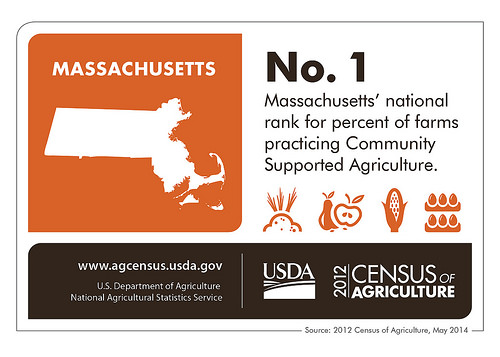
But what makes Massachusetts agriculture particularly unique is our direct- to-consumer sales, direct sales to retail outlets (such as stores, restaurants, and institutions), and community supported agriculture (CSA) arrangements. More than 28 percent of the Bay State operations engage in direct market sales, and our state ranks third in the nation for value of direct market sales per operation. In addition, Worcester and Middlesex counties are in the top ten counties nationwide for value of direct market sales. Over 13 percent of our sold to retail outlets which ranks 6th nationally.  CSA arrangements are also very prevalent in our farming industry. In fact, nearly six percent of farms in our state market products through a CSA arrangement, up from three percent in 2007. We rank sixth nationally for number of farms and first nationally by percent of farms using CSA arrangements. In addition, four Massachusetts counties – Middlesex, Hampshire, Worcester, and Franklin – rank in the top 10 nationwide for number of CSA arrangements.

As you can see, Massachusetts agriculture stands out in multiple ways, and it’s clear that we will remain unique and continue to grow.

Original  Post

===============================================================

If you want to learn how to get involved in agriculture in Massachusetts, you might be interested in the B.S. degree or the ONLINE Certificate in Sustainable Food and Farming offered by the University of Massachusetts Amherst.  Or at least, stay connected with whats happening at Just Food Now in Western Massachusetts.

New York Times Editorial blasts “Big Food”

Parasites, Killing Their Host  – The Food Industry’s Solution to Obesity

Mark Bitman – New York Times – June 17, 2014

You can buy food from farmers — directly, through markets, any way you can find — and I hope you do. But unless you’re radically different from most of us, much of what you eat comes from corporations that process, market, deliver and sell “food,” a majority of which is processed beyond recognition.

The problem is that real food isn’t real profitable. “It’s hard to market fruit and vegetables without adding value,” says Marion Nestle, a professor of nutrition, food studies and public health at New York University. “If you turn a potato into a potato chip you not only make more money — you create a product with a long shelf life.” Potatoes into chips and frozen fries; wheat into soft, “enriched” bread; soybeans into oil and meat; corn into meat and a staggering variety of junk.

How do we break this cycle? You can’t blame corporations for trying to profit by any means necessary, even immoral ones: It’s their nature.

You can possibly blame them for stupidity: Even a mindless parasite knows that if it kills its host the party’s over, and by pushing products that promote “illth” — the opposite of health — Big Food is unwittingly destroying its own market. Diet-related Type 2 diabetes and cardiovascular disease disable and kill people, and undoubtedly we’ll be hearing more about nonalcoholic steatohepatitis, or NASH, an increasingly prevalent fatty liver disease that’s brought on by diet and may lead to liver failure.

Food companies are well aware of the health crisis their products cause, and recognize that the situation is unsustainable. But one theory has it that as long as even one of the big food companies remains cynical and uncaring about its market, they all must remain so.

Chief among the hopeful arguments is one that goes something like this: The first big food outfit to recognize that its future lies in creating a market for healthy and even environmentally neutral food (let’s throw in justice for workers and animal welfare while we’re at it!) may show the way to the future of healthy food as a sound business model. Some profitable corporations nibble at the edges of this already, but — as a piece in the current Harvard Business Review points out — American capitalists have become poor innovators.

Only the naïve, however, would believe that Big Food is generally working toward this. As Nestle and Michele Simon, author of “Appetite for Profit,” have been saying for years, these organizations represent not the public interest but the corporate one, and since they haven’t devised a way to improve or even maintain their bottom lines selling real food, they have to appear to be selling “better” food.

But the key remains selling. A new paper in the journal Social Currents by Ivy Ken, an associate professor of sociology at George Washington University, discusses Big Food’s strategy of “working together” with communities to fight the obesity crisis. The goal is threefold, according to Ken: Corporations want us to focus on the importance of their role in “solving” childhood obesity and presenting themselves as part of the solution. “Their part of working together is re-engineering their products; our part of working together is to buy more and more of this food that’s not real,” Ken said to me.

The food industry also wants us to ignore its use of that strategy to increase its market share and profits; and it wants to maintain legitimacy at a time when community groups and public health officials are, writes Ken, “demanding limits to their involvement” in supplying food to children.

Our efforts to demand limits on the sale of junk to children are a threat to Big Food. If we succeed, it fails, or at least suffers. But if industry succeeds, whether in selling blatant junk or re-engineered versions that are low in fat or sodium or gluten- or sugar-free or reduced-calorie or high fiber or whatever — companies can create any frankenfood they feel will sell — we will continue to suffer. (Nestle often says, “A slightly-better-for-you junk food is still junk food.”) Our health will decline further, the environment will be further degraded, and our health care system (and therefore economy) will spend an increasingly disproportionate amount of money on diet-generated chronic disease.

If the most profitable scenario means that most food choices are essentially toxic — in the sense that overconsumption will cause illness — that’s a failure of the market, not of individual choice. And government’s rightful role is not to form partnerships with industry so that the latter can voluntarily “solve” the problem, but to oversee and regulate industry. Its mandate is to protect public health, and one good step toward fulfilling that right now would be to regulate the marketing of junk to children. Anything short of that is a failure.

Original Post

“Big Food” pressures Congress to roll-back progress on healthy food for children

NY Times Op-Ed by Michelle Obama – May 28, 2014

WHEN we began our Let’s Move! initiative four years ago, we set one simple but ambitious goal: to end the epidemic of childhood obesity in a generation so that kids born today will grow up healthy.

To achieve this goal, we have adhered to one clear standard: what works. The initiatives we undertake are evidence-based, and we rely on the most current science. Research indicated that kids needed less sugar, salt and fat in their diets, so we revamped school lunch menus accordingly. When data showed that the lack of nearby grocery stores negatively affected people’s eating habits, we worked to get more fresh-food retailers into underserved areas. Studies on habit formation in young children drove our efforts to get healthier food and more physical activity into child care centers.

Today, we are seeing glimmers of progress. Tens of millions of kids are getting better nutrition in school; families are thinking more carefully about food they eat, cook and buy; companies are rushing to create healthier products to meet the growing demand; and the obesity rate is finally beginning to fall from its peak among our youngest children.

So we know that when we rely on sound science, we can actually begin to turn the tide on childhood obesity.

But unfortunately, we’re now seeing attempts in Congress to undo so much of what we’ve accomplished on behalf of our children. Take, for example, what’s going on now with the Women, Infants and Children program, known as WIC. This is a federal program designed to provide supplemental nutrition to low-income women and their babies and toddlers. The idea is to fill in the gaps in their diets — to help them buy items like fresh produce that they can’t afford on their own — and give them the nutrition they’re missing.

Right now, the House of Representatives is considering a bill to override science by mandating that white potatoes be included on the list of foods that women can purchase using WIC dollars. Now, there is nothing wrong with potatoes. The problem is that many women and children already consume enough potatoes and not enough of the nutrient-dense fruits and vegetables they need. That’s why the Institute of Medicine — the nonpartisan, scientific body that advises on the standards for WIC — has said that potatoes should not be part of the WIC program.

Unfortunately, this isn’t an isolated occurrence. We’re seeing the same kind of scenario unfold with our school lunch program. Back in 2010, Congress passed the Healthy, Hunger-Free Kids Act, which set higher nutritional standards for school lunches, also based on recommendations from the Institute of Medicine. Today, 90 percent of schools report that they are meeting these new standards. As a result, kids are now getting more fruits, vegetables, whole grains and other foods they need to be healthy.

This is a big win for parents who are working hard to serve their kids balanced meals at home and don’t want their efforts undermined during the day at school. And it’s a big win for all of us since we spend more than $10 billion a year on school lunches and should not be spending those hard-earned taxpayer dollars on junk food for our children.

Yet some members of the House of Representatives are now threatening to roll back these new standards and lower the quality of food our kids get in school. They want to make it optional, not mandatory, for schools to serve fruits and vegetables to our kids. They also want to allow more sodium and fewer whole grains than recommended into school lunches. These issues will be considered when the House Appropriations Committee takes up the annual spending bill for the Agriculture Department on Thursday.

Remember a few years ago when Congress declared that the sauce on a slice of pizza should count as a vegetable in school lunches? You don’t have to be a nutritionist to know that this doesn’t make much sense. Yet we’re seeing the same thing happening again with these new efforts to lower nutrition standards in our schools.

Our children deserve so much better than this. Even with the progress we have made, one in three children in this country is still overweight or obese. One in three is expected to develop diabetes in his or her lifetime. And this isn’t just about our children’s health; it’s about the health of our economy as well. We already spend an estimated $190 billion a year treating obesity-related conditions. Just think about what those numbers will look like in a decade or two if we don’t start solving this problem now.

The bottom line is very simple: As parents, we always put our children’s interests first. We wake up every morning and go to bed every night worrying about their well-being and their futures. And when we make decisions about our kids’ health, we rely on doctors and experts who can give us accurate information based on sound science. Our leaders in Washington should do the same.

Original Post

Walmart’s policies are the cause not the solution to poverty

walmart2Walmart, the largest grocery store in the world, is often presented as a solution to poverty because of its low prices.  There is a reason for those low prices however and it is because they put ever-increasing pressure on suppliers (including those that supply food) to drive down their costs.  This drives down wages, both for the Associates who work in the stores as well as all across the manufacturing and food production chain. Walmart’s death grip on groceries is making life worse for millions of people!

The following is a call for action from the Food Chain Workers Alliance.  We need to recognize that food is cheap in the U.S. because we allow people to be exploited.  When we shop at Walmart (and other “big box” stores for food) we participate and benefit from this exploitative system.

Food workers are particularly vulnerable because of their lack of political voice.  When workers protest to unfair conditions, they are punished.

PLEASE SIGN THE STATEMENT LINKED BELOW!

———————————————————————–

Stand with Wal-Mart Strikers
on June 4th! 

On June 4th Walmart Associates, faith communities, union members, community groups, allied groups and students are coming together to take action against inequality.

walmartOUR Walmart members will be striking in key locations across the country to protest Walmart’s illegal retaliation against Associates who have spoken up about inequality and have struck. Associates have been calling for Walmart wages to be raised to $25,000. Faith communities, union members, community groups, allied groups and students will be taking action in solidarity with Associates who are standing up against inequality. These actions will be happening at stores across the country and online.

You can support by signing onto FCWA’s Solidarity Statement herePlease sign onto the statement by Tuesday June 3!  You can also participate in a local action in your city or state. To find a local action click here.

To find out more about the campaign and actions on June 4 click here.

The “voice” of the United Nations on Human Right to Food

nytNY Times Editorial – Mark Bittman – May 27, 2014

I wish Olivier de Schutter had the power to match the acuity of his analysis, but it’s great that we’ve had an advocate whose vision is as broad as that of the corporations who have for the last 50 years determined global food policy. Since 2008, the human rights lawyer has had the title of United Nations special rapporteur on the right to food. (His second three-year term ends this week.) This is obviously not a genius marketing title and, even worse, the position carries no real power.

Still, the notion of an impartial observer who can see trends as corporations do — across political borders, and agnostic to them — is a valuable one. It’s easy enough for individual Americans to see how our problems may resemble Canada’s; it’s much more difficult to imagine ourselves struggling the way Indonesians do. That’s what De Schutter has done: shown us that the issues with the food system are as global as trade.

With increasing depth, De Schutter has analyzed a food crisis that is international and systemic, with common threads in countries rich and poor. He’s revealed how we can change things, how the will of the citizens and countries of the world can be powerful tools in making a new food system, one that is smart and sustainable and fair. “All over the world,” he says, “food systems are being rebuilt from the bottom up, often on a small, city-wide scale. That’s food democracy, which should be promoted just as in the early 20th century people dreamt of workplace democracy.”

Olivier de Schutter at the United Nations in Geneva in 2008. Credit Fabrice Coffrini/Agence France-Presse — Getty Images

De Schutter’s job has been to travel the world, observe and report. He’s spent time in countries as disparate as Malaysia and Mexico. During his term, he says, the “entire discourse” about food has changed (these quotes are from conversations we’ve had over the years and a phone interview this past Monday), and that more and more the solutions are seen to be moving away from what he calls “productivism”: the focus on chemically intensive monocrop agriculture with high yields and cash profits as the main goals.

The way of the future, he believes, is agroecology, a sustainable form of agriculture that draws on science, tradition and wisdom to treat farmers, earth and consumers respectfully. (In other words, it’s sustainable. I wrote about it three years ago.)

“We’ve learned,” he says, “that investing in the monocrop growth of cereal or soybeans may produce a lot of calories but it does not contribute to adequate diets.” This linking of nutrition to agricultural policies — what you grow determines to a large extent what you eat — is a big shift.

Put another way, producing an adequate number of calories to feed the world has not resulted in either feeding the world completely or well: People still go hungry, and dietary diseases among seemingly well-fed people are the result of failed agricultural policies and malevolent marketing practices. Productivism, of course, has also pushed against ecological limits that were not imagined 50 years ago.

Even if De Schutter’s focus on “the right to food” had been interpreted narrowly, his analysis is damning: “Poor countries should be supported not by dumping food on their local markets but by helping them reinvest in their own local food systems, by investing in their helping them feed themselves.” This is especially true of poor farmers who may be driven off the land by an inability to compete with food sold at international commodity prices, people who subsequently cannot afford that commoditized food. Think, please, about the horrible irony of that situation, and of what food justice actually means.

The above paragraphs will serve as a crude and barely adequate summary of some of De Schutter’s overview. As usual, however, solutions or at least positive maneuvers are harder to come by, and this is where I focused the most recent of my conversations with him. The major surprise here is how mainstream and international what once seemed like radical thinking about diet has become, especially in our anti-regulatory climate.

Because when I asked De Schutter where we are going now, he promptly said, “Many of us have arrived at the conviction that junk food and sugary drinks are like tobacco and deserve to be treated in the same way.”

This is significant because the United Nations has acted meaningfully and powerfully regarding tobacco. About 10 years ago, the World Health Organization (W.H.O.) sponsored the Framework Convention on Tobacco Control, which was then adopted by the World Health Assembly. (Nothing describing the machinations of the United Nations is simple.) It uses language such as “the right of all people to the highest standard of health,” which like much United Nations language is self-evident but rarely gets said in daily conversation and is often overlooked in government policy.

Original Post


NY Times: Farm Bill Reflects Shifting American Menu

WASHINGTON — The farm bill signed by President Obama last month was at first glance the usual boon for soybean growers, catfish farmers and their ilk. But closer examination reveals that the nation’s agriculture policy is increasingly more whole grain than white bread.

Within the bill is a significant shift in the types of farmers who are now benefiting from taxpayer dollars, reflecting a decade of changing eating habits and cultural dispositions among American consumers. Organic farmers, fruit growers and hemp producers all did well in the new bill. An emphasis on locally grown, healthful foods appeals to a broad base of their constituents, members of both major parties said.

“There is nothing hotter than farm to table,” said Representative Bill Huizenga, a Michigan Republican from a district of vast cherry orchards.

While traditional commodities subsidies were cut by more than 30 percent to $23 billion over 10 years, funding for fruits and vegetables and organic programs increased by more than 50 percent over the same period, to about $3 billion.

 Gravenstein apples being harvested in Sebastopol, Calif. The new farm bill gives fruit and vegetable farmers greater access to crop insurance, protecting them from the vagaries of weather. Credit Jim Wilson/The New York Times
Gravenstein apples being harvested in Sebastopol, Calif. The new farm bill gives fruit and vegetable farmers greater access to crop insurance, protecting them from the vagaries of weather. Credit Jim Wilson/The New York Times

Fruit and vegetable farmers, who have been largely shut out of the crop insurance programs that grain and other farmers have enjoyed for decades, now have far greater access. Other programs for those crops were increased by 55 percent from the 2008 bill, which expired last year, and block grants for their marketing programs grew exponentially.

In addition, money to help growers make the transition from conventional to organic farming rose to $57.5 million from $22 million. Money for oversight of the nation’s organic food program nearly doubled to $75 million over five years.

Programs that help food stamp recipients pay for fruits and vegetables — to get healthy food into neighborhoods that have few grocery stores and to get schools to grow their own food — all received large bumps in the bill.

The new attention and government money devoted to healthy foods stem from the growing market power of those segments of the food business, as well as profound shifts in nutrition policy and eating habits across the country.

“This is my fourth farm bill, and it’s the most unique I have ever been involved in,” said Senator Debbie Stabenow, the Michigan Democrat who negotiated, prodded, cajoled and finally shepherded the bill through Congress over two and a half years. “Past farm bills pit regions against regions. I said that we were going to support all of agriculture.”

The bill also eased a 75-year-old restriction on growing and researching industrial hemp, paving the way for several states to begin pilot growing programs for this variety of the cannabis plant, which can be refined into oil, wax, rope, cloth, pulp and other products.

At the same time, hunting programs were protected in the farm bill, which attracted the rare approbation of the National Rifle Association. The bill also ties conservation requirements to crop insurance benefits, which many environmental groups praised. “I think this is the new coalition,” Ms. Stabenow said.

While still in the shadows of traditional farming, organics are the fastest-growing sector of the food business. Support for that movement has traditionally come from Democrats in Congress, but the organic farming provisions in the bill had broad support from both parties.

“We kind of overperformed with younger new members of Congress on both sides of the aisle,” said Laura Batcha, the executive director of the Organic Trade Association.

Ms. Batcha pointed to a provision sought by her organization to exempt organic producers from having to pay assessments for certain marketing programs, which received broad backing from both Republicans and Democrats. The support surprised her, she said, but showed the popularity of organic products.

“I think we should let consumers make their own decisions about what kinds of foods they purchase,” said Representative Reid Ribble, Republican of Wisconsin, who is a member of the House Agriculture Committee. “And if there’s a market for organic products, we should support it.”

Over all, healthy food has become more politically popular because of efforts to combat childhood obesity and diabetes and a growing national interest in the farm-to-table movement promoted by the first lady, Michelle Obama, and other national figures.

“The average member of Congress, whether they are urban or suburban, knows that is what their constituents want,” said Ferd Hoefner, the policy director of the National Sustainable Agriculture Coalition. “Even the most ag-centric member of the Agriculture Committee knows that is what helps sell the bill when it gets to the floor.”

For farmers of fruits and vegetables, oddly referred to in ag-speak as specialty crops, the ability to participate in crop insurance programs, which were expanded as direct payments to farmers were ended, is a major victory.

John King, a co-owner of King Orchards, which specializes in Montmorency cherries in Central Lake, Mich., was previously able to get insurance only for his apples. His cherries, peaches, nectarines, apricots and raspberries went uncovered.

In 2012, the combination of a bitterly cold winter and a March heat wave resulted in Mr. King’s greatest losses in the farm’s 34-year history, wiping out all of his stone fruit and a third of his apple crop. “Crop insurance did not even cover half my labor bill for the year,” said Mr. King, who has already signed up for the maximum insurance for 2014.

“Over the years the big-program crops have been able to get what they want while for specialty crops it has been, ‘Tough luck as you freeze,’ ” Mr. King said. “Well, we grow the stuff people eat and want to eat, and we do need some financial cover from this increasingly precarious weather situation.”

On the farm bill, Ms. Stabenow was able to come to an agreement with her Republican counterparts in the Senate as well as the House, where the most conservative members sought large cuts to the food and nutrition program that makes up about 80 percent of the bill.

Ms. Stabenow had to fend off the most conservative House members, who at one point wanted drug testing for food stamp recipients. (Ms. Stabenow told them that she would agree only if every recipient of farm bill dollars was also tested.) But she also had to deal with some liberals who pushed back against any cuts to the food stamp program, including a provision that had allowed some states to inflate residents’ food assistance by counting the costs of utility bills that residents did not actually have.

“I appreciate passionate advocates,” Ms. Stabenow said. “But I believe it helps to be the first one to call out situations where there is not accountability.”

Ms. Stabenow was so persistent, her colleagues, supporters and Senate aides said, that some senators began to fear her approach as she moved purposefully between the Republican and Democratic cloakrooms just off the Senate floor. The clerks there would bet over drinks whether she could get her bill passed.

In general, the bill reflects the diverse agricultural landscape of Ms. Stabenow’s home state, which plays a leading role in movements like community gardens in schools and offers a program that gives food stamp recipients double credit for food and vegetable purchases — a model for the federal farm bill.

“I give her a lot of credit,” Mr. Hoefner said. “She made it clear from the get-go that these items needed to be in the bill.”

——————————————————————————————————-

A version of this article appears in print on March 9, 2014, on page A16 of the New York edition with the headline: Farm Bill Reflects Shifting American Menu and a Senator’s Persistent Tilling. Order Reprints|Today’s Paper|Subscribe

Can the U.S. celebrate the International Year of Family Farming (without embarrassment)?

iyffThe United Nations declared 2014 as the International Year of the Family Farming (IYFF) and approved the following objectives:

  1. Promote policies in favor of the sustainable development of Family Farming by adopting concrete and operative measures and strategies, making budgetary allocations in support of Family Farming.
  2. Re-enforce the legitimacy of the farming associations to represent the interests of Family Farming in support of the making of farming policies.
  3. Increase awareness among civil society of the role of Family Farming.
  4. Achieve recognition of the role of women in Family Farming and of their rights.
  5. Advocate and defend an international economy of food products based on rules which foster development and food security in all countries.
  6. Promote investigation associated with sustainable rural development giving it human and financial resource.

fafo_2014_02To achieve these objectives, representatives of Farmers’ Organizations five continents met in Abu Dhabi on January 21-22, 2014, with the intention of developing specific policy recommendations.

In the statement agreed during the meeting, the participants reaffirmed that “Family Farming can and must become the cornerstone of solid sustainable rural development, conceived of as an integral part of the global and harmonised development of each nation and each people while preserving the environment and natural resources”.

“However, for this to be achieved Family Farming requires genuine public support which is non-existent today in most countries. A support which ensures the access to and control of land, water and other natural resources, to nearby markets, credit, investment and agricultural extension as well as equitable responses to the specific needs of rural women and youth”, emphasize farmers’ leaders.

Family farming organizations agreed on five main demands to be forwarded to decision makers during the IYFF-2014.

farmersunionIn spite of the support for this effort by the National Farmers Union in the U.S., the track record of U.S. policy has been anti-farmer for the past 60 years.  Wenonah Hauter writes in Foodopoly, “After World War II, farmers became the target of subtle but ruthless policies aimed at reducing their numbers, thereby creating a large and cheap labor pool.  In more recent times, federal policy has been focused on reducing the number of farms as labor has been replaced by capital and technology.” 

U.S. federal farm policy has been markedly pro agri-business and anti family farmer, in spite of the rhetoric of U.S.D.A. administrators.  While this policy has resulted in cheap food (consumers in the U.S. expend less than 10% of their income on average toward food) the effect on all other aspects of society such as public health, environmental quality, rural community vitality, and the economic viability of the family farm has been decidedly negative.

It will take a remarkable turn around in public policy in the U.S. if we intend to participate in the celebration that is the International Year of Family Farming! 

To learn more and support the New England chapter of the National Farmers Union, please consider joining this progressive voice in support of family farms.

joinFor a more complete story see: Will the International Year of Family Farming slow the “cancerous” growth of industrial farming?

How Industrial Agriculture Has Thwarted Factory Farm Reforms

In an interview with Yale Environment 360, Robert Martin, co-author of a recent study on industrial farm animal production, explains how a powerful and intransigent agriculture lobby has successfully fought off attempts to reduce the harmful environmental and health impacts of mass livestock production.

by Christina M. Russo

In 20Robert Martin08, the Pew Commission on Industrial Farm Animal Production released a landmark report, Putting Meat on The Table: Industrial Farm Animal Production in America. The commission’s study condemned the way the U.S. raised its cattle, pigs, and chickens and made a sweeping series of recommendations on how to reduce the severe environmental, public health, and animal welfare problems created by the current system. Last month, the Johns Hopkins Center for a Livable Future (CLF) released a study analyzing the fate of these reforms and reached a stark conclusion: The power of the industrial agriculture lobby had blunted nearly all attempts at change.

In an interview with Yale Environment 360 contributor Christina Russo, Robert Martin — the executive director of the Pew Commission’s 2008 report and now the Food System Policy program director at the CLF and co-author of its recent study — discusses what went wrong and how reforms can proceed. According to Martin, the key is building public pressure on the Obama administration and Congress to demand changes from an intransigent industry that Martin describes as “having more money than Big Tobacco did in efforts to regulate cigarettes and the personality of the National Rifle Association.” One hopeful sign, said Martin, “is that there are more and more people who are concerned about where their food comes from and how it’s produced.”

Yale Environment 360: Can you highlight the findings of your latest report?

Robert Martin: There was a lot of activity generated by the Pew report, and in a very important way it focused the debate in a way that hadn’t happened before. But what we found was that very little progress had been made and that in almost every case things had worsened in the last five years.

Our number one public health recommendation [in the 2008 report] was to ban the non-therapeutic use of antibiotics, and we define therapeutic as treating sick animals that have a diagnosed microbial disease. We also had a provision for disease prevention — that is, if several animals in a flock or herd became sick, you should treat the whole flock or herd at therapeutic levels for very short period of time to try and kill the bacteria.

The practice that is common now is daily, low-level amounts of antibiotics added to the animal feed or water to really suppress bacteria long enough for the animals to get through the production system. And what this does is it leads to very serious antibiotic resistance issues that are housed in these operations but make their way into the human population either through flies carrying the resistant bacteria out, wild birds carrying them out, bacteria being flushed out in the waste of the animals, or by being carried out into the community by workers.

In the last five years, Rep. Louise Slaughter of New York has sponsored the Preservation of Antibiotics for Medical Treatment Act, which would ban for use in animal agriculture the top seven antibiotics important in human medicine. Unfortunately, that legislation has gone nowhere. Eighty percent of the antibiotics sold by weight in the country are used in food animal production. So, while we can make strides in reducing inappropriate use of antibiotics in human medicine, if 80 percent of the antibiotics are being sold and used in food animal production, clearly that is where we can now make the most important strides.

Yale Environment 360: What did you find in terms of the environmental impact of the Pew report?

Martin: On the environmental side there is a very troubling aspect. At the time of the release of the Pew Commission report, only about 34 percent of the waste generated by these operations was permitted under Clean Water Act permits; the only way you can regulate Concentrated Animal Feeding Operations — or CAFOs — is through the U.S. Environmental Protection Agency’s Clean Water Act. So the Pew Commission recommended that there be a full inventory of these operations, because we don’t even know where all of them exist. The U.S. Department of Agriculture (USDA) said these operations generate 350 million tons of waste per year. The EPA says they generate 500 million tons of waste per year. And so we said ‘Look, you need to do an inventory and you need to bring more of them under permitting.’

The Obama administration had just started to find out where these operations were. But because of pressure from the industry, they abandoned that effort late last year before the election. Every [presidential candidate] gets so focused on winning Iowa and Ohio and Minnesota — states that are heavy CAFO states — that they abandoned that effort to inventory operations. And there are more of these operations coming online everyday. The environmental damage is getting worse, and the federal regulatory agencies that should be stepping up aren’t.

As for animal welfare, the animals are overcrowded and they stand either in or over their own waste all their lives. And the only reason why they don’t die in those situations is because of the non-therapeutic use of antibiotics. And the only reason why the overcrowding can go on from a waste standpoint is because these swine barns are built over concrete waste pits that are flushed into an open cesspool twice a day. The waste is then collected and then sprayed untreated on fields surrounding the CAFOs. So, the way these animals are overcrowded with lack of natural movement, which is a very serious animal welfare issue — it’s just really all part of one system.

In looking at all these areas, I was asked by a reporter what kind of grade I would give progress on the Pew Commission’s recommendations, and I answered that I’d give the regulatory [agencies] and lawmakers an ‘F.’ Because really no progress has been made. These are enormously powerful industries. I always say that Big Ag has more money than Big Tobacco did in efforts to regulate cigarettes and the personality of the National Rifle Association. I think it puts it in a context people can understand.

Yale Environment 360: The Pew Commission’s report was released with the hope that Obama would take the lead in industrial agriculture reform, which the Bush administration had not done. What indication did you have that the Obama administration would take these recommendations seriously to begin with?

Martin: When Obama was a candidate in the Iowa caucus, his platform really read like an aggressive support for sustainable agriculture. He talked about checking the growth of the large industrial animal operations. Then, during the North Carolina primary he was shown a copy of the Pew Commission report and he said he endorsed the findings and he would work to implement its recommendations. And I take him at his word. But when you put the former governor of Iowa as the Secretary of Agriculture — Tom Vilsack, who had stated publicly there was no problem with antibiotic use and food animal production — well, Vilsack’s interest was in not really rocking the boat.

In January 2009, as Obama was taking office, the Economic Research Service at the USDA said that antibiotics tended to be overused in large-scale animal operations. And a month or two later Vilsack said we are using them judiciously, there’s no problem. And what the U.S. Food and Drug Administration (FDA) seems to be doing now is promulgating regulations — they are voluntary guidelines — only at the consent of the regulated. They are only willing to do what the industry says it will accept.

I would guess Teddy Roosevelt is spinning in his grave. He was more worried about the ‘meat cartel,’ as he called it, than Standard Oil and the railroads. And that’s why the Food and Drug Administration was formed.

Yale Environment 360: What are the most concerning environmental impacts of industrial farm animal production?

Martin: In the fields around these operations, it’s also an over-application of phosphorous, which over the long term will harm the productivity of the land because the phosphorous will burn out of the soil. And I think the public health link to this environmental damage is a real concern, as well: What kinds of pathogens are being carried in this waste into the waters that can make people sick?

There is also a very serious air quality problem. Studies by the University of Iowa and University of North Carolina have shown that up to five miles downwind of these operations children have an increase in asthma-like symptoms because of the particulate matter that is blown out of these barns by the ventilation systems.

Yale Environment 360: The Pew report said that, pound for pound, pigs produce four times the waste of a human. Can you describe in more detail the crude process of waste disposal at these facilities?

Martin: In a typical industrial swine operation, there may be 5,000 animals housed in two barns. The barns are built over concrete pits that are probably three feet deep. The animals stand on metal-slated floors, so their waste drops through the floor and is collected in these pits under the building. And two times a day the pits are flushed into what is called a waste lagoon, which is really an open cesspool containing the liquid and solid waste from the animals. When that pit fills up, the waste is either pumped into a truck and hauled a very short distance and sprayed on fields or pumped directly from the cesspool onto surrounding fields near the CAFO — with no treatment.

Not only is it serious environmental degradation because a lot of the waste just runs off into surface water, but swine waste contains a lot of the same pathogens that human waste does; physiologically, pigs and people are very similar. Untreated swine waste is 200 times more concentrated than treated human waste. And treated swine waste is 75 times more concentrated than human waste. But swine waste is not treated — it’s just held in these lagoons and pumped onto fields. And whatever is in that waste goes into the ground water and into the surface water.

Yale Environment 360: Do you think the environmental movement has appropriately seized on industrial farms as an environmental issue?

Martin: I think some of the national environmental groups have been a bit slow on this. It’s an interesting thing — people who live closest to these operations become environmentalists very quickly, because they see the damage not only to air quality, because of the stench, but they also see the damage because of the over-application of the waste.

Yale Environment 360: Undercover videos have shown animals being violently abused in the U.S. Are the efforts by animal welfare groups successfully bringing attention to the problems of the industrial livestock operations, even more so than environmentalists?

Martin: I would really have to commend the Humane Society of the United States for a couple of reasons. Number one, they did the really tough work going state by state — in some states to ban gestation crates for pigs or in other states to ban [confined] cages for chickens. They finally got the attention of the industry because everywhere they went up against the industry, the Humane Society won. So, they deserve a huge amount of credit for using the animal welfare concerns as the symptoms of a sick system.

Yale Environment 360: How does the recent purchase of Smithfield Foods by a Chinese company factor into this larger storyline?

Martin: The purchase of Smithfield by a large Chinese company is very concerning. Number one, it is a huge export of U.S. energy and grain and water to China in the form of pigs. There is a virtually insatiable appetite for pork in China. So I worry that we will be a net loser from an environmental and energy standpoint — and all we will be left with is the hog [manure].

One of the things the industry always says is, ‘Oh my god, we have to feed 10 billion people in 2050.’ The fact is there was a report called Agriculture at a Crossroads in 2008, and they said that we annually raise enough food calories for 10 billion people. The problem is what we are doing with those calories and the waste and spoilage of those systems. There is about 48

MORE FROM YALE e360

The Folly of Big Agriculture:
Why Nature Always Wins

The Folly of Big Agriculture: Why Nature Always Wins

Large-scale industrial agriculture depends on engineering the land to ensure the absence of natural diversity. But as the recent emergence of herbicide-tolerant weeds on U.S. farms has shown, Verlyn Klinkenborg writes, nature ultimately finds a way to subvert uniformity and assert itself.
READ MORE

percent wastage, especially in developing countries. But also about 80 percent of the corn we raise in the country is fed to animals that we then consume, which is an inefficient transfer of energy.

Yale Environment 360: There are so many actors in your report. Which actor could provide the most reform if it wanted to?

Martin: I think clearly if the president said, ‘I want to do X,’ then the agencies in the executive branch would have to follow suit. If he told the FDA that more voluntary guidelines weren’t the way to go on antibiotics, and he wanted rules and not suggestions, and he wanted a program to ratchet down and eliminate the non-therapeutic use of antibiotics in food animals, it could happen. They did it in Denmark. They eliminated the non-therapeutic use of antibiotics in swine production and their productivity has gone up. They have more piglets per sow, fewer infections in the swine herd, and fewer infections in the human population.

Yale Environment 360: It’s the five-year mark of the Pew report, and your assessment is quite grim in terms of reform. So how can these recommendations be implemented in the future?

Martin: The chairman of the Pew Commission was the former governor of Kansas and he had a saying that I quote all the time: ‘A politician begins to see the light when he feels the heat.’ Our conclusion in the report was that an informed and engaged public is essential to getting the attention of policy makers and regulatory officials. So a hopeful sign, actually, is that there are more and more people who are concerned about where their food comes from and are interested in how it’s produced. I think the only optimistic thing is the growing number of people who are worried about the food system.

POSTED ON 19 Nov 2013 IN Business & Innovation Business & Innovation Policy & Politics Pollution & Health Sustainability Central & South America North America

Waste Not, Want Not: Away From Landfills and into Empty Stomachs

wasteBy Danielle Nierenberg

The U.S. Environmental Protection Agency (EPA) recently launched the Food Waste Challenge— a collaboration between the EPA and the U.S. Department of Agriculture (USDA)— which aims to further America’s efforts to reduce its carbon footprint while simultaneously addressing food waste and hunger.

The initiative invites businesses and organizations across the food chain to develop strategies to reduce food waste and to redirect more unspoiled food — that would otherwise end up in landfills — to food pantries, food banks, and other food recovery organizations that serve many of America’s most hungry and undernourished citizens.

The Food Waste Challenge functions as an extension of the efforts of the Food Recovery Challenge, which launched in 2010 and currently has roughly 200 participating organizations, to combat food waste in America. The Food Recovery Challenge provides free technical support for participating organizations to help them track and gradually reduce their food waste.

These initiatives are coming at a time of great need for further efforts to address food waste and hunger in the U.S. A USDA study found that 14.5 percent of households in the US were food insecure in 2012, while a 2012 study by the National Resources Defense Council reports that about 40 percent of the food America produces goes uneaten—much of which ends up in landfills.

Food makes up one of the two largest components of U.S. landfills, and food that decomposes in landfills increases greenhouse gas emissions (methane) contributing to climate change. Food waste also increases the demands for food production and transportation—processes which consume energy and contribute to greenhouse gas emissions.

The Food Waste Challenge will collaborate with the Food Recovery Challenge in a dual effort to decrease the negative environmental impacts of food waste and increase energy conservation by raising awareness about food waste while also providing organizations with the tools to make measurable progress toward more sustainable food management programs and policies.

Organizations participating in the Food Waste Challenge will help cultivate and disseminate best practices in food waste reduction, while participants of the Food Recovery Challenge set measurable quantitative food waste-reduction goals that the EPA will help them to meet by offering them tools (data management software and technical assistance) to quantify their progress and attain their goals.

The EPA aims to obtain 400 partners by 2015 and 1,000 by 2020 for the Food Waste Challenge — an initiative they hope will lead a shift in the way that the U.S. thinks about food and food waste management.

Original Post