SWOOPE, Va. – The United States needs to recruit new farmers, fast. The average age of the farmer is rising and the U.S. Department of Agriculture says the number of farmers is projected to continue to drop in the coming years.
Another answer may be found at Polyface Farms in Swoope, Virginia. This pasture-based organic farm, which only sells locally, has gained an international reputation for setting the standard in innovative farming techniques.
A Prized Internship
Third generation farmer Joel Salatin emphasizes following the cycles of nature and rejecting any pesticides, fertilizers, or hormones. Polyface offers apprentice and internship programs which have become a sought-after opportunity for young farmers.
The day CBN News visited, we found the parking lot filled with intern cars from all over the country. Every year, hundreds apply for a few coveted spots.
“I think the pendulum is beginning to swing around now to where young people are beginning to realize that sitting in a Dilbert cubicle, working for ‘the man’ in a Fortune 500 company, doesn’t do it for me,” Salatin said. “I want to touch what I’ve made.”
Salatin turns away hundreds of internship seekers every year. Many have read at least one of his many books on alternative farming, respect his sustainable methods, and envy his thriving farm operation.
Tim Rohrer fled his California desk job to intern for Salatin, who he calls the “Steve Jobs” of agriculture.
“Being here, there have not been many days we’ve worked so far that have not been less than 12 hours a day,” Rohrer told CBN News. “And yet I’m up and ready to go the next day and it’s just ’cause there’s a passion for doing it. I believe in it.”
Part of that passion is driven by a desire to help fix our country’s unhealthy eating problem. At Polyface, interns and apprentices learn the latest in regenerative farming techniques.
“I really am very concerned about health and nutrition and the way we grow foods and the way that affects us,” intern Shalena Campfield said.
For many of the interns, their walk with Christ is also a motivation.
“Faith plays a big role for me,” intern Erick Schlener said. “I see farming as my mission field.”
The ‘American Royalty’
Former Polyface intern Ben Beichler runs a dairy farm a few hours away. He credits his internship with jumpstarting his farming career.
“So much of what we do here on the farm is experiences like knowing what you’re looking for, like knowing what to do if you get into a tight situation,” he told CBN News. “And Polyface gave me real-life experiences {like} where cows get out and things break down.”
Since his internship, Beichler has faced the same challenges that deter many of today’s young farmers: land and capital.
“I like to joke, farming is the American royalty: you’re either born into it or you marry it,” he said. “Or you have a really long struggle.”
For Beichler and many of his peers, it’s been a struggle. Beichler is getting by right now managing a small herd for Old Church Creamery, his in-laws’ business.
A Viable Market
For others, like Jordan Green, working land that others have written off gives them a start. Green, owner and founder of J&L Green Farm, leases several properties in the Blue Ridge Mountains outside of Harrisonburg, Virginia.
Green oversees everything from chickens to what’s called “forested pork,” pigs that mainly feast on grass, berries, and nuts.
“I like doing something different every day, and enjoying working outdoors, working with animals,” he said.
The real question: just where is the market for local food heading? Most industry watchers doubt it will become mainstream but see it continuing to grow as a niche market.
“I see sustainable farming becoming more and more plausible and viable,” Green said.
The Farmer’s Life
What will also help is the energy and dedication these young farmers bring to their work and ultimately to Americans’ tables.
“I know it’s what I’m supposed to do so at the end of the day, it’s going to happen,” Schlener said.
“I’m in farming for life,” Beichler said. “There’s no question about that.”
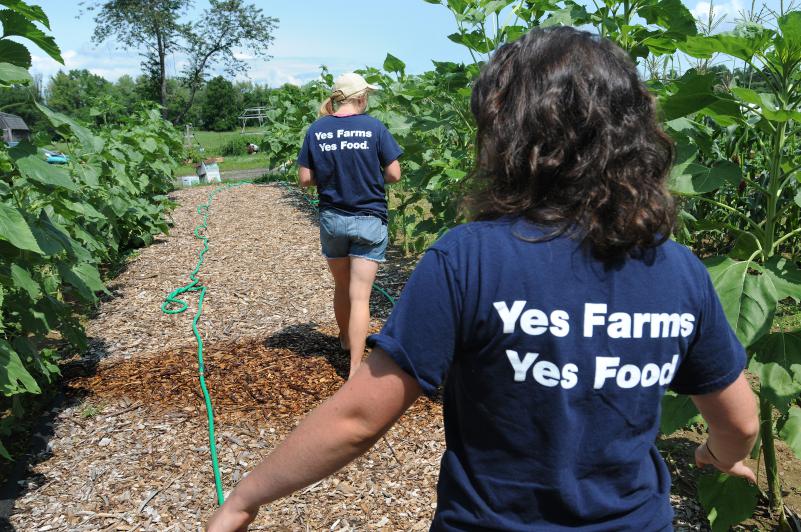
Sarah Berquist, left, and Cate Elliott manage the Food For All garden that provides food for Not Bread Alone and the Amherst Survival Center. The garden is located at the University of Massachusetts Agricultural Learning Center on N. Pleasant St. in Amherst. Purchase photo reprints »
Join Cate and Sarah during their volunteer hours: Tuesdays from 9-12 and Wednesdays 11-2 all summer long behind the Wysocki House at 911 North Pleasant St., Amherst, MA.
By DEBRA SCHERBAN in the Daily Hampshire Gazette and the Amherst Bulletin – August 14, 2014
It was a grim task, pulling up 400 tomato plants tainted by blight’s black, contagious lesions. Seven 20-something men and women at a garden at the University of Massachusetts in Amherst were untying the strings holding the fruit-laden vines to their stakes and stuffing them into big plastic bags.
“It’s heartbreaking,” said Sarah Berquist, as she watched one of her co-workers close up a full bag. “But it’s pretty prominent around here.” Blight, which spreads through the air, can wipe out acres of tomatoes. Protocol dictates that infected plants be removed and discarded as soon as the condition is detected. “We don’t want to be in incubator for the disease,” she said.
The tomatoes are just one of a number of crops UMass students Berquist and Cate Elliott, managers of the one-acre plot, are growing to donate to Amherst’s Survival Center and the Not Bread Alone soup kitchen in town. So, they were taking the task philosophically — more room now for fall beets, carrots and cabbage. They were out that recent Tuesday morning with five members of the UMass permaculture team tending the crops during a time slot reserved for community members to pitch in, too. None, though, had shown up that day.
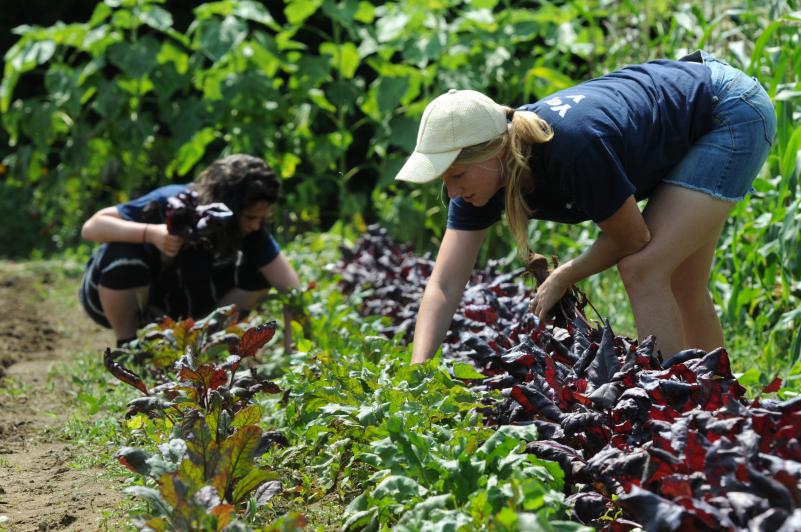
Cate Elliott and Sarah Berquist harvest vegetables in the Food For All garden at the University of Massachusetts Agricultural Learning Center. They manage the garden, which provides food for Not Bread Alone and the Amherst Survival Center. The garden is located at the University of Massachusetts Agricultural Learning Center on N. Pleasant St. in Amherst. Purchase photo reprints »
The project is called Food For All, and Berquist and Elliott had already turned over kale, basil, lettuce, celery, broccoli and cucumbers to the two programs which provide free community meals, as well as groceries, to those in need. They also have spinach, beans, corn, squash, onions, beets, potatoes, herbs — medicinal and culinary — and pumpkins growing.
They are proud of the step they’ve in the effort to promote local crops.
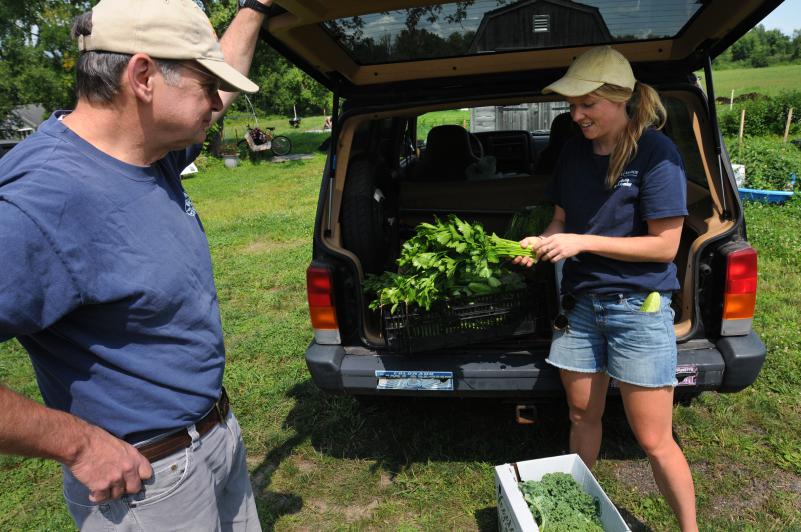
Bob Stover of Not Bread Alone takes a delivery of cucumbers, celery and cale from Sarah Berquist at the Food For All garden at the University of Massachusetts Agricultural Learning Center. Some of the vegetables are grown at Food For All and some are grown at other plots at the ALC and brought to the Food For All site for easier pick up. Purchase photo reprints »
“It’s rare to be growing food specifically for donation centers, so it’s kind of an innovative twist,” said Elliott.
She and Berquist met with folks from the Survival Center and Not Bread Alone at the beginning of the growing season to make their plans. Knowing both places get donations from various sources, they asked where the gaps were: why grow turnips if they already get plenty?
Tracey Levy, program director for the Amherst Survival Center, is pleased with the results.
“It’s been great,” she said in a telephone interview. “We’ve received some incredible produce.”
But there is a second part to the project that she likes just as much.
“It gives people who have an interest in growing a chance to garden with others,” she said. “They might not have the land or the skills, but this gives them an incredible opportunity.”
Cate Elliott pulls weeds in the Food For All garden at the University of Massachusetts Agricultural Learning Center. Purchase photo reprints »
There are hours set aside each week, like that Tuesday morning slot, for volunteers to come to the garden behind the former Wysocki farmhouse at 911 North Pleasant St., and work alongside Berquist and Elliott. Or they can just sit at a table shaded by an umbrella and watch.
“You can see it’s beautiful here,” said Berquist, her blond hair pulled back under a beige ball cap. “Two red hawks live here,” she said squinting up at one flying over head.
Elliott, dressed in blue shorts, a green T-shirt and sneakers with purple laces agreed. “We always tell volunteers that they are welcome to work in the fields, but they are just as warmly invited to sit under the umbrella and enjoy the garden.”
Visitors can park in the lot there near the farmhouse, now used for office and meeting space, and walk up a short gravel path which leads to the lush fields known as the UMass Agricultural Learning Center.
There are experimental gardens — one USDA project on Japanese Knotweed is on the right. Displays for urban gardening are on the left side where vegetables grow in blue plastic wading pools and ceramic containers. In the distance you can see a UMass student garden, a large plot of vegetables which are sold at a campus farmers market.
The Food For All garden is on the right and visitors are greeted by a sign which posts the volunteer hours — Tuesdays and Thursdays, 9 a.m. to noon and Wednesdays, 11 a.m. to 2 p.m. But Berquist and Elliott say they are glad to try to arrange alternative hours, too.
“Anybody can come,” said Berquist. “The hands-on piece is the most fun.”
Elliott, 21, a senior in the sustainable food and farming program that Berquist, 25, finished before starting graduate studies, got college credit to design the garden.
It was the idea of John Gerber, a professor at the UMass Stockbridge School of Agriculture, and Shelly Beck, pantry coordinator at the Survival Center, took part in the planning, said Berquist. Beck was involved in a similar garden in Greenfield.
Aside from Food For All, UMass has five campus permaculture gardens — plots of crops that thrive off one another in a variety of ways — supplying the dining commonses, and the idea was to create one aimed at the broader community.
Helping to stock programs like the Survival Center and Not Bread Alone also gives students a chance to see a side of the food system that is new to them, said Berquist. “You can be at the university for four years and never set food in the community that you are a part of,” said Berquist, who also works in educational gardens at two of Amherst’s elementary schools — Wildwood and Fort River.
“I think it’s the coolest thing that Stockbridge is reaching out.”
The Food For All project includes free workshops and events for the public. There was a kick-off celebration July 27, when about 20 people showed up on a rainy Sunday to tour the garden and help plant late-season eggplant and peppers. On July 30 there was a potluck supper at the Hitchcock Center for the Environment in Amherst during which a panel of educators, farmers and community organizers discussed local food sources. Next up is a session on food preservation at the kitchen used by Not Bread Alone at 165 Main St., Amherst Aug. 18 from 5 to 7 p.m.
Berquist and Elliott brim with enthusiasm when they talk about piquing public interest. They point out that people can help themselves to produce when they come — they urged me to do a half-dozen times: “Take some kale. Take cucumbers. We have some yummy basil, too.”
“We just want people to take advantage of the opportunity to come together and grow food and share food,” said Berquist.
And that means everybody.
The garden that Elliott designed has an 8-foot wide path, covered with woodchips, running down the middle. It’s wide enough for two wheelchairs to pass one another. Lined by a thick border of sunflowers, it leads to three folding tables on one side that contain pots filled with onion, thyme, basil, squash and cherry tomato plants for people to tend without having to walk or bend over.
“Our mission was to make this as accessible as possible,” said Elliott. “We want people of all abilities to enjoy the garden.”
As Berquist and Elliott gave me the tour, Lilly Israel, Sammi Gay, Sara Hopps, Nathan Aldrich, Eric Pepperell, Erik Cullen and Matt Lee loaded the bags filled with uprooted tomato plants into a pickup truck for safe disposal. Then they turned their attention to weeding cucumber and pumpkin patches. Israel was leading a cluster of voices in a rendition of the song “Do, Re, Mi” from the “Sound of Music.”
“Gotta sing while you work,” she said, the sides of her head shaved with a pile of blond hair pulled up on top. “Keeps the morale up.”
The workers had been at it since 9 a.m. and shortly after 11, Berquist called them to the side of the garden for a stretching break and then a snack of pomegranate and black pepper chips. The chips got mixed reviews, but spirits were high.
“This is a beautiful office. I love being here,” said Berquist as I said goodbye. “Take some kale with you. We have plenty.”
Debra Scherban can be reached at DScherban@Gazettenet.com.
By SCOTT MERZBACH – Staff Writer- Thursday, July 24, 2014
AMHERST — Ensuring all residents have access to locally grown organic food will be the subject of a series of workshops that begins with a kickoff celebration at the “Food for All” garden at the University of Massachusetts Sunday afternoon.
This garden, which is in its first season, is designed to fill gaps in food donations for places like the Amherst Survival Center and the Not Bread Alone soup kitchen.
The produce grown and harvested aims to meets the needs of the community based on projections from both meal sites, said Sarah Berquist, who co-manages the garden with Cate Elliott.
“Our hope is to serve as a space for people from the Not Bread Alone and Amherst Survival Center communities, as well as the general public who like to garden but don’t have space, and/or people who are looking to learn more about growing organic food through hands-on experience,” Berquist said in an email.
This is a new commemorative stamp introduced by the U.S. Postal Service
For most of us, there’s no better place to buy fruits and vegetables than at a farmers’ market. Period. The talk about high prices isn’t entirely unjustified, but it can be countered, and I’ll get to that in a minute.
What’s inarguable is that farmers’ markets offer food of superior quality, help support smaller-scale farmers in an environment that’s more and more difficult for anyone not doing industrial-scale agriculture, and increase the amount of local food available to shoppers. All of this despite still-inadequate recognition and lack of government support.
Then there’s “know your farmer, know your food.” When you buy directly from a farmer, you’re pretty much guaranteed real freshness (we’ve all seen farmers’ market produce last two or three times longer than supermarket produce). You’re supporting a local business — even a neighbor! And you have the opportunity to ask, “How are you growing this food?” Every farmer I’ve spoken to says — not always in a thrilled tone — that the questions from shoppers never stop. But even if a vegetable isn’t “certified organic,” you can still begin to develop your own standards for what makes sense and what doesn’t.
Farmers’ markets are not just markets. They’re educational systems that teach us how food is raised and why that matters.
“Producer-only” farmers’ markets, as opposed to markets that sell food from anywhere, are really the ideal. The organizations that run these tend to be nonprofits, and often use volunteers to keep going. In many cases they are mission-driven: organizers want to make sure small farms remain viable and that we — nonfarmers — have access to good local food. At this stage of the game, there is no higher cause.
The quality of produce in producer-only markets — that is, places where people sell what they grow — is phenomenal, especially right now. If you’re going to complain that tomatoes are $6 a pound in some markets (they are; they’re also sometimes 99 cents), you might also note that usually these are real tomatoes, sometimes explosive in flavor, whereas the $4 per pound tomatoes I bought in the supermarket this week were grown in water and were less tasty than your average canned tomato. To some extent, you get what you pay for.
Then again, there are often bargains on incredibly high-quality produce for anyone who is willing to shop. Last week, at a recently opened market near Washington, D.C.’s convention center, I bought tiny lavender “fairy tale” eggplants for less than $3 a pound. The Saturday before last, at New York’s Union Square Greenmarket, I found perfectly ripe, real apricots for $5 a pound. (A chef strode up next to me and bought two cases; the farmer had only three total, which is why you want to go early.) That may sound expensive, but if you want a real apricot, this is the only way to get it.
At the 37-year-old market on 175th Street in Washington Heights, I found purslane — a salad green I’ve been foraging for 40 years, and that I adore — and bought a bunch as big as my head for $2. I found papalo (also called Bolivian coriander), a delicious, strong-tasting green I’ve bought every time I’ve seen it since I first tasted it in Mexico a few years ago.
And at the tiny farmers’ market in Truro, on Cape Cod, now in its second year, I bought lobsters for 40 percent less than they cost in local stores, pork jowls for $2 a pound, and gorgeous half-yellow, half-green summer squash for a dollar each; they were worth it.
With more than 8,000 farmers’ markets nationwide (representing something like 50,000 farmers, according to the Department of Agriculture), potentially millions of people are being affected by similar experiences. That’s a great thing. And this week — National Farmers Market Week — a commemorative postage stamp is being introduced at a ceremony in Washington on Thursday. Present will be Bernadine Prince, co-executive director of FreshFarm Markets in Metro DC, which runs 13 producer-only markets, and president of the Farmers Market Coalition. Prince said to me, “Farmers’ markets are an economic engine that keeps farmers going.” Yes, that too.
That’s good for everyone, but things could be better. It’s clear to me — after visits to farmers in New York, New Jersey, Massachusetts and California, to farmers’ markets wherever I’ve traveled in the last few years, and recent conversations with Prince, Michael Hurwitz (director of New York’s Greenmarket), Francie Randolph (who runs Sustainable CAPE and founded the Truro market last year), and others — that a few key improvements could make it easier for farmers and markets to thrive.
Near the top of many lists is municipal support, largely in the form of space, water, electricity and the like, and the reduction (or absence) of fees. “Each of our 13 markets requires a different negotiation and different set of fees,” says Prince. “Some are a dollar a year and some are far more expensive.” Since this money comes mostly from fees charged to farmers, the costs are usually passed on to consumers.
By increasing foot traffic, bringing shoppers into otherwise-ignored spaces, providing space for farmers to sell their goods at retail prices (80 percent of the farmers in New York’s markets, says Hurwitz, could not survive on wholesale alone), these markets benefit everyone. Markets need infrastructure — either permanent space or, at least, water and electricity.
Farmers who come to market may be working 18-hour days, or even longer, depending on the length of their drive. On top of this, to handle retail sales they’ve got to process a variety of forms of payment in addition to cash, from SNAP (food stamps) to credit cards to tokens (you actually do not want to know how convoluted these payments get). When there’s a unified, wireless form of payment, this will become less of a burden. That’s in the works — Hurwitz estimates it’ll be here no later than the end of the decade — but undoubtedly it could be hurried along.
At least a few hundred markets are taking advantage of programs like Wholesome Wave that double the value of food stamps at farmers’ markets, and that number will soar when the Agriculture Department’s Food Insecurity Nutrition Incentive program kicks in, contributing as much as $20 million to the cause. That’s real progress, but more is needed.
In short, says the Southern Maine congresswoman Chellie Pingree, a staunch supporter of local food systems, “We’ve had some success in passing policies that support farmers’ markets, but really the numbers are pretty small compared to the huge support that flows to big commodity crops. Policy makers are slowly catching up with the public on the benefits of supporting local agriculture, but we have a long way to go before the playing field is really leveled.”
By RICHIE DAVIS – Recorder Staff – Sunday, August 3, 2014
SOUTH DEERFIELD — Pigs and bumblebees were there, as were biochar, solar collectors and energy- saving coolers.
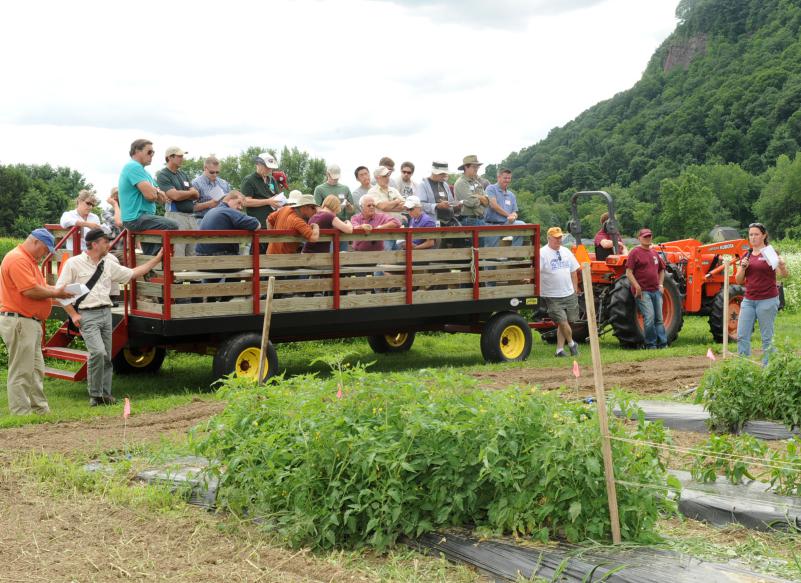
Agricultural field day at the University of Massachusetts Crop and Animal Research Farm is an annual chance for farmers to see the latest innovations in crop research, and the event last Tuesday event drew more than 60 people to view 18 ongoing trials, including one that integrated pig and vegetable production.
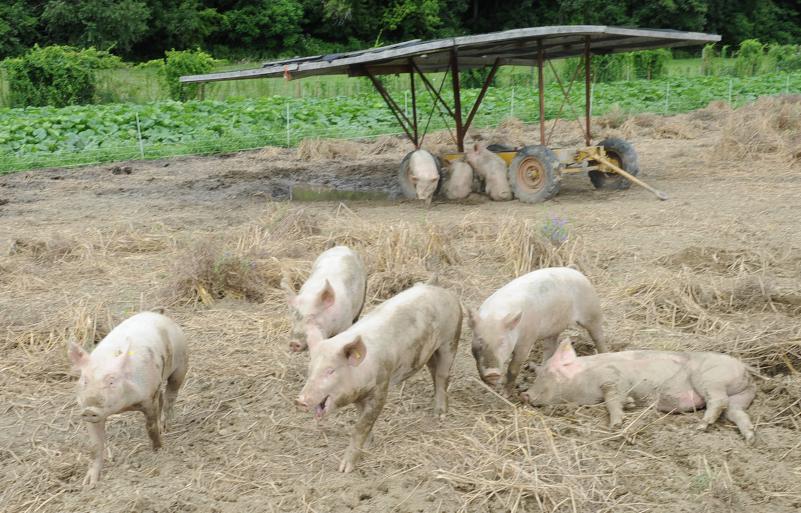
With an increased demand for locally raised meat and a growing demand by vegetable growers for manure, the strategy of having a test crew of 10 pigs eat hairy vetch and winter rye as cover crops before letting them loose in a harvested squash field was what Frank Mangan, a vegetable researcher, was looking into.
“Working with vegetables for 30 years, I wanted to work with a crop that you can actually harvest year-round,” Mangan told onlookers as an assistant whistled to 10 four-month-old pigs that come running across what had been “a very lush field of vetch and rye” that they continue to trample and eat.
The farm is going through the process of applying for certification from the federal Good Agricultural Practices and state Commonwealth Quality programs, under which manure is becoming heavily regulated.
“We’re trying to make the case that manure is an important part of our system here in New England, with smaller farms, and we want to encourage that kind of rotation,” he said. Current GAP rules require a 120-day wait period from the time manure is applied until a vegetable crop that “touches the ground” can be harvested. “They’re still negotiating this, and we want to make the case that this is a viable system, and we can do it safely.”
The pigs are scheduled to be slaughtered in late September, at about 200 pounds each, to provide one dinner for one of UMass’s four dining commons.
“We serve 45,000 meals a day,” he said. “I hear that and I think ‘market,’” especially since the Amherst campus is signed up for the Real Food Challenge to serve 30 percent of its meals with local, non-genetically- modified foods.
Feasting on the cover crop, he said, the pigs are eating half their normal volume of grain as part of a diversified, low-labor system providing a vegetable as well as meat.
Years ago, when farmers were encouraged to plant cover crops, they said the land was too valuable to be used for that purpose, Mangan said. “Here instead of just raising pigs on an acre or growing a vegetable, we split it in half, so the full acre is ‘in production,’” with the squash harvest planned in September, 120 days after the manure was applied.
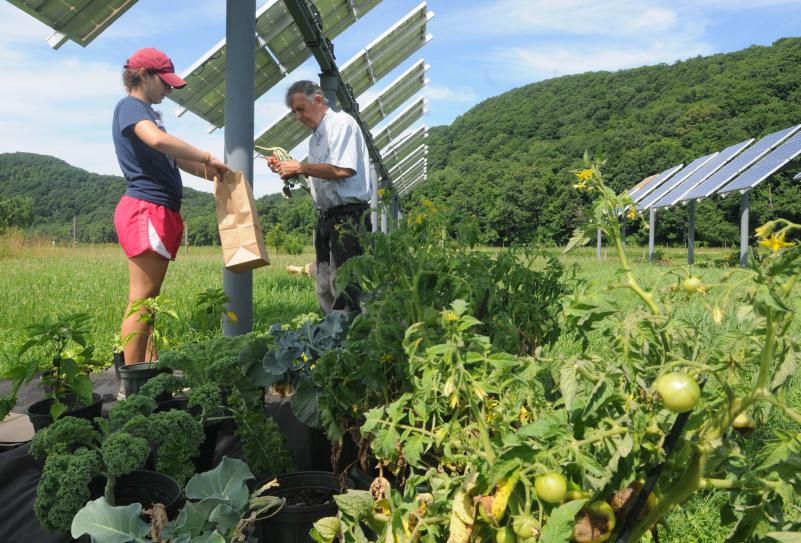
Another example of mixed crop was what agronomy professor Stephen Herbert called “the first installation of dual-use grazing land and solar panels” in the country, with 90 to 95 percent of normal hay yields. “What you see around the country, and around Massachusetts is farmers giving up land for solar panels,” said Herbert. “We need every acre of farmland we have for food.”
The UMass system, with 70 panels 7 feet off the ground and arranged on posts at different distances apart, generates 26 kilowatts of electricity on less than a quarter-acre, and includes small plantings of tomatoes, kale, broccoli and lettuce. A larger system is also planned.
“It’s a no-brainer,” he said of the systems, plotted so the panels shade out little of the crops. “You just have to be crazy enough to imagine what you might do.”
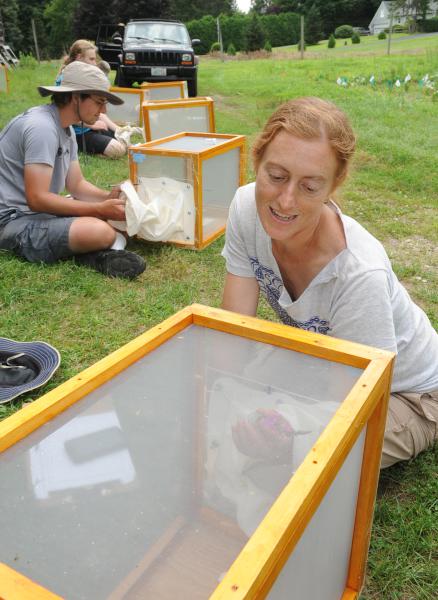
On a demonstration plot on one-half acre, biologist Lynn Adler pointed to 1,500 flowering plants of 15 varieties which researchers are inoculating with laboratory-raised parasites, crithidia. The crithidia are placed in large screen cages with common Eastern bumblebees to study the effect of different defensive plant chemicals on transmission of disease to the bees. The research is part of a broader study of diseases that are weakening native bee populations.
“We’re recording how many flowers they forage on … and how much total foraging time,” said Adler, explaining that after each afternoon’s trial, the bees are returned to the lab and dissected after a week to see whether they are infected and what the extent of the infection is.
It’s far too early to know whether it’s the bee balm, foxglove, snapdragons, sunflowers or other varieties that are most likely to transmit the pathogen left in the feces of other infected bees, and to discover what kind of floral traits might predict odds of transmitting disease.
“Is it species that make lots of flowers, is it species that make lots of nectar, is it flowers of a certain shape, or flowers with a defense chemistry in their nectar?” said Adler. “Can I make some more general predictions that would help us be able to predict in a landscape which species are likely to be the hub of transmission?” That kind of research is a far cry from testing the use of a humidifier with air-cooled food storage systems that try to boost energy efficiency and also the freshness of stored fall crops like carrots, or a test to improve soil fertility by using mineral-rich rock dust and biochar from burning plant matter with limited oxygen.
But each of the experiments, Herbert said, could potentially have import applications in helping to make agriculture in the region more viable.
In 2005, the House of Representatives passed an act that forbade consumers to sue fast-food operators over weight gain. “The Cheeseburger Bill” (formally, “The Personal Responsibility in Food Consumption Act”) attempted to legislate the message that the costs of fast food are personal, not social, and certainly not a consequence of selling harmful food at addictively low prices.
The reality is different, as we begin to understand the extent of the financial and economic costs wrought on our society from years of eating dangerously. That’s a different kind of cheeseburger bill; the butcher’s bill, if you like: The real cost.
What you pay for a cheeseburger is the price, but price isn’t cost. It isn’t the cost to the producers or the marketers and it certainly isn’t the sum of the costs to the world; those true costs are much greater than the price.
This is an attempt to describe and quantify some of those costs. (I have been working on this for nearly a year, with a student intern, David Prentice.) It’s necessarily compromised — the kinds of studies required to accurately address this question are so daunting that they haven’t been performed — but by using available sources and connecting the dots, we can gain insight.
Whatever the product, some costs are borne by producers, but others, called external costs — “externalities,” as economists call them — are not; nor are they represented in the price. Take litter: If your cheeseburger comes wrapped in a piece of paper, and you throw that piece of paper on the sidewalk, it eventually may be picked up by a worker and put in the trash; the cost of that act is an externality. Only by including externalities can you arrive at a true cost.
Almost everything produced has externalities. Wind turbines, for example, kill birds, make noise and may spin off ice. But cheeseburgers are the coal of the food world, with externalities in spades; in fact it’s unlikely that producers of cheeseburgers bear the full cost of any aspect of making them. If we acknowledge how much burgers really cost us we might either consume fewer, or force producers to pick up more of the charges or — ideally — both.
We estimate that Americans eat about 16 billion burgers a year of all shapes and sizes, based on data provided by the NPD Group, a market research firm. (The “average” cheeseburger, according to the research firm Technomix, costs $4.49.) And our calculation of the external costs of burgers ranges from 68 cents to $2.90 per burger, including only costs that are relatively easy to calculate. (Many costs can’t possibly be calculated; we’ll get to those.)
The big-ticket externalities are carbon generation and obesity. Environmental Working Group’s “Meat Eater’s Guide” (2011) estimates the carbon footprint of beef cattle at 27 pounds of CO2 equivalent per pound; the use of “spent” dairy beef in burger meat reduces that slightly, but we can say that each pound of burger meat accounts for roughly 25 pounds of CO2 emissions. (Cheese counts, too: It produces 13.5 pounds of CO2 equivalent per pound, and even bread has a carbon footprint.)
The cost of this carbon is hard to nail precisely, but the government’s official monetary valuation of greenhouse gas pollution is roughly $37 per metric ton of CO2 emissions. Many experts, however, double that rate; others multiply it nearly tenfold. So the monetary value of the carbon emissions produced by the average cheeseburger might range from 15 cents (the official government rate), to 24 cents (conservative independent sources) and $1.20 (high independent). The average of these three estimates comes out to 53 cents per burger.
The calculable chronic disease costs are similar. There’s some evidence that red meat intake may increase risk of cardiovascular disease and mortality, but like many of the speculative externalities discussed below, it’s impossible to assign a cost to this. (If red meat were further implicated in cardiovascular disease, the true costs of a burger would rise significantly.)
In any case, a main factor in the rise of obesity has been an increase in the availability of calorie-dense foods, and burgers played a big role in this process. Between 1970 and 2000, per capita calorie intake increased by 24 percent, and the “food-away-from-home sector” grew to nearly half of all food we eat. Restaurants, of course, are the source of most burger consumption.
Between 2007 and 2010, 11.3 percent of adult Americans’ daily caloric intake came from fast food. Correlation is not causation, of course, and it seems likely that foods high in sugar and other hyperprocessed carbohydrates are most responsible for high obesity rates, but burgers certainly played a role in rising caloric intake.
To estimate the share of obesity-related costs resulting from burger consumption, we estimated the share of calories coming from burgers in fast-food restaurants, where the majority are eaten. Assuming that the 11.3 percent of calories is proportional to the incidence rate of obesity (it may be higher), its associated health risks, and its treatment costs, up to 15 percent of fast food’s share of direct and indirect costs arising from obesity (about 1.65 percent of the whole) are attributable to burgers.
The link between obesity and a handful of deadly chronic diseases — arthritis, cardiovascular disease, hypertension, Type 2 diabetes and some cancers, among others — is well documented, as is their enormous economic burden. Direct medical diet-related costs are currently pegged at about $231 billion annually.
These numbers above would mean that this cost of burgers is about $4 billion per year (from fast food burgers only!), which averages out to 48 cents per burger. (Some put these costs five or six times as high, and there are indirect costs as well; again, we’re being conservative.) And between 2010 and 2030, the combined costs arising directly from diseases related to obesity could increase by an additional $52 to $71 billion each year. This could double the cost per burger in additional health costs alone.
Some other costs are only vaguely calculable, and we have numbers, but the ranges are so great that they’re useless; what matters, though, is that the numbers are above zero. There are elevated nitrates in water supplies resulting from the chemical fertilizers used to grow corn to feed cattle (the city of Des Moines has been forced to spend $3.7 million to build a water treatment facility for precisely this reason; then there’s the famous “dead zone” in the Gulf of Mexico); the cost of food stamps and other public welfare programs made necessary in part by the ultralow wages paid at most fast-food operations; the beef industry’s role in increasing antibiotic resistance, which costs, according to the Centers for Disease Control and Prevention, something like $55 billion a year; some measure of E. coli illnesses; and land erosion, pesticide residues, direct corn subsidies, injury rates at slaughterhouses, and so on.
Each of these adds pennies or less to the external costs of a cheeseburger. But although they may be trivial individually (unless of course, you’re being directly affected by them), they add up. Even more difficult to calculate are the “cost” of a shortened life, or the value of loss of biodiversity that results from the destruction of rain forests to provide land for cattle or their feed. There is even an emerging body of research linking decreased male sperm quality to mothers’ beef consumption.
Last year, burger chains grossed about $70 billion in sales. So it’s not a stretch to say that the external costs of burgers may be as high as, or even outweigh, the “benefits” (if indeed there are any other than profits). If those externalities were borne by their producers rather than by consumers and society at large, the industry would be a highly unprofitable, even silly one. It would either cease to exist or be forced to raise its prices significantly.
In this discussion, the cheeseburger is simply a symbol of a food system gone awry. Industrial food has manipulated cheap prices for excess profit at excess cost to everyone; low prices do not indicate “savings” or true inexpensiveness but deception. And all the products of industrial food consumption have externalities that would be lessened by a system that makes as its primary goal the links among nutrition, fairness and sustainability.
Click on the image below for the radio version of this report!Today, the idea of “buying local” is firmly rooted in our culture.
Farmers markets flourish almost every day of the week in western Massachusetts. Community-supported farms offer the chance to buy a share of a crop. And lots of farm stands and retail stores trumpet the sale of local produce.
The value of a “local” perspective is even rubbing off on other parts of the Pioneer Valley’s economy, including financial investing. In our series, A New Kind of Local, we look at the growth and the challenges of the movement, starting with a history of local food.
Local as a movement
The idea that consumers can help preserve farms by choosing to buy locally-grown food first began to take root more than 40 years ago.
“A lot of us thought we could change the world,” Rich Pascale says.
Pascale, 65, started farming in Franklin County in 1974. It was a time when young people moved to rural areas to build self sufficient lives.
“Live simply, grow your own food,” he says. “And from that point it was like, ‘We have to make some money,’ so we have to sell our own food.”
He’s been selling at the Greenfield Farmers Market for four decades.
“So these are $3.50 for the six packs,” he says of his goods. “And these are $2.75 for tomato plants.”
A way to stabilize prices
In the mid 1970s, as more young people, like Pascale, were choosing to farm, the state was losing farms. Nearly half of them went out of business between 1964 and 1974
“The Massachusetts agricultural economy was on the downward skids,” says Greg Watson, commissioner of the state Department of Agricultural Resources. “We were losing about 10,000 acres of farmland a year. And I think a lot of people had just given up.”
But not everyone.
“It was the summer of 1973 and Governor Sargent called me,” recalls Ray Goldberg, a professor emeritus from Harvard Business School.
Massachusetts Governor Francis Sargent asked Goldberg to head up an emergency food commission.
“We had crop failure around the world,” he says. “Food prices were rising faster than general inflation.”
And the OPEC oil embargo forced up petroleum prices. Goldberg says the commission found Massachusetts was highly dependent on food from distant places.
“We were a high-cost food area compared to any other state in the nation,” says Goldberg. “So there was a great deal of encouragement to get more locally grown production.”
The commission’s work led to new policies. One program allows farmers to sell their development rights to the state, preserving more than 70,000 acres. The state launched an advertising campaign, with the slogan: “Massachusetts Grown and Fresher.” And it helped expand the number of farmers markets.
From farm field to parking lot
Agriculture Commissioner Greg Watson was a young man in 1978 when he was hired by the state to launch markets in poor areas of Boston. Watson says, at first, neither African-American residents nor the white farmers trusted each other.
“The first reaction of farmers to come into the city was ‘I won’t come out alive!’” Watson recalled. “And the residents were saying ‘Why should we go to the trouble of making the parking lot in the South End available for rich farmers to come in and get richer?’ So there were these really solid stereotypes, both of them really far from reality.”
Watson was able to sign up 20 farmers to come to the grand opening of the Dorchester market. It was a big deal. The lieutenant governor was there, and a bunch of television cameras.
“Opened up at 9 o’clock, not a single farmer,” he says. “About 9:20, people were getting impatient, they were nervous, a pickup truck comes down the street.”
That was the only farmer to show up. But Watson says that night on the news, instead of pictures of an empty street, the cameras had zoomed in.
“All you saw was the farmer, his wife and his daughter,” he says. “They couldn’t get the food off the truck fast enough. People were clamoring. Next week we had 20 farmers.”
Back then, there were fewer than 10 farmers markets statewide. Today, there are nearly 300.
Although the middleman is cut out, in some cases the food at farmers markets costs more than at supermarkets. Watson remembers one customer who explained why she was willing to pay more.
“‘Because my kids eat it,’” Watson recalls her saying. “They were eating raw peas. ‘If I pay a little less and half of it gets scraped into the garbage is that economical?’”
Today, many farmers markets take food stamps. Watson says perhaps farms could become more efficient to lower the price of food.
“Are there things we can do to help make this not just accessible, but also affordable? And those are challenges,” he says.
A face on the food
The state has gained back many of the farms it lost 40 years ago. But they’re smaller now – about half the size.
“Eggplant, cherry tomatoes, okra, tomatillos. We have about 30 varieties of hot peppers here,” says Allison Landale, as she points out neatly tended rows of crops she and her husband Dean cultivate on 15 acres in Deerfield.
The farm has been in her mother’s family since the 1800s. Her father farmed it. Allison says when she first started working with him in the early 1990s, at times it was tough.
“Local wasn’t anywhere near what it is today,” she says.
The farm’s sales have tripled in the past five years. The Landales say the nonprofit CISA, Community Involved in Sustaining Agriculture gives them a lot of support. CISA first developed the Local Hero advertising campaign in 1999.
Back in Deerfield, Dean Landale is pounding stakes for tomato plants. For him, the concept of “local” makes farming more personal.
“We see our customers,” Landale says. “We don’t ship to a supermarket someplace. So our face is basically attached to what we sell.”
That connection between farmer and consumer is strong today. But local food advocates are still hard at work.
There’s a push to bring more processing facilities, including slaughterhouses. One group says by 2060, New England farmers could produce half of the food consumed here.
Phaedra Ghazi, research assistant, and Stephan Herbert, a Umass professor at the Stockbridge school of Agriculture, bags vegetable samples part of a dual use of land study for agriculture and solar PV. Photo by Carol Lollis.
ERIC GOLDSCHEIDER – Daily Hampshire Gazette – July 15, 2014
SOUTH DEERFIELD — What if you could use open space to generate solar electricity and farm it at the same time?
Stephen Herbert, a professor of agronomy at the University of Massachusetts Amherst Stockbridge School of Agriculture, says this is more than a pipedream.
A demonstration plot at a research station in South Deerfield is doing just that.
“We have shown that we can get 90 percent of the yield of a pasture with solar panels compared with not having them as long as we leave enough space between clusters of panels,” he said.
Cattle and sheep graze beneath them. The animals also benefit from the shady spots the panels create.
The initial installation was 70 panels, which generate 26 kilowatts of electricity on less than a quarter acre. They are seven feet off the ground and are mounted on individual posts. The wiring connecting them is above ground.
Herbert said the demonstration plot experiments with spacing and configuration to find the sweet spot that allows maximum sun to reach the ground so the vegetation gets what it needs while the rest is captured for generating electricity. He also experiments with ways of driving poles into the ground to support the panels while minimally disturbing the soil.
“It’s a simple thing, but nobody is doing it,” according to Herbert, who said the demonstration plot, which has been up for almost four years, is the only one of its kind in the country.
Herbert believes that ideas like this one will get more attention in the years ahead as dilemmas around the balance between using land to grow food while generating significant amounts of alternative energy become more acute.
“My position is that we should make solar panels compatible with agriculture,” said Herbert. He thinks that in the future we will see dual use solar installations that can also be used for growing vegetables.
According to a description of this work on Herbert’s website, “only solar has the potential to substantially power the state while only using a reasonable amount of the state’s landmass.”
Herbert said he understands the benefits to farmers of leasing out land for a couple of decades to host solar arrays on fields they might otherwise sell to developers.
But he doesn’t think growing crops and generating electricity should be mutually exclusive.
By Alice Waters – July 7, 2014 – Wall Street Journal
Ms. Waters is a chef, author and founder of Chez Panisse restaurant and the Edible Schoolyard Project.
Over the past half-century, the fast-food industry, aided by government subsidies, has come to dominate the food marketplace. That development has given us an obesity epidemic and, with the growth of so-called factory farms, has degraded the environment.
More recently, in a reaction against fast food and Big Ag, the sustainable-food movement, with a focus on local food networks and healthy eating, has gained a foothold in restaurants and farms across the country. What began as an underground movement has now gone mainstream.
Looking forward, I believe that ever-growing numbers of Americans—led by passionate chefs, farmers and activists—will choose the latter of these two paths: a sustainable food future. Let me describe how I believe, ideally, that future will look.
Farmers’ Markets
The number of farmers’ markets and young people taking up farming will multiply geometrically. As such, we will see at least one farmers’ market in every town in the country and, in turn, the revitalization of many areas.
At the same time, small mom-and-pop restaurants will enjoy a resurgence. These owners—with little enthusiasm for franchises—will be interested primarily in quality of life and in building a community around their businesses. These restaurants will build relationships directly with farms and will want to increase the quality and variety of their produce. As a result, I expect to see a greater variety of fruits and vegetables becoming available in the market.
Growing demand will push farmers to be innovative, as will climate change. That will mean more greenhouses in the colder parts of the country, growing food in urban areas and choosing crops that can withstand extreme weather.
This movement poses a threat to fast-food businesses and industrial food companies, both of which I predict will continue to shape-shift and co-opt their values for profit. As long as their products continue to be supported by government subsidies, they will be successful. The reality is that the sustainable-food movement’s reach will grow only to a point and ultimately will be limited to those with access, means and education—unless legislators dramatically change food and agriculture policy.
I think that those in government will come back to their senses in the coming years and begin to subsidize farms instead of factories. As access to real food becomes increasingly divided between the haves and the have-nots, food security will become even more of a social-justice issue.
Back to School
I am confident that we will see a growing consensus about the most effective way to transform food in America: building a real, sustainable and free school-lunch program. Decision makers will agree that the most sensible place to reach every child and to have the most lasting impact is with a program of “edible education.” Having worked in that field for more than 20 years via the Edible Schoolyard Project, I know what’s possible: Providing children with delicious meals made from organic ingredients transforms their attitudes about, and behavior toward, food for life.
Beyond the individual nutrition outcome of each child, an institutional food program with principled buying criteria (food that is locally sourced and organic) becomes a subsidy system for real food—a subsidy system that sees schools become the engine for sustainability.
I know that those on both sides of the political aisle finally realize that in food we find the root problem of many of our nation’s ills. I am not sure yet that they realize that food has the solution.
When droughts or crop failures cause food prices to spike, many Americans barely notice. The average American, after all, spends just 6.6 percent of his or her household budget on food consumed at home. (If you include eating out, that rises to around 11 percent.)
In Pakistan, by contrast, the average person spends 47.7 percent of his or her household budget on food consumed at home. In that situation, those price spikes become a lot more noticeable.
The US Department of Agriculture’s Economic Research Service keeps tabs on household expenditures for food, alcohol, and tobacco around the world.
Americans, it turns out, spend a smaller share of their income on food than anyone else — less even than Canadians or Europeans or Australians:
Note that the map above is based on data for food consumed at home — the USDA doesn’t offer international comparisons for eating out, unfortunately. Still, even if you do include food consumed at restaurants, Americans devote just 11 percent of their household spending to food, a smaller share than nearly every other country spends on food at home alone.*
Below is a chart showing numbers for a handful of select countries. Note that this doesn’t include spending on subsidies and the like — it’s just a measure of the fraction of household expenditures devoted to food consumed at home:
There are a few notable points here:
1) Richer countries spend a smaller fraction of their income on food. This makes intuitive sense. There’s an upper limit on how much food a person can physically eat. So as countries get richer, they start spending more of their money on other things — like health care, or entertainment, or alcohol. South Koreans spent one-third of their budget on food in 1975; today that’s down to just 12 percent.
That said, this relationship doesn’t always hold. It depends, at least in part, on what kind of food people favor, patterns of eating out, and the specific food prices and subsidy schemes in their country. Note that India spends a smaller fraction of its budget on food consumed at home than Russia, which is much richer. Likewise, South Korea spends a smaller share of its budget on food than wealthier Japan does.
2) Americans spend less than Europeans on food. The fact that Americans spend a smaller portion of their budgets on food than Europeans do is partly a consequence of the fact that Americans are richer. But Americans spend less on an absolute level, too.
The average American spends $2,273 per year on food consumed at home, the USDA notes. The average German spends $2,481 per year. The average French person spends $3,037 per year. The average Norwegian spends a whopping $4,485 per year on food.
The USDA doesn’t explain the variation. Some of it likely has to do with different tax systems in Europe (here’s a comparison of food prices in Europe), as well as differences in eating out. But there are also dozens of forces making food in the United States so cheap — from farm subsidies to advancements in industrial agriculture that have pushed down the price of food. (Over the years, the price of meat, poultry, sweets, fats, and oils in the United States have fallen, although the price of fresh produce has risen.)
There are fierce debates about the downsides of industrial agriculture — as well as the desirability of subsidizing agriculture. But one thing this system has done fairly well is keep the sticker price of food at the grocery store down.
3) High spending on food and malnutrition seem to go hand in hand. This is another perhaps obvious point, but worth highlighting. Poorer countries that have to spend a much larger share of their budget on food also end up with much higher malnutrition rates.









 UMass Sustainable Food and Farming