Food Safety Rules: What Farmers – and their Advocates – Need to Know Now

Reposted from NESAWG

August, 2013 Potluck News

NESAWG is part of a broader team that helps to educate and advocate about sustainable farm and food issues at the national level.  To that end, we bring our northeast regional perspective to the national table.

In the area of food safety, new rules governing food safety need to account for differences among types of farms to be meaningful and effective across the board.  In the northeast, we have a high concentration of IPM and organic farms, and farms serving direct markets like CSAs and farmers markets.  Read below regarding the upcoming rules and what farmers (and consumers) need to know.

__________________________________________________________________________

August is crunch time for farmers in the northeast.  Everything needs weeding, harvesting, reseeding and cover-cropping—and all at once.  Who has time to read 1,200+ pages of food safety rules and regulations?  Brian Snyder, Executive Director of the Pennsylvania Association for Sustainable Agriculture, for one.  And it’s a good thing he does.

The time for deciphering and commenting on the Food Safety Modernization Act’s proposed rules is now, especially since the courts are unlikely to allow any further extensions of the November 17 deadline.  Snyder is doing all he can to inform farmers and their advocates of the issues and urge them to take action.  The stakes couldn’t be higher.

 75 Years in the Making

“This is the first major rewrite of food safety legislation in 75 years,” says Snyder.  “Farmers can count on the fact that these will be the rules that they have to abide by for the rest of their lives, and probably even the next generation or two.”

Read the action steps that Snyder suggests all farmers take now!

Of course, agriculture has changed drastically in the last seven decades.  Our safety standards need to adapt to the complexities of our current global food system.  According to the Centers for Disease Control and Prevention, about 48 million people get sick from food-borne diseases each year.  In this summer’s latest outbreak, at least 418 people in 16 states were sickened by contaminated salad mix.  Our food system is so vast and complicated, Snyder says, “They couldn’t even tell us which country the produce was from until weeks after the outbreak.”

Updating decades-old legislation may help enhance tracking and minimize outbreaks.  The risk is that the rules as proposed would have unintended effects on farms that are not typically found to be the source of this type of widespread contamination— those using sustainable or organic growing methods and  distributing via small and direct markets.

 All Farms Great and Small

The tendency in Washington has always been to create rules that are adapted, in one way or another, for large industry—in this case, massive, conventional farms.  Those rules, when applied to sustainable or organic operations, pose serious threats.

“These regulations will be prohibitive in terms of expense and can put a number of farms and facilities that we work with out of business,” says Snyder.

For example, one rule would require that some farmers conduct weekly tests of each and every well used for irrigating crops.  Another mandates that fields fertilized with manure be left fallow for at least nine months.  In places that have cold winters, like the northeast, Snyder notes that a nine-month hiatus is equivalent to taking a field out of production for a full year.  Rules such as these exceed even the organic standards, which have served as many farmers’ benchmark for decades.  “How many farmers, organic or otherwise, have any idea that this going to be the rule if we don’t get it changed?”

An Exemption for Every Rule?

There is an exception to every rule, and much has been made about the exemptions written into the proposed FSMA regulations.  Many northeast farmers are being lulled into believing that exceptions for smaller farms apply to them.  In reality, cautions Snyder, “Those exemptions have limits that are more variable than they think.”

For example, the FDA’s proposed produce rule exempts any farmer selling less than $25,000 worth of product from compliance with some of the procedures.  A dairy farmer who plants an acre of vegetables to sell at a local market—hoping to clear enough to fix the milking machine—may assume she’s exempt.  However, the FDA doesn’t just count sales of produce toward that $25,000 limit, but everything sold on the farm for either human or animal consumption, including the milk sales that constitute her main income.  For most farms in this situation, Snyder observes, “They are going to be well over $25,000 before they plant their first zucchini.”

Another much-touted exemption is similarly limited: a farm with annual sales under $500,000 is exempt, but only if it earns at least 50% of its income through direct sales in the same state or within 275 miles of that farm.  Misleading information about these exemptions abound.  Snyder believes that the lobbyists who stand to gain if these rules are approved unimpeded are circulating much of it.  “That is the reason why every farmer really needs to pay attention,” he says, “There are trap doors in these exemptions that may not be immediately clear.”

 Farmers: Act Now!

Read Snyder’s suggestions for actions farmers and their advocates can take right now.

===============================================================================

For more ideas, videos and challenges, please join my Facebook Group; Just Food Now.   And also check out more World.edu posts. You also may be interested in the 15-credit Certificate, the 2-year Associate of Sciences degrees or the 4-year B.S. Sustainable Food and Farming major in the University of Massachusetts Stockbridge School of Agriculture.

Eating grass fed beef is good for the planet

grassfedbeef
Published: Saturday, Jul. 6, 2013 – Sacramento Bee

Eating meat is bad for the planet, right? That hamburger you’re contemplating for lunch comes from a cow that, most likely, was raised within the industrial agriculture system. Which means it was fed huge amounts of corn that was grown with the help of petroleum, the carbon-based substance that has helped drive Earth’s climate to the breaking point. In industrial agriculture, petroleum is not only burned to power tractors and other machinery used to plant, harvest, and process corn – it’s also a key ingredient in the fertilizer employed to maximize yields.

Eating beef is particularly environmentally damaging: Cows are less efficient than chickens or pigs at converting corn (or other feed) into body weight, so they consume more of it than other livestock do. As a result, the industrial agriculture system employs 55 calories of fossil fuel energy to produce 1 calorie of beef. Meanwhile, livestock production is responsible for much of the carbon footprint of global agriculture, which accounts for at least 25 percent of humanity’s annual greenhouse gas emissions, according to the U.N. Food and Agriculture Organization.

Despite its large carbon footprint, the agricultural sector is invariably overlooked in climate policy discussions. The latest example: In his 50-minute speech on climate change last week, President Barack Obama did not even mention agriculture except for a half-sentence reference to how farmers will have to adapt to more extreme weather.

Perhaps no one has been more influential in popularizing the environmental critique of industrial agriculture than Michael Pollan. His 2006 best-seller, “The Omnivore’s Dilemma,” revealed how corporate profits, misguided government policies and an emphasis on convenience have given Americans food that is cheap but alarmingly unhealthy for those who eat it, not to mention the soil, air and water relied upon to produce it.

These days, however, Pollan is delivering a deeper yet more upbeat message, one he shared in an interview while promoting his new book, “Cooked: A Natural History of Transformation.” (Disclosure: Pollan and I have been friendly colleagues since we met at Harper’s in the early 1990s, when he was executive editor.) Now, instead of just exposing the faults of the industrial agricultural system, Pollan is suggesting radical new ways to make agriculture work for both people and the planet.

Technology is central to Pollan’s vision, but, he says, “We have to think about what technology means. Does it only mean hardware and intellectual property? If we limit it to those two definitions, we’re going to leave out a lot of the most interesting technologies out there, such as methods for managing the soil and growing food that vastly increase agricultural productivity and sequester carbon but don’t offer something you can put into a box.” And why call even seemingly old-school methods “technology”? Because, he says, “technology has so much glamour in our culture, and people only want to pay for technology.”

With the right kind of technology, Pollan believes that eating meat can actually be good for the planet. That’s right: Raising livestock, if done properly, can reduce global warming. That’s just one element of a paradigm shift that Pollan and other experts, including Dennis Garrity, the former director general of the World Agroforestry Center in Nairobi, Kenya, and Hans Herren of the Millennium Institute in Washington, D.C., are promoting. They believe that new agricultural methods wouldn’t just reduce the volume of heat-trapping gases – they would also, and more importantly, draw down the total amount of those gases that are already in the atmosphere.

“Depending on how you farm, your farm is either sequestering or releasing carbon,” Pollan says. Currently, the vast majority of farms, in the United States and around the world, are releasing carbon – mainly through fertilizer and fossil fuel applications but also by plowing before planting. “As soon as you plow, you’re releasing carbon,” Pollan says, because exposing soil allows the carbon stored there to escape into the atmosphere.

One method of avoiding carbon release is no-till farming: Instead of plowing, a tractor inserts seeds into the ground with a small drill, leaving the earth basically undisturbed. But in addition to minimizing the release of carbon, a reformed agriculture system could also sequester carbon, extracting it from the atmosphere and storing it – especially in soil but also in plants – so it can’t contribute to climate change.

Sequestering carbon is a form of geoengineering, a term that covers a range of human interventions in the climate system aimed at limiting global warming. It’s a field that is attracting growing attention as climate change accelerates in the face of continued political inaction. Last month, the amount of carbon dioxide in the atmosphere passed 400 parts per million, its highest level since the Pliocene Epoch 2.6 million years ago (when a warmer planet boasted sea levels 30 feet higher than today’s – high enough to submerge most of the world’s coastal capitals). Meanwhile, human activities, from driving gas-guzzlers to burning coal to leveling forests, are increasing this 400 ppm by roughly 2 ppm a year.

The case for geoengineering begins with the recognition that the most widely discussed “solutions” to global warming – such as riding a bike rather than driving a car and making electricity from wind rather than natural gas – address only the 2 ppm part of the problem while leaving the 400 ppm part untouched. To be sure, reducing the 2 ppm of annual emissions growth is absolutely necessary – it just doesn’t go far enough. At 400 ppm, global warming is already contributing to a mounting litany of record-breaking weather. In the last year, the United States alone has suffered its hottest summer on record, its worst drought in 50 years, and the largest Atlantic hurricane on record, Superstorm Sandy. Globally, the list of climate-related extreme weather events is much longer.

What’s more, even if annual emissions of greenhouse gases drop to zero, global temperatures will keep rising and climate impacts keep intensifying for decades to come, thanks to the inertia of the climate system. The only way to possibly reduce impacts in the years ahead is to address what is fundamentally driving them: the 400 ppm of CO2 currently in the atmosphere.

According to Pollan, photosynthesis is “the best geoengineering method we have.” It’s also a markedly different method than most of the geoengineering schemes thus far under discussion – like erecting giant mirrors in space or spraying vast amounts of aerosols into the stratosphere to block the sun’s energy from reaching Earth. Whether any of these sci-fi ideas would actually work is, to put it mildly, uncertain – not to mention the potential detrimental effects they could have.

By contrast, we are sure that photosynthesis works. Indeed, it’s only a slight exaggeration to say that photosynthesis is a major reason we humans can survive on this planet: Plants inhale CO2 and turn it into food for us, even as they exhale the oxygen we need to breathe.

What does all this have to do with eating meat? Here’s where Pollan gets positively excited. “Most of the sequestering takes place underground,” he begins.

“When you have a grassland, the plants living there convert the sun’s energy into leaf and root in roughly equal amounts. When the ruminant – e.g., a cow – comes along and grazes that grassland, it trims the height of the grass from, say, 3 feet tall to 3 inches tall. The plant responds to this change by seeking a new equilibrium: it kills off an amount of root mass equal to the amount of leaf and stem lost to grazing. The discarded root mass is then set upon by the nematodes, earthworms and other underground organisms, and they turn the carbon in the roots into soil. This is how all of the soil on earth has been created: from the bottom up, not the top down.”

The upshot, both for global climate policy and individual dietary choices, is that meat eating carries a big carbon footprint only when the meat comes from industrial agriculture. “If you’re eating grassland meat,” Pollan says, “your carbon footprint is light and possibly even negative.”

Some, but not all, of Pollan’s analysis here resembles the holistic management of grasslands advocated by Allan Savory, a biologist from Zimbabwe whose TED talk earlier this year provoked widespread interest. Savory has his critics, though, including James McWilliams, a historian at Texas State University, who wrote in Slate that the most comprehensive scholarly analyses of holistic grazing found that it did not improve plant growth or, by implication, carbon sequestration.

For his part, Pollan emphasizes that switching from corn-fed to properly grazed cows brings other benefits as well. Sequestering carbon improves the soil’s fertility and water retentiveness, thus raising food yields and resilience to drought and floods alike. Says Pollan: “I’m a believer in geoengineering of a very specific kind: when it is based on bio-mimicry” – that is, it imitates nature.

Pollan calls this approach “open source carbon sequestration.” He emphasizes that more research is needed to understand how best to apply it, but he is bullish on the prospects. Using photosynthesis and reformed grazing practices to extract atmospheric carbon and store it underground “gets us out of one of the worst aspects of environmental thinking – the zero-sum idea that we can’t feed ourselves and save the planet at the same time,” Pollan says. “It also raises our spirits about the challenges ahead, which is not a small thing.”

• To read previous articles in the “Views on Food” series, go to www.sacbee.com/CAfood Mark Hertsgaard has written about climate change for outlets including The New Yorker, Vanity Fair, Time and The Nation. A fellow of the New America Foundation, he has authored six books, including “HOT: Living Through the Next Fifty Years on Earth.”

© Copyright The Sacramento Bee. All rights reserved.

Read more here: http://www.sacbee.com/2013/07/06/5547890/viewpoints-why-overlook-agriculture.html?goback=%2Egde_2612649_member_257641615#storylink=cpy

Downtown Amherst storefront eyed for local products

By DEBRA SCHERBAN  – July 4, 2013 – Daily Hampshire Gazette

AMHERST — Organizers of a local products marketplace in the works for about a year have found a downtown storefront, are seeking members and could be open for business on North Pleasant Street this fall.

souperbowlRepresentatives of the All Things Local Store, an indoor farmers market featuring produce and wares from local growers and craftspeople, are negotiating with the owners of the SouperBowl restaurant at 104 North Pleasant St. to take over the equipment of that business, which has closed. If those talks succeed, they will sign a lease Aug. 1 with property owner Barry Roberts and could open by October, said Tina Clarke, a member of the working group planning the market.

“It will be like an old-fashioned marketplace,” Clarke said. The project is based on Local Roots Market and Cafe in Wooster, Ohio, which Clarke said she discovered during a training she was conducting in that area.

Become a Member of All Things Local Coop Here

SouperBowl co-owner Shiang Sobieski said if the sale goes through, SouperBowl will not reopen in Amherst. The restaurant, which specialized in soups and chili, has a sign on the door indicating it is closed for the summer. She declined to comment further while the deal is pending.

Meanwhile, the working committee of the All Things Local Store has been holding house parties and conducting an online campaign at its website, www.AllThingsLocalStore.com. Its goal is to sign up 300 members and raise $15,000 by July 31, which will cover two months’ rent, Clarke said. The fee is $50 per household.

Becky Reed, owner of One More Gambol Farm, and Bernard Brennan, owner of Amethyst Farm, stand near Reed's garden at her farm in Amherst Tuesday. They are two of seven members of the incorporating board of directors for the All Things Local Store planned for downtown Amherst. JERREY ROBERTS
Becky Reed, owner of One More Gambol Farm, and Bernard Brennan, owner of Amethyst Farm, stand near Reed’s garden at her farm in Amherst Tuesday. They are two of seven members of the incorporating board of directors for the All Things Local Store planned for downtown Amherst.
JERREY ROBERTS

John M. Gerber, a professor of the Stockbridge School of Agriculture at the University of Massachusetts Amherst, who is working with the group, said the first gathering last week resulted in 35 memberships. Another membership party was held Tuesday at 7 p.m. at One More Gambol Farm, 483 Montague Road, Amherst.

In addition, Clarke said there are about seven membership parties in the planning stages. She estimates 200 people are ready to sign up. “People are so excited about this,” she said.

The working group, which consists of local farmers and businesspeople, grew out of Transition Amherst, a community group focused on climate change, rising energy prices and economic instability. The seven members of the group are Clarke, a certified transition trainer; Jeremy Barker-Plotkin, co-owner of Simple Gifts Farm; Bernard Brennan, owner of Amethyst Farm; Robin Luberoff, an attorney; William McGinnis, an information systems and business strategy consultant; John Thibbits, project manager at Atkins Farms Country Market; and John R. White, a community organizer with food cooperative management experience.

Clarke said these seven will form the initial board of directors until a permanent board is elected.

The All Things Local Store aims to provide space for vendors who would be charged 20 percent by the market that will go toward paying rent and utilities, Clarke said. The farmers will get to keep 80 percent of their sales, she said. The idea is to eventually offer events such as “Meet the Producer” nights, cooking demonstrations, parties, lectures and use of the commercial kitchen for canning parties and other activities, according to the website.

All Things Local differs from a worker-run collective, she said, which is also in the planning stages in Amherst.

Called Amherst Community Market, that group is committed to setting up a full-service grocery store similar to River Valley Market in Northampton, Clark said. Initially, the thinking was the two groups could join forces, she said, but they realized their goals differed.

“In our case, each producer decides the price, sales, etc.,” she said. The overhead is low. “This will be a downtown marketplace that can compete with the big chains like Walmart and Whole Foods.”

Some of the local producers who have already signed on to participate are Simple Gifts Farm, Milk & Honey Herbs, Amethyst Farm, Backyard Bakery, Book and Plow Farm, RealPickles, Swartz Family Farm, King Creek Farm and Queens Greens.

Clarke said the group hopes to sign up 1,200 members to cover all the market’s costs.

As for opening day? “We’re shooting for Oct. 1, maybe sooner. We’re optimistic,” she said.

ATLposter


Source URL:http://www.gazettenet.com/businessmoney/7250796-95/downtown-storefront-eyed-for-local-products-marketplace-in-amherst

Suggested reading…..

13 Books on the Food System That Could Save the Environment
By Food Tank: The Food Think Tank

LINK: http://foodtank.org/news/2013/06/thirteen-books-on-the-food-system-that-could-save-the-environment

Changing the ways consumers purchase, eat, and discard food is important for creating a more sustainable food system. Check out these books that identify and explain the problems in the food system—and how to make changes.

1. Cooked: A Natural History of Transformation by Michael Pollan

Michael Pollan takes back the “single most important thing [to] do as a family to improve our health and well-being”: cooking. A poetic exploration of the beauty and simplicity of preparing food, this book will help readers get off the couch and into the kitchen.

2. VB6: Eat Vegan Before 6:00 to Lose Weight and Restore Your Health . . . for Good by Mark Bittman

Mark Bittman delves into the benefits – to the environment, to personal health, and to the economy – of reducing meat consumption. Without forbidding or condemning meat, this is a great book for the environmentally-conscious omnivore.

3. Bet the Farm: How Food Stopped Being Food by Frederick Kaufman

Bet the Farm starts with an unnerving statistic: in 2008, “farmers produced more grain than ever, enough to feed twice as many people as were on Earth. In the same year… a billion people went hungry.” Kaufman delves into the problems with our food system and uncovers the financial underpinnings that motivate this dysfunctional system.

4. Foodopoly: The Battle Over the Future of Food and Farming in America by Wenonah Hauter

A farmer from Virginia and an advocate for healthy eating, Hauter explores the “corporate, scientific, industrial, and political” aspects of our food system in an effort to understand the problems with mainstream production and distribution systems, and how to fix them in order to incorporate healthy, mindful eating.

5. Behind the Kitchen Door by Saru Jayaraman

Exploring the food system from a different angle, Jayaraman points to the deeply troubling labor practices that exist in the food industry. With personal stories and interviews, Jayaraman unveils the low wages and grueling positions that farm and kitchen workers endure.

6. The Last Hunger Season: A Year In An African Farm Community On The Brink Of Change by Roger Thurow

Thurow spent a year with four women smallholder farmers in western Kenya to document their struggles in supporting and feeding themselves and their families. He evaluates the extent to which the work of initiatives like the One Acre Fund can help these farmers pull themselves up and defeat hunger and poverty.

7. American Wasteland: How America Throws Away Nearly Half Its Food (And What We Can Do About It) by Jonathan Bloom

Focusing on food waste in the United States, this book takes the issue beyond big farms and corporations to a very personal level. A great introduction to the ways that our own actions are impacting the food system, and what we can do about it.

8. The Urban Food Revolution: Changing the Way We Feed Cities by Peter Ladner

According to the World Health Organization, more than half of the world’s population now lives in cities. The Urban Food Revolution looks at the ways in which urban food systems need to change in order to become healthier and more sustainable

9. Diet for a Hot Planet: The Climate Crisis at the End of Your Fork and What You Can Do About It by Anna Lappe

Anna Lappe’s Diet for a Hot Planet outlines the ways in which the current food system contributes to climate change, the barriers to a true reform, and what consumers can do to provoke change.

10. WASTE: Uncovering the Global Food Scandal by Tristram Stuart

Uncovering waste in production and processing, the role of supermarkets in passing on wastefulness to suppliers and consumers, and consumers’ wasteful practices at home, Stuart’s book explores the many pathways of waste that exist in our food system. Even better, his book provides examples of countries where the food system is working, and offers tips on reducing and reusing our food.

11. The Backyard Homestead: Produce all the food you need on just a quarter acre! edited by Carleen Madigan

The Backyard Homestead tells would-be farmers how to farm on just a quarter of an acre.

12. The Perfect Protein: The Fish Lover’s Guide to Saving the Oceans and Feeding the World by Andy Sharpless

Sharpless argues that seafood will be the best source of sustainable protein for a rapidly growing global population. And he highlights the importance of protecting the health and biodiversity of wild fish populations.

13. The Essential Urban Farmer by Novella Carpenter and Willow Rosenthal

For those without a backyard, the Essential Urban Farmer is the essential tutorial to begin growing food in cities.

Sustainability grows as a major in the Pioneer Valley

By MADELEINE LIST – Gazette Contributing Writer – Tuesday, June 4, 2013

For students in western Massachusetts, green is the new black.

Majors and certificates in different areas of sustainability are becoming increasingly popular at local colleges. Some are creating entire new programs to meet the rising demand.

In the fall, Greenfield Community College plans to introduce a program called SAGE, for Sustainable Agriculture and Green Energy — a collaboration of existing energy-efficiency and farm and food systems programs at the college, said Peter Rosnick, the college dean.

“The reason why there is so much interest in both of these programs is because (students) want to find solutions for climate change, they want to find solutions around energy and heating homes and finding means of transportation past oil,” he said.

“There is also a recognition that we need to be more self-reliant. If you are concerned about climate change, if you are concerned about the state of our environment, we need to figure out how to produce our own food,” he said.

pullcarrotEnergy efficiency and farm and food systems are both degree programs at GCC that are more related than one might think, said Abrah Dresdale, coordinator of the farm and food systems program.

“The global industrial agriculture system is the No. 1 consumer of fossil fuels, expending more carbon than any other industry, including war,” she said. “There’s a huge implication on our food availability and the whole way the system works, from the machinery used on the farm, to the plastic used in the packaging to the transportation of the food thousands of miles.”

SAGE will be the first program of its kind at GCC, and will provide opportunities not only for students, but for faculty and kindergarten through Grade 12 educators to learn ways Continue reading Sustainability grows as a major in the Pioneer Valley

Breeding the Nutrition Out of Our Food

By JO ROBINSON  in the NY Times, May 26, 2013

WE like the idea that food can be the answer to our ills, that if we eat nutritious foods we won’t need medicine or supplements. We have valued this notion for a long, long time. The Greek physician Hippocrates proclaimed nearly 2,500 years ago: “Let food be thy medicine and medicine be thy food.” Today, medical experts concur. If we heap our plates with fresh fruits and vegetables, they tell us, we will come closer to optimum health.

cornThis health directive needs to be revised. If we want to get maximum health benefits from fruits and vegetables, we must choose the right varieties. Studies published within the past 15 years show that much of our produce is relatively low in phytonutrients, which are the compounds with the potential to reduce the risk of four of our modern scourges: cancer, cardiovascular disease, diabetes and dementia. The loss of these beneficial nutrients did not begin 50 or 100 years ago, as many assume. Unwittingly, we have been stripping phytonutrients from our diet since we stopped foraging for wild plants some 10,000 years ago and became farmers.

These insights have been made possible by new technology that has allowed researchers to compare the phytonutrient content of wild plants with the produce in our supermarkets. The results are startling.

Wild dandelions, once a springtime treat for Native Americans, have seven times more phytonutrients than spinach, which we consider a “superfood.” A purple potato native to Peru has 28 times more cancer-fighting anthocyanins than common russet potatoes. One species of apple has a staggering 100 times more phytonutrients than the Golden Delicious displayed in our supermarkets.

weakgreensWere the people who foraged for these wild foods healthier than we are today? They did not live nearly as long as we do, but growing evidence suggests that they were much less likely to die from degenerative diseases, even the minority who lived 70 years and more. The primary cause of death for most adults, according to anthropologists, was injury and infections.

Each fruit and vegetable in our stores has a unique history of nutrient loss, I’ve discovered, but there are two common themes. Throughout the ages, our farming ancestors have chosen the least bitter plants to grow in their gardens. It is now known that many of the most beneficial phytonutrients have a bitter, sour or astringent taste. Second, early farmers favored plants that were relatively low in fiber and high in sugar, starch and oil. These energy-dense plants were pleasurable to eat and provided the calories needed to fuel a strenuous lifestyle. The more palatable our fruits and vegetables became, however, the less advantageous they were for our health.

The sweet corn that we serve at summer dinners illustrates both of these trends. The wild ancestor of our present-day corn is a grassy plant called teosinte. It is hard to see the family resemblance. Teosinte is a bushy plant with short spikes of grain instead of ears, and each spike has only 5 to 12 kernels. The kernels are encased in shells so dense you’d need a hammer to crack them open. Once you extract the kernels, you wonder why you bothered. The dry tidbit of food is a lot of starch and little sugar. Teosinte has 10 times more protein than the corn we eat today, but it was not soft or sweet enough to tempt our ancestors.

Over several thousand years, teosinte underwent several spontaneous mutations. Nature’s rewriting of the genome freed the kernels of their cases and turned a spike of grain into a cob with kernels of many colors. Our ancestors decided that this transformed corn was tasty enough to plant in their gardens. By the 1400s, corn was central to the diet of people living throughout Mexico and the Americas.

weakcornWhen European colonists first arrived in North America, they came upon what they called “Indian corn.” John Winthrop Jr., governor of the colony of Connecticut in the mid-1600s, observed that American Indians grew “corne with great variety of colours,” citing “red, yellow, blew, olive colour, and greenish, and some very black and some of intermediate degrees.” A few centuries later, we would learn that black, red and blue corn is rich in anthocyanins. Anthocyanins have the potential to fight cancer, calm inflammation, lower cholesterol and blood pressure, protect the aging brain, and reduce the risk of obesity, diabetes and cardiovascular disease.

EUROPEAN settlers were content with this colorful corn until the summer of 1779 when they found something more delectable — a yellow variety with sweeter and more tender kernels. This unusual variety came to light that year after George Washington ordered a scorched-earth campaign against Iroquois tribes. While the militia was destroying the food caches of the Iroquois and burning their crops, soldiers came across a field of extra-sweet yellow corn. According to one account, a lieutenant named Richard Bagnal took home some seeds to share with others. Our old-fashioned sweet corn is a direct descendant of these spoils of war.

Up until this time, nature had been the primary change agent in remaking corn. Farmers began to play a more active role in the 19th century. In 1836, Noyes Darling, a onetime mayor of New Haven, and a gentleman farmer, was the first to use scientific methods to breed a new variety of corn. His goal was to create a sweet, all-white variety that was “fit for boiling” by mid-July.

He succeeded, noting with pride that he had rid sweet corn of “the disadvantage of being yellow.”

The disadvantage of being yellow, we now know, had been an advantage to human health. Corn with deep yellow kernels, including the yellow corn available in our grocery stores, has nearly 60 times more beta-carotene than white corn, valuable because it turns to Vitamin A in the body, which helps vision and the immune system.

SUPERSWEET corn, which now outsells all other kinds of corn, was born in a cloud of radiation. Beginning in the 1920s, geneticists exposed corn seeds to radiation to learn more about the normal arrangement of plant genes. They mutated the seeds by exposing them to X-rays, toxic compounds, cobalt radiation and then, in the 1940s, to blasts of atomic radiation. All the kernels were stored in a seed bank and made available for research.

In 1959, a geneticist named John Laughnan was studying a handful of mutant kernels and popped a few into his mouth. (The corn was no longer radioactive.) He was startled by their intense sweetness. Lab tests showed that they were up to 10 times sweeter than ordinary sweet corn. A blast of radiation had turned the corn into a sugar factory!

Mr. Laughnan was not a plant breeder, but he realized at once that this mutant corn would revolutionize the sweet corn industry. He became an entrepreneur overnight and spent years developing commercial varieties of supersweet corn. His first hybrids began to be sold in 1961. This appears to be the first genetically modified food to enter the United States food supply, an event that has received scant attention.

Within one generation, the new extra sugary varieties eclipsed old-fashioned sweet corn in the marketplace. Build a sweeter fruit or vegetable — by any means — and we will come. Today, most of the fresh corn in our supermarkets is extra-sweet, and all of it can be traced back to the radiation experiments. The kernels are either white, pale yellow, or a combination of the two. The sweetest varieties approach 40 percent sugar, bringing new meaning to the words “candy corn.” Only a handful of farmers in the United States specialize in multicolored Indian corn, and it is generally sold for seasonal decorations, not food.

We’ve reduced the nutrients and increased the sugar and starch content of hundreds of other fruits and vegetables. How can we begin to recoup the losses?

Here are some suggestions to get you started. Select corn with deep yellow kernels. To recapture the lost anthocyanins and beta-carotene, cook with blue, red or purple cornmeal, which is available in some supermarkets and on the Internet. Make a stack of blue cornmeal pancakes for Sunday breakfast and top with maple syrup.

weakpotoatIn the lettuce section, look for arugula. Arugula, also called salad rocket, is very similar to its wild ancestor. Some varieties were domesticated as recently as the 1970s, thousands of years after most fruits and vegetables had come under our sway. The greens are rich in cancer-fighting compounds called glucosinolates and higher in antioxidant activity than many green lettuces.

Scallions, or green onions, are jewels of nutrition hiding in plain sight. They resemble wild onions and are just as good for you. Remarkably, they have more than five times more phytonutrients than many common onions do. The green portions of scallions are more nutritious than the white bulbs, so use the entire plant. Herbs are wild plants incognito. We’ve long valued them for their intense flavors and aroma, which is why they’ve not been given a flavor makeover. Because we’ve left them well enough alone, their phytonutrient content has remained intact.

Experiment with using large quantities of mild-tasting fresh herbs. Add one cup of mixed chopped Italian parsley and basil to a pound of ground grass-fed beef or poultry to make “herb-burgers.” Herbs bring back missing phytonutrients and a touch of wild flavor as well.

The United States Department of Agriculture exerts far more effort developing disease-resistant fruits and vegetables than creating new varieties to enhance the disease resistance of consumers. In fact, I’ve interviewed U.S.D.A. plant breeders who have spent a decade or more developing a new variety of pear or carrot without once measuring its nutritional content.

We can’t increase the health benefits of our produce if we don’t know which nutrients it contains. Ultimately, we need more than an admonition to eat a greater quantity of fruits and vegetables: we need more fruits and vegetables that have the nutrients we require for optimum health.

weakcarrots————————————————————————————————————————–

Jo Robinson is the author of the forthcoming book “Eating on the Wild Side: The Missing Link to Optimum Health.”

Original Post

Old MacDonald had a farm – and then the neighbors sued

pill

by Scott Pitman and Michael Pill

Published in Massachusetts Lawyers Weekly: May 16th, 2013

Growing up in Iowa, and now living in the fertile Pioneer Valley of western Massachusetts, co-author Michael Pill appreciates the American Farmland Trust bumper sticker: “No Farms No Food.”

John Gerber, professor of sustainable food and farming at the University of Massachusetts-Amherst, says one reason he has a big garden, raises chickens, collects honey from his backyard bee hive, and harvests greens throughout the winter in an unheated greenhouse is “the reality of our current global situation, which in my mind includes the ‘perfect storm’ of climate change, peak oil and economic downturn.”  Gerber believes there is a need for more community and family-level self-sufficiency in the face of “this global crisis.”

Most of us depend on supermarkets with only a few days’ inventory replenished by petroleum-fueled trucks that deliver food from hundreds or even thousands of miles away. It is a complex, fragile system that we take for granted.

So who’s right in attorney Gerald Nissenbaum’s ongoing legal battle with Ingaldsby Farm, next door to his home in Boxford? The latest chapter in the conflict was summarized in Lawyers Weekly (“Lawyer loses latest round in bout with neighboring farm,” April 1).

To survive in an age of large-scale industrial food production, the family farm at issue advertises “[f]resh produce, frozen fresh foods and baked goods. Kids can feed rabbits, goats, pigs, sheep and chickens, play on a large wooden train, watch a puppet show, or just play in the large sand box.”

The Boxford battle turns on the limits of the protection afforded to farm stands under G.L.c. 40A, §3, which grants a zoning exemption (numbers in brackets added to aid in parsing statutory language) to:

“[F]acilities for the sale of produce, wine and dairy products, provided that either

[1] [a] during the months of June, July, August and September of each year or

[b] during the harvest season of the primary crop raised on land of the owner or lessee,

25 per cent of such products for sale, based on either gross sales dollars or volume have been produced by the owner or lessee of the land on which the facility is located, or

[2] [a] at least 25 per cent of such products for sale, based on either gross annual sales or annual volume, have been produced by the owner or lessee of the land on which the facility is located and

[b] at least an additional 50 per cent of such products for sale, based upon either gross annual sales or annual volume, have been produced in Massachusetts on land other than that on which the facility is located, used for the primary purpose of commercial agriculture, aquaculture, silviculture, horticulture, floriculture or viticulture, whether by the owner or lessee of the land on which the facility is located or by another … .”

Chapter 1128, §1A defines “farming,” “agriculture” and “farmer” as follows (numbers in brackets added to aid in parsing statutory language):

“‘Farming’ or ‘agriculture’ shall include farming in all of its branches and

[1] the cultivation and tillage of the soil,

[2] dairying,

[3] the production, cultivation, growing and harvesting of any agricultural, aquacultural, floricultural or horticultural commodities,

[4] the growing and harvesting of forest products upon forest land,

[5] the raising of livestock including horses,

[6] the keeping of horses as a commercial enterprise,

[7] the keeping and raising of poultry, swine, cattle and other domesticated animals used for food purposes, bees, fur-bearing animals, and

[8] any forestry or lumbering operations, performed by a farmer, who is hereby defined as one engaged in

[a] agriculture or farming as herein defined, or

[b] on a farm as an incident to or in conjunction with such farming operations, including preparations for market, delivery to storage or to market or to carriers for transportation to market.”

Based on that definition, G.L.c. 40A, §3 provides that municipalities cannot through zoning “prohibit, unreasonably regulate, or require a special permit for the use of land … for the primary purpose of commercial agriculture, aquaculture, silviculture, horticulture, floriculture or viticulture … .”

Where agriculture is permitted by local zoning, this statutory exemption applies to parcels of any size. In areas “not zoned for agriculture, aquaculture, silviculture, horticulture, floriculture or viticulture,” the exemption applies “to parcels of 5 acres or more or to parcels 2 acres or more if the sale of products produced from the agriculture, aquaculture, silviculture, horticulture, floriculture or viticulture use on the parcel annually generates at least $1,000 per acre based on gross sales dollars … .”

The Ingaldsby Farm owners chose pumpkins as their path to farm-stand exemption heaven (see [1][b] in G.L.c. 40A, §3 above), while neighbor Nissenbaum contends that apples should be deemed the primary crop, with rather different consequences.

The multi-year fight continues. Given the foregoing and the following, the ground is fertile for battle. Oranges, anyone?

A raft of other legislative and regulatory provisions make challenging farms and farm stands a daunting proposition. For example, G.L.c. 111 includes provisions protecting farming operations from local boards of health, beginning with the following definition in G.L.c. 111, §1:

“‘Farming’ or ‘agriculture,’ farming in all of its branches and cultivation and tillage of the soil, dairying, the production, cultivation, growing and harvesting of any agricultural, aquacultural, floricultural or horticultural commodities, the growing and harvesting of forest products upon forest land, the raising of livestock including horses, the keeping of horses as a commercial enterprise, the keeping and raising of poultry, swine, cattle and other domesticated animals used for food purposes, bees, fur-bearing animals, and any practices, including any forestry or lumbering operations, performed by a farmer, who is hereby defined as one engaged in agricultural of farming as herein defined, or on a farm as an incident to or in conjunction with such farming operations, including preparations for market, delivery to storage or to market or to carriers for transportation to market.”

Chapter 111, §125A includes a provision “that the odor from the normal maintenance of livestock or the spreading of manure upon agricultural and horticultural or farming lands, or noise from livestock or farm equipment used in normal, generally acceptable farming procedures or from plowing or cultivation operations upon agricultural and horticultural or farming lands shall not be deemed to constitute a nuisance.”

Legislation providing for abatement of private nuisances grants immunity to farming operations (as defined by G.L.c. 128, §1A) in these words:

“No action in nuisance may be maintained against any person or entity resulting from the operation of a farm or any ancillary or related activities thereof, if said operation is an ordinary aspect of said farming operation or ancillary or related activity; provided, however, that said farm shall have been in operation for more than one year. This section shall not apply if the nuisance is determined to exist as the result of negligent conduct or actions inconsistent with generally accepted agricultural practices.”

If a local board of health nevertheless determines under G.L.c. 111, §125A that “a farm or the operation thereof constitutes a nuisance,” that statute requires written notice which can be appealed within 10 days to the local District Court. If an appeal is filed, “the operation of said order shall be suspended, pending the order of the court.”

If that weren’t enough, agricultural activities are also exempt from the Massachusetts Wetlands Protection Act and Regulations (G.L.c. 131, §40 and 310 C.M.R. 10.00). The definition of “Agriculture” in 310 C.M.R. 10.04 authorizes and defines “[n]ormal maintenance of land in agricultural use” that does not require an order of conditions from the local conservation commission.

Under 310 C.M.R. 10.04, “land in agricultural use” within a wetland or buffer zone must be “primarily and presently used in producing or raising one of more of the following agricultural commodities for commercial purposes”:

“1. animals, including but not limited to livestock, poultry, and bees;

  1. 2. fruits, vegetables, berries, nuts, maple sap and other foods for human consumption;
  2. 3. feed, seed, forage, tobacco, flowers, sod, nursery or greenhouse products, and ornamental plants or shrubs; and
  3. 4. forest products on land maintained in forest use … .”

The exemption is lost if agricultural use lapses for more than “five consecutive years,” unless the inactivity is under a U.S. Department of Agriculture contract or the land is used for “forestry purposes.” Id.

That becomes an issue when land allowed to lie fallow for more than five years is brought back into agricultural production. If hay has been cut to keep fields from returning to forest, one can argue to the local conservation commission that the haying constitutes “agricultural use.”

The wetlands exemption for agricultural use is reviewed in detail in “Farming in Wetland Resources Areas: A Guide to Agriculture and the Massachusetts Wetlands Protection Act (January 1996) (mass.gov/dep/water/laws/farman.pdf) by the state departments of Environmental Management (now Conservation & Natural Resources), Environmental Protection, and Food and Agriculture (now Agricultural Resources).

The Massachusetts Endangered Species Act grants similar protection, defining “land in agricultural use,” G.L.c. 131A, §1, to include the following activities:

“[R]aising animals … for the purpose of selling such animals or a product derived from such animals in the regular course of business … raising fruits, vegetables, berries, nuts and other foods for human consumption, feed for animals, tobacco, flowers, sod, trees, nursery or greenhouse products and ornamental plants and shrubs for the purpose of selling such products in the regular course of business; or when primarily and directly used in raising forest products … .”

Definitions and exemptions in the Endangered Species Act Regulations, 321 C.M.R. 10.02 and 10.14(1), are similar to those in the Wetlands Protection Act Regulations, 310 C.M.R. 10.04.

The bottom line is that attorney Nissenbaum, and others who may not want a farm next door, have an uphill battle in the face of the extensive legal protection for farming in Massachusetts. Perhaps next time we won’t get to compare apples to pumpkins. We’ll miss that.

Scott Pitman practices at the Law Offices of William V. Hovey in Boston. Michael Pill is a lawyer at Green, Miles, Lipton in Northampton.

Complete URL: http://masslawyersweekly.com/2013/05/16/old-macdonald-had-a-farm-and-then-the-neighbors-sued/

Reprinted with permission of the authors.

The Plight of the Honeybee

Jennifer S. Holland for National Geographic News – Published May 10, 2013

Bees are back in the news this spring, if not back in fields pollinating this summer’s crops. The European Union (EU) has announced that it will ban, for two years, the use of neonicotinoids, the much-maligned pesticide group often fingered in honeybee declines. The U.S. hasn’t followed suit, though this year a group of beekeepers and environmental and consumer groups sued the EPA for not doing enough to protect bees from the pesticide onslaught.

For the last several years scientists have fretted over the future of bees, and although research has shed much light on the crisis, those in the bee business—from hive keepers to commercial farmers—say the insects remain in deep trouble as their colonies continue to struggle.

The current crisis arose during the fall of 2006 as beekeepers around the country reported massive losses—more than a third of hives on average and up to 90 percent in some cases. Bees were flying away and simply not coming back; keepers would find boxes empty of adult bees except for a live queen. No bee corpses remained to tell the tale. The losses were unprecedented and fast.

Now it’s five years later, and though colony collapse disorder (CCD)—the name given to the mysterious killer condition—has dwindled in the manner of cyclical diseases, bees are still battling for their lives and their colonies are weaker than ever. The latest data, from the 2012-2013 winter, indicate an average loss of 45.1 percent of hives across all U.S. beekeepers, up 78.2 percent from the previous winter, and a total loss of 31.1 percent of commercial hives, on par with the last six years. (Most keepers now consider a 15 percent loss “acceptable.”)

Unprecedented Pollinator Crisis

Why keep worrying over the fate of a bunch of pesky stinging insects? Bees in their crucial role as pollinators are paramount. Western nations rely heavily on managed honeybees—the “moveable force” of bees that ride in trucks from farm to farm—to keep commercial agriculture productive. About a third of our foods (some 100 key crops) rely on these insects, including apples, nuts, all the favorite summer fruits (like blueberries and strawberries), alfalfa (which cows eat), and guar bean (used in all kinds of products). In total, bees contribute more than $15 billion to U.S. crop production, hardly small potatoes.

No, we wouldn’t starve without their services—much of the world lives without managed pollinators. But we’d lose an awful lot of good, healthy food, from cherries and broccoli to onions and almonds. Or we’d pay exorbitant costs for farmers to use some other, less efficient pollination technique to supplement the work that healthy natural pollinators could do. Plus, bee health can tell us a lot about environmental health, and thus about our own well-being.

 Collecting honey from a honeycomb of the giant honeybee using smoke.

A man uses smoke to harvest honey from a honeycomb.Photograph by Tim Laman, National Geographic


Today’s pollinator crisis, which has also hit Europe and now parts of Asia, is unprecedented. But honeybees have done disappearing acts on and off for more than a century, possibly since humans began domesticating them 4,500 years ago in Egypt. In the United States, unexplained colony declines in the 1880s, the 1920s, and the 1960s baffled farmers, and in 1995-1996 Pennsylvania keepers lost more than half of their colonies without a clear cause. The 1980s and 1990s saw various new parasites that hit bees hard; Varroa and tracheal mites became major killers, and they continue to plague hives and keep beekeepers up at night.

When CCD appeared, the USDA’s Agricultural Research Service and the National Institute of Food and Agriculture joined forces to study and fight the assailant, but a half-dozen years later they still lack a smoking gun. Recent work reveals higher loads of pathogens in the guts of bees from collapsed colonies versus healthy ones—making viral infections a likely culprit.

But this isn’t a case of one cause, one effect. Bee expert Dennis vanEngelsdorp of the University of Maryland likens the situation to HIV/AIDS in humans. “You don’t die of AIDS; you die of pneumonia or some other condition that hits when your immunity is down,” he says. Today’s bee mortalities may be behaving slightly differently. “But we’re pretty sure in all these cases, diseases are the tipping point” after bees’ immune systems are compromised.

So what makes bees vulnerable to those diseases, what’s killing their immunity, continues to be the $15-billion question.

Problems Piling Up

Zac Browning is a fourth-generation beekeeper based in North Dakota. His mostly migratory commercial operation runs about 22,000 hives in three states—meaning he trucks his bees to different locations at different times of year, renting out their pollination services to big farms like those producing almonds in California and canola in Idaho.

CCD devastated his hives a few years back, but “we’ve seen losses more recently from everything imaginable,” he says. “Pests, parasites, pesticide exposure, starvation, queen failures, you name it.”

In addition to these problems piling up, “our inputs have gone up one-and-a-half times in the last decade,” he says. “We now have to try to sustain bees [with extra food] when natural food is scarce, dearth periods that didn’t exist before.”

Part of the problem is keepers have to boost hive numbers to meet demand, “but the carrying capacity of the environment hasn’t changed.” In fact, it’s gone down. The amount of undeveloped land with good bee forage just isn’t enough to sustain the masses, he says.

Meanwhile, studies have shown that colonies with access to the best pollens (with more than 25 percent protein plus essential amino acids), which occur in diverse plant habitats once common across the landscape, are more robust and more resistant to disease than those in pollen-poor environments.

The Threat From Pesticides

Another adversary in the bees’ battle, as the EU reminds us, is pesticides. Pesticides themselves aren’t necessarily a death sentence for bees—and debate rages over whether, when properly applied, these chemicals can be used safely among pollinators. But exposure to them seems to open the door to other killers.

For example, bees exposed to sublethal doses of neonicotinoids—the type the EU is banning and that are used routinely in the U.S. on wheat, corn, soy, and cotton crops—become more easily infected by the gut parasite Nosema.

Meanwhile, last year a French study indicated that this same class of chemicals can fog honeybee brains and alter behavior. And a British study on bumblebees, a natural pollinator in decline in many places, reported neonicotinoids keep bees from supplying their hives with enough food for queen production.

 A queen bee.

A man shows his hive’s queen bee.Photograph by Marcio Jose Sanchez, AP


“Honeybees are complex,” says Browning. “If you reduce their lives by even just a few days, the colony itself never thrives, never reaches its maximum potential. Sublethal effects that don’t kill adults outright may still render hives weak and lethargic. And those hives might not survive the winter.”

What takes down the individual bee doesn’t necessarily wipe out the colony, vanEngelsdorp explains. And pesticides, like other factors, do their worst when combined with other chemicals or stressors, not necessarily all by themselves. “It’s synergism,” he says. “One plus one may equal 10 with the right two products or insults together.” (Samples of bee-collected pollen typically contain residue from numerous pesticides.) In the end, then, an immune-suppressed colony faces a downward spiral, unable to cope with stressors that weren’t a problem during healthier years.

The chemicals of modern agriculture have long been vilified, and they certainly represent a vital and active line of inquiry: The number registered for use in the U.S. exceeds 1,200 active ingredients distributed among some 18,000 products, and state pesticide use records are mostly unavailable, leaving a lot of question marks. No one knows much about how low-level exposure to various chemicals over time or how various combinations affect the insects. Meanwhile, migratory colonies likely have very different chemical exposure than those who stay put. The landscape is messy.

A New Concern

In newly worrisome findings, a study from a team at Penn State has revealed that “inert” ingredients (adjuvants) used regularly to boost the effectiveness of pesticides do as much or more harm than the active “toxic” ingredients. In one study adjuvants were shown to impair adult bees’ smelling and navigation abilities, and in a separate study they killed bee larvae outright.

The formulas for these other ingredients “are often proprietary information and not disclosed by the companies,” says Penn State’s Maryann Frazier, who wasn’t an author on the study, “so they cannot be independently tested and assessed for toxicity. When [the] EPA screens pesticides for registration, they only consider the active ingredient,” she says.

In addition, “there are no requirements by [the] EPA for companies to test the impacts of pesticides on immature stages of pollinators,” she says, “only adults.”

The EPA participated in a stakeholder conference last year to discuss honeybee health (a report is just out from that event). An EPA spokesperson declined to comment on the pending lawsuit but noted that the agency has been working to speed up its review of research related to neonicotinoids and their effect on honeybees. It is also tweaking existing regulatory practices to address various concerns including pesticide dust drift, product label warnings, and enforcement of bee-kill investigations.

Barrage of Stressors

So in addition to a changing climate and bizarre local weather systems, bees are threatened by chemical exposure in untested and unregulated combinations, disappearing foraging habitat with increasing monoculture that requires trucking bees from place to place, and fungal and viral intruders, plus the dreaded Varroa mite.

Meanwhile, nature is not sitting still. The diseases that are taking out immune-suppressed bees are quick to evolve resistance to farmers’ attempts to protect their bees. “Based on our management surveys last year, not one commercial product against Varroa worked consistently,” says vanEngelsdorp, citing numerous examples.

With the barrage of stressors bees face, perhaps we shouldn’t be surprised that they’re no longer as resilient as they once were. And honeybees, vanEngelsdorp points out, are among the most robust pollinators. The native insects, such as bumblebees, stingless bees, and flies, may be in worse shape, though their plights—and role in the ecosystem—are far less well known.

Meanwhile, the lawsuit against the EPA is just revving up (the first hearing was March 15), and scientists continue to push hard to get more information on the unregulated ingredients in agrochemicals that are proving harmful. “Unless we can get at what’s actually being used on fields, we can’t analyze their effects,” says toxicologist Chris Mullin, a co-author of the Penn State adjuvant study. And some products, he says, “are nearly 100 percent adjuvant. Illogically, they are considered safe until proven otherwise.”

Other voices have risen strongly against current land use practices. “Honeybees need habitat,” Browning says. “That’s any floral source with good nutrition. And that’s not wheat, corn, or soy, crops that take up well over 60 percent of U.S. farmland.” We’ve traded bee needs for biofuel, he laments, and we’re paying the price.

“We also need good cooperation from [the] EPA—and from farmers and pesticide applicators—to implement and enforce best management practices,” he says. Also on his wish list: a better battery of tools to effectively combat the Varroa mite, the bane of all beekeepers.

“Bee culture has adapted to fit monoculture, and that’s not healthy,” says Browning. “If we can instead invest in good sustainable practices in agriculture, we can still thrive.”

But his confidence in the future, along with that of many of his fellow beekeepers, is declining with his hives. “We’re just about tapped out,” he says. “Without some real action we’ll see this industry dwindle away.” And as the industry goes, so go the little yellow insects that put so much good food on our plates.

Jennifer S. Holland, a contributing writer to National Geographic, wrote about pollinators in the March 2011 issue of National Geographic.

Original Post

Congratulations to the 2013 SFF Graduates

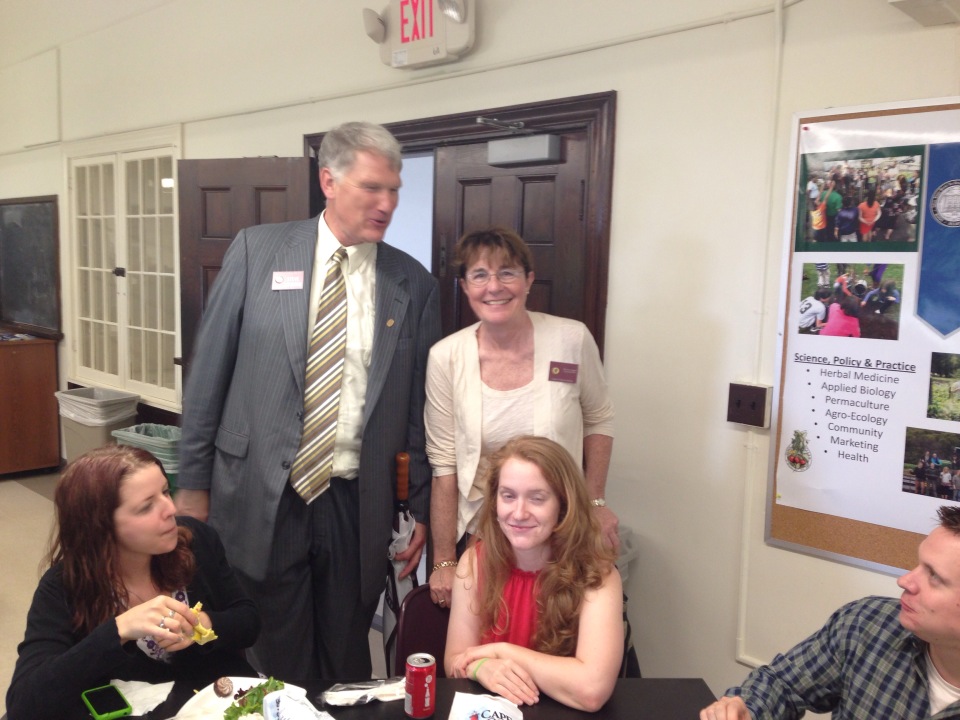
Thanks for joining us for a luncheon before the college graduation ceremony so our faculty could meet your families.

Deans Goodwin and Baker stopped by to wish our graduates well
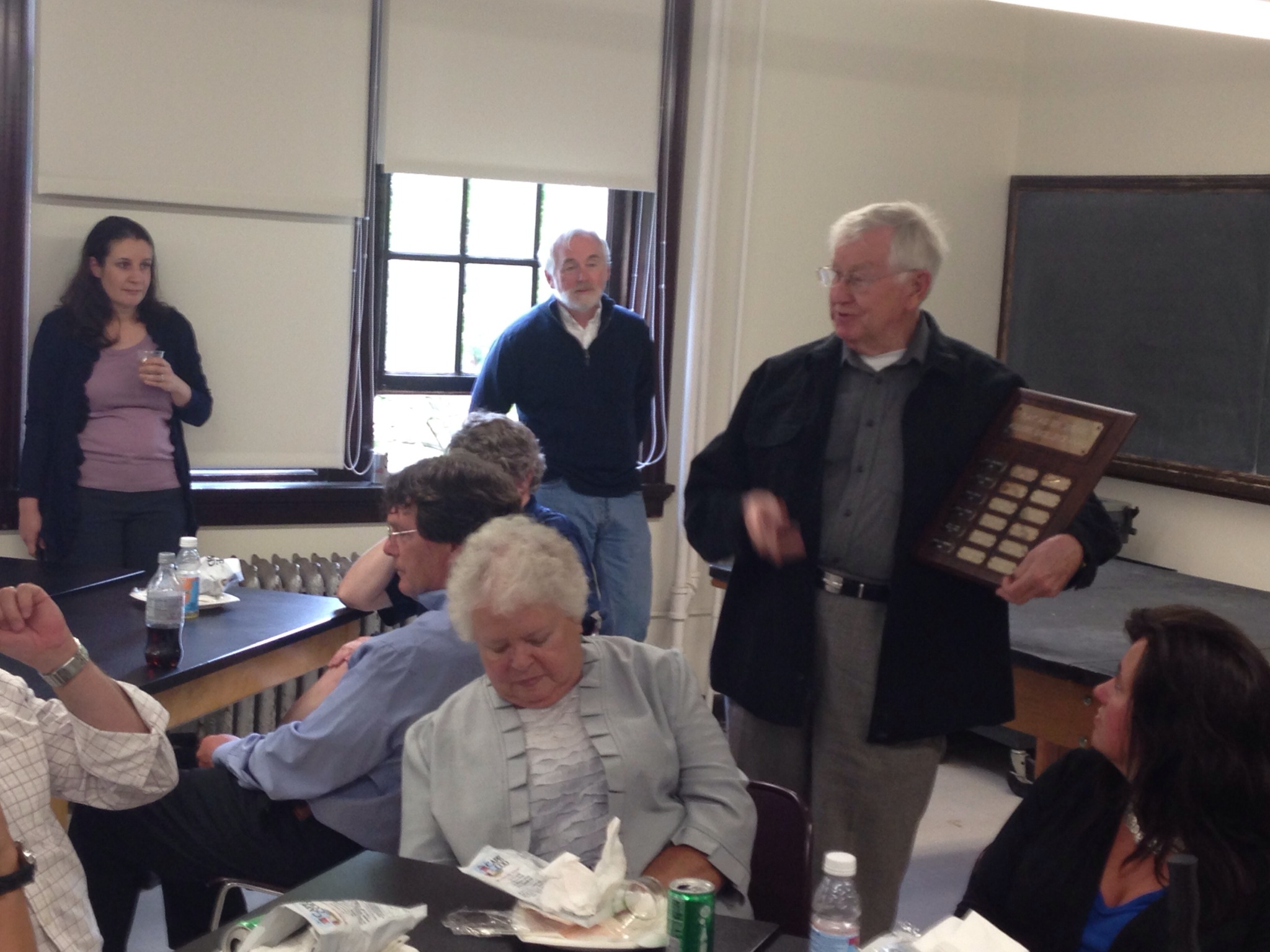
Dr. Barker acknowledged the student with the highest GPA in the graduating class

This was the largest graduating class for the Sustainable Food and Farming major ever!  Congratulations to all of our seniors!

Getting ready outside the Mullins Center

Stockbridge was in the front row in recognition of our role at the beginning of Mass Aggie

Stockbridge was in the front row in recognition of our role at the beginning of Mass Aggie

 The Mullins Center was full!

The Mullins Center was full!
Astrid O'Connor spoke on behalf of the Stockbridge School of Agriculture
Astrid O’Connor spoke on behalf of the Stockbridge School of Agriculture


Jordan Teboldi's graduation cap
Jordan Teboldi’s graduation cap

Congratulations to Graduating Sustainable Food and Farming students:

  • Liz Altieri
  • Ashley Barrett
  • Rose Boyko
  • Max Carbone
  • Brooke Dillon
  • Becca Drew
  • Morgan Dugan
  • Thayer Dugan
  • Brian Eaton
  • Dan Finkelstein
  • Amber Halkiotis
  • Jacob Harness
  • Katie Houghton
  • Andrew Kapinos
  • Astrid O’Connor
  • Nora Seymour
  • Jordan Teboldi


From fish to produce, local CSAs continue to flourish

Ed Struzziero of Cape Cod Fish Share, left, talks with Kevin Landau of Pelham, Saturday, after Landau purchases fresh Hake and Cod in the Wheat Berry parking lot in Amherst.

In 1986, Brookfield Farm on Hulst Road in Amherst became only the third CSA farm in the country. CSA stands for community supported agriculture. The way it works is that members of the CSA pay for a share of a farm’s produce up front in the spring, then receive crops as they come in from June to November.

Winter shares of storage crops such as potatoes are also available. The farmer gets working capital; the share owners get super-fresh local produce, and the local community benefits because agricultural land is kept in useful — and scenic — production.

Today the CSA concept flourishes in both its original and new forms.

Brookfield farms has over 500 shareholders for whom it grows 50 crops on 30 acres of land. Its success has helped inspire several other local CSA farms. But while these and other farms produce an enormous variety of vegetables, pretty much the rest of our other food still comes from far afield: meat, fish and baking supplies are a few examples.

Increasingly, though, enterprising food producers have been turning to the CSA model to distribute their products. Now it’s possible to get fish, meat and grains on the share system, thus providing the protein element essential to the human diet. Locavores — people committed to eating local and regional foods — can find lots of food grown right here in the Valley or within the hundred-mile radius that most locavores define as the range of regional fare.

Since we live many miles from the ocean, fish seems one of the more unlikely candidates for the share system. Since 2011 Cape Cod Fish Share has been ferrying fresh fish from Chatham to its 400 members located in towns throughout the state, including Amherst and Northampton.

Here’s how it works: Members sign up for 5-week shares so the amount of fish is predetermined, and the fishermen have a guaranteed market. The fish bypasses the usual auction process, and can be sped westwards faster and fresher.

Share members get two kinds of fish each week. Since many fish are seasonal, says Ed Struzziero, one of the founders and a University of Massachusetts Amherst graduate, “We choose a species mix that takes advantage of what’s available. We had northern shrimp for a few weeks in spring, Nantucket Bay scallops in late fall, striped bass and bluefish in the summer, and so on. We balance mild fish with more exotic species, all caught using sustainable fishing practices.”

While old favorites such as cod, haddock and swordfish often appear in members’ shares, Struzziero notes that, “For many members, the share has introduced new treats: monkfish, skate, hake and redfish among others.”

The quality is startling, too.

“People are blown away at how tender swordfish and tuna steaks are when fresh,” Struzziero said.

He describes the share system as a “win-win situation.” The large orders the CSA places for less common species remove the economic risk for the boats to fish and land anything other than the “greatest hits” that are found elsewhere, he said.

“When we place our order, the purchase has happened. Our customers have trusted us to provide their fish, and the boats in turn have trusted us to take possession.”

As for ways to cook the fish, the weekly newsletter announcing what’s in the next share includes several recipes.

Ben and Adrie Lester of Wheat Berry pose for a portrait with Gabriel Lester, 1, Saturday, next to the grinding station at Wheat Berry in Amherst. The station allows for customers to grind their own grain after purchasing it from the local grain share.

In Amherst, the Cape Cod Fish Share van delivers to share-holders at Wheatberry Bakery & Cafe at 321 Main St. Saturdays from to 10 a.m. to 1 p.m. The van often arrives with extra scallops and sometimes fish for sale to non-members.

“Best to come early,” Struzziero advises nonmembers hoping to buy. They also have brochures or can be contacted via email at ed@capecodfishshare.com.

Surprising grains

While picking up fish, members often stroll into Wheatberry, where they will see a display of gallon jars filled with grains and beans and dried corn.

Wheatberry owners Ben and Adrie Lester graduated from culinary school, and are enthusiastic members of a CSA farm and committed to eating local foods. As bakers they wondered if they could buy locally grown grains. Most local farmers told them they could not; grains don’t grow in our soil and climate, they told the Lesters.

Undeterred, the couple rented land and sowed wheat and other grains — and they thrived. They also discovered that some local growers were experimenting with the grains that aren’t supposed to grow round here, including rice.

“Now there’s 18,000 pounds of locally produced grains,” Ben Lester said. “It’s not a lot in one sense, but considering that there were no grains here at all 5 years ago, it’s terrific.”

Working with local growers, Wheatberry now offers a grain CSA, which provides its members with about 115 pounds of 10 to 12 organically grown grains, including wheat, barley, emmer, spelt, a couple of sorts of corn, black beans and more. (A half share is also available.)

“To most people nowadays grain means flour, and so we have a self-service mill where members can grind their share into flour if they like,” Lester said. “But we also emphasize cooking grains whole and serving them as you would rice, or topping them with a pasta sauce.”

Since grains are harvested once a year, there is only one share delivery, so share owners don’t have to pick up every week: “An easier commitment than the weekly pickups at many other CSAs,” Lester said.

Fifty of Wheatberry’s 167 grain CSA members live in the Boston area, while others come from Maine and New York.

“We didn’t advertise,” he said. “They found our website on the Internet when they were looking for a source of organic whole grains.”

For information, visit www.wheatberry.org.

Other CSAs

Meat, too, is being produced by the CSA system. For several years Jeremy Barker-Plotkin has been growing a myriad of popular vegetables, including heirloom varieties of tomatoes and potatoes, at Simple Gifts Farm on North Pleasant Street in Amherst. Now the farm has started raising pigs, so as well as offering vegetable shares it also has pork shares. A typical share provides five pounds of pork every month for four months or a single delivery of 20 pounds. The pork comes in various forms: sausage, hot dogs, bacon, chops and ribs.

“A 20-pound box of pork stores more easily in the freezer part of a fridge than most people think,” Barker-Plotkin said.

Barker-Plotkin’s pigs are reared on organic grain and the natural foods they find as they snuffle the pasture.

“We are supposed to eat vegetables and exercise,” he points out, “So it makes sense to eat meat from animals that have also eaten vegetables and exercised.”

The supply of pork is continuous, so one can buy a pork share at any time.

For information, visit www.simplegiftsfarmcsa.com.

Like several other CSAs Simple Gifts raises chickens for purchase by members. In addition, our area now has at least 10 farms specializing in meat shares. Among the newest is Valley Fresh Meat, which offers chicken, beef, pork, turkey and goat meat raised by Hadley neighbors Sunnybrook Farm and Copperhead Farm.

Dee Scanlon of Copperhead Farm began raising chickens five years ago to provide her three children with better eggs and meat. Today she also raises goats and turkeys, while the Boisverts at Sunnybrook raise pigs, beef and chickens.

Both farms give their animals plenty of outdoor pasture so they can ramble and hunt for nature’s treats, and all the grain or hay used for supplemental feeding is free of hormones and antibiotics. Teaming together to form a CSA that could offer a variety of different kinds of meat seemed a good idea.

“Shares are available throughout the year; there’s no sign-up period. And we’ve designed the shares to take account of different needs and families,” Scanlon said. “You could get a share that gives you enough meat for the year, or you could do one that gives you enough for a month.”

The pickup point is the North Hadley Sugar Shack on River Drive in Hadley, which also stocks the meat for purchase by customers who do not belong to the CSA.

Shares typically include a variety of meats the farms produce — and that includes goat, which has not traditionally been part of the mainstream American diet. Scanlon says the goat meat is popular with customers who are immigrants, and others are beginning to try it.

“Really, you can cook it like you’d cook beef: use it ground in sauces or barbecue or slow-roast the bigger pieces. The ribs are delicious,” she said.

Committed to producing healthful food, she notes, “Farm fresh is not as outrageously expensive as a lot of people think and the food is local and really good for you.”

For more information about this meat CSA, visit www.valleyfreshmeat.com. For information on the many CSAs now operating in our area, visit the Community Involved in Sustaining Agriculture (CISA) website buylocalfood.org. Go to the heading Buy Local and from there Find Local and then to CSA Farm Listing, which provides a complete listing.

Original Post.