How do we respond to the egg recall?

While the recall of a half billion eggs seems to be impacting the Midwest and South direclty, we all should be thinking about the reason that food is making people sick.  A recent article in the Huffington Post traces the root cause of the problem to the industrial food system and the nature of factory farms.  I agree – and here is why.  And here is a graph depicting the relative number of salmonella cases in different hen raising systems.  Big factory farms use battery cages.
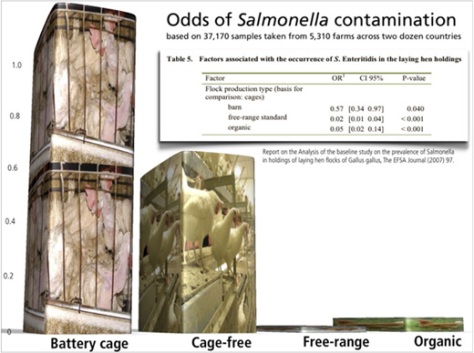
It is difficult to know how to respond however, when almost all of the eggs we see in our supermarkets are from big factory farms using battery cages.  But….. WE DO HAVE CHOICES!

Today’s press reported several stories about how the egg recall was stimulating interest in local eggs (mostly free-range).  But you need to make sure  your “local” eggs are really grown locally – not just repacked with a local label.  To find a local egg producer in Western Massachusetts check the CISA website.  Lots of local hens!  Or even better…..

Raise your own hens!

———————————————————

Backyard hens……. one of the reasons we don’t see more hens in the towns and cities of Western Massachusetts is the local zoning ordinances.  But that is changing!  For more on zoning laws in one town and on raising hens in general, click here.

And finally, click here to join a listserve of “backyard chicken folks” – there are lots of us in Western Massachusetts!  Join us!

How with the new Food Safety Bill impact small farms?

The recall of a half million eggs is likely to help move the Food Safety bill, S 510,  through the U.S. Senate (a similar bill already passed the House) more quickly.   Small farm advocates have been suspicious of the intent (or at least the impact) of the proposed legislation.  While I certainly understand why we might be suspicious of anything coming from the federal government, in this case – I believe we need this legislation.

A recent brief from the Senate staff suggests that the legislation is NOT aimed at small farms. Specifically it states:

  • Regulatory Flexibility for Organic Foods
    Throughout the bill, consideration is given to the unique agricultural practices and requirements of organic foods under the Organic Foods Production Act of 1990.

  • Protections for Farmers Markets, Cottage Industries and Direct Farm-to-Market Sales
    Small entities that produce food for their own consumption or market the majority of their food directly to consumers or restaurants are not subject to registration or new record keeping requirements under S. 510. This includes food sold through farmers’ markets, bake sales, public events and organizational fundraisers.

For details, here is a summary of the amendments that have been filed to protect small farms from being unfairly disadvantaged.  Personally, I can support this bill – BUT it is not a cure all.  There are bigger, more systemic problems associated with the industrial food system, such as:

1.  Factory farms that produce virulent forms of E. coli

2. The exploitation of people, the land and community.

3. The dependency of industrial agriculture on rapidly diminishing supplies of fossil fuel.

I believe the most effective action we can take s individuals and families is to grow food justly”

For more on solutions see; Just Food Now.


Food and Civilization (are we on the brink of collapse – again?)

A new book titled Empires of Food: Feast, Famine, and the Rise and Fall of Civilizations – (that includes our own), examines previous civilizations and claims that our current food system is following in the footsteps of millennia of incredibly efficient yet inflexible models of production and distribution of food.  Sounds like deja vu all over again! Read the article here.