
Dear Campus Community,

Thanks to your continued support, the UMass Permaculture Initiative has
had remarkable success in the creation of campus edible and sustainable
landscapes.  Your support has also furthered the development of
experiential and academic programing, and strengthened our local community
to be more resilient. Thank you for your support, UMass!

If you are interested in getting involved in UMass campus sustainability,
we encourage you to apply for the UMass Permaculture Committee. The UMass
Permaculture Committee is a collaboration between staff and students and
is looking for passionate underclassmen with marketing interest or
experience who can commit to two academic semesters: Spring 2013 and Fall
2013. The Spring ‘13 meeting times are Tue/Thur 11:15-12:30 & Wed. 4:30-
6:00pm. Each student will receive 3 independent study credits per
semester, 6 credits total. Application deadline is January 28th. Download
the application here: http://bit.ly/UMPApplication & send to
info@UMassPermaculture.com

For more information and to meet the committee, please visit:
http://www.UmassPermaculture.com

Looking to learn more about where your food really comes from and get
credit for it? The Real Food Challenge Internship gives you a chance to
analyze dining hall sourcing, assisting in making our campus food system
nourishing and transparent. At the same time, you will be part of a
national food movement and help educate fellow students. Join the UMass
Student Food Advocates for the Real Food Challenge Internship. Offering 1-
3 credits. For more information contact: umassforrealfood@gmail.com or
check out the class syllabus here: http://bit.ly/RealFoodIntern

Check out the National Real Food Challenge!
http://www.realfoodchallenge.org/
“Keep Calm & Compost On!” Come celebrate campus composting on January 30th
at Earthfoods in the Student Union! Attendees can take part in DIY
workshops, win free t-shirts, take part in raffles, and live funk music
all while eating great food provided by UMass Dining! Workshops include
making your own reusable bags as well as vermicomposting! Visit our
Facebook page at UMass Amherst Permaculture to learn more.

We appreciate your support and wish you luck in the spring semester.
Hope to see you around the gardens soon! Go UMass!

The UMass Permaculture Initiative

Follow us on twitter!:  http://bit.ly/UMPTwitter
Like us on Facebook!:  http://bit.ly/UMPIFB
Subscribe to our Newsletter:  http://bit.ly/UMPNewsletter
All posts by jgerber123
Why dosen’t everyone have enough food?
The world produces enough food for everyone. But not everyone has enough food.
The IF campaign is a unique chance to show that you won’t accept injustices in the global food system any more. IF we turn up the pressure on world leaders to act, we can change lives around the world.Make 2013 the year everyone starts to have enough food.
But to win we need mass support.
The campaign will be bigger…
- IF you watch our campaign films – and share them!
- IF you download your essential guide to the issues: and share it!
The big IFs
There are some big issues driving hunger around the world. With your support in 2013 we can tackle them and make sure there’s enough food for everyone.
We’re in the Enough Food for Everyone…IF campaign so that small-scale farmers can grow their way out of poverty. Here’s why it matters:
- Land and water: IF we make sure poor farmers have secure access to resources like land and water. More.
- Aid and investment: IF we give enough of the right kind of support to help people feed themselves. More.
- Transparency and tax: IF we make sure governments and big corporations are honest and open about their actions. More.
Hit the big IF below and add your voice!

Support Small Sustainable Farms to Address Climate Challenge
The Agricultural Fulcrum: Better Food, Better Climate
By Diana Donlon
The National Climate Assessment, released this week, predicted increasingly negative impact of weather extremes on crops. But with industrialized farming as a key player in greenhouse gas emissions and climate change, the vicious cycle needs breaking.

Jacky Chen/Reuters
This past year treated us to a climate change preview in spades: crazy heat waves, prolonged drought, and epic storms like Sandy. To help us stabilize the climate, before we reach the point of no return, we must tap the immense potential of our food system.
Since becoming an agrarian society, we’ve known that growing food successfully depends on climate stability. Not enough water, crops wither and die. Too much, they rot. Beyond this, we know that crops have specific climatic requirements. Wheat, for instance, grows best in a dry, mild climate. Stone fruits like cherries need a minimum number of “chill hours” in order to blossom and later fruit. Intense heat disrupts pollination and can even shut down photosynthesis. These are basic parameters. If we continue to disregard them, food will become more scarce over time and we will go hungry. Indeed, as the National Climate Assessment, the government’s 1,146-page report released earlier this week states: “The rising incidence of weather extremes will have increasingly negative impacts on crop and livestock productivity because critical thresholds are already being exceeded.”
Agriculture, positioned as it is at the intersection of food and climate, presents a unique fulcrum. Pushed in the direction of industrial agriculture, it contributes egregiously to our climate problem: As activist Bill McKibben has noted, industrial agriculture — predominant in the U.S. — “essentially insures that your food is marinated in crude oil before you eat it.” This is because at every step, from the production of fertilizers and pesticides to the harvesting, processing, packaging, and transporting of materials, the industrial food system depends on climate-changing fossil fuels. Indeed, in a new report on climate change and food systems, the agriculture research organization CGIAR concluded that our global food system is responsible for nearly a third of all greenhouse gas emissions.
But we can tip the scale in the other direction toward sustainable agriculture, working in concert with natural systems instead of depleting them. This side of the scale presents an elegant, under-recognized opportunity to stabilize the climate. Not only do agro-ecological, organic and other sustainable farming methods emit significantly less greenhouse gas (GHG) overall, they can also sequester or store excess carbon. Given our long list of existing environmental worries — erosion, polluted watersheds, dead zones in the Gulf of Mexico — strengthening our top soil is a lot smarter than loading it up with nitrogen and washing it down the Mississippi.
Sustainable agriculture not only recaptures GHG, it eliminates the need for synthetic fertilizers like manufactured nitrogen which emits nitrous oxide. According to the EPA, agriculture is directly responsible for 68% of U.S. nitrous oxide emissions (a potent GHG; each molecule has 310 times the atmospheric warming potential of one molecule of carbon dioxide). By favoring biodiversity, productivity, resource efficiency and resilience — sustainable agriculture also offers tangible benefits like cleaner water, preserved wildlife habitat, and reduced exposure to pesticides.
Despite these obvious advantages, sustainable systems are often dismissed as backward or as some romanticized fantasy, particularly by multi-national chemical companies with a vested interest in maintaining the industrial system. In reality these low-impact methods of farming are rooted in the realities of local climate and culture and provide promising models of resilience. Consider, for instance, Angelic Organics, a biodynamic farm in north central Illinois: it grows more than 55 different crops on 100 acres while using cover crops that sequester atmospheric carbon in the soil, harvest nitrogen from the air, protect the soil from erosion, and provide habitats for beneficial insects. Examples of such productivity combined with critical ecosystem services can be found all over the country and on every continent. Most importantly, a 2009 scientific report known as the International Assessment of Agricultural Knowledge, Science and Technology for Development (IAASTD) concluded that sustainable agriculture is, in fact, more resilient in the face of climate change than industrial mono-cropping — the mile after mile of corn and soy that now dominates our farming states.
Imagine what we could do for the climate if instead of blanketing 30 percent of the nation’s farmland with a single industrial crop (corn), the U.S. were to create a thriving network of rural farms and urban gardens. To tip the climate scale in our favor we need the energetic,good food movement to care as much about politics as peaches. By flexing its growing political muscle, the movement can support legislation that promotes research and training in sustainable agricultural practices. These practices mitigate climate change and put good food on our tables. Legions of young people who understand the climate change imperative are turning to agriculture. As a country we must make it as easy as possible for them to pursue careers in sustainable farming, and support them with forward-looking agriculture policies that are grounded in the climate reality of 2013.
This article available online at:
Some Ag Colleges are “selling out” to Big Ag
NOTE: what some people call selling out, others would call a strategic partnership. What do you think about this situation?
John Gerber
—————————————————————————————————————————-
—By Tom Philpott
 Dave Gilson
The University of Illinois’ College of Agricultural, Consumer and Environmental Sciences (ACES) in Champaign-Urbana made a momentous announcement: it has accepted a $250,000 grant from genetically modified seed/agrichemical giant Monsanto to create an endowed chair for the “Agricultural Communications Program” it runs with the College of Communications.
The university’s press release quotes Monsanto’s vice president of technology communications giving a taste of its vision for the investment:
With the population expecting to reach 9 billion by 2030, farmers from Illinois and beyond will be asked to produce more crops while using fewer resources. At Monsanto we are committed to bringing farmers advanced ag technologies to help them meet this challenge. Effectively communicating farmers’ efforts to feed, clothe and fuel a rapidly growing population is a major part of the solution.
A cynic might translate that statement this way: In order to maintain our highly profitable and hotly contested business model, we’ll need a new generation of PR professionals to construct and disseminate our marketing message.
Monsanto’s latest gift isn’t its first dalliance with the prestigious college, which is located in a city surrounded by millions of acres of fields planted with Monsanto’s GMO corn and soy seeds, both treated with regular doses of the company’s Roundup herbicide. Back in 2002, Monsanto donated $200,000 to ACES for the Monsanto Multi-Media Executive Studio, to be “used by faculty and staff of the college for presentations and seminars and for conferences involving companies and organizations with ties to the college and its mission.”
Nor is Monsanto the only gigantic food and ag company bestowing cash upon ACES. A cursory look at the college’s web site turned up a recent paper touting a novel infant formula that “boosts babies’ immunity”—funded by Nestle Infant Nutrition and co-authored by a researcher in its employ.
Then there’s this study, also by ACES researchers, which purports to show that soy protein “alleviates symptoms of fatty liver disease.” It’s brought to you by grants from the agribiz-aligned Illinois Soybean Association and Solae, a joint project of agrichemical giants DuPont and Bunge that calls itself “the world leader in developing innovative soy technologies and ingredients for food, meat and nutritional products.”
The most remarkable thing about all of this is that it isn’t remarkable at all. A few weeks ago, I pointed to a great Chronicle of Higher Education article documenting how university animal-health research has become dominated by the pharmaceutical industry—and how the products that emerge from that process are much more about pharmaceutical industry profits than animal health. Now there’s this eye-opening new report from Food & Water Watch (FWW) that documents in painstaking detail how the food and agrichemical industries have transformed our national public agricultural research infrastructure into essentially an R&D and marketing apparatus for their industry. (Similar trends hold for other areas of science research, most prominently medicine.)
FWW reminds us how ag-research institutions like the University of Illinois started: as so-called land-grant universities, launched by the federal government on public land in 1862. The idea of the land grants was to generate agricultural research, funded by the federal government, that benefited society as a whole. And that’s pretty much how things went for the first century. “Well into the 20th century, seed-breeding programs at land-grant universities were responsible for developing almost all new seed and plant varieties,” FWW writes. It might have added that those varieties were public resources, not owned or patented by any company. Farmers were free to save them for the next season, and many did.
But then, starting in the 1980s, the federal government started to level off its investment in ag research—and meanwhile, after passage of the Bayh-Dole Act of 1980, began to encourage professors to behave like entrepreneurs who could benefit financially from their research, not public employees creating ideas for the public domain. That’s when food and agribusiness companies, which were then in the process of consolidating into the vast global enterprises we know today, began to funnel huge amounts of cash into the land grants.
By the early ’90s, industry funding had begun to outpace USDA research support for the land grants. And now, as fiscal austerity further pinches federal research funding, the gap between the industry and the USDA as land-grant paymaster has hit an all-time high. Here’s FWW:
 Food & Water Watch
And it’s not only research. Just as sports franchises have turned to corporate sponsors to fund stadiums, the land grants have turned to their agribiz benefactors for building funds, FWW found. At University of Minnesota, seed breeders toil in the Cargill Plant Genomics Building; while University of Missouri ag-science grad students attend seminars in the Monsanto Auditorium. Iowa State undergrads lounge in the Monsanto Student Services Wing; and food-science researchers at Purdue can bounce between the Kroger Sensory Evaluation Laboratory and the ConAgra Foods, Inc. Laboratory.
And all of this cash buys more than just symbolic power. In addition to landing their names on buildings, agribiz giants also “fill seats on academic research boards and direct agendas,” the report shows. At Iowa State University, reps from the agribiz-aligned Iowa Farm Bureau and Summit Group, an industrial-scale producer of hogs and cows, have won seats on the governing Board of Regents. The report brims with examples of agribiz employees occupying seats on advisory boards of various ag-related centers within the land grants. My favorite is the way the University of Georgia’s Center for Food Safety forms its advisory board. Get this, from the center’s web site:
We invite food processing and related companies who are not presently members of the Center for Food Safety to join more than 40 food processors who are actively involved in the Center’s programs. There are different ways in which you can be involved with the Center. You may want to become a member of the Center’s Board of Advisors. The role of the Board is to provide input on food safety research needs of the industry. In addition, the Board provides suggestions on unique (not routine) opportunities/services the Center can offer to industry. For example, Center faculty can offer specialized workshops on food safety and quality issues or training on advanced equipment and techniques. A $20,000 annual contribution to the Center entitles a company a seat on the Board. [Emphasis added.]
Companies that have taken the center up on its offer include Cargill, Kraft, Hormel, Kellogg’s, Unilever, Earthbound, and McDonald’s.
Sometimes, compliant administrators are rewarded generously for their work. Monsanto tapped South Dakota State University president David Chicoine for its own board of directors in 2009, FWW reports. According to Inside Higher Education, Chicoine stood to make more from Monsanto in his first year on the board than he did from his state job. It gets better:
Weeks before Chicoine joined Monsanto, the company sponsored a $1 million plant breeding fellowship program at SDSU. Chicoine’s appointment at Monsanto also coincided with a new SDSU effort to enforce university seed patents by suing farmers for sharing and selling saved seed.
At some of the more prestigious schools, professors have morphed into something that looks a lot like house researchers for the agrichemical industry. Check out this snapshot from Iowa State. Using the Freedom of Information Act, Food and Water Watch analyzed the grants received by a selection of professors between 2006 and 2010, and calculated what percentage of their grants came from private sources. Here’s what they found:
 The corporate sector’s generosity might be commendable if it produced research that benefitted the public as a whole—such as new open-source seed varieties that are well adapted to organic ag, or techniques for rotating cattle and crops on land that improve soil and reduce fertilizer use. But that’s not what’s happening, FWW shows. Instead, the companies are funding strings-attached research that serves their own narrow interests. The report cites numerous studies to show this, and several concrete examples like these two:
When an Ohio State University professor produced research that questioned the biological safety of biotech sunflowers, Dow AgroSciences and [DuPont’s] Pioneer Hi-Bred blocked her research privileges to their seeds, barring her from conducting additional research. Similarly, when other Pioneer Hi-Bred-funded professors found a new [genetically engineered] corn variety to be deadly to beneficial beetles, the company barred the scientists from publishing their findings. Pioneer Hi-Bred subsequently hired new scientists who produced the necessary results to secure regulatory approval.
To be sure, while corporate cash has come to dominate university ag research, the USDA still funds a substantial amount of it: more than $300 million (vs. about $600 million from industry) in 2010. In addition to its research grants for land-grant professors, the agency also employs its own scientists and maintains its own labs; its total research budget stands at about $2 billion per year. Yet rather than act as a counterweight to the corporations, the USDA essentially mimics them. It “prioritizes commodity crops, industrialized livestock production, technologies geared toward large-scale operations, and capital-intensive practices,” FWW shows.
Here’s a startling example: the USDA dedicates more money to research on sweetener crops like sugar beets ($18.1 million per year) and oilseed crops ($79.4 million) than it does to nutrition education ($15.5 million).
Such expenditures of public cash help sweeten the fortunes of the food and agrichemical industries, but foretell a bitter harvest for society as whole.
————————————————-
Fixing Our Food Problem
By Mark Bitman – published in the NY Times, January 1, 2013
Nothing affects public health in the United States more than food. Gun violence kills tens of thousands of Americans a year. Heart disease, cancer, stroke and diabetes kill more than a million people a year — nearly half of all deaths — and diet is a root cause of many of those diseases.
And the root of that dangerous diet is our system of hyper-industrial agriculture, the kind that uses 10 times as much energy as it produces.
We must figure out a way to un-invent this food system. It’s been a major contributor to climate change, spawned the obesity crisis, poisoned countless volumes of land and water, wasted energy, tortured billions of animals… I could go on. The point is that “sustainability” is not only possible but essential: only by saving the earth can we save ourselves, and vice versa.
How do we do that?
This seems like a good day to step back a bit and suggest something that’s sometimes difficult to accept.
Patience.
We can only dismantle this system little by little, and slowly. Change takes time. Often — usually — that time exceeds the life span of its pioneers. And when it comes to sustainable food for billions, we’re the pioneers of a food movement that’s just beginning to take shape. The abolition movement began at least a century before the Civil War, 200 years before the civil rights movement. The struggle to gain the right to vote for women in the United States was active for 75 years before an amendment was passed. The gay rights struggle has made tremendous strides over the last 40 years, but equal treatment under the law is hardly established.
Well-cared-for animals will necessarily be more expensive, which means we’ll eat fewer of them; that’s a win-win.
Activists who took on these issues had in common a clear series of demands and a sense that the work was ongoing. They had a large and ever-growing public following and a willingness to sacrifice time, energy and even life for the benefit not only of contemporaries but for subsequent generations.
They were also aware that there is no success without a willingness to fail; that failure is a part of progress. A single defeat was seen as a temporary setback. The same vision should be applied to every issue the nascent food movement is tackling.
Yet before we can assess our progress, we must state our goals. There is no consensus behind a program for achieving sustainable production of food that promotes rather than attacks health. We can’t ask for “better food for all”; we must be specific. In the very near term, for example, we must fight to protect and improve programs that make food available to lower-income Americans. We must also support the increasingly assertive battles of workers in food-related industries; nothing reflects our moral core more accurately than the abuses we overlook in the names of convenience and economy.
Beyond that, I believe that the two issues that will have the greatest reverberations in agriculture, health and the environment are reducing the consumption of sugar-laden beverages and improving the living conditions of livestock.
About the first I have written plenty, and can summarize: when we begin treating sugar-sweetened beverages as we do tobacco, we will make a huge stride in improving our diet.
The second is even more powerful, and progress was made in that arena in 2012 as one food company after another resolved to (eventually) reject pork produced with gestation crates. So over the next few years, some animals will be treated somewhat better. This is absolutely, unquestionably thanks to public pressure, which should now set its sights higher and insist that all animals grown for food production be treated not just better but well.
Well-cared-for animals will necessarily be more expensive, which means we’ll eat fewer of them; that’s a win-win. They’ll use fewer antibiotics, they’ll be produced by more farmers in more places, and they’ll eat less commodity grain, which will both reduce environmental damage and allow for more land to be used for high-quality human food like fruits and vegetables.
Allies may argue that I miss the mark with either or both of these, and that’s fine: it’s a discussion. The point is that no major food issue will be resolved in the next 10 years. As pioneers, we must build upon incremental progress and not be disheartened, because often there isn’t quick resolution for complex issues.
An association between tobacco and cancer was discovered more 200 years ago. The surgeon general’s report that identified smoking as a public health issue appeared in 1964. The food movement has not yet reached its 1964; there’s isn’t even a general acknowledgment of a problem in need of fixing.
So, in 2013, let’s call for energy, action — and patience.
Original Post
Millenials Suit Up as Next-generation Farmers
With aging farmers retiring, a bumper crop of new workers is stepping up to tend the land and feed their souls.
By Amy DuFault
December 28, 2012

America’s farmers are, on average, pushing 60, and after years of backbreaking labor, considering retirement. More often than not, their children aren’t taking over the family business.
That puts the future of countless acres of fertile, family-farmed land into question. Farm bureaus across the country are working to ensure the future of that land by helping a younger generation enter the agriculture profession.
Take, for instance, the Maine Farmland Trust, which works with Maine FarmLink to connect would-be young farmers with untended land. To date, the trust has completed 56 “links,” representing 4,987 acres in 12 of Maine’s 16 counties.
“Because the majority of Maine farmers are now of retirement age, getting new farmers onto the land is imperative,” says Maine FarmLink on their site. “Farmers who wish to retire do not have anyone to take over the farm. Likewise, many people who want to farm do not have the family or resources they need to get started.”
FarmLink is just one of many collaborative endeavors connecting next-generation farmers to the land and resources they need in order to help keep U.S. farms viable now and into the future. From farm apprenticeships to leases and full-out land purchases, younger farmers are working with and for agriculture veterans in their twilight years to continue tradition and preserve farming history.
Sometimes these stories are so good, they draw the attention of filmmakers.
When Christine Anthony and Owen Masterson moved to Atlanta from Los Angeles in 2005, they initially had a hard time finding farmers markets where they could buy farm-fresh food. But as they worked their way into the market community, they got to know a number of farmers, and were inspired to create a film called GROW!
The farmers featured in GROW! range in age from 23 to 38. Twelve are Georgia natives, and while most of the others are from the South, a few have migrated from Northern states. Most of the farmers are college educated and hold degrees in such varied subjects as accounting, chemistry, physics, English literature, photography, theology, horticulture, political science, business, history, education, BioSystems Engineering and computer science.
Not all who wander are lost; this is an interested, passionate, educated and very creative group of individuals.
Of the 12 farms, four are managed, two are on traditional family land, two are renting or leasing, three are borrowing land, and one farm is owned in partnership with one of the couple’s parents. All work on their farms full time and are able to make a living by farming.
“The ability to grow food is an art and a skill,” says GROW! filmmaker Owen Masterson. “Eating well is a choice. When you factor mono crop farm subsidies, antibiotic and pesticide overuse, environmental damage and health concerns into the equation, organic is not more expensive or elitist.”
“Sometimes at screenings there are the ‘doubters’ who ask, ‘But can this kind of agriculture feed the planet?’ What’s more important to think about is that these young farmers are feeding their communities by producing better, healthier food using practices that preserve the land without the use of synthetic, petro-chemical based fertilizers and pesticides,” Masterson adds.
Colin McCrate and Brad Halm of the Seattle Urban Farm Company are part of the urban farm movement. The two went in the opposite direction of their Georgia colleagues, moving to Seattle after working on large farms. In addition to recently releasing the book Food Grown Right, In Your Backyard, the two work designing, installing, and maintaining urban-food production systems in the Puget Sound Area.
Halm tells TakePart that he’s known a handful of people who started their first urban garden, fell in love with it, dropped everything and moved to the country to start a new farming career—all in the course of just a few years,
“This is obviously a big decision and usually means walking away from high-paying corporate jobs and changing school systems—in addition to buying flannel shirts and mud boots,” Halm says. “I remember one client in particular who started with a small raspberry patch and a single raised bed. Three years later she was farming four acres with vegetable crops, 150 fruit trees, a couple of sheep and a huge flock of chickens.”
He adds that urban farming is no different than country farming other than the amount of space one has to work with.
“The good news is that, to create a healthy, functioning food system we need a lot more urban farms and a lot of local, small rural farms. As perspectives about the food system continue to change, I hope that more people will have the motivation and opportunity to find their place in sustainable agriculture—wherever that may be,” Halm says of the growing organic farming movement.
For Masterson, shedding a light on these new, younger farmers has been as fulfilling for him as the audiences he is educating.
“Over and over we hear the refrain: Thank you for making this film. At festival screenings and Q+A’s we are happily surprised by the number of people that, after watching GROW!, want to know where they can find young, beginning farmers like those in the film for their unused land. For many it was as if someone turned on a light in a room they didn’t realize was dark.”
—————————————————————————————————————-
For anyone who wishes to study Sustainable Food and Farming, please consider our UMass Bachelor of Sciences degree or our 15 Credit Certificate Program.
The Year in Food and Farming

It’s been quite a year for food and farming coverage here at Grist. Below is a wrap-up of some of the biggest stories of the year.
1. The worst drought in half a century
Corn withered, farmers scowled and resorted to feeding their cows candy, and many predicted the coming of the real Hunger Games. But the country’s worst drought in over 70 years was far more complex than most news sources reported. Most of that industrial corn was heavily propped up by crop insurance (supplemented with taxpayer dollars), while small farmers often remained invisible.  Even the silver lining — the Gulf “dead zone” shrank for the first time in years – turned out to be a little misleading, as next year’s rains could send more critter-killing farm nutrients into the Gulf of Mexico than ever before. And some scientists believed it was the corn and other huge monocrops that cover the region that were the problem because they leave farms especially vulnerable to changing weather patterns.
Do you want to know what’s really ominous? As of mid-December, Kansas, Oklahoma, and Texas still hadn’t gotten rain.

2. Organic takedown
Organics were in the headlines throughout 2012, but two stories grabbed most of the attention. And although they’re very different stories, they may have had surprisingly similar effects. The first was a New York Times article that took a much-needed critical look at the way the organic industry has grown and consolidated in recent years to the possible detriment of the federal organic standards. It was an intriguing piece, but, as I wrote back in July, the author may have overshot the mark when she implied that such changes have rendered the label meaningless.
The second, more hyped story hit the presses nearly two months later, when Stanford University compiled the existing science about nutrition in organic food, and claimed that organic was — again — virtually benefit-less. Many in the food world stepped up to point to the facts that a) most people buy organic food for reasons other than nutrition; and b) the science did in fact report significant differences where it mattered most (it showed lower pesticide residue in produce and little or no antibiotic residue in meat), but that didn’t stop many from trumping the “meaninglessness” of the label. My takeaway: Organic food isn’t a panacea, but I’m still awfully glad it’s an option.

3. GMOs: No labels, but lots to keep track of
The food world watched closely this year as voters in California came surprisingly close (48.5 percent in the final tally) to voting to label genetically engineered (or GMO) ingredients in processed food, despite some nearly $45 million in opposition advertising from pesticide and big processed food companies. And considering the fact that it was one of the most visible food policy fights to pit grassroots organizers against Big Ag, the fact that the race was that close should give pessimists pause. If nothing else, it means the fight’s not over.
And it’s no wonder; the rest of this year’s GMO news can be easily seen as an argument for the importance of labeling. Scientists pointed to new evidence that genetically engineered seeds might lead to more herbicide use in large-scale farming (contrary to conventional wisdom); farmers battling herbicide resistant “superweeds” were encouraged to switch to stronger, older chemicals, and the U.S. Department of Agriculture put the onus on organic farmers to insure themselves against GMO contamination and told them they had to grow GMO sugar beets or face a sugar shortage. Optimists might take note of the fact that the Supreme Court began preparing to hear the case of a soybean farmer sued over seed patents in 2013 — a case which could put the brakes on one aspect of the biotech industry’s market domination. Either way, GMOs are probably worth paying attention to with or without labels.

4. Pink slime and beyond — food safety in the spotlight
“Pink slime” — the term used for Lean Finely Textured Beef treated with ammonia and used as an additive in conventional hamburgers — became a household name in March of 2012. The product had been in use for years, and its now-famous nickname had also been in effect for a while at that point. But the product made its big national debut on Jamie Oliver’s Food Revolution right around the time the news broke that school lunches around the nation were serving pink slime, and the rest was media history. Of course, as we reported, pink slime was just the tip of the iceberg when it comes to gross stuff in industrial meat.
In fact, there seemed to be no shortage of gross, toxic stuff in our food this year. Scientists found also a surprising quantity of arsenic in rice (hint: it gets into the soil via pesticides and fertilizer from factory farms, where chickens are fed arsenic as a growth promoter). But that’s not all. Eaters also found salmonella in peanut butter, cantaloupe (again), ground beef, tuna scrape (those extra bits they use in spicy tuna rolls), and dog food. In fact, there were so many food safety frights this year, and so little sign that the Food and Drug Administration was planning to do anything about it, that several news outlets declared food safety in this country a big old failure.
Meanwhile, the U.S. Department of Agriculture moved forward with plans to “modernize” — and by that they mean privatize — part of its meat and poultry inspection program. It’s a change that could make industrially produced poultry a lot crappier (literally).
5. The farm bill that wasn’t
Barring some kind of last-minute aberration, it’s looking like the giant, multibillion-dollar food and farming bill will have made it though an entire year of negotiations and non-negotiations (in equal parts) without moving an inch. Grist tracked the farm bill’s “progress” through the course of 2012, looked closely at what lawmakers proposed on both sides of the aisle, and the implications for the big picture. We’ve collected the bulk of our farm bill coverage here, but to make a long story short: good food movement advocates want to keep federal funding in place for things like on-farm conservation, food stamps, and organic farming, while reducing the giant subsidies for big commodity farms. Farm-state lobbyists — and the GOP-controlled House — want just the opposite. What happens if the farm bill goes over the fiscal cliff? Well, it looks like farm policy might just go back to the future.
 6. Something’s fishy
With all the attention seafood fraud has received this year, you’d think it was all that was going on in the seafood world. Sure, no one wants rockfish when they’re paying for halibut, but the ocean (and the food we grow there) might warrant your attention for a few other reasons. We reported on the ongoing effort to keep small “forage” fish from being completely wiped out by an industry that feeds factory farm animals, for instance, as well as the recent, shocking move by the FDA to clear the way for the approval of GMO salmon, and the crucial relationship between mercury, the burning of fossil fuels, and seafood. We also helped sound the alarm about oysters, which are in danger thanks to the increasing acidification of the ocean and have inspired scientists and farmers to work together in a rare partnership. We also highlighted several attempts to crack the elusive “sustainable aquaculture code,” including this barramundi operation, an experimental deep water operation, and this project, which farms multiple edible species at once in the waters right outside New York City.
 7. Urban farming: Blowing up
On the positive side, 2012 proved that urban farms are much more than a passing trend. Take the impressive food forest planned for Seattle, or the artist who took to grafting fruit-bearing branches onto ornamental city trees in San Francisco. How about this bee corridor? Or this giant urban farm corridor developers are planning for Chicago’s South Side? There is so much inspiring work happening on the urban farming front that several great projects sprouted this year simply to take stock of the abundance of urban farms around the country. Grist also heard from city farming legend Will Allen on the advent of the book he released. And we explored tough questions like: Can urban farms get too big? Are urban homesteaders clueless about class? And what exactly is the relationship between growing food and gentrification, anyway?

8. Local food: Scaling up
The bad news is very few companies produce the bulk of our food, and this consolidated system puts the squeeze on both food producers and consumers. But 2012 also saw great strides in the growth of an alternative, localized system. Yes, this was the year “food hub” became a buzz word, and people all over began stepping up public and private efforts to get more local food to more people. From plans to grow and distribute food from an old prison in Illinois and mondo greenhouses outside Washington D.C.; to funds that allow ordinary people to pool their dollars to support small producers; the rapid expansion of large community-supported agriculture (CSA) box subscription services; new USDA grants for value-added foods; and other important efforts on the part of the government to boost local food infrastructure. One thing is clear: People want a choice, and choosy people want local food.

9. More meat, less meat, better meat?
Factory farms aren’t going anywhere. In fact, several states have seen a rise in the number of concentrated animal farming operations (CAFOs) this year — mostly to satisfy the growing international demand for meat. These farms are still bad for the nearby land, water, and air — not to mention the animals and people involved. (In fact, some scientists are actually documenting the way factory farms impact the health of nearby residents.) CAFOs are also where a whopping 80 percent of the antibiotics in this country get put to use every year — a fact that correlates directly to the rise in antibiotic-resistant infections.
But there are many encouraging signs of change. For one, 2012 saw an amazing number of businesses — from the uber-progressive Bon Appetit Management Company to less likely candidates such as Burger King and Sysco — phase out some of the least humane practices in animal agriculture today: the use of confining gestation crates for sows.
This year also brought wind of all kinds of inspiring alternative projects. We featured a Food Inc. chicken farmer’s new, pasture-based operation, a humane farm deep in the heart of CAFO country, a group of young farmers raising heritage breeds in the Sierras, and an agroforestry expert who is grazing animals in perennial fruit and nut orchards as a way to create healthy soil and sequester carbon. And, on the macro level, we looked into a few promising experiments that could be a game changer for pasture-based systems: A business creating a national network of pastured egg operations and the first grass-fed beef mega-farm.
 10. Food workers became slightly less invisible
You can’t have truly sustainable food if the people who made it are working in substandard conditions. And while food workers have traditionally gotten the short end of the stick (only 13 percent earn a living wage), 2012 may just have been the year that labor issues entered the food conversation in earnest on a national level. Organizers collected important data about workers throughout the food chain [PDF] and the media responded. Fast-food employees went on strike. Chipotle signed onto an agreement to support fair working conditions for tomato pickers after resisting for years; students on a variety of campuses pushed for more rights for cafeteria employees; and the small but important domestic fair trade effort began to take root. Now the question is: If Obama’s next term brings immigration reform, will it truly help the people who grow, harvest, transport, pack, ship, and cook the food we eat? Only time will tell.
What did we miss? Tell us which food and farming stories stuck out to you this year.
—————————————————————————————————————-
For anyone who wishes to study Sustainable Food and Farming, please consider our UMass Bachelor of Sciences degree or our 15 Credit Certificate Program.
Don’t like today’s food monopolies? Blame Robert Bork
 Most people, if they think of the recently departed and extremely conservative Judge Robert Bork at all, think of his failed nomination by President Ronald Reagan to the Supreme Court (and maybe his natty facial hair). But Robert Bork deserves credit for more than just inspiring the term “Borked.” He actually deserves credit (or, more accurately, blame) for the domination of our food system by a handful of mammoth corporations. I’m talking about you, Monsanto, Cargill, Tyson, and Walmart.
As we noted last month, farmers feel the brunt of his legacy:
According to a 2007 study [PDF] from the University of Missouri, the four largest companies controlled 82 percent of the beef packing industry, 85 percent of soybean processing, 63 percent of pork packing, and 53 percent of broiler chicken processing. In fact, so much consolidation has taken place throughout the food chain that it can be difficult for any one person to fathom the true effects.
But consumers experience it, too. Walmart now earns one out of every four dollars Americans spend on groceries and controls 50 percent of the grocery sales in some cities.
What exactly does Robert Bork have to do with any of this? According to an interview in the Washington Post’s Wonkblog with legal scholar Barak Orbach of the University of Arizona, Bork is considered the father of modern antitrust law, whose influence, Orbach says, he “cannot overstate.” Orbach observes that it was Bork’s legal work in the 1960s that transformed the way the government looked at monopolies and mergers, and led directly to the rise of the mega-corporations that dominate industry after industry.
His main “innovation” was the inclusion of the concept of “consumer welfare” in any evaluation of a potential antitrust violation. In short, he believed that if the consumer benefited from the monopoly, through, say, low prices, then there probably was no antitrust violation. What made this radical was that before Bork, big businesses were considered an inherent threat to small business — the legal term was “inhospitality” — and antitrust regulators wouldn’t consider any potential benefit of consolidation.
As Orbach explains to Wonkblog, Bork saw this assumption that all big business was bad as a one-way ticket to socialism. It was the middle of the Cold War, after all:
He said the Russians were about to take over, through antitrust! In 1963 he wrote an article in Fortune called, “The Crisis in Antitrust,” and he, in that article, he’s describing the socialists who threatened free market forces. It wasn’t too far-fetched if you think about it. If you think antitrust is used to suppress competition, then this is a suppression of the American spirit, of entrepreneurship, of free markets. Who does these things? Socialists.
Sigh.
What Bork did was incorporate the “new” economic theory developed at the University of Chicago (aka “the Chicago School”) — which said the free market was the best means to allocate resources in society, rather than government regulators or Congress — into antitrust law. And if the goal of any analysis of a proposed corporate merger or acquisition was “consumer welfare” instead of protecting small businesses, well, it was a small jump to allowing pretty much every merger and acquisition that came down the pike, since they often led to lower prices and increased “efficiency” in the industries at hand.
He was also influential in convincing judges and the government that “vertical” integration, i.e. the way a company attempts to control its entire production chain, was not inherently anti-competitive. Before Bork, deals and mergers that accomplished this kind of thing were rejected outright by judges. Now, such agreements dominate the landscape — a good example being the harsh and heavily restrictive contracts that poultry processors like Tyson and Purdue are able to foist on chicken farmers.
It was Bork’s legacy that led Obama’s antitrust team to realize there was little they could do to attack current monopolists like Monsanto or beef packers without new laws. (I discussed the pullback of Obama’s antitrust enforcement in the food industry last month.)
Nothing is simple, of course. And Orbach observes that Bork’s work did lead to big benefits to consumers — he mentions telecom, finance, and e-commerce as industries that would be much less consumer-friendly today if not for him. But he doesn’t mention the fact Bork also transformed the American table.
Bork’s work also gave us cheap meat and dairy as well as massive quantities of processed food sold at at heavily discounting supermarkets. Some of this was likely inevitable. But Bork was the one to link economics to antitrust and make consumer welfare the primary goal. Maybe some other jurists would have provided a similar legal framework eventually. But without his extremely conservative approach, the antitrust pendulum might not have swung quite so far. At this point, it will take major legislation by Congress to move it back.
Liberals in the ’80s believed that America had successfully dodged judicial and legal disaster when Senate Democrats kept Bork off the Supreme Court. But it turns out the damage had already been done.
Tom Laskawy is a founder and executive director of the Food & Environment Reporting Network and a contributing writer at Grist covering food and agricultural policy. His writing has also appeared in The American Prospect, Slate, The New York Times, and The New Republic. Follow him on Twitter.
13 Resolutions to Change the Food System in 2013
Danielle Nierenberg
Sustainable Agriculture and Food Policy Expert
As we start 2013, many people will be thinking about plans and promises to improve their diets and health. We think a broader collection of farmers, policy-makers, and eaters need new, bigger resolutions for fixing the food system — real changes with long-term impacts in fields, boardrooms, and on plates all over the world. These are resolutions that the world can’t afford to break with nearly one billion still hungry and more than one billion suffering from the effects of being overweight and obese. We have the tools — let’s use them in 2013!
Here are our 13 resolutions to change the food system in 2013:
1. Growing the Cities: Food production doesn’t only happen in fields or factories. Nearly one billion people worldwide produce food in cities. In Kibera, the largest slum in Africa, farmers are growing seeds of indigenous vegetables and selling them to rural farmers. At Bell Book & Candle restaurant in New York, customers are served rosemary, cherry tomatoes, romaine, and other produce grown from the restaurant’s rooftop garden.
2. Creating Better Access: People’s Grocery in Oakland and Fresh Moves in Chicago bring mobile grocery stores to food deserts giving low-income consumers opportunities to make healthy food choices. Instead of chips and soda, they provide customers with affordable organic produce, not typically available in their communities.
3. Eaters Demanding Healthier Food: Food writer Michael Pollan advises not to eat anything that your grandparents wouldn’t recognize. Try eating more fruits, vegetables, and whole foods without preservatives and other additives.
4. Cooking More: Home economics classes have declined in schools in the United Kingdom and the U.S. and young people lack basic cooking skills. Top Chefs Jamie Oliver, Alice Waters, and Bill Telepan are working with schools to teach kids how to cook healthy, nutritious foods.
5. Creating Conviviality: According to the Hartman Group, nearly half of all adults in the U.S. eat meals alone. Sharing a meal with family and friends can foster community and conversation. Recent studies suggest that children who eat meals with their families are typically happier and more stable than those who do not.
6. Focus on Vegetables: Nearly two billion people suffer from micronutrient deficiencies worldwide, leading to poor development. The World Vegetable Center, however, is helping farmers grow high-value, nutrient rich vegetables in Africa and Asia, improving health and increasing incomes.
7. Preventing Waste: Roughly one-third of all food is wasted–in fields, during transport, in storage, and in homes. But there are easy, inexpensive ways to prevent waste. Initiatives like Love Food, Hate Waste offer consumers tips about portion control and recipes for leftovers, while farmers in Bolivia are using solar-powered driers to preserve foods.
8. Engaging Youth: Making farming both intellectually and economically stimulating will help make the food system an attractive career option for youth. Across sub-Saharan Africa, cell phones and the internet are connecting farmers to information about weather and markets; in the U.S., Food Corps is teaching students how to grow and cook food, preparing them for a lifetime of healthy eating.
9. Protecting Workers: Farm and food workers across the world are fighting for better pay and working conditions. In Zimbabwe, the General Agricultural and Plantation Workers Union of Zimbabwe (GAPWUZ), protects laborers from abuse. In the U.S., the Coalition of Immokalee Workers successfully persuaded Trader Joe’s and Chipotle to pay the premium of a penny-per-pound to Florida tomato pickers.
10. Acknowledging the Importance of Farmers: Farmers aren’t just farmers, they’re business-women and men, stewards of the land, and educators, sharing knowledge in their communities. Slow Food International works with farmers all over the world, helping recognize their importance to preserve biodiversity and culture.
11. Recognizing the Role of Governments: Nations must implement policies that give everyone access to safe, affordable, healthy food. In Ghana and Brazil, government action, including national school feeding programs and increased support for sustainable agricultural production, greatly reduced the number of hungry people.
12. Changing the Metrics: Governments, NGOs, and funders have focused on increasing production and improving yields, rather than improving nutrition and protecting the environment. Changing the metrics, and focusing more on quality, will improve public and environmental health, and livelihoods.
13. Fixing the Broken Food System: Agriculture can be the solution to some of the world’s most pressing challenges–including unemployment, obesity, and climate change. These innovations simply need more research, more investment, and ultimately more funding.
We can do it — together!
Agroecology or Industrial Farming?

Danielle Nierenberg
Sustainable Agriculture Expert
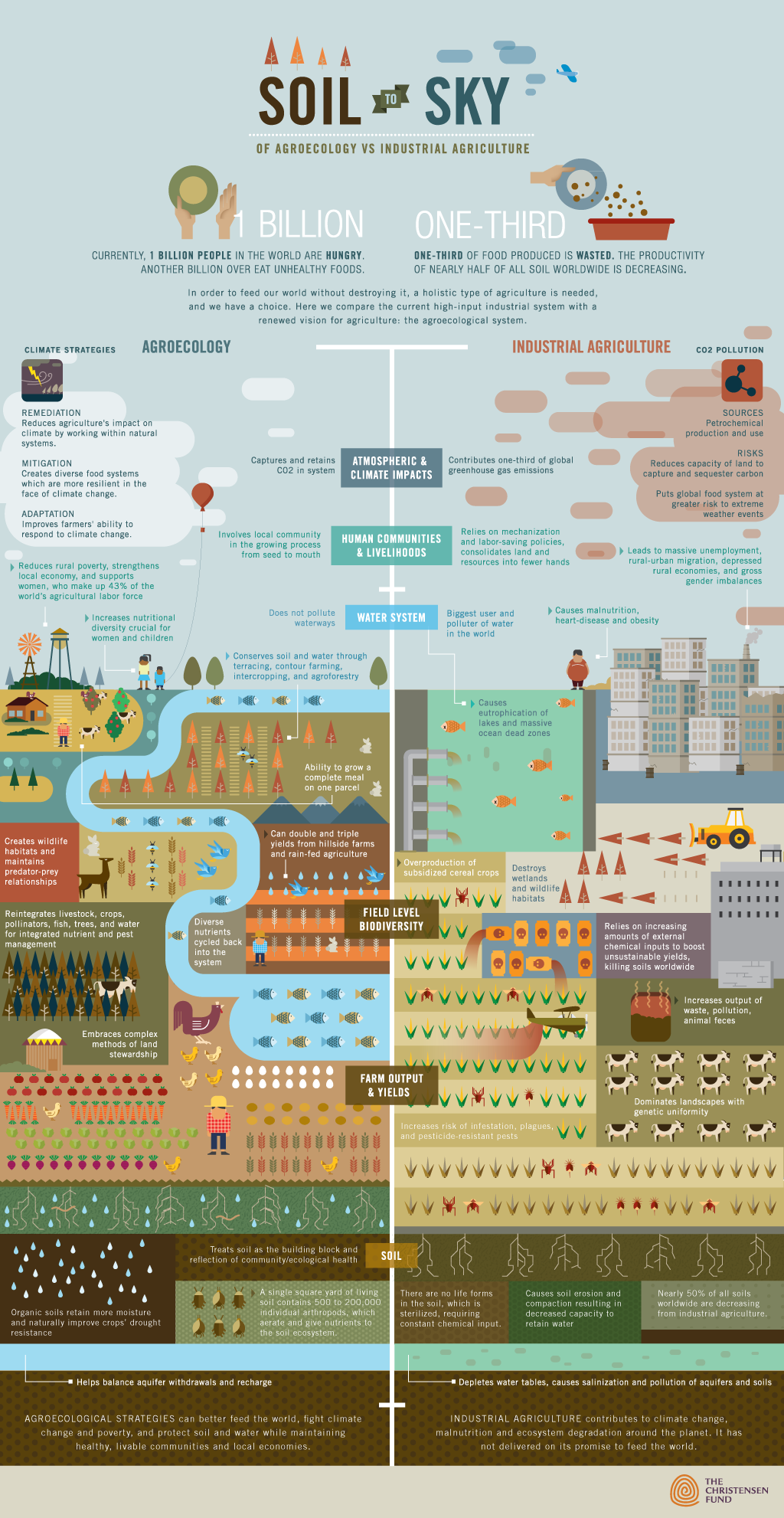
Take a look at this interesting infographic from The Christensen Fund that evaluates the major differences between agroecology and industrial agriculture.
Downsides of the industrial agricultural system include a huge reliance on petrochemicals and heavy mechanization. Agriculture contributes roughly one-third of global greenhouse gas emissions, and industrial agriculture can also be a tremendous user and polluter of the world’s water resources.
But the graphic also shows how agroecological approaches — including the incorporation of livestock and crops, integrated pest management, and cover cropping — can not only reduce the burden of agriculture on the environment, but also improve nutrition and increase incomes. Agroecology can actually conserve and protect both soil and water — through terracing, contour farming, intercropping, and agroforestry — and absorb greenhouse gases like carbon dioxide. And agroecological practices could double and triple yields in poorer areas, where many farms lack irrigation infrastructure, or are situated on hillsides or other difficult farming sites.
Reports and organizations such as State of the World 2011: Innovations that Nourish the Planet, the International Food Policy Research Institute, the United Nations Human Rights Council, and the International Assessment of Agricultural Knowledge, Science and Technology for Development all agree: agroecology can protect and restore degraded soils, improve biodiversity, decrease pollution, and encourage communities to become more involved in agriculture. And because agroecology operates within the natural organization of an environment, it creates diverse agricultural systems which are more resilient to dramatic weather events, making it an increasingly sound option for feeding the world.
 UMass Sustainable Food and Farming