Category Archives: Food Policy and Advocacy

The Call for Food Sovereignty

A resolution written by the newly created U.S. Food Sovereignty Alliance begins with the statement …

“…over a half-century ago, Mahatma Gandhi led a multitude of Indians to the sea to make salt—in defiance of the British Empire’s monopoly on this resource critical to people’s diet. The action catalyzed the fragmented movement for Indian independence and was the beginning of the end for Britain’s rule over India. The act of “making salt” has since been repeated many times in many forms by people’s movements seeking liberation, justice and sovereignty: Cesar Chavez, Nelson Mandela, and the Zapatistas are just a few of the most prominent examples. Our food movement— one that spans the globe—seeks food sovereignty from the monopolies that dominate our food systems with the complicity of our governments. We are powerful, creative, committed and diverse. It is our time to make salt.”

A thousand activists representing family farms, and environmental, faith-based,  anti-hunger and poverty groups met recently in New Orleans to create the U.S. Food Sovereignty Alliance. The Alliance reminds us that “misguided policies and the recent sharp rise in food prices have left one billion people around the world facing hunger and food insecurity.” They state that volatility in the financial system puts many people the U.S. at risk as well, and they call for a movement to fix our broken food system.

The recent announcement by the Walmart Corporation that they intend to invest in sustainable agriculture and local food systems might worry some of us interested in food sovereignty.  I wrote about my own concerns recently.

Peter Rossett, speaking at Mt. Holyoke College this week reported that “the only real solution to helping small farmers, he said, lies in the concept of food sovereignty, a term first coined by a movement called La Via Campesina, or The Farmers’ Way – a grassroots coalition of small farmers, peasants, rural workers and indigenous communities in Latin America, Africa, Asia and Europe.”

For students interested in understanding this global problem for which sustainable agriculture is the solution, check out our program at UMass.

And to be kept informed about local activities, join the Facebook group Just Food Now in Western Massachusetts.

Happy Meals that last (forever)….

Vladimir Lenin, King Tut and the McDonald’s Happy Meal: What do they all have in common? A shocking resistance to Mother Nature’s cycle of decomposition and biodegradability, apparently.

According to Brett Michael Dykes “that’s the disturbing point brought home by the latest project of New York City-based artist and photographer Sally Davies, who bought a McDonald’s Happy Meal back in April and left it out in her kitchen to see how well it would hold up over time.

The results? “The only change that I can see is that it has become hard as a rock,” Davies told the U.K. Daily Mail.

She proceeded to photograph the Happy Meal each week and posted the pictures to Flickr to record the results of her experiment. Now, just over six months later, the Happy Meal has yet to even grow mold. She told the Daily Mail that “the food is plastic to the touch and has an acrylic sheen to it.”

Pretty impressive, huh?  Still “lovin it?”

John Lennon’s Birthday or Eat Less Meat?

I can’t tell which topic got more attention this weekend on Facebook, John Lennon’s birthday or the report from the National Academy of Sciences that suggested that excessive consumption of meat products might be bad for the planet.  Of course, this (the meat story) isn’t news for health food advocates, permaculture bloggers, or those environmental “crazies,”  many of whom have been saying this for years!

But now we have a NAS report, Forecasting potential global environmental costs of livestock production 2000-2050 which states, “by 2050, the livestock sector alone may either occupy the majority of, or significantly overshoot, recently published estimates of humanity’s ‘safe operating space’ when it comes to climate change, reactive nitrogen mobilization, and appropriation of plant biomass.”

Interesting…..

  1. Climate change – yup, lots of cows add carbon dioxide and methane to the atmosphere
  2. Nitrogen mobilization – that means more runoff of a highly mobile fertilizer element into rivers and streams
  3. Appropriation of plant biomass – that means we are feeding cows rather than people

Of course, we all know that excessive consumption of red meat contributes to poor human health as well.  So it seems that excessive meat consumption isn’t so good for human health or planetary health.  Hmmmmmmm……

I wonder what we should do about this?

Well, the report suggests producing animals more efficiently might help – but will not be enough.   This scientific body claims that  “across the board reductions in per capita consumption of livestock products should … be a policy priority.”   Further, the paper calculated cuts in average  per capita meat consumption of 19-42 percent will be required by 2050,  just to stay even and avoid increasing the rate of environmental damage we experience today.

Tell your friends now…….there is NOTHING you can do that would have a greater impact on both personal and planetary health than reducing your consumption of meat!

————————————————————

How about it?  Are you willing to save your life and the planet too?  Why not join former President Clinton and Paul McCartney and pledge to the Meat Free Monday campaign.  Better yet, if you must eat meat…… make sure it is from a local farm and grass fed.

Find a local farm here! And check out this Local Meat Video here.

If fast food “went organic” – would you eat it?

A recent blog post asked this question and I paused…..  Wait a minute, why don’t I eat fast food?  Well, the fact that it is full of fat and carbohydrates for the most part puts me off.  And then I can’t stop seeing that scene from “Supersize Me” when Morgan Spurlock is getting sick in his car after eating a burger…….  but is that all?

Fast food chains keep prices down by exploiting workers, farmers, and ranchers… but that’s the American way, isn’t it?  So what’s wrong with fast food?  We might argue that if McDonalds bought organically raised beef, it would help organic producers.  Right?

Well, maybe……  but when it gets right down to it, fast food is all wrapped up in fast lifestyles.  Not the fast lifestyles of the “rich and famous” but rather the ever so busy lifestyle of families that are running faster and faster trying to stay even.   At what cost?  Personal health?  Environmental decay?

I grow a lot of my own vegetables and raise my own chickens and eggs at least partly to be reminded to slow down.  When I’m hanging clothes on the line to dry in the sun, I’m reminded to breathe and appreciate the outdoors.  That fast paced life of rushing off to work and running to keep pace with the rest of the world isn’t very attractive, even in an organic wrapper.

So, I guess the answer for me is no.  I’m not buying organic burgers if I can get them at a drive through window.  How about you?

In need of the wild – on farms, orchards – and life!

I am lucky enough to teach what I love.  In one of my classes at the University of Massachusetts this week, Botany for Gardeners, we discussed the “Johnny Appleseed chapter” of Michael Pollan’s book Botany of Desire.  If you haven’t read it yet, check it out.

Pollan, who is well-known among local food advocates for Omnivore’s Dilemma, is an avid gardener.  In Botany of Desire he explored the natural history of four plants, one of them – the apple.  While the book if full of good botany and history on the apple, there are also some big ‘life lessons.”  In our discussion (with 165 students – some of them interested), this quote from the book emerged…..

“the apple had to forsake its former domestic life and return to the wild before it could be reborn…. as distinct from the old European stock as Americans themselves.”

What does that mean?

It was truly inspiring to find that many of the students “got it.”  Do you?  Do you know enough about the food you eat (in this case, the apple) to be able to learn something about life in general from its history and biology?  Here are a few clues from Pollan:

  1. The apple is a native of Kazahstan (remember Borat?) where there are large forests of trees related to the apple with many, many different types, shapes, colors and flavors (most of them inedible).  This region, the so-called center of origin of the apple, is the the “mother ship” of apple diversity.

  2. Apples were brought to New England by European settlers and were not terribly well-adapted to their new home in America at first.

3. Apples are spread by “clones”, that is genetically identical off-spring are grafted onto new rootstocks and re-planted.  The new trees produce fruit that are exactly like the parents (in this case, just like the original plants imported from Europe with the Pilgrims).

4. John Chapman (Johnny Appleseed) collected seeds from apple cider mills and planted nurseries of apples (from seed) throughout the Midwest (this is called sexual reproduction because it takes the flower of two different trees to make a fruit and seed.

6. Some of the new apple types grown from seed did well and adapted to their new home, others didn’t and died out.  Over time, settlers selected the types they liked best and then returned to the standard means of maintaining preferred varieties – grafting (called vegetative reproduction rather than sexual reproduction).

7. Apples grown from seed are likely to be quite different from their parents (its called heterozygosity – I”m teaching a science class). In this sense, the European apple might be said to have “returned to the wild” because the new American apples were very different from their European parents.

8. So the domesticated apple of Europe, went wild in America before it was once again domesticated in its new home.  The “wild phase” was key to its survival!

——————————————————————————————————————————————-

Get it?

Yup, wildness is a necessary part of survival. Continuous change is a strategy that contributes to the sustainability of a species in a changing world.

Can you think of any implications of this story for our current human culture?  What about in your own life?

——————————————————————

I would love to hear what you think?

P.S.  If you are curious about our undergraduate teaching program, check us out here.

We need a food safety bill AND we need to protect small farms – please help!

ACTION ALERT from the National Sustainable Agriculture Coalition
September 15, 2010

FOOD SAFETY LEGISLATION MUST PROTECT
FAMILY FARMS, SUSTAINABLE & ORGANIC AGRICULTURE

CALL YOUR SENATORS TODAY AND URGE THEM
TO SUPPORT THE TESTER AMENDMENT

The Food Safety Modernization Act (S. 510) could reach the Senate floor as early as today.  NSAC has been able to win several improvements to the bill but more changes are needed to avoid serious harm to family farm value-added processing and the emergence of local and regional food systems.

S.510 would considerably ramp up FDA regulation on farms that even minimally process their crops and sell them to restaurants, food coops, groceries, schools and wholesalers.  An amendment sponsored by Senator Jon Tester (D-MT) would exempt small farm and small food processing facilities as well as small and mid-sized farmers who primarily direct market their products to consumers, stores or restaurants within their region.

Please call your Senators today and ask them to support the Tester Amendment.

It’s easy to call:

Go to Congress.org and type in your zip code.  Click on your Senator’s name, and then on the contact tab for their phone number.  You can also call the Capitol Switchboard and ask to be directly connected to your Senator’s office: 202-224-3121.

The message is simple. “I am a constituent of Senator___________ and I am calling to ask him/her to support the Tester Amendment and to include the Tester language in the Manager’s Amendment to the food safety bill.  The Tester Amendment will exempt small farm and food facilities and farmers who direct market their products to consumers, stores or restaurants.   We need a food safety bill that cracks down on corporate bad actors without erecting new barriers to family farms and the growing healthy food movement.  Our continuing economic recovery demands that we preserve these market opportunities for small  and mid-sized family farms.

Changing our diet from oil to the sun

As we move into an era of oil depletion and energy constraint, everything from transportation to medicine to food to climate change response strategies will be affected. Almost everything we do is dependent on oil.  Here are some suggestions from the Oil Depletion Protocol for…

Changing the food you eat

The petroleum used in supplying food accounts for about one third of average per-capita oil consumption. Therefore the food choices you make can substantially change the amount of petroleum you use:

  • purchase local and organic food whenever possible
  • shop at farmers’ markets
  • join a community garden
  • grow a vegetable garden and plant fruit and nut trees
  • try to purchase food that has been grown within 100 miles of where you live – known as the 100-Mile Diet, the emphasis is on eating locally produced, indigenous food that requires less transportation, supports local farmers, and promotes more sustainable agriculture
  • if you have a garden or are planning on starting one, abide by organic garden and lawn care practices and use organic fertilizers and natural pesticides – neither of which are derived from oil by-products

What are you willing to do?

Saving the world…… (one clothespin at a time)

A few years ago, Michael Pollan wrote a piece for the NY Times Magazine called “Why Bother?”  Pollan noted that with all of the problems in the world, any one person’s behavior makes little difference – so why bother recycling, gardening, walking instead of driving, changing an incandescent lightbulb to a compact florescent – you get the picture).

———–

I was inspired by this article to write up some ideas that I often share in my Sustainable Living class at UMass about “why I bother” (to bike, raise chickens, invest in solar hot water, garden, and yes – use solar power to dry our clothes).  The article is here.

The story begins by talking about our current situation, which I present as “a perfect storm” of global problems.

The story continues by examining what could possibly motivate us to change the way we live.  For me it is an expanded sense of “self interest” which recognizes that I am “a part of – rather than apart from nature.”

Finally, I conclude by suggesting that simple actions, the ones we can all do on a daily basis, need to obey “Mother Nature’s Rules” if we are to be sustainable.  They are:

  1. Rely as much as possible on current solar income

  2. Cycle everything possible (waste=food)

  3. Enhance biological diversity (it makes 1 & 2 work)

I share this essay in class and it often results in lots of feedback (some of it full of praise – and some of it pretty angry and cynical).  I appreciate it all and continue to ask us to think about the question “why bother?”

————-

Perhaps you will share this essay with friends and ask the same question – and maybe then share your thoughts below?

In any case, thank you for reading this far……..

Namaste.

Its not just the chickens that are sick…. stop antibiotic use in factory farms!

Antibiotics fed routinely to livestock in their food and water can promote faster growth, but the practice is also used as a way to compensate for the effects of extreme overcrowding and unsanitary conditions in factory farms.  This practice is dangerous to humans as it serves as a petri dish which selects for antibiotic resistant bacteria. 

Johns Hopkins researcher, Kellogg Schwab, says he’s more than just concerned: “This development of drug resistance scares the hell out of me. If we continue on and we lose the ability to fight these microorganisms, a robust, healthy individual has a chance of dying, where before we would be able to prevent that death.” Schwab says that if he tried, he could not build a better incubator of resistant pathogens than a factory farm.

The American Medical Association has called for a ban on this practice, and the FDA is considering new guidelines, but they are non-binding and not adequate to protect human health.   To see a full report from John Hopkins, click here or on the picture below.

The FDA is accepting public comments on their draft guidlines until August 28 (Saturday). Will you join me and tell them it’s time to enact real regulations that protect public health and ensure responsible use of antibiotics in animals?  A web based (simple) means of sending them comments is available here.  Or write your own!

How do we respond to the egg recall?

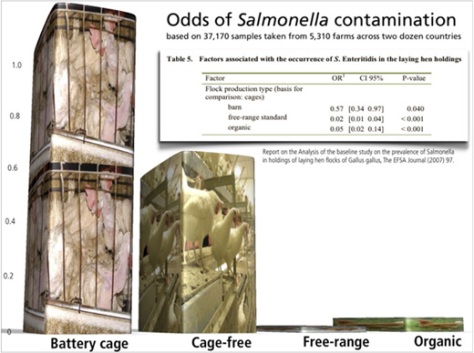
While the recall of a half billion eggs seems to be impacting the Midwest and South direclty, we all should be thinking about the reason that food is making people sick.  A recent article in the Huffington Post traces the root cause of the problem to the industrial food system and the nature of factory farms.  I agree – and here is why.  And here is a graph depicting the relative number of salmonella cases in different hen raising systems.  Big factory farms use battery cages.

It is difficult to know how to respond however, when almost all of the eggs we see in our supermarkets are from big factory farms using battery cages.  But….. WE DO HAVE CHOICES!

Today’s press reported several stories about how the egg recall was stimulating interest in local eggs (mostly free-range).  But you need to make sure  your “local” eggs are really grown locally – not just repacked with a local label.  To find a local egg producer in Western Massachusetts check the CISA website.  Lots of local hens!  Or even better…..

Raise your own hens!

———————————————————

Backyard hens……. one of the reasons we don’t see more hens in the towns and cities of Western Massachusetts is the local zoning ordinances.  But that is changing!  For more on zoning laws in one town and on raising hens in general, click here.

And finally, click here to join a listserve of “backyard chicken folks” – there are lots of us in Western Massachusetts!  Join us!