PRODUCER INTERVIEW – Gabor’s Eggs

The following is an interview with one of the producer/vendors at the All Things Local Cooperative Market.

Gabor Lukacs of Gabor’s Eggs

Egg Shaped Gold – by Caroline Seymour

It’s so easy to separate the grocery store from the farm.  Eggs come from chickens, obviously, but on a weekly trip to Stop and Shop it’s hard to remember that eggs don’t just come from cardboard cartons.  What’s more, we’re even made to believe that all eggs are created equal.  You might feel good about buying cage-free eggs, but if there’s really no difference between the eggs then it’s not worth worrying about, right?

eggsWrong!  The color of an egg’s shell doesn’t really matter, but what’s inside can vary widely based on the life of the chicken it came from, and the difference is big enough to see.  Try putting one supermarket egg in a bowl next to Gabor’s Eggs from All Things Local, and the difference is clear. Gabor’s eggs have a richer, more brightly colored yolk.  The yolks stand taller, they’re stronger, and they even taste better.  And as you might expect, the difference doesn’t come from chemicals and hormones, but from something even more unusual: treating chickens like chickens.

It turns out, letting chickens do what chickens like to do causes them to produce better eggs.  This means letting them out of the little cages (commonly called battery cages) that commercially raised chickens live in and letting them outside.  Gabor Lukacs, an Amherst resident who raises chickens of his own, knows exactly what this means.  His chickens live in a wide area around his garden, picking at bugs and grass and choosing whether they want to stand in the shade of their summer enclosure or their more sheltered winter enclosure.  He knows they have enough space, because “Some space in their area is still covered in grass, which means they haven’t had time to get to it all – it means they have plenty of room.”  Letting chickens act like chickens means their stress levels are at a minimum; they don’t have to fight each other for space, they have a variety of food to eat, and they can focus on living happy chicken lives.

gabor1It may sound surprising to hear that Gabor’s eggs aren’t certified organic.  They’re free to live in the open, and aren’t treated with hormones or antibiotics.  But Gabor raises his chickens in an environment that’s about something even more important: he focuses on living locally.  In his own words, “Local creates community.  Organic doesn’t.”  Today, the term ‘organic’ is regulated by the government, which unfortunately means that it’s expensive to become certified, and the term doesn’t necessarily mean that anything is produced in a sustainable, humane way.  Gabor’s chickens and gardens are designed to be sustainable; he doesn’t have to buy commercial chicken food or fertilizers, but relies on the resources in and around Amherst.  This includes recycling food waste from the All Things Local café; chickens eat grains, of course, and they love the vegetable leftovers like carrot peels.  So even though they’re not certified organic, they are local, sustainable, and produce delicious eggs!

The benefits of these eggs go even deeper than taste.  All eggs provide some level of vitamin D, an essential nutrient that plays an important role in bone health and digestion.  One study found that free range chickens living outdoors produced eggs with four times more vitamin D than chickens living in battery cages[1].  Imagine eating four supermarket eggs to get the amount of vitamin D in just one of Gabor’s eggs!  It’s important to note that just because eggs are labeled ‘free range’ doesn’t mean they have all the space they need; commercial free range chickens can still be packed together, which makes them stressed out and more likely to fight.  Another study found that chickens treated similarly to Gabor’s had twice as much carotenoids than commercially produced eggs[2].  Carotenoids are precursors to vitamin A, which is essential for vision, and can also act as antioxidants, which protect the body from damaging chemicals.  Carotenoids give foods a yellow or orange color, which is why Gabor’s eggs are so much brighter than those bought from the grocery store.

Why don’t all eggs just get these benefits?  It’s simple – chicken farms don’t know how to manipulate hormones and nutrition to produce eggs as good as Gabor’s.  The simple truth is that there’s no substitute for chickens’ natural diet and habits when it comes to producing good eggs.  This is food that you can feel good about buying, and really enjoy eating!  If you haven’t already tried them, pick up some of Gabor’s Eggs next time you’re in All Things Local and see the difference for yourself.

To support Gabor and other producers like him, please become a member and buy your food at the All Things Local Cooperative Market!

atlSources:

[1] Kuhn J, Schutkowski A, Kluge H, Hirche F, Stangl, G. Free-range farming: a natural alternative to produce vitamin D-enriched eggs. Nutrition. 2014;30(4):481-4.

[2] Hesterberg K, Schanzer S, Patzelt A, et al. Raman spectroscopic analysis of the carotenoid concentration in egg yolks depending on the feeding and housing conditions of the laying hens. Journal of Piophotonics. 2012;5:33-39.

Original Post was in the All Things Local Newsletter

Want to Major in Sustainable Food and Farming?

The Bachelor of Sciences degree in Sustainable Food and Farming is a welcoming home for those students who want to apply their knowledge of biology, environmental science, sociology, anthropology, policy, health and education to the real world!

Our students get involved in the world!

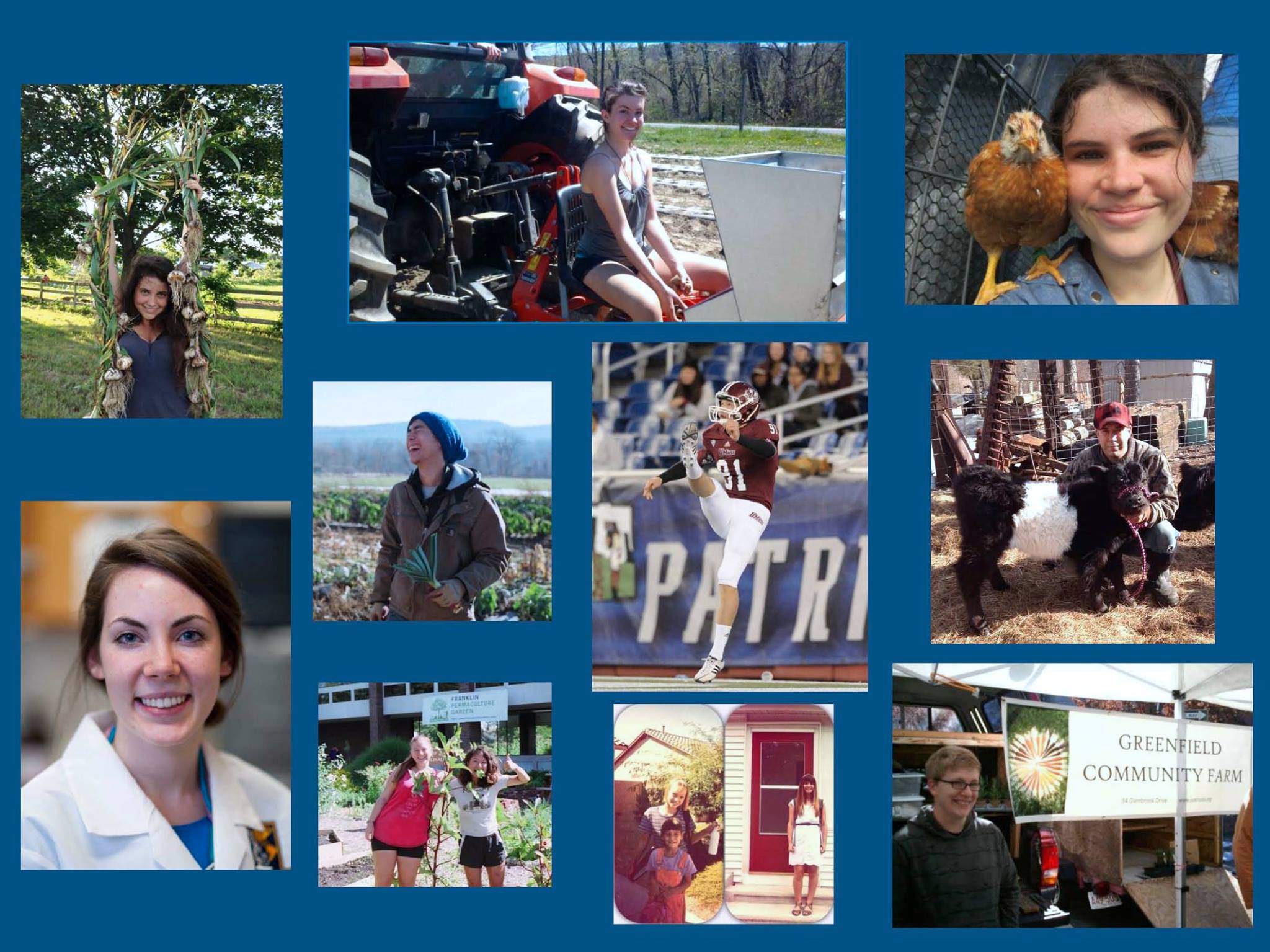
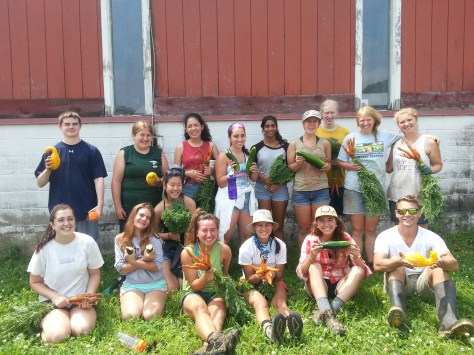
Sustainable Food and Farming Graduates 2014

Many students at UMass find that while they have a desire to be useful in the world, their area of study turns out to be a bit abstract and they are disappointed when their classes seem to be disconnected from the real world.  If this is the case…..

the Stockbridge School of Agriculture welcomes you!

Our major in Sustainable Food and Farming allows students to create their own degree plan, while earning a B.S. degree from UMass.   Working closely with an adviser, our students select courses from a diverse set of interest areas at UMass and the Five Colleges.  They are encouraged to get involved in internships which count toward their major.   And each academic plan is custom designed based on the student’s personal passion and career goals.

This major is about growing food….. and much, much more!  Our students are headed for careers in:

  • local ecological farming and marketing
  • community-based education for sustainability
  • public policy, advocacy and community development
  • permaculture and community gardening
  • food justice
  • medicinal herbals
  • and more…

If you are struggling with your current major and would like to explore your options in the Stockbridge School of Agriculture, please contact Dr. John M. Gerber for an appointment.

A few fall classes that may be of interest are:

STOCKSCH 197D – Draft Horse Husbandry (get up close and personal with some really big horses.  Meets at the AG Learning Center.  Very hands-on!)

STOCKSCH 197G – Intro to Permaculture (both the application and ethics of ecological living)

STOCKSCH 197 MC – Intro to Mushroom Culture (practical class that fills up fast)

STOCKSCH 211 – Pasture Management (for the serious farming student who wants to work with livestock)

STOCKSCH 265 – Sustainable Agriculture (field trips to local farms every Tuesday afternoon)

STOCKSCH 281 – Topics in Herbalism I (Chris Marano is the guy to know on local herbalism)

STOCKSCH 297 AL – Ag Leadership and Community Education (Sarah Berquist will teach you how to be an effective community leader)

STOCKSCH 297P – Small Farm Husbandry II – Pigs and Poultry (small class, very practical – fills fast)

STOCKSCH  300 – Deciduous Orchard Science (field trips to local orchards every Wednesday afternoon)

STOCKSCH 350 – Sustainable Soil and Crop Management (for the serious farming student)

STOCKSCH 397C – Community Food Systems (best local food systems class on campus)

STOCKSCH 397 GB – Grapevine Biology (new class on growing grapes)

STOCKSCH 397 PB – Pollinator Biology and Habitat (very practical science class with lots of work outdoors)

For more classes, see: Requirements for the Major

Stockbridge School of Ag Students Serve the Local Community

amherstbulleJohn M. Gerber      –     Friday, February 27, 2015

One of the most exciting programs at the University of Massachusetts Amherst today is an undergraduate major that serves the citizens of Amherst and surrounding towns by growing food, growing community and “growing” new farmers.

As local and regional food production expands in New England, so does enrollment in the Stockbridge School of Agriculture’s Sustainable Food and Farming program. UMass graduates are engaged in creating ventures to relocalize the food system to create more community and to reduce the carbon cost of shipping food long distances.

UMass began as the Massachusetts Agricultural College in 1863 and recently the former “Mass Aggie” was recognized as having the third-best agricultural science program in the U.S. and the eighth best in the world. Levi Stockbridge, Hadley farmer and one of the first teachers at Mass Aggie, would be proud. Building on its historic mission of practical research, outreach to the community and hands-on education, today’s Stockbridge School helps educate young women and men in ecological landscape management and sustainable food systems — crucial training in an era threatened by the impact of radical climate change.

Many Stockbridge students and grads are committed to implementing the Food Solutions New England vision of producing at least half of New England’s food by 2060. They contribute to this goal by working toward careers in local food and farming, urban agriculture, permaculture, herbal medicine, community education and advocacy for a more sustainable and just world.

An example of a local business providing students with valuable experience is the All Things Local Cooperative Market in downtown Amherst, started by area people committed to the relocalization vision. Stockbridge students and graduates volunteer at this year-round farmers’ market, some selling products they produced themselves, such as organic eggs, milk, artisan tea, blueberries, fermented kombucha, mushrooms and other vegetables.

Other Stockbridge students engage with their local community by working with Grow Food Amherst, a network of neighbors and students uniting town and gown. Amherst Development and Conservation Director David Ziomek planted the seed, and Sustainability Coordinator Stephanie Ciccarello nurtures the project with monthly meetings that engage over 450 residents helping to move Amherst towards greater food-resiliency.

Many students gain valuable experience by working on local farms, nonprofit organizations, co-ops, local businesses and community groups. The vibrant local food economy of the Pioneer Valley provides a supportive environment for food entrepreneurs, and Stockbridge is closely tied to this rapidly growing community of young people.

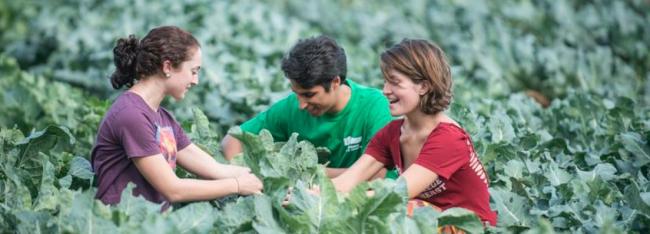
Building on Levi Stockbridge’s commitment to experiential learning, students in the Sustainable Food and Farming major are actively engaged in hands-on learning projects that contribute both to their own education as well as to the local community. For example: The UMass Student Farm is a year-round class where students manage a small organic farm and sell their produce through food service and retail markets — including a popular on-campus farmers’ market.

The Permaculture Initiative has converted underused grass lawns on campus into edible, low-maintenance food gardens, winning the White House Champions of Change competition in 2012.

The Massachusetts Renaissance Center Garden is a demonstration garden open to the public, featuring the herbs and vegetables grown during Shakespeare’s time.

The Student Food Advocacy group and Chancellor Subbaswamy signed the Real Food Commitment, which ensures that by 2020, at least 20 percent of the food purchased for the dining halls will be local, organic, fair trade and animal-friendly.

The School Garden Project helps K-6 teachers at Amherst elementary schools create vegetable and herb gardens as living classrooms.

The Food for All Garden at the new Undergraduate Agricultural Learning Center is a student-led project that grows food with the help of Amherst community members, and distributes the food through Not Bread Alone and the Amherst Survival Center.

Stockbridge students and alums are committed to building a more sustainable food system focused on environmental quality, social justice and economic vitality. These young visionaries imagine a world where the bulk of one’s food comes from local and regional farms. They believe that a consciousness rooted in sustainability will deepen as producers and consumers become more self-aware members of a community of caring for each other and the earth.

But these young entrepreneurs need our help. We buy food from local farmers at a rate far greater than the national average, yet these purchases represent less than 10 percent of total agricultural sales. We can do better. We can support these young people by buying their products from local farms, at our new All Things Local Cooperative, and at our weekly farmers’ markets.

At the same time we can invest in one of the key economic development objectives of the Amherst Master Plan, relocalization, and help the UMass Stockbridge School of Agriculture grow local food, grow community and grow more local farmers.

John Gerber is a member of the Pioneer Valley Relocalization Project, a professor in the University of Massachusetts Stockbridge School of Agriculture and founding member of Grow Food Amherst.


Source URL: http://www.amherstbulletin.com/commentary/15821972-95/john-gerber-new-life-for-an-old-school-the-stockbridge-school-of-agriculture

Praying for an Indepdendent Life for Chloe Rombach

Family and friends of Chloe Rombach have learned to find hope in the smallest signs since the 22-year-old suffered a severe brain injury when she was struck by a car in December.

She can breathe on her own now. She opens her eyes. The family believes there are times when she might be making eye contact. Other times she moves her fingers or an arm a little when asked.

“We don’t know what level she’ll eventually reach,” said her father, Edward Rombach, 62, of Marblehead. “We’re just praying for the best possible outcome.”

He says the family is well aware they are in this for the long haul.

“The doctors keep saying, ‘this isn’t a sprint, it’s a marathon,’” Rombach said. “I fully expect to be deeply engaged in this for the rest of my life.”

Rombach said he and his family take heart from even the slightest indication of improvement.

“Whenever we have a toast,” Rombach said, pausing a moment to control his emotions, “we raise a glass and say, ‘To an independent life.’”

Chloe Rombach moved to western Massachusetts to attend UMass Amherst, graduating two years ago. Most recently, she lived on Bridge Street in Northampton. She was crossing the street in a crosswalk near her home when she was struck by a car on the night of Dec. 9.

No charges have been filed against the driver, Kenzie Kimble-Badgett, 18, of 8 Button Road in Easthampton. Police said after the accident that the dark and rain likely made for poor visibility, and that drugs and alcohol do not appear to have been factors in the accident.

Rombach was dragged by the car and pinned underneath for about 20 minutes while firefighters worked to move the vehicle. She was rushed to Baystate Medical Center in Springfield.

“The evening of Dec. 9 and my wife and I were just finishing up dinner and there was a knock on the door. It was Marblehead police,” said her father. The officers communicated the information about the accident that Northampton Police had told them.

A nor’easter was dumping torrential rain on the state that night. “It was a three-hour drive in the driving rain, not knowing what we were going to find,” he said. “That was a horrific night.”

His daughter suffered third-degree burns and cuts in the accident, but her most serious injury is a diffuse axonal brain injury, according to her father. It is an injury affecting a large area of the brain that is caused by the brain moving back and forth inside the skull. In Chloe Rombach’s case, it caused life-threatening brain swelling.

Modest progress

In the days immediately after the accident, doctors at Baystate Medical Center performed a craniectomy to remove two sizable skull plates over her frontal cortex to relieve the pressure from the swelling, according to her father. Doctors also said it is likely her brain was further injured by oxygen deprivation while she was pinned under the car.

On Saturday, a neurological examination at Massachusetts General Hospital determined that Chloe Rombach is ready to have the surgery to put the skull plates back in, probably sometime in March. It’s another good sign, her parents believe.

“She’s making modest progress,” her father said.

She breathes on her own, though through a tracheotomy tube. She also has a feeding tube, and infections are always a risk, he said. She is visited by physical therapists, respiratory therapists, and many more specialists who try to help her along.

Rombach and his wife, Jeannie, visit Chloe every day at the rehabilitation hospital 10 minutes from their home. Edward Rombach, who is unemployed, said being at the hospital with his daughter is “my job now.”

Jeannie Rombach, 60, has been taking time off from her job as a special education teacher in Marblehead, though she will have to go back to work soon, according to her husband. Their older daughter, A.J. Rombach, an artist in Philadelphia, came back to Massachusetts the day after the accident and spent nine weeks with her sister, though she is now back home.

Community support

The family created a CaringBridge website where they post daily updates about Chloe’s condition for loved ones to read. Rombach said there seems to be an infinite number of sympathetic people, from friends of friends and co-workers to extended family members, who have offered “support, prayers, intentions and thoughts.” A friend started a crowdfunding website to collect donations for the family’s medical expenses, and it has raised over $33,207.

Rombach said he feels thankful to all the people who have extended help to the family. “That’s really what’s sustained us,” he said.

“When this happened I felt like I was pushed out the window of a high building and I was falling to my death. All the prayers, the meals that showed up, the people lending us cars and making donations, it was like a safety net keeping me from falling,” he said. “They were like angels lifting me up.”

Rombach said that one of the many reasons it is so hard to see his daughter in bed is that she was always so full of life.

“She was a very adventurous gal — sometimes enough to make us nervous,” he said.

After high school, she took a year off to spend time on ecosystem farms in Spain, Costa Rica and Brazil. Agriculture, especially organic and sustainable vegetable and fruit farming, was her passion.

“She saw this as an interesting possible career path,” Rombach said.

‘All things agriculture’

In 2013, she earned a degree in sustainable food and farming from UMass Amherst after only three years. Rombach said that when he and his wife would visit, her kitchen was full of greens she grew herself.

Chloe Rombach was a leader in two agricultural projects at UMass, the Student Farm Enterprise project and the Garden Share Club. Amanda Brown, a lecturer in the Stockbridge School of Agriculture and director of the UMass Student Farm, said Rombach spent a year working on the farm.

“She was involved in all things agriculture at UMass,” Brown said Monday. “She did a little bit of everything. She worked in the fields with us in all kinds of weather, and she was involved with the farmers market and the CSA pick-ups on campus.”

She said Rombach has a “huge heart,” a talent for farming and a contagious laugh. When they worked together several years ago, Brown said, Rombach was always upbeat and never complained.

“She was well-liked and respected by her peers right away,” Brown said. “She was just great to be around.”

Brown said everyone in Stockbridge and the farm was devastated to learn of the accident. Many have kept abreast of her progress through the CaringBridge website and through other classmates who are connected to her family. “We’ve kind of been supporting each other,” she said.

Rombach was also an actor and had “a hell of a set of pipes,” her father said. In middle school, she played Dorothy in the “Wizard of Oz,” he said, and in high school, she played Maria in “West Side Story” and sang in an a capella group.

Her interest in natural healing methods drew her to another passion: yoga. After taking classes at the Karuna Center for Yoga & Healing Arts for six months to a year, she became an instructor in November.

Karuna director Eileen Muir called Rombach “the shining star” of the yoga teacher training program.

“She has an incredibly bright disposition. She was always enthusiastic and just shone her way through the training,” Muir said. “She was an integral part of our community — and still is.”

Staff and students at the center have been deeply affected by Chloe’s accident, Muir said. She keeps in touch with the Rombach family, she said, and she and another staff member send weekly updates to the Karuna community based on the information on her CaringBridge site.

“I send healing energy her way every day,” Muir said.

The family believes she was walking to the yoga center at 25 Main St. when she was stuck by the car.

Practical help

Jake Clough of Northampton said he became friends with Chloe after he got to know her last summer when they were both students at the Karuna Center. He said there is a “huge community” in the Northampton area that is pulling for Chloe and checking her CaringBridge site religiously for updates.

“She’s one of the strongest people I’ve met, so that’s what’s getting me through it,” he said. “I just trust in her and her strength.”

Clough, 24, a musician, said he and other friends are planning a fundraising concert to help the Rombach family with the staggering medical expenses, though a date has not been set.

“Raising money is the most practical thing we can do right now,” he said. “We’d all just like to be able to help.”

For his part, Rombach said his family is touched by the support — and they do need the money. “It’s only going to scratch the surface of what it will cost for long-term recovery,” he said. For instance, just her ambulance ride to Mass General for the exam Saturday cost $3,000 to $4,000, he said.

A friend initially started a fundraising effort on the GoFundMe website, but Rombach later took over and started a new campaign with a fundraising goal of $100,000 at http://www.gofundme.com/n1a53s. He said his daughter’s health care costs may one day reach several million dollars.

For now, Rombach said, he and his family will keep praying while they sit by Chloe’s bed, massaging her and looking for any sign of recovery. They hope one day — though it might be years from now — she will walk again and live an independent life.

At the same time, Rombach said, even as he and his wife care for their daughter now, they are concerned about who would continue to care for her when they no longer can.

“Most people go through seeing their parents die or get sick,” Rombach said. “I wouldn’t wish this on my worst enemy. It’s the hardest thing for a parent.”

For updates on Chloe Rombach’s condition, visit www.caringbridge.org/visit/chloerombach.

Continue reading Praying for an Indepdendent Life for Chloe Rombach

UMass Students Can Get Academic Help Here

 Student Resources at UMass

help

  1. The Learning Resource Center (LRC) is located on the 10th floor of DuBois Library, and offers FREE peer-supported academic tutoring and supplemental instruction for over 180 courses at UMass. Tutoring support at the LRC is available for individual or small group sessions on a walk-in basis.They also assist students with learning workshops to improve your note-taking, studying, time-management or problem-solving skills. Its important to be proactive about your academic goals, so if you think you might need some additional support, feel free to stop by the Learning Resource Center or visit their webpage for more information.
  2. The Writing Center can be found in the Learning Commons within the basement of DuBois Library. At the Writing Center, students can receive one-on-one support with all aspects of the writing process from beginning to end. The Writing Center tutors meet with writers in 45 minute face-to-face or online consultations. If you need help with anything from getting your ideas onto paper to revising your last draft, then check out their website to schedule an appointment with a Writing Center tutor.
  1. Also located in the basement of DuBois Library is the  Academic Advising Link, where Peer Advisors like me are ready for anything! These Peer Advisors from Undergraduate Advising can assist you with the course selection process, answer questions about academic requirements, promote major exploration, and much more. Swing by the Academic Advising Link in the library Sunday-Thursday from 4-8pm to have an awesome Peer Advisor assist you.
  1. Check out the Tutoring Centers available in the Lederle Graduate Research Tower if you need some assistance with various Math or Stats department courses. These centers are staffed by instructors, graduate TAs, and undergraduate peer TAs who are always happy to provide some assistance and math review. For the most up-to-date information regarding the time and room numbers for each tutoring session, please review the Tutoring Centers website.
  1. The DuBois Library offers an Ask a Librarian service to assist students with both understanding the borrowing or inter-library loan process, and locating the materials they need. They can also teach students how to utilize the library equipment, learn to use RefWorks, and more. Students can email, phone, IM, text, or visit the reference desk in the basement of the library within the Learning Commons in order to Ask these Librarians anything. Feel free to visit their website for more information.

Share your thoughts on the Massachusetts Food System at this open forum at UMass

ma-food-plan-web-logoListening Sessions for the Massachusetts Food System Planning Process

Tuesday, February 3, from 4:00 to 5:30 p.m.

 Amherst Room, UMass Campus Center, 10th floor

Do you have a perspective on an aspect of our food system that you believe should be heard by the people who are developing a Food System Plan for Massachusetts, the first such plan in over 40 years?

The Commonwealth of Massachusetts, through its Food Policy Council, has engaged a partnership of four agencies to develop the plan. The plan will recommend a number of strategies to strengthen our food system, including legislative, regulatory and budget recommendations as well actions that many individuals and organizations can pursue. It will focus on increasing food production and related jobs within the state as well as on access and equity within the system and ecological resilience.

Last Fall, the Planning Partners held a number of Listening Sessions in eastern Massachusetts to seek input into the plan. Now, several groups on the UMass Amherst campus have come together to sponsor a Listening Session on campus for people from on-campus and off-campus. All are welcome. These include faculty, students and staff from UMass and the Five Colleges and all Mass. residents. Attendance at this Listening Session will be very appropriate for those who would like an introduction to the planning process and, most importantly, to provide input to the planners.

Planning Partners: Metropolitan Area Planning Council, Pioneer Valley Planning Commission, Franklin Regional Council of Governments, Massachusetts Workforce Alliance, Fertile Ground.

Listening Session Sponsors: UMass Center for Public Policy and Administration; UMass Center for Agriculture, Food and the Environment; UMass Auxiliary Services.

Listening Session Co-Sponsors: UMass Department of Nutrition, the Sustainable Food and Farming Program at the UMass Stockbridge School of Agriculture, UMass Real Food Challenge.

Details about the Listening Session:

  • Date: Tuesday, February 3, from 4:00 to 5:30 p.m.
  • Place: Amherst Room, UMass Campus Center, 10th floor
  • Admittance is without charge and RSVPs are not required. Parking is available in the adjacent Campus Center Parking Garage. For further information contact Joe Shoenfeld, shoenfeld@cns.umass.edu, 413-545-5309.

Industrial Agriculture is Really Good at “Public Relations”

By Jonathan Latham, PhD

By conventional wisdom it is excellent news. Researchers from Iowa have shown that organic farming methods can yield almost as highly as pesticide-intensive methods. Other researchers, from Berkeley, California, have reached a similar conclusion. Indeed, both findings met with a very enthusiastic reception. The enthusiasm is appropriate, but only if one misses a deep and fundamental point: that even to participate in such a conversation is to fall into a carefully laid trap.

The strategic centrepiece of Monsanto’s PR, and also that of just about every major commercial participant in the industrialised food system, is to focus on the promotion of one single overarching idea. The big idea that industrial producers in the food system want you to believe is that only they can produce enough for the future population (Peekhaus 2010). Thus non-industrial systems of farming, such as all those which use agroecological methods, or SRI, or are localised and family-oriented, or which use organic methods, or non-GMO seeds, cannot feed the world.

Dustbowl and soil erosion USA, 1935's

To be sure, agribusiness has other PR strategies. Agribusiness is “pro-science”, its opponents are “anti-science”, and so on. But the main plank has for decades been to create a cast-iron moral framing around the need to produce more food (Stone and Glover 2011).

Therefore, if you go to the websites of Monsanto and Cargill and Syngenta and Bayer, and their bedfellows: the US Farm Bureau, the UK National Farmers Union, and the American Soybean Association, and CropLife International, or The Bill and Melinda Gates Foundation, The Rockefeller Foundation, USAID, or the international research system (CGIAR), and now even NASA, they very early (if not instantaneously) raise the “urgent problem” of who will feed the expected global population of 9 or 10 billion in 2050.

Likewise, whenever these same organisations compose speeches or press releases, or videos, or make any pronouncement designed for policymakers or the populace, they devote precious space to the same urgent problem. It is even in their job advertisements. It is their Golden Fact and their universal calling card. And as far as neutrals are concerned it wins the food system debate hands down, because it says, if any other farming system cannot feed the world, it is irrelevant. Only agribusiness can do that.

The real food crisis is of overproduction
Yet this strategy has a disastrous foundational weakness. There is no global or regional shortage of food. There never has been and nor is there ever likely to be. India has a superabundance of food. South America is swamped in food. The US, Australia, New Zealand and Europe are swamped in food (e.g. Billen et al 2011). In Britain, like in many wealthy countries, nearly half of all row crop food production now goes to biofuels, which at bottom are an attempt to dispose of surplus agricultural products. China isn’t quite swamped but it still exports food (see Fig 1.); and it grows 30% of the world’s cotton. No foodpocalypse there either.

Of all the populous nations, Bangladesh comes closest to not being swamped in food. Its situation is complex. Its government says it is self-sufficient. The UN world Food Program says it is not, but the truth appears to be that Bangladeshi farmers do not produce the rice they could because prices are too low, because of persistent gluts (1).

Chinese net food exports

Even some establishment institutions will occasionally admit that the food shortage concept – now and in any reasonably conceivable future – is bankrupt. According to experts consulted by the World Bank Institute there is already sufficient food production for 14 billion people – more food than will ever be needed. The Golden Fact of agribusiness is a lie.

Truth restoration
So, if the agribusiness PR experts are correct that food crisis fears are pivotal to their industry, then it follows that those who oppose the industrialization of food and agriculture should make dismantling that lie their top priority.

Anyone who wants a sustainable, pesticide-free, or non-GMO food future, or who wants to swim in a healthy river or lake again, or wants to avoid climate chaos, needs to know all this. Anyone who would like to rebuild the rural economy or who appreciates cultural, biological, or agricultural diversity of any meaningful kind should take every possible opportunity to point out the evidence that refutes it. Granaries are bulging, crops are being burned as biofuels or dumped, prices are low, farmers are abandoning farming for slums and cities, all because of massive oversupply. Anyone could also point out that probably the least important criterion for growing food, is how much it yields. Even just to acknowledge crop yield, as an issue for anyone other than the individual farmer, is to reinforce the framing of the industry they oppose.

The project to fully industrialise global food production is far from complete, yet already it is responsible for most deforestation, most marine pollution, most coral reef destruction, much of greenhouse gas emissions, most habitat loss, most of the degradation of streams and rivers, most food insecurity, most immigration, most water depletion, massive human health problems, and so on (Foley et al 2005; Foley et al 2011). Therefore, it is not an exaggeration to say that if the industrialisation of food is not reversed our planet will be made unlivable for multi-cellular organisms. Our planet is becoming literally uninhabitable solely as a result of the social and ecological consequences of industrialising agriculture. All these problems are without even mentioning the trillions of dollars in annual externalised costs and subsidies (Pretty et al. 2000).

So, if one were to devise a strategy for the food movement, it would be this. The public already knows (mostly) that pesticides are dangerous. They also know that organic food is higher quality, and is far more environmentally friendly. It knows that GMOs should be labeled, are largely untested, and may be harmful. That is why the leaders of most major countries, including China, dine on organic food. The immense scale of the problems created by industrial agriculture should, of course, be understood better, but the main facts are hardly in dispute.

But what industry understands, and the food movement does not, is that what prevents total rejection of bland, industrialised, pesticide-laden, GMO food is the standard acceptance, especially in Western countries, of the overarching agribusiness argument that such food is necessary. It is necessary to feed the world.

But, if the food movement could show that famine is an empty threat then it would also have shown, by clear implication, that the chemical health risks and the ecological devastation that these technologies represent are what is unnecessary. The movement would have shown that pesticides and GMOs exist solely to extract profit from the food chain. They have no other purpose. Therefore, every project of the food movement should aim to spread the truth of oversupply, until mention of the Golden Fact invites ridicule and embarrassment rather than fear.

Divide and Confuse
Food campaigners might also consider that a strategy to combat the food scarcity myth can unite a potent mix of causes. Just as an understanding of food abundance destroys the argument for pesticide use and GMOs simultaneously, it also creates the potential for common ground within and between constituencies that do not currently associate much: health advocates, food system workers, climate campaigners, wildlife conservationists and international development campaigners. None of these constituencies inherently like chemical poisons, and they are hardly natural allies of agribusiness, but the pressure of the food crisis lie has driven many of them to ignore what could be the best solution to their mutual problems: small scale farming and pesticide-free agriculture. This is exactly what the companies intended.

So divisive has the Golden Fact been that some non-profits have entered into perverse partnerships with agribusiness and others support inadequate or positively fraudulent sustainability labels. Another consequence has been mass confusion over the observation that almost all the threats to the food supply (salinisation, water depletion, soil erosion, climate change and chemical pollution) come from the supposed solution–the industrialisation of food production. These contradictions are not real. When the smoke is blown away and the mirrors are taken down the choices within the food system become crystal clear. They fall broadly into two camps.

Vegetables growing

On the one side lie family farms and ecological methods. These support farmer and consumer health, resilience, financial and democratic independence, community, cultural and biological diversity, and long term sustainability. Opposing them is control of the food system by corporate agribusiness. Agribusiness domination leads invariantly to dependence, uniformity, poisoning and ecological degradation, inequality, land grabbing, and, not so far off, to climate chaos.

One is a vision, the other is a nightmare: in every single case where industrial agriculture is implemented it leaves landscapes progressively emptier of life. Eventually, the soil turns either into mud that washes into the rivers or into dust that blows away on the wind. Industrial agriculture has no long term future; it is ecological suicide. But for obvious reasons those who profit from it cannot allow all this to become broadly understood.  That is why the food scarcity lie is so fundamental to them. They absolutely depend on it, since it alone can camouflage the simplicity of the underlying issues.

Soil erosion, USA, 1935

Reverse PR?
Despite all this, the food and environmental movements have never seriously contested the reality of a food crisis. Perhaps that is because it is a narrative with a long history. As early as the 1940s the chemical and oil industries sent the Rockefeller Foundation to Mexico to “fix” agriculture there. Despite evidence to the contrary, the Rockefeller scientists derived a now-familiar narrative: Mexican agriculture was obviously gripped by a production deficit that could be fixed by “modern” agribusiness products (The Hungry World, 2010). This story later became the uncontested “truth” that legitimised the green revolution and still propels the proliferation of pesticides, fertilizers, GMOs and other agribusiness methods into every part of the globe.

Yet in the age of the internet it is no longer necessary to let an industry decide where the truth resides. It is possible to restore reality to the global discussion about food so that all potential production methods can have their merits fairly evaluated (IAASTD, 2007). Until this is done agribusiness and chemical industry solutions will always be the default winner, alternative agriculture will always be alternative, if it exists at all.

The evidence with which to contradict the lie is everywhere; but in an unequal and unjust system truth never speaks for itself. It is a specific task that requires a refusal to be intimidated by the torrents of official misinformation and a willingness to unembed oneself from the intellectual web of industry thinking. (That will often mean ordinary people acting alone.)

The task requires two things; the first is familiarity with the basic facts of the food system. Good starting points (apart from the links in this article) are Good Food for Everyone Forever by Colin Tudge or World Hunger: Twelve Myths by Joseph Collins, Peter Rosset and Frances Moore Lappe.

Power, lies, and consent
The second requirement is a shift in perception. The shift is to move beyond considering only physical goals, such as saving individual species, or specific political achievements, and to move towards considering the significance of the underlying mental state of the citizenry.

Companies and industries pay huge sums of money for public relations (PR). PR is predicated on the idea that all human behaviour is governed by belief systems. PR is therefore the discovery of the structure of those belief systems, mainly through focus groups, and the subsequent manipulation of those belief structures with respect to particular products or other goals.

Thus human reasoning, which asks questions like: Is it fair? What will the neighbours think? can be accessed and diverted to make individuals and groups act often against their own self-interests. Two important general rules are that it works best when people don’t know they are being influenced, and that it comes best from a “friendly” source. PR is therefore always concealed which creates the widespread misunderstanding that it is rare or ineffective.

Anyone who desires social change on a significant scale should seek to understand this, and its corollary, that the food crisis lie is far from the only lie. As philosopher Michel Foucault documented for madness and also criminality, many assertions constituting supposed “reality” are best understood as establishment fabrications. Those described by Foucault mostly have deep historical roots; but others, such as the genetic origin of disease, or the validity of animal experiments, are untruths of recent origin. The function of these fabrications is always social control. As Edward Bernays, the father of modern PR, long ago wrote:

“The conscious and intelligent manipulation of the organized habits and opinions of the masses is an important element in democratic society. Those who manipulate this unseen mechanism of society constitute an invisible government which is the true ruling power of our country.”

The possibility of manipulating habits and opinions, which he also called “the engineering of consent” was not an idle boast.

Foucault, who was concerned mostly with the power held by governments, considered that the fabrications he had identified were not conspiracies. They were emergent properties of power. Power and knowledge grow together in an intertwined and mutually supportive fashion. He argued that knowledge creates power but is also deferential to power and so is deformed by it. An example is when US newspapers decline to use the word “torture” for when torture is used by the US government. These newspapers and the US government are together doing what Foucault theorised. The US government gets to torture and gains power in the process while the public is simultaneously deceived and disempowered. In this way the preferred language of the powerful has historically and continuously evolved into the established public truth, to the disadvantage of the people.

Bernays, however, worked mainly for corporations. He knew, since some of them were his own ideas, that many of the more recent fabrications were not emergent properties but were intentionally planted.

The essential point, however, is to appreciate not only that companies and others deliberately engineer social change; but also that when they do so it begins with the reordering of the “reality” perceived by the people. The companies first create a reality (such as Mexican hunger) for which their desired change seems to the people either obvious, or beneficial, or natural. When it comes, the people therefore do not resist the solution, many welcome it.

The structure of “reality”
Dictators and revolutionaries provide an interesting lesson in this. The successful ones have achieved sometimes extraordinary power. As always, they have done so first by changing the opinions of the people. The dictator, like any corporation, must make the people want them. As a general rule, dictators do this by creating new and more compelling false realities on top of older ones.

Hitler, to take a familiar example, harnessed a newly synthesised idea (German nationalism) to a baseless scientific theory (of racial genetics) and welded this to pre-existing “realities” of elitism and impugned manhood (the loss of WWI). These ideas were instrumental in his rise to power. But the important lesson for social change is that none of the ideas used by him possessed (now or then) any objective or empirical reality. They were all fabrications. It is true Hitler also had secret money, bodyguards, and so on, but so did others. Only Hitler found the appropriate combination of concepts able to colonise the minds of enough German people.

But Hitler is not known now for being just another leader of Germany. He is infamous for two events, the holocaust and World War II. The same lessons apply. Millions fought and died for almost a decade in a struggle to assert ideas that could have been destroyed by the intellectual equivalent of a feather. But that is how powerful ideas are.

The lies told in more democratic societies are not so very different to those used by Hitler in the sense that the important ones have predictable properties that can be categorised and sorted. What the food scarcity lie has in common with Hitler’s use of race, and with myths of nationalism, or of modern terrorism, and many others, is the creation of a threat, in this case of famine and possible social breakdown. The creation of an internal or external threat is thus the first category of lies.

The second category recognises the necessity of “efficient government”. No government can issue direct and separate orders to all the people all the time. Nor can it possess the resources for physical enforcement of those orders. It must therefore find ways to cause the people to govern, order, and regiment themselves, in exquisite detail. Therefore, governments supply and support guiding principles in the form of artificial unifying aspirations, such as “progress” or “civilisation”. Typically, they also strongly encourage the desirability of being “normal”; and especially they reinforce elitism (follow the leader), and so on.

Anther structural category follows from the recognition that the effective operation of power over others, unless it is based on pure physical force or intimidation, usually requires an authoritative source of ostensibly unbiased knowledge. The population must be “convinced” by an unimpeachable third party. This function is typically fulfilled by either organised religion or by organised science. Scientific or religious institutions thus legitimate the ideas (progress, hierarchy, normality, inequality, etc.) of the rulers. These sources conceal the use of power because they combine the appearance of authority, independence and disinterestedness. These qualities are all or partly fictions.

Another category are fabrications intended to foster dependence on the state and the formal economy. These aim to undermine the ancient dependence of individuals on the land and each other, and transfer that dependence to the state. Thus the worship of competition, the exaggeration of gender differences, and genetic determinism (the theory that your health, personality, and success derive only from within) are examples of fabrications that sow enmity and isolation among the population.

Another important category, which include the myths of papal infallibility, or scientific and journalistic objectivity, exist to reinforce the power of authority itself. These fabrications act to bolster the influence of other myths.

The above list is not exhaustive, but it serves to introduce the idea that the organising of detailed control over populations of millions, achieved mostly without resorting to any physical force, requires the establishing and perpetual reinforcement of multiple interlocking untruths. This itself has important implications.

The first and most important implication is that if the lies and fabrications exist to concentrate and exercise power over others (and then conceal its use), then it also follows that genuinely beneficial and humanitarian goals such as harmony, justice, and equity, require retrieval of the truth and the goals will follow naturally from that retrieval.

The task of anyone who wants harmony, justice, peace, etc to prevail therefore becomes primarily to free the people from believing in lies and thus allowing them to attain mastery over their own minds. At that point they will know their own true needs and desires; they will no longer “want” to be oppressed or exploited.

The second implication of this entwining of knowledge with power is that, when properly understood, goals of harmony, understanding, health, diversity, justice, sustainability, opportunity, etc., are not contradictory or mutually exclusive. Rather, they are necessarily interconnected.

The third implication is that an empire built on lies is much more vulnerable than it seems. It can rapidly unravel.

Given that resources are limited, the problems of achieving broad social justice, of providing for the people, and of restoring environmental harms consequently become that of discerning which of the lies (since there are many) are most in need of exposing; and perhaps in what order.

Conclusion
Thus the necessary shift in perception is to see that, as in most wars, the crucial struggle in the food war is the one inside people’s heads. And that the great food war will be won by the side that understands that and uses it best.

This food war can be won by either side. The natural advantages of the grassroots in this realm are many. They include the power of the internet–which represents a historic opportunity to connect with others; second, that it takes a lot less effort to assert the truth than it does to build a lie-many people only need to hear the truth once; and thirdly, that in this particular battle the non-profit public-interest side doesn’t necessarily need a bigger megaphone because, unlike the industry, they are (broadly) trusted by the public.

Consequently, it is perfectly possible that a lie that took several powerful industries many decades to build up could be dismantled in months. It is necessary only to unleash the power of the truth and to constantly remember the hidden power of the people: that all the effort industries put into misleading them is an accurate acknowledgement of the potential of that power.

There are many writers and NGOs, such as Pesticides Action Network, IATP, the EWG, the Organic Consumers Association, the Center for Food Safety, and others, who are aligned with the grassroots, and who are doing a good and necessary job of explaining the problems and costs of industrial agriculture. But these arguments have so far proven inadequate. Agribusiness knows why that is.

But by combining these arguments with a refutation of the food crisis they can help destroy the industrial model of agriculture forever. And when that happens many of our worst global problems, from climate change and rainforest destruction down, will become either manageable or even negligible.

It is all in the mind.

Footnotes
(1) Thanks to Prof J Duxbury, Cornell University.

References
Billen et al (2011) Localising the Nitrogen Imprint of the Paris Food Supply: the Potential of Organic Farming and Changes in Human Diet. Biogeosciences Discuss 8: 10979-11002.

Cullather, N. (2010) The Hungry World: America’s Cold War Battle against Poverty in Asia (Harvard)

Foley et al (2005) Global Consequences of Land use. Science 309: 570.

Foley et al (2011) Solutions for a cultivated planet. Nature 478: 337–342.

Peekhaus W. (2010) Monsanto Discovers New Social Media. International Journal of Communication 4: 955–976.

Pretty J. et al., (2000) An Assessment of the Total External Costs of UK Agriculture Agricultural Systems 65: 113-136.

Stone GD and Glover D. (2011) Genetically modified crops and the ‘food crisis’: discourse and material impacts. Development in Practice 21: DOI: 10.1080/09614524.2011.562876

Original Post

Subjecting animals to torturous conditions is not acceptable

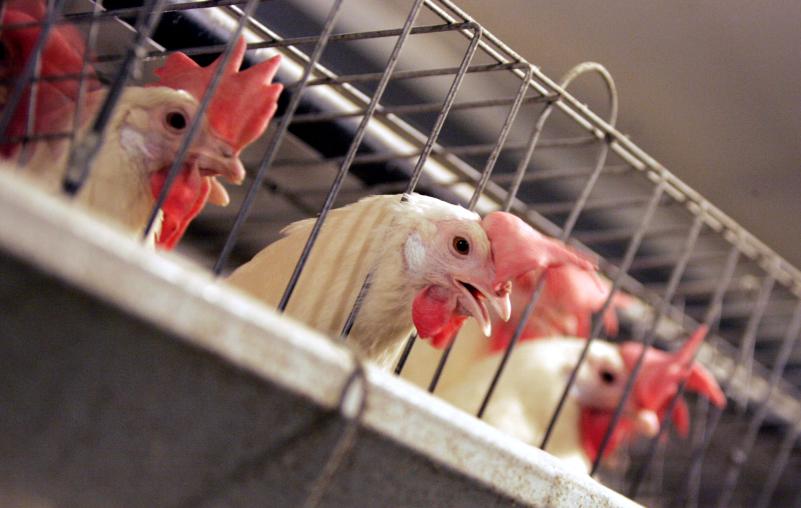
FILE-This Sept. 10, 2008 file photo, chickens huddle in their cages at an egg processing plant at the Dwight Bell Farm in Atwater, Calif. The New Year is bringing rising chicken egg prices across the country as California starts requiring farmers to house hens in cages with enough space to move around and stretch their wings. The new standard backed by animal rights advocates has drawn fire nationwide because farmers in Iowa, Ohio and other states who sell eggs in California have to abide by the same requirements. (AP Photo/Marcio Jose Sanchez,File)

The headlines in the mainstream Associated Press about the change in the California Chicken laws was:

chickenThe story which appeared in local papers nationwide focuses on how eggs will cost more because California now requires a minimum amount of space per bird.  The “big news” is all about dollars and sense!  The average retail price nationwide ranges from 15 cents to 20 cents per egg and economists predict the new California law will cause a jump in price from 10 to 40% making the highest price it may reach is close to 28 cents!

We know that from the perspectives of pure economics it makes sense to mistreat animals to squeeze as much profit as possible from the enterprse.  Thanks to Mark Bitman for printing “another side of this story.” 

nytBy Mark Bitman – December 31, 2014 – New York Times Editorial

The most significant animal welfare law in recent history — California’s Prop 2 — takes effect today. The measure, which passed by a landslide vote in 2008, requires egg and some meat producers to confine their animals in far more humane conditions than they did before. No longer will baby calves (veal) or gestational pigs be kept in crates so small they cannot turn around and, perhaps more significantly, egg-laying hens may not be held in “battery” cages that prevent them from spreading their wings.

The regulations don’t affect only hens kept in California. In 2010, Gov. Arnold Schwarzenegger signed into law a bill that extended the protections of Prop 2 to out-of-state birds: You cannot sell an egg in California from a hen kept in extreme confinement anywhere. For an industry that has been able to do pretty much what it wants, this is a big deal: It bans some of the most egregious practices.

Does limiting confinement for hens mean the end of cages? Maybe. It might become impractical for growers to build bigger cages; that is, it might be easier simply to keep hens in groups that meet the new minimum area required per bird, and so keep the hens “cage free.” That’s not a panacea, but it is an improvement.

The new minimum is not specified in numbers, but the courts have said that it “establishes a clear test that any law enforcement officer can apply, and that test does not require the law enforcement officer to have the investigative acumen of Columbo to determine if an egg farmer is in violation.” Hens must be able to spread their wings without touching a cage or another bird.

There is, however, another new state regulation — the so-called shell egg food safety regulation, aimed at reducing salmonella — enacted by the California Department of Food and Agriculture. This requires a minimum of 116 square inches per bird, compared with the current 67 square inches, which is less space than an 8-by-10 photo, and just a tad more than a standard iPad.

Prop 2 trumps this rule, and birds probably need more than 116 square inches to spread their wings. In fact, many experts think something closer to 200 square inches is more realistic. But some farmers may think they can get away with 116; law enforcement will determine whether they’re right, and noncompliance is a criminal offense.

The new regulations will probably raise the price of eggs. Surprisingly, as producers in California switch production systems to comply with the new law, eggs raised by so-called conventional means sometimes cost more than cage-free eggs. This belies the arguments that the conversion process is difficult or prohibitively expensive; it just shows that many producers failed to take advantage of the five years between the extension of the new housing standards to all birds, and its taking effect, to adequately prepare. What have they been doing instead? Predictably, filing lawsuits fighting Prop 2, all of which have failed.

That Prop 2 is supported by a majority of people in the country’s biggest ag state, and that its legitimacy has been supported by courts, shows the direction in which the raising of animals is headed. Gestation crates are on their way out, and battery cages will soon join them. With this measure, the table is set for similar action in states all over the country.

“We’ve worked on passing anti-confinement laws in 10 states now,” says Paul Shapiro, a spokesperson at the Humane Society of the United States. At least three other states are to take up similar legislation in 2015.

The most important part of the new law may be that every whole egg sold in California must adhere to the standards set by Prop 2, regardless of where it’s from. And since California can’t raise all the eggs eaten by its citizens, millions of those eggs — perhaps as many as a third consumed in the state — will come from elsewhere. From Iowa, for example, where more than 14 billion eggs are produced each year. (Interesting: There are just over 3 million people in Iowa, and nearly 60 million laying hens.) There has been talk of shortages, but they would be short-lived.

So, in California, just as you had to meet higher emission standards than required by federal law if you wanted to sell cars, now you must meet higher welfare standards for hens if you want to sell eggs. Whether farmers comply, or disobey, or leave the business remains to be seen. But Prop 2 means a new norm; eventually it will be, well, normal.

Just how high are the standards set by Prop 2? “By itself, the law means that many millions of animals will no longer be held in cramped cages, and that’s huge,” says Mr. Shapiro. “But the message it sends to the factory farming industry is clear: Business as usual — that is, subjecting animals to torturous conditions for their entire lives — is no longer going to be acceptable.”

Original Post

Summer Pre-College for High School Students in Sustainable Farming and Food Systems

UMass Pre-college Summer Program

Sustainable Farming and Food Systems

July 9 – 15, 2017

Apply Here

summer college flyer 2017 (2)

or for more information click!

Are you interested in learning more about where your food comes from? Or how does your food get to your plate? And where does the waste go afterwards?

2015-07-28 10.29.58Join one of the leading university Sustainable Food and Farming programs in the nation for an immersion in sustainability and food systems. In this one-week course, students will gain hands-on experience in the local food system as well as comprehensive understanding of the U.S. Food System. This program will focus on three areas in our food system:

  1. sustainability and systems thinking,
  2. social justice, and
  3. agricultural leadership.

This week will include at least 2 field trips and hands-on experience at local farms.

2015-07-30 10.32.01
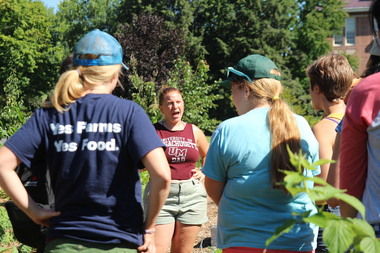
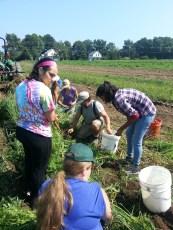
Students from 2015 working in the field

With a focus on sustainability, students will explore and analyze inequities present in our food system using systems thinking tools like concept mapping and iceberg models. Students will simultaneously participate in a UMass project growing organic food for local food relief organizations, such as Not Bread Alone soup kitchen and Amherst Survival Center, exploring both the food production and community engagement subsystems necessary to have a successful partnership addressing equity in our food system.

2015-07-30 10.18.18Finally, students will have an opportunity to explore their personal relationships to food, and lead each other in activities to deepen understanding how to change personal actions to impact our food system. This practice is important for students interested in leading, managing, teaching, and articulating various perspectives in sustainability.

Program Fees

Contact the instructor, Sarah Berquist at sbberqui@umass.edu …  for more information.

Apply Here

2015-07-30 12.07.34
Summer College Class 2015

Free food safety course offered by UMass

TO:  UMass Sustainable Food and Farming students

Please get certified! nancyc

Through a grant from the U.S. Department of Agriculture (USDA), the UMass Department of Nutrition has launched the Food Safety from Farm and Garden to Preschool online training program. The department has partnered with the University of New Hampshire Cooperative Extension to develop this free, online, interactive food safety program for early child care educators, foodservice staff, and parents.

The program is now available online at; www.umass.edu/safefoodfarm2kid

The program takes about 2-hours.  It is self-paced  and was created to help early childcare educators, foodservice staff, volunteers, and parents understand the importance of reducing the risk of food safety related to fresh fruits and vegetables in young children. The program includes five units:

  1. Farm to Preschool Benefits
  2. Fresh Produce and Foodborne Illness Risks
  3. Food Safety Basics for the Classroom and the Kitchen
  4. Food Safety and Gardening Activities
  5. Food Safety on Field Trips to Farms and Farmers’ Market.

Online discussion boards and printable resources such as Best Practices Planning Tools, resources, and Certificates of Completion are available and may be able to be used towards Professional Development requirements. The program is also offered as an in-person training workshop in Massachusetts and New Hampshire.

Nancy Cohen, Professor and Head of the Department of Nutrition and the Principal Investigator on the USDA grant, expects that through increased food safety knowledge and increased adoption of safe and healthy practices in Farm to Preschool (F2P) programs, that food safety risk will be reduced considerably for the hundreds of preschool children who participate in expanding F2P programs throughout New England.

“Over 400 participants from across the U.S. participated in the program in the first five weeks,” says Cohen. “Early indications show improved knowledge and planned behavior changes, not only in food safety practices, but in plans to increase gardens and fresh fruits and vegetables served. Research will continue to determine behavior changes as a result of the program.”

Original Post at: http://www.umass.edu/sphhs/news-events/nutrition-department-launches-farm-preschool-food-safety-program#sthash.g0O0TsHe.dpuf