Can the U.S. celebrate the International Year of Family Farming (without embarrassment)?

iyffThe United Nations declared 2014 as the International Year of the Family Farming (IYFF) and approved the following objectives:

  1. Promote policies in favor of the sustainable development of Family Farming by adopting concrete and operative measures and strategies, making budgetary allocations in support of Family Farming.
  2. Re-enforce the legitimacy of the farming associations to represent the interests of Family Farming in support of the making of farming policies.
  3. Increase awareness among civil society of the role of Family Farming.
  4. Achieve recognition of the role of women in Family Farming and of their rights.
  5. Advocate and defend an international economy of food products based on rules which foster development and food security in all countries.
  6. Promote investigation associated with sustainable rural development giving it human and financial resource.

fafo_2014_02To achieve these objectives, representatives of Farmers’ Organizations five continents met in Abu Dhabi on January 21-22, 2014, with the intention of developing specific policy recommendations.

In the statement agreed during the meeting, the participants reaffirmed that “Family Farming can and must become the cornerstone of solid sustainable rural development, conceived of as an integral part of the global and harmonised development of each nation and each people while preserving the environment and natural resources”.

“However, for this to be achieved Family Farming requires genuine public support which is non-existent today in most countries. A support which ensures the access to and control of land, water and other natural resources, to nearby markets, credit, investment and agricultural extension as well as equitable responses to the specific needs of rural women and youth”, emphasize farmers’ leaders.

Family farming organizations agreed on five main demands to be forwarded to decision makers during the IYFF-2014.

farmersunionIn spite of the support for this effort by the National Farmers Union in the U.S., the track record of U.S. policy has been anti-farmer for the past 60 years.  Wenonah Hauter writes in Foodopoly, “After World War II, farmers became the target of subtle but ruthless policies aimed at reducing their numbers, thereby creating a large and cheap labor pool.  In more recent times, federal policy has been focused on reducing the number of farms as labor has been replaced by capital and technology.” 

U.S. federal farm policy has been markedly pro agri-business and anti family farmer, in spite of the rhetoric of U.S.D.A. administrators.  While this policy has resulted in cheap food (consumers in the U.S. expend less than 10% of their income on average toward food) the effect on all other aspects of society such as public health, environmental quality, rural community vitality, and the economic viability of the family farm has been decidedly negative.

It will take a remarkable turn around in public policy in the U.S. if we intend to participate in the celebration that is the International Year of Family Farming! 

To learn more and support the New England chapter of the National Farmers Union, please consider joining this progressive voice in support of family farms.

joinFor a more complete story see: Will the International Year of Family Farming slow the “cancerous” growth of industrial farming?

Mushroom Growing Workshop for Stockbridge Students – Registration Required

 Free Workshop for Stockbridge School of Agriculture Students

Saturday, April 12 from 1:00pm – 3:00pm

at the Wysocki House in front of the UMass Agricultural Learning Center (911 North Pleasant St. – north of campus toward Puffton Village)

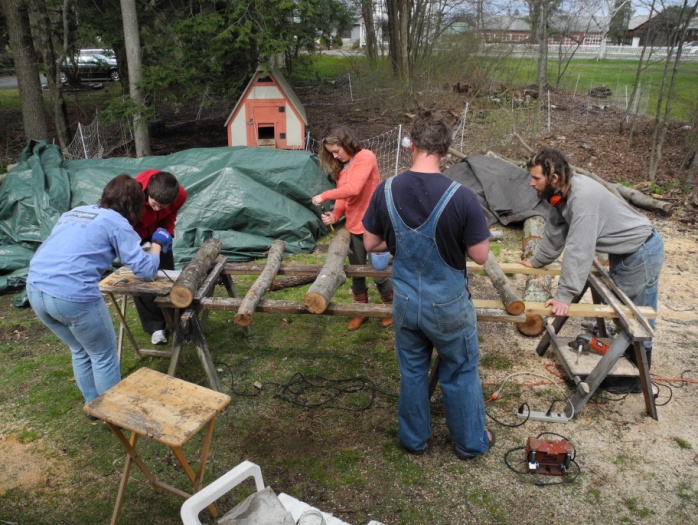
willie4Join Stockbridge graduate, Willie Crosby from Fungi Ally, for a hands-on workshop to learn the basics of growing medicinal and culinary mushrooms in your backyard. The workshop will focus on methods of growing mushrooms on wood using 3 techniques. Participants will learn the procedures of inoculating logs, totems, and woodchip beds and get to implement each one. Upon completion of the workshop students will have the knowledge and experience to cultivate mushrooms using these methods at home.

fwillie1willie2


—————————————————————————————————————

To register for this workshop, send an email to John Gerber with a contact phone number.  Willie’s workshops generally cost $25 but this one is being provided to Stockbridge students free of charge.

Summer Learning Internships in the Peruvian High Amazon

TO:  University of Massachusetts Students

FROM:  John M. Gerber, Professor of Sustainable Food and Farming

This month long internship opportunity in Peru is offered by a friend and colleague, Dr. Frederique Apffel-Marglin, a former Anthopology professor at Smith College.  I have had several students participate in one of her courses at the Sachamama Center for Biocultural Regeneration and the experience has been universally transformative.

If you are looking for a summer experience, please check this out and be sure to contact me if you want to earn academic credit for this internship.

Learning Internship Description

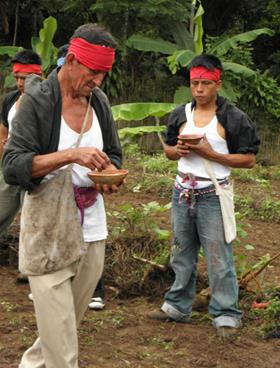
offerings.045327This internship will teach students experientially how to re-create the perennially fertile pre-Columbian anthropogenic soil known in Brazil as Terra Preta do Indio (black earth of the Indians). This soil contains a type of charcoal made with reduced oxygen, called biochar that never decomposes in the soil, retains nutrients and sequesters greenhouse gases by keeping them in the soil permanently. Students will learn to build a backyard biochar oven on the model of the successful oven at SCBR designed by its administrator, Randy Chung Gonzales. Professor F. Apffel-Marglin has been able to successfully re-create this pre-Columbian anthropogenic soil (which in SCBR we call by its Kichwa name Yana Allpa) and create extremely fertile food gardens on degraded lands in native communities as well as in several primary and high schools in the region, in collaboration with the school board of the Lamas Province. Students will learn from SCBR permanent technical team on its Yana Allpa project. This team consists of Ingeniero Teddy Saavedra Benzaquen and Girvan Tuanama Fasabi, a deeply knowledgeable Indigenous Kichwa young farmer. Students will be taken to visit native communities as well as some of the schools SCBR works with. Additionally, under the guidance of Professor Apffel-Marglin, students will experientially learn to relate to the earth in its many aspects as a Being – a Thou – with many different aspects rather than as an insentient, mechanical, natural resource there exclusively for satisfying some human need. Since SCBR is in an indigenous milieu, the living world of the local Kichwa indigenous people will help us to empathize and connect with that milieu without necessarily adopting their specific practices.

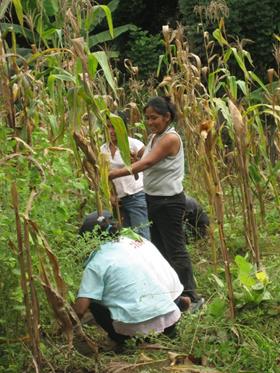
cultivatinginthechacra-huertoinshukshuyaku.050011This re-created pre-Columbian Amazonian black earth of millenarian fertility, discovered by archeologists in the last two decades, is able to give local farmers, both indigenous and mestizo, an affordable and successful alternative to slash and burn agriculture. This is urgently needed since this region has the highest rate of deforestation in all of Peru and degraded lands, where the forest is no longer able to regenerate, are growing alarmingly. This type of soil has in it biochar, a type of charcoal that allows the greenhouse gases emitted by plants and bacteria in the soil to remain in the soil and not be emitted into the atmosphere. It is a permanent type of agriculture, whereas slash and burn uses a field for only a few years, and then farmers must clear and burn another patch of forest to grow food. This type of biochar agriculture is both much more productive as well as able to strongly mitigate global warming at least three times over: by not cutting trees, not burning them and keeping greenhouse gases in the soil permanently. This recreated soil holds the promise of achieving food security and community-based food sovereignty for native communities as well as all small farmers and also holds the promise of greatly mitigating global warming. Much of this technology can be adapted to colder climates in the global North.

Further Academic Opportunities
Those students wishing to add readings and writing to this internship can work individually with Professor Apffel-Marglin to identify relevant readings and help with writing if that is desired by a student. Students of course always have the option of registering for an Independent Study in the following academic year with a willing and interested faculty in their own institution and thus gain credit for all or part of the work done at SCBR during the month of July.

Additional Possible Activities
• Students may also learn about Amazonian medicinal plants with Girvan Tuanama Fasabi who is a walking encyclopedia on that topic and grows them at SCBR.
• Students may also learn indigenous and mestizo organic “slow food” cooking with SCBR’s manager and chef, Profesora Ida Gonzales Flores.
• Students can learn in the indigenous section of Lamas, called Wayku, indigenous crafts such as ceramics, waist band weaving and more with an award winning Kichwa ceramicist and weaver, Manuela Amasifuen Sangama, at an additional cost of US $ 7.50 for an entire afternoon.
• Students wishing either to learn basic Spanish or improve their Spanish can take lessons with Abby Corbett, who has a graduate diploma in Spanish Language from the University of Louisville and several years’ experience teaching Spanish, for an additional cost to be negotiated directly with her at SCBR.

Cost
$ 1,400.00 per student; for the 31 days of July (July 1-31, 2014); includes room and board; local course related transport to visited communities; tuition to SCBR and instructors. Students are responsible for expenses incurred during their free days, although SCBR will provide a picnic lunch as well as breakfast and dinner on the weekly free days. This cost does NOT cover international air travel to and from Peru or to the city of Tarapoto where the nearest airport is located.

To reach Tarapoto in the department of San Martin, you take a flight to Lima (Peru’s capital), then a flight to Tarapoto (one hour flight; there are four airlines making daily flights Lima-Tarapoto-Lima) or a bus ride from Lima to Tarapoto (about 28 hours).  For international travel, the Panamanian COPA airline tends to be less expensive; major US airlines (United, Continental, American) also fly to Lima.
SCBR will pick up students at the Tarapoto airport for the half hour ride to Lamas.

Application
• Send a brief statement about yourself, your interest in this internship and background for it to Prof. F. Apffel-Marglin at: fmarglin@smith.edu ; If possible state which of these activities are most appealing to you and whether you are interested in guided readings and writing.
• Deadline: May 15, 2014.
• Non-refundable deposit of $ 150 due on June 1st, 2014. (payment information will be forwarded after applicants have been selected)
• Full payment due on June 15, 2014.

Frédérique Apffel-Marglin, PhD is Professor Emerita, Department of Anthropology at Smith College and Distinguished Visiting Professor, College of the Environment, Wesleyan University (2013-14). She founded SCBR in the Peruvian High Amazon in 2009 which she directs. (fmarglin@smith.edu; for more information see her biography on the SCBR website: www.casasangapilla.com/sachamamain

Pioneer Valley companies are investing in local produce to grow the economy and profits

By RICHIE DAVIS – Gazette Contributing Writer – Tuesday, January 21, 2014

Three homegrown food purveyors are changing the way they do business.

gazzzzThe three — Real Pickles, Artisan Beverage Cooperative and New England Natural Bakers — may all have slightly different objectives and techniques for putting a new twist on the way they do business, but they’re all examples of a trend likely to continue in the coming year.

It’s an innovative model for growing the local economy, as well as growing more food locally in a way that sinks deeper roots in the region.

“CISA has been saying that the next step for the committed consumer is to invest in local products, but there are not a lot of options for doing that,” said Sam Stegemen of Deerfield-based Community Involved in Supporting Agriculture and PV Grows, a collaborative that’s been tilling the soil for local investment in the food economy.

PV Grows oversees a $750,000 loan fund that’s helped a Hadley malt operation and a distributor for farms around the region, and plans to unveil a new investment fund this year that would let people with $1,000 or more to provide capital for fledgling farm and food initiatives.

Working with the Slow Money PV Chapter, which is also dedicated to funneling investors to help the local food system, PV Grows will present a Pioneer Valley Entrepreneur Showcase from 4 to 7 p.m. Tuesday at the Hampshire College Red Barn in Amherst, providing examples of how local entrepreneurs like the Artisan Beverage Cooperative have worked to solidify Katalyst Kombucha and Green River Ambrosia in the local economy.

The two decade-old Greenfield businesses, making distinct lines of beverages, had shared facilities, equipment and workers routinely at the Franklin County Community Development Corp. food processing center on Wells Street, but decided to change their ownership structures to merge the two businesses into a single worker-owned co-op.

“We kept two complete sets of books, with charge-backs to one another if, for example, we used the Katalyst Kombucha crew to do bottling, with reimbursements, and it got messier and messier to force that to be two separate things,” said Garth Shaneyfelt, a Green River Ambrosia founder who is now among seven worker-owners of the combined co-op, which expects to sell more than $1 million worth of beverages — one based on a 2,200-year-old, cultured Chinese drink and the other honey-derived mead products — throughout the Pioneer Valley and as far away as Florida.

“It makes a lot of sense,” Shaneyfelt said. “We’re all owners and are directly invested, so these are solid jobs, and we all make the decisions about where we expand and what we’re doing with products. There’s a lot consolidation of beverage companies in general, and natural foods and even small alcohol producers, so we’re able to say, ‘This is something that’s staying here, we’re part of the community. It feels pretty solid.’ ”

The same attitude prevails at Real Pickles, where seven workers are now members of the new worker-owned cooperative formed from what had been a private enterprise. There, the original partners worked with the state Securities Division to raise $500,000 in capital from 77 investors to buy out the business in less than two months — less than one-third of the time allowed, said founder and general manager Dan Rosenberg.

So far, about half of the workers have decided to become owners.

Increasingly, he said, when entrepreneurs start food-related businesses these days — especially here in the Pioneer Valley — they’re driven not solely by a profit motive, but also by wanting “to make some improvements in the world.” They also have a social mission to keep jobs in the community for the long haul and to have workers have a say in how the business is run.

“If someone’s interested in building strong local and regional food economies, a worker cooperative is a great way to keep the business in the community and not ship off jobs,” said Rosenberg, adding that the change has also added to workers’ sense that they’re truly invested in the business.

That’s the case, too, at New England Natural Bakers, now a worker-owned business that’s kept a hierarchical decision-making process that’s inclusive of the 50 employees.

The company, with about $12 million in sales — about 70 percent of which are in private labels for supermarket chains along the Eastern Seaboard — took out a loan of several million dollars to finance a buyout of the 35-year-old business, and has seen “an even greater amount of loyalty” by workers, as demonstrated by their exceeding what Broucek calls standard labor efficiencies.

“The Pioneer Valley has always been a hotbed of natural food companies in various forms, and the folks who have been in the management and ownership level of these kinds of establishments in general have been of the persuasion that wages should be more equal, that workers should have more say to make sure things are fair.”

Stegeman said Tuesday’s showcase — also featuring Amherst’s new All Things Local Cooperative Market, Northampton’s River Valley Market Cooperative, a proposed Mexican restaurant that features local meats and other businesses seeking local investors — will illustrate ways entrepreneurs are finding innovative ways to attract investment from people so committed to the local food economy that they’re literally willing to put their money where their mouths are.

In the case of Santa Oaxaca Taco Shop, for which El Jardin Bakery owner Neftali Duran is seeking alternative financing, the Oaxaca native hopes to set up a limited-menu eatery, possibly with a pub, that’s sustainable, affordable and serves good food with an option for customers to choose local meats and other ingredients

“If people are willing to pay a little extra for local, so be it,” says Duran, who’s thinking such a “realistic, very simple taco shop” serving southern Mexican fare could work in Greenfield, depending on who he’s able to find as a partner.

Such are the possibilities, say food entrepreneurs, to keep it local.

“There are a lot of businesses out there doing what they need to do and saying, ‘We’re not going to get big loans, so we’ll get investors,’” Stegeman said. The classic “fast money” investment story is to sell the business after 10 or so years so investors can get their money back, he said, but that runs counter to the notion of a business with roots in the community, one that will remain true to a principled local-first mission even after the founding owners move on.

Shaneyfelt said that in this area, there’s a lot of support for alternative approaches that are aimed at preserving and strengthening the locally rooted economy.

“It’s a really viable alternate economic structure,” he said of the new Artisan Beverage Cooperative approach. “We’re still doing the capitalism thing, I’m still using Quickbooks, we’re still sending invoices, and taking in money and paying the bills. And we’re working with other cooperatives.”

Source URL:http://www.gazettenet.com/news/townbytown/northampton/10310707-95/the-big-return-area-companies-are-investing-in-local-produce-to-grow-the-economy

UMass food services expands efforts to serve sustainable food

By SCOTT MERZBACH – Monday, January 13, 2014 in Daily Hampshire Gazette

dinnngAMHERST — The University of Massachusetts is amping up efforts to rely on locally produced food with the Real Food Challenge, a national movement pushing colleges to adopt more sustainable food practices, and a two-year grant from a Boston-based foundation.

The Real Food Challenge at UMass has set a goal of ensuring 20 percent of all food served at UMass is “real food” by 2020. “Real food” is defined as food that is grown locally and regionally, is organic, and is sustainably grown, humanely raised and produced with fair trade principles.

Participation in the challenge received boost this fall when UMass snagged a two-year, $485,000 grant from the Henry P. Kendall Foundation of Boston, which aims to make contributions toward creating “a resilient and healthy food system in New England that increases the production and consumption of local, sustainably produced food.”

“We’re hoping this grant will be a catalyst for progress to this goal over the next couple Continue reading UMass food services expands efforts to serve sustainable food

“Breaking Bad” in the heart of the corn belt

authorThe author of this article titled “Large-scale farming is Iowa’s Breaking Bad” which appeared in the DesMoines Register, teaches at University of Northern Iowa.

This could not have made some farmers happy in Iowa, as the most financially successful are “hooked” on industrial agriculture.  I don’t think we can blame the farmers…..

==================================================================

The TV series “Breaking Bad” has ended, but the real thing goes on in Iowa just as bad or much worse. And I am not referring to meth business, which we know is thriving in Iowa, unfortunately. The Waterloo-Cedar Falls Courier reported in November that the Tri-County Drug Enforcement Task Force seized nearly $2 million of methamphetamine in the last three months, including $1 million worth in the first two weeks of October alone. Seventy some meth labs were investigated in 2012.

As Nick Reading put it in “Methland,” “all drug epidemics are only in part about the drug. Meth is indeed uniquely suited to Middle America, though this is only tangentially related to the idea that it can be made in the sink. Meth’s basic components lie equally in the action of government lobbyists, long-term trends in agricultural and pharmaceutical industries, and the effects of globalization and free trade.”

During a conversation over coffee, I asked several friends what enterprise in Iowa would parallel the tragedy portrayed in “Breaking Bad”? To my surprise, without missing a beat, several people independently nominated commodity agriculture and the vast network of global corporations behind it.

Industrial commodity agriculture is entirely based on acres. It does not need stable communities. All that is needed are land, machinery, energy and chemical inputs to produce one or two products for distant markets. Civic organizations, schools, churches, libraries, rural businesses are all unnecessary to “feed the world” or to fuel ethanol plants. Long-term anthropological studies in many rural communities in the U.S. have confirmed these realities. As we have seen all over Iowa, in once-thriving towns a gas station and, if you are lucky, a bar are all that’s left.

Think of coffee or banana plantations. The markets are not local, the benefits go elsewhere, farmers receive very little, which means rural poverty. It’s the same in Iowa.

Sociologists and economists report that markets in nearly every agricultural sector (corn, beans, beef, hogs, corn processing, etc.) are all controlled by a handful of global corporations, leaving farmers as price takers while production expenses rise. Add soil erosion, water pollution and below-poverty wages for food sector workers, and the result is rural decline and desperate situations that are the habitat for the meth enterprise.

Among key ideas so masterfully brought to life in “Breaking Bad” were the fact that extraordinary and tragic things go on in ordinary days, in ordinary neighborhoods.

In an ordinary day in Iowa, there is pesticide drift from an aerial sprayer into your kitchen, a giant fish-kill from a manure spill, respiratory illnesses among rural residents living near confinement hog operations, atrazine and nitrate in your rural well water, salmonella poisonings from factory chicken farms with proven records of evading public health laws, and flash floods downstream due to degraded soils and impaired watersheds upstream. You are watching a season of “Breaking Bad” in Iowa.

The TV series made it abundantly clear that the waves of tragedy emanating from the meth enterprise reach far and wide and manifest their violence in ways not clearly traceable to meth. One example was the father who has a hard time dealing with the loss of his daughter who had died of meth overdose. He works as an air traffic controller and, in a moment of weakness, he neglects to warn the two passenger planes approaching one another in time. Two plans collide, with hundreds dead.

In Iowa, more than 6 million pounds of the weed killer atrazine are applied annually. This hormone-disrupting chemical is banned in Europe because of its likely connection to breast cancer and other chronic illnesses. The rate of Parkinson’s disease in the Midwest is twice the national rate, and corn and soybean pesticides are among the suspects.

As the city of Des Moines struggles at high costs with off-the-chart levels of corn fertilizer in its drinking water source, the livelihood of hundreds of fishermen in the Gulf of Mexico has diminished due to excessive corn fertilizer run-off from the Midwest down the Mississippi River.

We must chart a different path. Many Iowans are striving to change all this. They include farmers who are practicing good agronomy based on ecological understanding of the land, integrating crops and livestock, grass-based production, long-term crop rotations, organic practices.

Groups across Iowa are expanding local markets for local agricultural products to create new opportunities for beginning farmers and create markets that are fair. They include food service directors and restaurant owners who support these farms. They include ordinary Iowans who value the way these farmers are growing their food and are making a point of supporting them and the land stewardship they practice.

They include Practical Farmers of Iowa, a network of farmers and others who are proving that a sane, productive, profitable, system of food and agriculture is possible and practical.

We need state and federal policies that support these forms of being in Iowa rather than breaking bad.

Original Post

History-making day for Boston urban agriculture

Rachel Greenberger reported that….

This morning in City Hall, by unanimous consent, the Zoning Commission passed Article 89, a progressive series of measures to pave the way for farming in Boston.

At the request of Mayor Tom Menino, Edith Murnane of the Mayor’s Office of Food Initiatives and Tad Reed and Marie Mercurio of Boston Redevelopment Authority have led an incredible nearly two-year charge, convening a Urban Agriculture Working Group in the process, to reach this day.

“Urban agriculture is currently forbidden,” Tad Reed told the board and the room of citizens and stakeholders who turned out in support, “because it has not been addressed in the zoning code to date.”

Higher Ground Farm
Higher Ground Farm

Article 89 concerns commercial agriculture only and does not touch current code pertaining to gardens for personal use. Its focus areas are ground-level farming, open air roof-level farming, and rooftop greenhouses. It also addresses on-site composting, soil safety and raised beds, and the keeping of hens and bees.

When Chairman Bob Fondren invited public comment, ten citizens, local leaders, and business people stood to speak in support of Article 89. No one stood to speak against it.

Article 89 then passed by a unanimous vote.

Edith Murnane had tears in her eyes as I hugged her and congratulated her for her impeccable work.

Now Article 89 goes to Mayor Menino’s desk for signature. Considering that the Mayor requested this initiative in the first place, there is little chance of impediment.

This is a Red Letter Day for Boston, which now joins the ranks of urban-agriculture progressive cities like New York, Portland, Chicago and Madison. As Bruce Bickerstaff put it, “not as a novelty but as a legitimate business proposition in a burgeoning industry.”

Original Post –  by Rachel Greenberger

——————————————————————————————————————

Anyone interested in this work may also be curious about our Urban Agriculture Online class at UMass.  Check out our online program here:  ONLINE UMass Certificate in Sustainable Food and Farming.

Margaret Christie & Philip Korman: Taking action in the cause of local food

Margaret Christie & Philip Korman; CISA – Daily Hampshire Gazette Editorial

December 10, 2013

Luckily, we are well-nourished for that effort — stomachs, hearts, and souls — by our local farms.

During this anniversary year, we set an ambitious goal at CISA to double the amount of local food in the diets of Pioneer Valley residents. In the next 20 years, we’ll make local food a full quarter of our diet as a region. As an organization, our next steps toward reaching that goal include providing more support for new farmers, increasing the availability of locally grown food for Hampden County residents and aiding the businesses that connect farms and tables — processors, retailers, institutions, restaurants, and distributors, for example.

Filling your family’s table with food from local farms is a delicious way to support farm businesses in your community, and is perhaps even more meaningful during special holiday meals. But you can do more to build a vibrant local food economy.

Using the power of our food dollars and our strength as active, engaged citizens, we can create a local food system that nurtures our families, our communities, our economy and our environment.

Doubling the amount of local food in our diets will require new infrastructure, new businesses and new market outlets, as well as the financing, public policy, support services and enthusiastic customer base to ensure their success.

This big goal brings together many organizations with diverse interests in the Pioneer Valley: economic development, public health, food access and the environment, for example. Ultimately, though, to succeed, it must be a community effort, and there’s a role for everyone.

CISA’s new publication, “Eat Up and Take Action for Local Food,” provides resources and encouragement to bring your love of local food to your workplace, your neighborhood and your friends and family.

The publication includes stories of local people and businesses that are going the extra mile for local food. You can read about the Springfield Food Policy Council, where residents come together to fill gaps in the city’s food system and champion such initiatives as a new city ordinance that supports gardening in the city. At Cooley Dickinson Hospital, wellness policies encourage employees to eat more fresh food from local farms by allowing employees to pay for a CSA share through payroll deduction, pick up the farm share at the hospital, and earn wellness credits by joining a CSA.

Or learn about Greenfield’s Real Pickles, which cemented its commitment to local ownership by forming a worker-owned cooperative and funded the co-op’s purchase of the business through a highly successful community investment campaign that raised half a million dollars.

“Eat Up and Take Action” also provides ideas for how you can take action. Here are just a few, both large and small:

• Bring a friend to the farmers’ market.

• Volunteer at your school garden or community farm.

• Become a local foods entrepreneur.

• Tell your child’s school that you’d like more local food at lunch.

• Make your workplace local-food-friendly: bring local snacks to meetings, add local-food-related benefits to your health insurance options, or give a corporate gift that supports local food.

Eating fresh, seasonal food nourishes our connection to the land where we live and the people that grow our food. It supports our local economy, creating jobs and increasing our economic resilience. It gives us a way to take concrete, hopeful action, every day, to address some of the big problems facing us: climate change, corporate power, a fragile global economy.

And it provides a route to building a local food system that nurtures our community for the long term.

Realizing that vision may require us all to do a bit more, to think about how we can promote and support local food not only at our dining tables but in the board room, break room, cafeteria, fitness center and town meeting room. Eat up and take action for local food. Find the report at www.buylocalfood.org.

Margaret Christie is special projects director and Philip Korman is executive director of Community Involved in Sustaining Agriculture.

Original Post

Pioneer Valley Food System Resources

We live in a region in which awareness of the value of local food and building a vibrant local food system is strong.  I’ve collected some of the reports that have done analysis of the current situation and made proposals for continuing growth below.  I hope you find these useful.  IF YOU KNOW OF OTHER REPORTS, PLEASE LET ME KNOW!

PIONEER VALLEY

nohoA newsletter on efforts in Northampton to encourage production, purchasing and consumption of local food.

 A report on food security in Franklyn County, MAfrank

Pioneer Valley Planning Commission Food  pvpc
Security Plan – Nobody goes hungry!

A Pioneer Valley Report on the potential for a  localjobsstrong local food economy to create jobs.

A report on how a 25% shift in food buying in the 25%Pioneer Valley can have a huge impact on the local economy.

CISA has a new publication on how to get involved in the  local food movement. 

cisaeatNEW ENGLAND REPORTS

A vision for a robust New England Food System. newenglN

NATIONAL REPORTS

Here is a regional research project which focused on Iowa but demonstrates the impact of building a healthy local food system.

Check out this national publication which studied the impact of local food investments.

A research journal article on the value of local food.

An Orion Magazine article on rebuilding a local foods infrastructure.