As I begin a year long sabbatical leave from my teaching job at UMass, I’ve been thinking once again about what agriculture means to me. In preparation, I re-read an essay I wrote years ago called “Agriculture is a business and a conversation with the divine.”
If you click on the title, you can find the essay…..
I think when I wrote this essay I was hesitant to use the word “divine”. Today, I find it easier talk about my relationship with the divine, whether that be God, the Buddha, the Tao, some “power greater than ourselves”, or whatever way we choose to think about the non-material. Of course, agriculture has its very important “material” aspects, but it is the spiritual connection that I’m thinking about today.
In the essay I refer to Wendel Berry’s quote “eating is an agricultural act.” Berry presents a few ideas on how we may each connect with the universe or the divine through food and farming.
——————
He suggests that we:
participate in growing food to the extent that we can,
prepare our own food,
learn the origins of the food we buy,
deal directly with a local farmer, and;
learn more about the biology, ecology and sociology of our food.
I would add to the list, composting all usable kitchen and garden “wastes”, as a necessary means of reconnecting with the non-human part of the universe.
——————
I wonder if you agree? Can you think of other ways in which we might renew and sustain our connection with “something bigger than ourselves” through food and farming?
The UMass Student Farm provides Sustainable Food and Farming majors a real world experience in farming and marketing. One of the major buyers of our produce is the Big Y World Class Market!
Farming is growing in popularity among recent college graduates, fed by concerns over nutrition and a weak job market.
The 24-year-old new owner of Full Heart Farm in Ledyard is one of them.
Allyson Angelini, who graduated from the UMass Sustainable Food and Farming program, last week took over the 6.25-acre property at 193 Iron St. She plans to get married on the farm in about a year.
“It doesn’t take much to fall in love with farming,” said Angelini, who gave up a desire to be a magazine journalist and instead got an agricultural education degree from the University of Massachusetts Amherst in 2009. “And farming is really cool now, and that feeling is growing.”
Erin Pirro, who supervises the Outstanding Young Farmer program in Connecticut, agreed.
“Farming is becoming sexy again,” she said. “Americans have become out of touch with their food supplies. There’s a lot of passion for locally grown food.”
Farming still has a predominately older demographic, according to the U.S. Agriculture Census. For every farmer under 35, there are six over 65, the latest census said.
Angelini’s age enabled her to be considered “disadvantaged” by the U.S. Department of Agriculture’s Farm Service Agency, making her eligible for the agency’s Beginning Farmers and Ranchers loan program.
Angelini has traveled in 5.5 years of researching farming, including working at a Stonington educational facility known as Terra Firma Farm and on a pork farm in Italy. She left her job at Jones Family Farms in Shelton in September to try to secure a farm in New London County.
Encouragement and assistance from elders is encouraging more 20-somethings to go into farming, Angelini said. Bob Burns, owner of Aiki Farms in Ledyard, was recently at Full Heart Farm, using his John Deere tractor to plow and harrow a portion of the land.
“(Angelini) is a delightful person, and Aiki Farms will support them as neighbors and fellow farmers,” said Burns, who is manager of the Ledyard Farmers Market, where Angelini plans to sell some her crops including beans, carrots, potatoes, squash and tomatoes.
Her parents, Greg and Sally Angelini, have been coming to Full Heart to help. Brother Ryan Angelini, who works at Electric Boat Corp., has also been assisting with repair projects. Keith Padin, Allyson Angelini’s fiancé, is a full partner in Full Heart, and his parents recently made their first visit to the farm.
“It’s hard to start a family farm without family around,” Allyson said.
Allyson and Keith are promoting that family feeling by giving names to each of their chickens and pigs.
Locally raised meat and produce strengthens family ties, Angelini said. And — on pure taste alone — local farming competes strongly, she said.
“Once you have farm-fresh eggs and homemade bacon, you never go back,” Angelini said.
Love of animals and land is not enough for a farmer these days, Angelini said.
“Young farmers need a wide skill set,” Angelini said. “There is so much diversity in the farm habitat.”
I’m being interviewed today by a reporter who wants to know about trends in New England agriculture. So in preparation, I’ve pulled up the following facts (and thought I’d share them here as well). For example, did you know that:
While the number of farms nationally continues to decline, farms have increased about 5% in New England since the last Ag Census to around 35,000 farms.
The land in agriculture has also decreased nationally, while land in productive farming in New England has increased by about 4% to 4.2 million acres.
Farmland in New England is being converted from hay production to more valuable crops such as nursery crops, small fruits and vegetables.
Beginning farmers (those with less than 10 years of experience) declined nationally but increased in New England.
The fastest growing demographic category in New England agriculture is in farms managed by women, up 15% in the past 5 years.
And in Massachusetts:
Massachusetts was one of only 10 states that saw an increase in both the number of farms and land in farms.
Massachusetts operators include a greater percentage of women and a relatively high percentage of beginning farmers.
Massachusetts crops feature an emphasis on nursery crops, and a good amount of fruits, nuts and berries.
The sales channels in Massachusetts are also different than the national norm, with unusually strong direct- to-consumer sales, direct sales to retail outlets (such as stores, restaurants, and institutions), and community supported agriculture (CSA) arrangements.
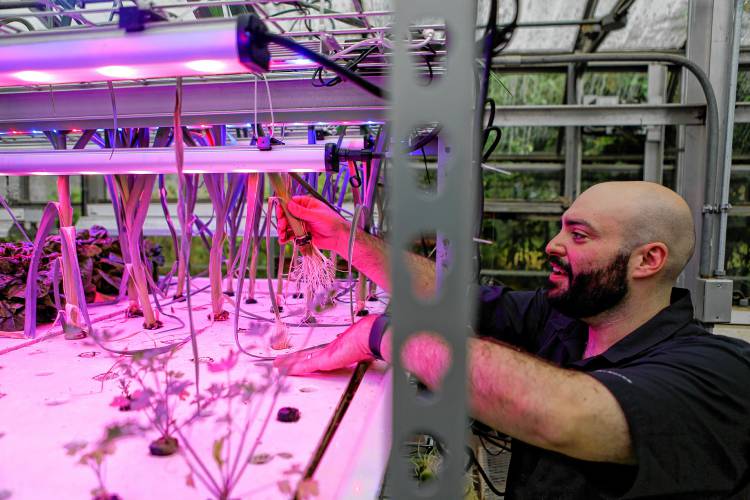
Evan Chakrin, harvests leeks from a hydroponic raft bed Aug. 4, 2017 at the new UMass Hydrofarm he co-founded at the university with Dana Lucas, 21, a senior studying Sustainable Food and Farming. Overhead, LED strip lights supplement daylight for the plants.
AMHERST — Evan Chakrin, 33, spends his summer afternoons harvesting plants, mostly lettuce, at a hydroponic food farm.
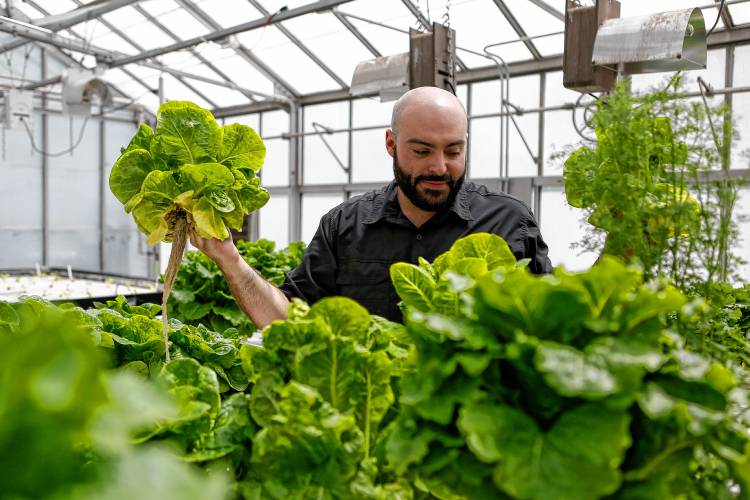
He worked Friday afternoon, harvesting 10 pounds of lettuce that he was planning to donate to the Amherst Survival Center. He picked a head, doused it in insect soap and packaged it in a clam-shaped container.
Evan Chakrin harvests butterhead bibb lettuce
The hydroponic farm grows food without using soil. Started in the winter of last year, it is the first of its kind on the University of Massachusetts Amherst campus. The farm provides food for on-campus restaurants such as Earthfoods Cafe.
Chakrin, a junior studying horticulture, co-leads the farm with Dana Lucas, 21, a senior studying Sustainable Food and Farming, using techniques that they say will revolutionize the future of farming.
“It’s basically just using science to grow plants,” Chakrin said. The farm grows everything from strawberries and tomatoes to lettuce and kale. It is housed in an underutilized greenhouse on the UMass Amherst campus. Chakrin and Lucas use the most common hydroponic techniques to grow their plants: raft systems and nutrient film technique channels.
Evan Chakrin displays the roots of strawberries growing in watertight channels using the nutrient film technique
The basic idea behind hydroponic farming is growing plants without soil, Chakrin said. Nutrients get dissolved into water surrounding the plants’ roots. This allows the system to be up to 90 percent more water- and nutrient-efficient than other types of farming. The system uses less water than an irrigated field. There is also no nutrient runoff into local water sources.
“We can totally control whatever we waste,” Chakrin said.
Lucas started working on the idea of creating a hydroponic farm in 2015, but she and Chakrin were not able to secure a grant until last December. The two received $5,000 and a previously underused greenhouse from the Stockbridge School of Agriculture.
“We were expecting a little space on campus, basically just a closet,” Chakrin said. “Then they surprised us with this.”
As soon as they got the space, they started working right away. They started germinating seeds, and by the middle of February, all of the systems were up and running. They then started selling their food to places on campus. The money from the sales goes into a fund that they can use to purchase more equipment or seeds.
Chakrin said selling the products allows them to be financially stable and gives the business a fresh, locally produced food option.
The farm will continue to grow in the years to come. In the fall, the two are teaching 12 undergraduate students in a one-credit practicum course about hydroponic farming.
The university offers many courses on the theories and science behind farming but not many on hydroponic techniques. Allowing other students to work in the farm gives them hands-on experience, Chakrin said.
“The techniques we use here are the main hydroponic techniques used,” Chakrin said. “This work is directly applicable to any of their food production goals.”
Chakrin said he hopes any students who are involved in urban food production get involved, even those not involved in the Stockbridge School of Agriculture.
The two also want to scale up their sales. Chakrin said he is hoping to start selling to bigger dining halls and other places on campus.
One of the benefits of hydroponic farms is that they can be used to grow food locally, even in urban areas. The lettuce grown at the UMass farm doesn’t come from some giant farm in California, Chakrin said. This reduces shipping costs and carbon costs for interstate shipping.
“I think it is a major loss that the average bite of food travels extremely far to get to our plates, and this is the solution to the problem,” Lucas said.
Lucas and Chakrin have started a consulting service for the future of farming, called Farmable. Lucas said the idea behind it is that any space, even small urban areas, can be made into a green space.
“Anywhere is farmable and this concept will revolutionize how urbanites are able to access food,” Lucas said.
The Princeton Review Ranked UMass Amherst No. 1 for Best Campus Food
At least part of the reason for this is the strong commitment to buying local food and supporting the UMass Student Farm!
————————————————
AMHERST, Mass. – The Princeton Review today ranked the University of Massachusetts Amherst No. 1 for best campus food in the nation.
After being ranked among the top three schools nationally since 2013, news of the No. 1 ranking is being celebrated by UMass Dining staff, who have worked tirelessly to achieve national recognition, says Ken Toong, executive director of Auxiliary Enterprises at UMass Amherst.
The university was among the schools featured live on NBC’s Today Show on Tuesday, Aug. 30. Sam the Minuteman, the UMass mascot, made a guest appearance and delivered a tray of delicacies, including pork sliders and Napoleons.
Robert Franek, senior vice president of Princeton Review, praised the university’s dining as “fresh, local and delicious” and called UMass Amherst “a glorious place … nourishing the body as well as the mind.”
“This honor is shared by every member of our staff who work each day to serve healthy, sustainable and delicious meals to our students,” says Toong. “This ranking is also a tribute to our students, whose high expectations drive our team to excel.”
“We’re pleased to see that The Princeton Review has recognized what all of us at UMass Amherst have long known: when it comes to college food, UMass Dining can’t be beat,” says Chancellor Kumble Subbaswamy. “Congratulations to the entire UMass Dining family.”
The rankings of the top 20 schools in 62 categories in The Princeton Review’s The Best 381 Colleges, released Aug. 29, are based on surveys of 143,000 students at the schools in the guide.
UMass Dining is now the largest college dining services operation in the country, serving 45,000 daily meals or 5.5 million per year. Since 1999, overall participation in the university meal plan has more than doubled, from 8,300 participants to more than 19,200.
The award-winning UMass Dining is a self-operated program committed to providing a variety of healthy world cuisines using the most sustainable ingredients. UMass Dining incorporates recipes from accomplished chefs and nutritionists as well as principles from the Culinary Institute of America and Harvard School of Public Health to its cycle menu. UMass Dining is known for being among the most honored collegiate dining programs in America by many national organizations. For the past six years, UMass Dining has been selected to the Princeton Review’s Best Campus Food list. Previously, it was ranked No. 10 in 2012, No. 3 in 2013 and 2014, and No. 2 in 2015 and 2016.
Produce prices at your local Chinatown are likely a fraction of what they cost at other supermarkets, and if you’ve wondered why, you’re not alone. In an investigative report for the Wall Street Journal reporter Anne Kadet admits she always assumed the low prices were a reflection of subpar produce. But a deeper investigation of New York’s Chinatown with author Valerie Imbruce led her to the opposite conclusion, and reveals the hidden truths behind the neighborhood’s fruit and vegetable supply chain.
The markets reduce prices by negotiating bulk discounts from wholesalers, said Wellington Chen, director of the Chinatown Partnership Local Development Corp.
Imbruce, who’s researched the Chinatown produce economy for over a decade, is the author of From Farm to Canal Street: Chinatown’s Alternative Food Network in the Global Marketplace. In the Journal she distills to Kadet the real reason Chinatown can keep prices low: “Chinatown’s 80-plus produce markets are cheap because they are connected to a web of small farms and wholesalers that operate independently of the network supplying most mainstream supermarkets.” While most of the rest of New York’s markets get their produce from the Hunts Point Market in the Bronx, Chinatown sellers work directly with small neighborhood warehouses. Since they’re operating in close geographic proximity, they can get fresh produce throughout the day from wholesalers, and therefore don’t need
Markets also cut costs by eschewing extra technology and certain aesthetic choices—the Journal points out that shelves “are typically made of plywood and lined with newsprint,” prices are scrawled on cardboard instead of printed on stickers, and credit cards are not always accepted. Chinatown retailers also manage to cut costs by “negotiating bulk discounts from wholesalers,” Kadet notes.
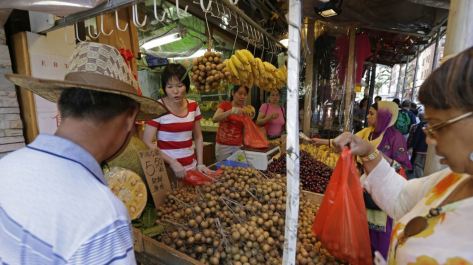
People shop at one of Chinatown’s many green grocers along Mott Street in NYC
“All this translates into low overhead for the retailers—and low prices for shoppers,” the article points out. “The typical Chinatown produce markup is just 10% to 12% over wholesale, said Wellington Chen, executive director of the Chinatown Partnership Local Development Corp.”
And then there’s the variety. In Chinatown, Imbruce says, you can find anything from jackfruit to fuzzy squash and baby Shanghai bok choy, in addition to almost 200 other fruits and vegetables. Wholesalers in Chinatown source these interesting items from family farms growing Asian vegetables in Florida or Honduras. Imbruce mentions that she has visited more than 75 of these farms and saw very little exploitation; in fact, they were happy to be working for Chinatown wholesalers “because they could cultivate an array of crops, leading to economic and agronomic stability.”
But what may keep Imbruce coming back is, as she puts it, the adventure of learning about other fruits and vegetables. “It’s just a fun, happy place to go…And it’s always bustling.”
July 23, 2017 – BAY SHORE, N.Y. — Jim Adams met his wife on a trip to Uganda a decade ago. Rosette Basiima Adams, 35, grew up in Kasese, a town, she said, where “everything we ate, we grew.”
“I went to see the gorillas in the Congo,” Mr. Adams, 42, recalled recently. But he left his tour group and ended up meeting Rosette, who was working at a hostel where he stayed.
Today, the couple are trying to grow a business cultivating crops on suburban lawns on Long Island. Their business, Lawn Island Farms, is the result of research and a desire to find a way to farm on the island.
“A lot of it was seeing America through Rosette’s eyes,” Mr. Adams said. In his wife’s hometown, he added, “all their food comes from within miles.”
With lots of ideas and little money, the Adamses began looking for land to farm. They started an online fund-raiser and posted fliers asking area residents to consider turning their lawns into small farms.
“There’s definitely an interest,” Mr. Adams said. “People say, like, ‘How do we replace the lawn and make it into a productive system?’”
The Adamses have received more inquiries than they can handle.
For now, the couple is farming at two locations in Bay Shore: one is a homeowner’s front lawn; the other is behind St. Peter’s by-the-Sea Episcopal Church.
They sent the additional inquiries they received to Pennie Schwartz, a home-farmer in Southold, farther east on Long Island.
Ms. Schwartz, 61, a retired chiropractor, said she wanted to help the Adamses turn each inquirer’s lawn into “an edible space.”
“It’s called foodscaping,” she said. “It’s really getting people to understand that lawns are really environmental energy suckers, for lack of a better word.”
Ms. Schwartz studies permaculture, a phenomenon that she said “combines landscape design with sustainability and environmental ecology” — and holds a certificate from Cornell.
“I don’t want to put the lawn guys out of business,” she said. But, “with all the chemicals that go into it, and all the watering we have to do to keep it green, there are better ways and better things to do.”
Ms. Schwartz wants to set up systems that landowners can maintain independently; each system should meet the landowner’s needs.
In other words, a family with children can still have a swing set.
On the two properties they farm, Mr. and Mrs. Adams are cultivating crops that grow quickly and that do not require much space, like salad greens and radishes.
One evening last month, the Adamses’ 9-year-old twins, Daisy and Curtis, ran through the front yard farm here on Hyman Street in pursuit of a rabbit.
Ms. Adams planting sunflowers in Ms. Trimarco’s lawn. Ms. Adams grew up in Kasese, Uganda, a town, she said, where “everything we ate, we grew.”CreditJames Estrin/The New York Times
Mr. and Mrs. Adams had just planted sunflowers when the homeowner, Cassandra Trimarco, drove up.
Ms. Trimarco, a physician assistant, contacted the Adamses after noticing their flier at a coffee shop.
“It’s me kind of donating in a way rather than controlling, because I don’t control anything, and it’s wonderful,” she said. “They think they’re lucky, but I think I’m lucky.”
Taking part in gardening can make a child feel happy and boost their development, research suggests. A study of 1,300 teachers and 10 schools commissioned by the Royal Horticultural Society (RHS) found children in schools that encouraged gardening became more resilient, confident and lived healthier lives. Check this out here.
TO: Stockbridge Students who have taken classes in French Hall
FROM: John M. Gerber, Professor of Sustainable Food & Farming
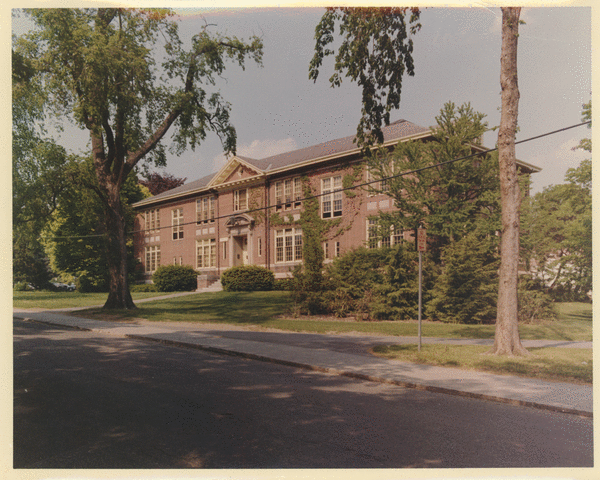
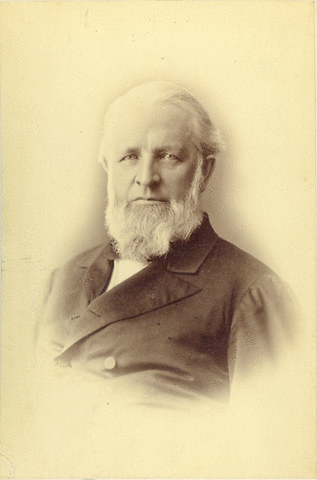
While you were studying horticultural plant pathology with Bess Dicklow, or sustainable agriculture with Katie Campbell-Nelson, or visiting your adviser Doug Cox or Susan Han, did you ever wonder who French Hall was named after? Probably not.
You have surely walked by the plaque near the front door commemorating Henry Flagg French, the first President of Massachusetts Agricultural College (Mass Aggie).
A native of New Hampshire and graduate of Dartmouth College and Harvard Law School, French loved agriculture but spent most of his career as a lawyer and a judge. He operated a farm, did his own agricultural research and was considered a leader in the emerging application of science to agriculture.
French held the post of president for two years, resigning in 1866 even before any students had arrived. According to Henry Bowker, a student who entered Mass Aggie with the first class in 1867, and remained connected as an alum and trustee for many years, “Judge” French “was a keen, sensitive man, with q good mind, highly trained and well informed, rather distant in manner, but kindly in nature.” Professor French was said to be well ahead of his time in his thinking on agriculture.
His short stay as President seems to have been because of an argument with the Board of Trustees (not an uncommon problem for college presidents then and today) over the proposed placement of new buildings. It seems that the original design for the campus was created by the famous architect who designed Central Park in N.Y. City, Frederick Law Olmsted. In 1866 the Trustees of Massachusetts Agricultural College requested that Olmsted, provide recommendations for the grounds of the newly formed institution.
Olmsted recommended that the college as a whole be modeled after a typical New England village. The Board of Trustees did not like the plan, fired Olmsted, and proceeded place buildings in a more expansive manner, spread farther apart among the fields. French seems have sided with Olmsted, and lost.
After leaving Mass Aggie, French moved to Washington D.C. and served as Assistant Secretary of the Treasury on the President’s Cabinet. He also authored a book titled “Farm Drainage” which described the way a particular type of drain was used called a “French Drain” which were probably invented in France but popularized by Professor French.
While here for only a few years, “Judge” French had a lasting impact on the policies and core values of the new college. The following was taken from a report he wrote: “Our college is to be established as part of the great scheme of public education…., not as a rival to our other excellent colleges, but as a co-worker with them in a common cause.”
Remember that prior to the Morrill Act of 1862, signed by President Lincoln, all of the colleges in the U.S. were private institutions offering education only to the wealthy. Levi Stockbridge himself, was frustrated because his father could only afford to send one of his son’s to Amherst College, and his older brother Henry was chosen. Nevertheless, Levi attended classes with his brother, and was mentored by Amherst College President Edward Hitchcock in chemistry. Public institutions, such as Mass Aggie which offered a free college education for many years to anyone qualified, was a radical departure from the elite colleges of the day.
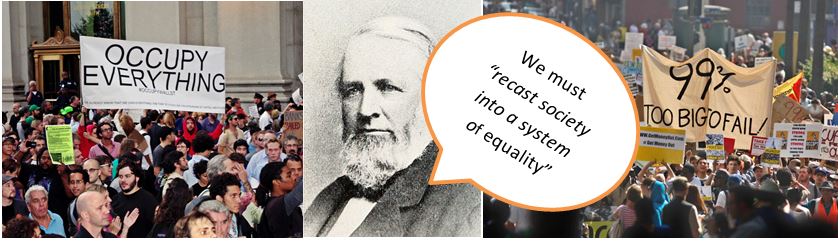
Judge French has strongly held democratic tendencies and claimed that Mass Aggie should “… differ essentially from any college existing in the country controlled by an aristocracy.” Further, he wrote in one of the first reports ever coming from the nascent University of Massachusetts Amherst that “wealth and education, monopolized by any class in any country, will draw to that class the political control of the country.” Sounds like Judge French would have camped out with the protesters at the Occupy Wall Street site!
One of my favorite quotes from French is above. He believed that we must “recast society into a system of equality.” Indeed he fully understood the purpose of the Morrill Land Grant Act of 1862, which was passed “to promote the liberal and practical education of the industrial classes in the several pursuits and professions in life.”

 As I begin a year long sabbatical leave from my teaching job at UMass, I’ve been thinking once again about what agriculture means to me. In preparation, I re-read an essay I wrote years ago called “Agriculture is a business and a conversation with the divine.”
 In the essay I refer to Wendel Berry’s quote “eating is an agricultural act.” Berry presents a few ideas on how we may each connect with the universe or the divine through food and farming.







 UMass Sustainable Food and Farming