
Here is a list of grants and scholarships I share with students. If you find any broken links or grants/scholarships you think I should add, please send a note to jgerber@umass.edu.
Grants and Scholarships

The Sustainable Food and Farming Bachelor of Sciences degree is the fastest growing major at UMass Amherst. Evidence of this was apparent at the recent Open House held at the Mullins Center!

While most of the SFF majors have come to Stockbridge in the past via transfer from other majors at UMass or from other colleges, the interest among high school students was exciting at the Open House. Lots of questions from students and parents!

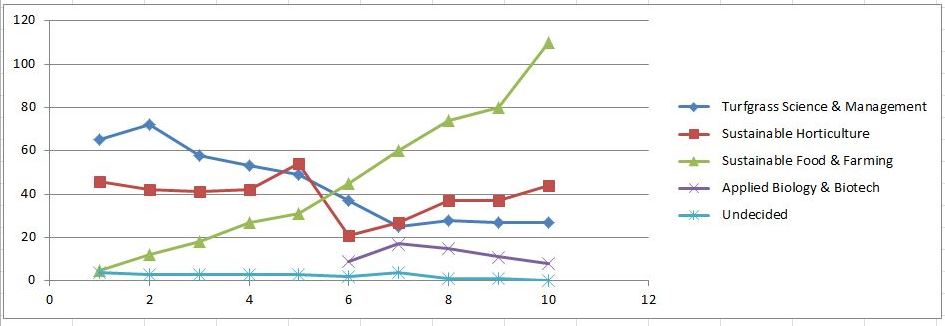
There has been a steady increase (green line) in Sustainable Food and Farming majors in the Stockbridge School of Agriculture over the past 10 years.
Sustainable Food and Farming is the largest program in Stockbridge (including both A.S. and B.S. students) representing about 40 % of our 300+ students.
 Perhaps most important however, the Stockbridge School of Agriculture was ranked 4th highest (out of 55 departments) in the university for quality of experience in the Senior Survey for 2013. Stockbridge was also highest program overall for quality of advising and preparation for career .
Recent graduate Lilly Israel gave a tour of the Franklin Permaculture Garden to a few high school students and their parents at the Open House. Lilly is now working for Auxiliary Services, coordinating the UMass Permaculture Gardens

For information on where some of our graduates are now working, check out the Recent Graduate link above. And for more information on the major, see: B.S. degree in Sustainable Food and Farming.

In its fourth year, National Food Day (held annually on October 24th) is an opportunity for people across the nation to celebrate the value and importance of eating fresh, local and healthy food.
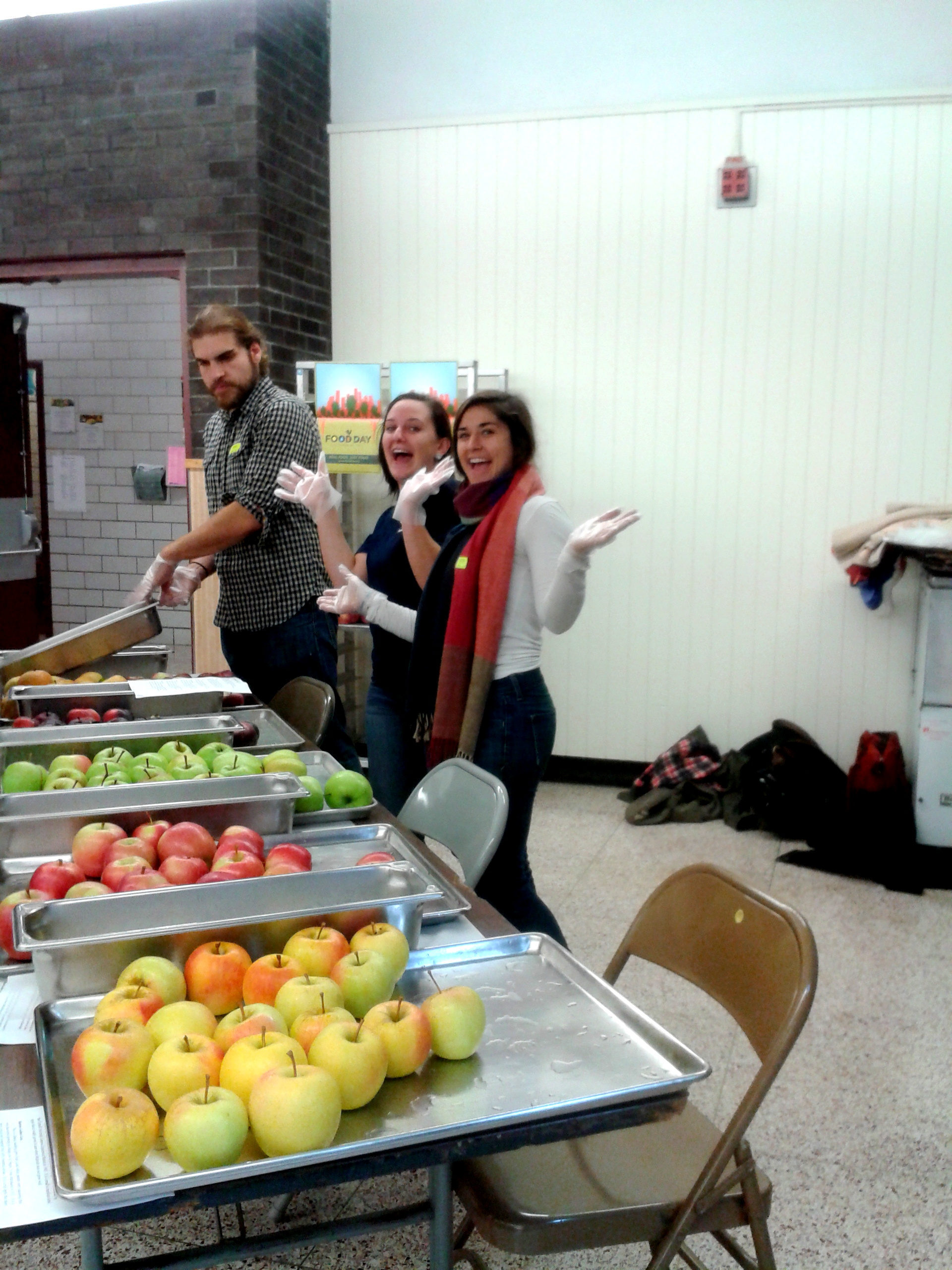
During lunchtime on October 24th, students at the Amherst Regional Middle School had the opportunity to sample unique varieties of apples provided by the UMass Cold Spring Orchard.
Johnathan Sivel, Michelle Nikfarjam, and Jessica Maeder from the Stockbridge School of Agriculture assisted Rebecca Fricke (from Grow Food Amherst and District Aide to Representative Ellen Story) distribute the apples and answer students’ questions.
Two of the best quotes from the students during the tasting in the cafeteria were:
and
This was a great opportunity for the students to taste local apple varieties that they don’t typically get from school or the grocery store. The students and teachers were really appreciative. Many of them came back for seconds and thirds and were genuinely interested in how the apple textures and tastes were so different.
A big thank you goes out to Rebecca Treitley, director of the ARPS Whitsons School Nutrition Program and her crew, led by Diane Tower, who helped Rebecca Fricke wash, set up and clean up the tasting. Also thanks to Dr. Duane Greene and the staff at Cold Spring Orchard for donating the apples.
The UMass Stockbridge School of Agriculture, in partnership with Holyoke Community College and Hampshire College, has been awarded an $810,000 grant from the National Science Foundation to create collaborative programs combining sustainable agriculture with clean energy studies and share resources that will benefit students at all three schools.
“The main purpose of the grant is to marry what has for the most part historically been two separate sides of sustainability education – clean energy and agriculture,” said Kate Maiolatesi, coordinator of HCC’s Sustainability Studies program.
Much of the grant will allow the development of cross-campus courses that combine the strengths of existing programs at each of the three schools. The first of these joint courses is expected to begin in the summer of 2015.
Students from all three campuses will go to HCC to learn about clean energy and then go to UMass and Hampshire to study sustainable agriculture practices. The joint program is expected to create stronger pathways for students to transfer from HCC to Hampshire and UMass.
Another large portion of the grant will pay for new clean energy and sustainable agriculture equipment that will be used by students from all three schools. This will include a new micro-farm greenhouse demonstration and training facility at UMass and a mobile, solar powered refrigeration unit. HCC will install a new solar powered electric fence, along with composting and irrigation equipment as well as a wind turbine for its sustainability and permaculture gardens.
The grant will also pay stipends to students who want to do summer internships with clean energy businesses or local farms.
There is so much going on, and we can’t list it all here, but for a complete list check out our Culinary & Agriculture Events calendar. Don’t forget, Topsfield Fair runs through Columbus Day, October 13.
Thanks to the Massachusetts Department of Agricultural Resources for putting this list together!


Now what?
In my last blog, I suggested that the big news coming out of the United Nations Climate Summit in N.Y. City – following the largest climate change march in history is……. what WILL NOT happen.
Tonight I attended a meeting in Amherst to help think about “whats next?” The organizers from 350Massachusetts and Climate Action Now in Western Massachusetts offered us several options for getting involved. Here are a few:
1. Divest UMass – The UMass Fossil Fuel Divestment Campaign (Divest UMass for short) is a dedicated student-led campaign organizing to confront the present and future issues created by climate change. Here is how to GET INVOLVED.
2. Divestment Massachusetts – College students, people of faith, environmentalists, economists, unions, mothers, and others converged on the State House on Sept. 10 to support S. 1225, a bill that requires MA to divest from fossil fuels! To support the effort to divest sign here – Divest Massachusetts from Fossil Fuels.
3. Mothers Out Front are mothers, grandmothers, and other caregivers who can no longer be silent and still about the very real danger that climate change poses to our children’s and grandchildren’s future. To connect to the Amherst group, go to; Amherst Mothers Out Front.
4. No Fracked Gas in Mass is working to stop the expansion of fossil fuel infrastructure in Massachusetts and to promote expanded efficiency and sustainable, renewable sources of energy and local, permanent jobs in a clean energy economy. Here are some suggestions on what you can do!
5. Climate Action Plan in Springfield – support the community actions of our neighbor to the south (and the biggest polluter in Western Mass). Help us to plan the march from the North End of Springfield to Springfield City Hall on October 20! Join the planning meeting October 1, 2014 at 6:00 pm at the South Congregational Church, 45 Maple Street, in Springfield.
 ========================================================
Many people are motivated to take action around climate change out of anger or fear, and this is a powerful force. For those of us who are motivated out of love for all of creation and concern for our sisters and brothers living in poverty, you are invited to join us on Saturday, October 4 from 2:00-4:00pm to learn from each other and ask…..
For those of you who agree with Pope Francis, who tells us that environmental degradation is the “sin of our time,” join us to celebrate the Feast of St. Francis at the Newman Catholic Center at UMass on Saturday, October 4 from 2:00-4:00pmin the Burke Lounge for a program titled From St. Francis to Pope Francis to You – Creating a Climate for Solidarity.
This workshop and discussion will focus on climate change from the perspectives of “the two Francises” – St. Francis and Pope Francis. If you are curious about the Catholic position on climate change and its impact on the poor, PLEASE JOIN US!
========================================================================
Write a letter or send and email to EPA Administrator Gina McCarthy like this one:
SUBJECT: Docket ID: EPA-HQ-OAR-2013-0602 – Support Carbon Pollution Standards for Power Plants
Dear Administrator McCarthy:
As someone who takes climate change seriously, I have committed myself to advocate on behalf of the poor, the vulnerable, and all of Creation.
Unfolding climate change caused primarily by our consumption of fossil fuels threatens both the planet and poor people. In light this,I believe that the Environmental Protection Agency’s proposed rule to regulate carbon pollution from existing power plants (Clean Power Plan Proposed Rule) can help limit damaging greenhouse gas emissions, uphold human life and dignity and demonstrate a greater respect for the planet.
At the same time, I urge the EPA to offer clear guidance to states on how to protect low-income individuals and families from undue suffering under potential energy rate hikes. Additionally, I encourage the EPA to work with policymakers to help workers impacted by the Plan transition to other employment.
If such steps to protect poor and vulnerable populations are taken seriously, then I support the Clean Power Plan Proposed Rule, Docket ID: EPA-HQ-OAR-2013-0602.
Sincerely,
Send the email to: a-and-r-docket@epa.gov
Or send a letter to:
USEPA Headquarters
William Jefferson Clinton Building
1200 Pennsylvania Avenue, N. W.
Mail Code: 1101A
Washington, DC 2046
————————————————————————————————————————————-
Want to stay connected, please join the Climate Action Now Weekly Newsletter and update alerts: http://climateactionnowma.org/email-list-sign-up/
In advance of a community conversation at the University of Massachusetts Catholic Newman Center on Saturday, October 4, 2014 from 2:00pm – 4:00pm, this article is being shared to help us think about “what would Francis do” about climate change?
For information on the public workshop and discussion,
 Published September 12, 2014 by Daniel DiLeo in Political Theology Today
In his Summa Theologiae, Thomas Aquinas distinguishes between two facets of human intellect: “speculative intellect which directs what it apprehends, not to operation, but to the consideration of truth; while the practical intellect is that which directs what it apprehends to operation” (I, q. 79, a. 11). Although each aspect has unique characteristics, Aquinas insists that the speculative and the practical “are not distinct powers” but together constitute the fullness of human intellect (I, q. 79, a. 11, s.c.). In other words, speculation and application are two sides of the same coin.
For political theologians, it is often a challenge to translate abstract speculation into concrete political advocacy. Although there are likely many reasons for this reality, it is a situation with which we should not be satisfied. It is always necessary, therefore, to identify and take action in situations where a direct connection between the speculative and the practical exists. One such opportunity arose earlier this summer with respect to climate change mitigation, and political theologians should now advocate around the proposed policy.
 Clean Power Plan and U.S. Catholic Bishops
On June 2, 2014, the U.S. Environmental Protection Agency (EPA) proposed the Clean Power Plan by which to reduce carbon pollution from existing power plants. The EPA is accepting public comments about the Plan until mid-October, and Republicans in Congress are working to block, interfere with, and/or otherwise eviscerate the Agency’s proposed carbon pollution standards.
The Catholic Church has explicitly and repeatedly recognized climate change as a moral issue that threatens to compromise the commitments of Catholic Social Teaching (to learn more, visit the Catholic Climate Covenant). As such, the Church continues to call on persons of faith and goodwill to address this issue through both individual efforts and coordinated public policies.
Shortly before the release of the Clean Power Plan, Archbishop Thomas Wenski of Miami wrote a letter to the Environmental Protection Agency on behalf of the United States Conference of Catholic Bishops (USCCB) as chair of its Committee on Domestic Justice and Human Development. There, the Archbishop highlighted the USCCB’s awareness that “the best evidence indicates that power plants are the largest stationary source of carbon emissions in the United States, and a major contributor to climate change” (indeed, carbon dioxide is the most pervasive greenhouse gas, and fossil fuel power plants—which account for 38% of U.S. carbon pollution—are the largest collective domestic source of this pollution).
In light of this reality, Archbishop Wenski emphasized that “the USCCB recognizes the importance of finding means to reduce carbon pollution.” Towards this end, the Archbishop insisted that carbon pollution standards be guided by key aspects of Catholic teaching: “Respect for Human Life and Dignity, Prudence on Behalf of the Common Good, Priority for the Poor and Vulnerable, Social and Economic Justice, Care for Creation and Participation.”
On July 30, 2014, Archbishop Wenski followed this initial letter to the EPA with another that he co-authored with Bishop Richard E. Pates of Des Moines, Chair of the USCCB Committee on International Justice and Peace. There, the two bishops declared: “We … welcome the setting of standards to reduce carbon pollution from existing power plants and thereby mitigate climate change. We support a national standard to reduce carbon pollution and recognize the important flexibility given to states in determining how best to meet these goals.” Towards this end, the bishops reiterated the ethical criteria for carbon pollution standards that the USCCB articulated in its May letter to the EPA. Finally, the bishops “call[ed] upon our leaders in government and industry to act responsibly, justly and rapidly to implement such a [national carbon pollution] standard.”
Catholic Advocacy around Carbon Pollution Standards
In light of the Clean Power Plan and the Catholic bishops’ advocacy around a national carbon pollution standard for existing power plants, political theologians have a distinct opportunity to practically engage in an active policy debate. Although their contributions to the discussion might take several forms, there are two immediate steps that political theologians are able to take. First, political theologians can submit faith-based public comments to the EPA. In addition, political theologians can contact their elected officials and urge them to support a national carbon pollution standard for existing power plants that is animated by Catholic teaching.
Conclusion
In his 1990 World Day of Peace Message, St. John Paul II recognized that “the ecological crisis is a moral issue” (emphasis in original). Guided by this awareness, Pope Emeritus Benedict XVI asserted in his encyclical Caritas in veritate that “the Church has a responsibility towards creation and she must assert this responsibility in the public sphere” (# 51). The current debate around the Clean Power Plan is a unique opportunity within which to bring Christian theology to bear on an active policy debate. As such, I urge political theologians to, at the very least, submit faith-based comments about the proposal to the EPA and let their elected officials know that they support a national carbon pollution standard guided by Catholic teaching.
Author
Daniel R. DiLeo is a Flatley Fellow and Ph.D. student in theological ethics at Boston College. His interests lie at the intersection of Catholic social thought, virtue ethics, political theology, environmental ethics and economic justice. He is especially focused on the issue of climate change and discernment of how Catholic theological ethics can contribute to deliberations about national climate policy. He has worked as Project Manager for the Catholic Climate Covenant since 2009, and was also a Mission Intern at the Catholic Health Association from 2009-2011. He is also a regular contributor to Millennial Journal.

Some proposed “learning” or axioms discussed in class:
Here are some of the tools and resources we are using in STOCKSCH 379 – Agricultural Systems Thinking class:
Some More Readings Used in Class
Reading Related to Food System Change
For more writing and thinking about systems thinking, see my blog posts here. And for more, check out the writings of my friend and farmer, Karl North.
Principle Resources Used to Develop the Course
Additional Resources Used to Develop the Course:

That was the key point of a new publication from the UN Commission on Trade and Development (UNCTAD) titled“Trade and Environment Review 2013: Wake Up Before It’s Too Late,” which included contributions from more than 60 experts around the world.
The findings on the report seem to echo those of a December 2010 UN Report in many ways, one that essentially said organic and small-scale farming is the answer for “feeding the world,” not GMOs and monocultures.
According to the new UN report, major changes are needed in our food, agriculture and trade systems, with a shift toward local small-scale farmers and food systems recommended.
Diversity of farms, reducing the use of fertilizer and other changes are desperately needed according to the report, which was highlighted in this article from the Institute for Agriculture and Trade Policy.
It also said that global trade rules should be reformed in order to work toward these ends, which is unfortunately the opposite of what mega-trade deals like the proposed Trans Pacific Partnership (TPP) and the U.S.-EU Trade and Investment Partnership (TTIP) are seeking to accomplish.
Even global security may be at stake according to the report, as food prices (and food price speculating) continue to rise.
“This implies a rapid and significant shift from conventional, monoculture-based and high-external-input-dependent industrial production toward mosaics of sustainable, regenerative production systems that also considerably improve the productivity of small-scale farmers,” the report concludes.
You can read more about the report from the Institute by visiting their website here.
 AUG. 27, 2014
Wait a sec. Nick, Caspar and Jared: Are those unconventional girls’ names now, like Kennedy and Reagan? Because if you’re looking for a farm-fresh tomato in the city this summer, you’re likely to find a woman growing it.
In recent years, chefs, writers, academics, politicians, funders, activists and entrepreneurs have jumped on the hay wagon for urban agriculture. New York now counts some 900 food gardens and farms, by the reckoning of Five Borough Farm, a research and advocacy project.

Yet city farmers will tell you that the green-collar work on these small holdings is the province of a largely pink-collar labor force. Cecilia, not Caspar. And they’ll provide the staffing numbers to show it.
This is where the speculation begins — and, inevitably, the stereotypes. Are women more willing to nurture their communities (and also their beet greens)? Are men preoccupied with techie farm toys like aquaponics? Is gender the reason the radio at the Queens Farm washing station is always stuck on Beyoncé and Alicia Keys?
More significant, if urban ag work comes to be seen as women’s work, what will that mean for the movement’s farming model, mission and pay?
Counting New York’s urban farmers and market food gardeners can seem like a parlor game: part math, part make-believe. Data on gender is scarce to nonexistent.
The federal 2012 Census of Agriculture isn’t much help. It suggested 42 farm “operators” in New York were men and 31 were women. But the census published data from just 31 city farms. (Under confidentiality rules, it doesn’t reveal which farms participated.) And its definitions fail to capture New York’s unique abundance of nonprofit farms and community gardens.
A “farm,” by census standards, is any place that grew and sold (or normally would have sold) $1,000 worth of agricultural products in a year. Yet surveys from the parks department’s GreenThumb program suggest that some 45 percent of the city’s hundreds of community food gardens donate their harvest to neighborhood sources and food pantries. Blair Smith, who compiles New York’s data for the U.S.D.A., explained, “Those are not farm businesses, at least from our standpoint.”
New York’s urban farmers — the people who actually work in the field — offer a sharply different head count of what you might call bulls and cows. Of the 19 farms and farm programs that contributed information for this article, 15 reported having a majority of women among their leadership, staff, youth workers, students, apprentices and volunteers. (Of the remaining four, one claimed gender parity and another hired two men this summer from a seasonal applicant pool of 18 men and 30 women.)
It’s a snapshot, not a statistically rigorous poll. Still, the farms, from all five boroughs, represent a broad sample of New York’s particular growing models: a commercial rooftop farm; community gardens; and farms attached to schools, restaurants, parks, churches, housing developments and community organizations. The sample included two city-based farmer-training programs and two out-of-state sustainable farm-education schools and fellowships. These are the types of programs that mold future urban farmers.
Describing their own farms and gardens, managers suggested that women make up 60 to 80 percent of field workers, organizers and educators. Applicant pools are similarly unbalanced for summer postings, internships and certification programs.
Farm School NYC, an affiliate of the food-access nonprofit Just Food, “is 100 percent female-run,” said its director, Onika Abraham. But then, she added, “I’m the only staff person.”
More important, Farm School NYC receives 150 to 200 applicants annually for professional agriculture instruction. For this year’s entering 30-person class, Ms. Abraham said, “the breakdown for applicants was 76 percent women and 24 percent male.” (Applications for next year are open through Sept. 15.)
The gender divide appears to exist in salaried posts and volunteer work alike. For 18 years, Steve Frillmann has led Green Guerillas, which provides support and materials to more than 200 community garden groups. Most of these sites lie in central Brooklyn, Harlem and the South Bronx, and three-quarters of their volunteer leaders, he estimates, are women. So, too, women typically represent 75 to 80 percent of the applicants who want to join Green Guerillas on an AmeriCorps stipend.
It’s challenging work, and Mr. Frillmann, 49, is happy to hire whoever wants to do it. “To be honest with you, we’ve never really lifted and looked under the hood and tried to figure out why,” he said.
At the extreme, Edible Schoolyard NYC runs a food and garden-teaching program with two growing plots and a staff of 16. Sixteen of these employees are women.
Kate Brashares, 40, who is the group’s executive director, said: “It’s a little unusual we don’t have any men on staff at the moment. There are usually one or two.”
Ms. Brashares believes that the diversity of her employees should reflect the low-income communities where they work. That diversity includes gender. “We talk about wanting to get a few more men in the place,” she said. “It’s funny, we haven’t talked about it that much, though. It’s one of those things that just sort of happened. As we’ve gotten bigger, it’s gotten more obvious.”
Less obvious is why the discrepancy exists. Ms. Brashares speculated about the prevalence of women in education and nonprofit careers. But ultimately, she concluded, “I honestly don’t know.”

Karen Washington has been observing the community garden scene for more than 25 years from her plot in the Garden of Happiness, a couple of blocks from the Bronx Zoo. She also organizes the Black Urban Growers conference and a long list of other food and neighborhood initiatives. This roster may explain why Ms. Washington, 60, is prone to make work calls at 10 o’clock at night, say, after teaching a class on season-extending hoop houses, or on the way home from running La Familia Verde farmers’ market.
Nowadays, she sees a cohort in her gardens that she gauges to be 80 percent women. “It was more 60/40 back in the early days,” Ms. Washington said. “Mostly Southern blacks and Puerto Ricans. They were in their 40s and they’re in their 80s now.”
Explaining the gender gap on a community garden level, she said, “a lot of it, from my point of view, had to do with the fact women lived longer than men.”
The stereotypical image of an American farmer may be a white man of late middle age captaining a $450,000 combine in an air-conditioned cockpit, high above a flokati of corn. But this profile is a poor match for farmers in Latin America, the Caribbean, Asia and Africa — that is, the groups that often predominate in New York’s community food gardens. Nevin Cohen, 52, an assistant professor at the New School and an expert on urban food issues, points to a telling statistic from a United Nations special rapporteur: “Women are 80 percent of the global agricultural labor force.”
Many of the women who farm in Bushwick with Maggie Cheney possess experience in small-scale agriculture. They’ve long fed their families out of extensive kitchen gardens (as Colonial-era immigrant women did in New England). Ms. Cheney, 30, is the director of farming and education for the food-access group EcoStation:NY. And on the group’s two growing sites, she said: “I tend to work with a lot of recent immigrants from Africa, Mexico, Ecuador. And the islands: Jamaica and Haiti, the Dominican Republic.”
Ms. Cheney’s youth interns (five boys and nine girls) include the children of some of those immigrants. Yet wherever they were born, the youth growers at the Bushwick Campus Farm do not approach New York gardens as virgin soil.
Their fathers may have experienced farm labor as a harsh and exploitative activity, Ms. Cheney said. These men are not necessarily the easiest people to recruit for a hot afternoon of unearthing potatoes. By contrast, “I see a lot of girls interested because they may have that positive relationship to being the ones who cook in the family and buy the food in the market.”
She added, “The ones that I see, their roles at home are very gendered.” The politics of the New York “food justice” movement start at progressive and run to radical. But the connection between women and urban farming can appear traditional and even conservative.
Born and raised on the Lower East Side, Ms. Abraham, 40, recalls visiting her family’s black farmstead in Alabama. She said: “My grandfather grew row crops: cotton, soybeans and corn. He worked the fields. My grandma was home with a large vegetable garden and chickens.”
Put another way: “My grandmother grew the food; he grew the money. And I think maybe the scale of what we do in the city relates more to this kitchen garden.”

The Five Borough Farm project identified three commercial farms in New York, all of them sophisticated rooftop operations. Gotham Greens, for example, runs two (and soon three) climate-controlled hydroponic greenhouses in Gowanus and Greenpoint, Brooklyn. (Next stop: Jamaica, Queens.)
Of the company’s 50-odd employees, more than two-thirds are men, said the company’s 33-year-old co-founder, Viraj Puri. “At Gotham Greens, our approach is more plant-science and engineering focused and less ‘gardening’ focused,” Mr. Puri wrote in an email. He posited that this orientation may account for the different gender skew.
Beyond these few enterprises, the city’s farms exist not just to grow okra, but to advance a shopping list of social goals. These include recreation, nutrition, public health, environmental stewardship, ecological services, food access and security, community development, neighborhood cohesion, job training, senior engagement and education. We ask a lot of our gardens.
Mara Gittleman, who jointly runs the Kingsborough Community College farm program, at the end of Manhattan Beach, often sees urban farming likened in the news media to “the new social work, or this thing you do for poor people.” In response, Ms. Gittleman, 26, founded the research project Farming Concrete to record and publicize the surprising yield raised in community gardens. These are vegetables that come not from the glittering glass on high, but from the ground up.
Be that as it may, if you’re trying to account for why so many college-educated women are attracted to urban agriculture, nearly everyone agrees that a social calling is the place to start. “Definitely, the most visible influx is young white people, and I’m one of them,” Ms. Gittleman said.

If urban farming were just about the crops, it would be cheaper and easier to do it 50 miles north. Urban farming, however, is not a solitary or single-minded activity. Along with the weeding and pruning, the job description includes sowing community interest and reaping grants.
Kennon Kay, the 31-year-old director of agriculture at Queens Farm, said: “What makes this farm different is the element of public interaction. We have over half a million visitors a year.”
The farm staff currently numbers two men and five women, which is actually a bumper crop of gents. And Ms. Kay takes pains to say: “I don’t want to knock the guys. They’re great.”
That said, in her experience, “Women have been extremely effective in multitasking, planning, communicating and being the representatives of this public organization.”
Inevitably, there’s an inverse to saying that women are attracted to work that involves children and the elderly, caring and social justice. In short, you’re implying that men don’t care, or care a lot less.
This is what you might call the men-as-sociopaths hypothesis (M.A.S.H.), and Nick Storrs, 29, who manages the Randalls Island Park Alliance Urban Farm, does not buy it. “I would refute the claim that guys are sociopaths,” he said.
Having cheerfully dispensed with that libel, he struggled to explain why men seem less interested in the social goals of community agriculture. “I don’t know, because I am interested in it,” Mr. Storrs said.
So where are the men?
“Wall Street,” Ms. Washington said (a theory that may not be inconsistent with M.A.S.H.).
The Bronx’s vegetable plots, she will tell you, are not insulated from what goes on outside the garden gates. “A lot of our men of color are incarcerated,” she said. “Huge problem. If you tell a 21-year-old man just out of jail to go into farming, he’s going to look at you as if you have two heads.”
Or in the words of Esther Liu, 25, a rooftop farmer at the Hell’s Kitchen Farm Project: “Men? Perhaps they want a living wage.”
The time has arrived, as it always does, to talk about money. The pay for community-based agriculture starts low and climbs over time to not much higher.
Ms. Cheney endeavors to pay her youth interns $8.30 to $9.30 an hour and the Bushwick farm managers $17 an hour. Farmers with longer tenure may earn $20. These are decent wages in agriculture, Ms. Cheney said. Yet they’re hardly enough to keep up with the climbing rents in a gentrifying neighborhood.
Deborah Greig, 32, oversees the crowded market at East New York Farms, leads the gardener-education program, manages dozens of youth workers, and cultivates specialty crops like dasheen and bitter melon. (And some 65 to 70 percent of her farm staff, apprentices and youth interns are women.) “I get paid $37,000 a year,” Ms. Greig said. “I started at $28,000 or $29,000, which was huge at the time. And I have insurance included.”
The permanence of the job, which she has held for seven years, is a boon to Ms. Greig and to the community where she works. Ultimately, Ms. Abraham, of Farm School NYC, argues that only stable employment will make urban farming viable for neighborhood women — and men — who lack the safety net of a college degree and family support.
For her part, Ms. Greig is probably underpaid. Don’t tell anyone, but she would do the job for less. “People don’t expect to be paid very much doing this work,” she said. “It’s a labor of love to a certain extent. I don’t think we’ve come up with a hard and fast model to pay people exceedingly well for doing nonprofit urban-farming work.”
Sounds like a job for the guys on Wall Street.
========================================================================
 Per
Per UMass Sustainable Food and Farming