Local Harmony creates public space

owen
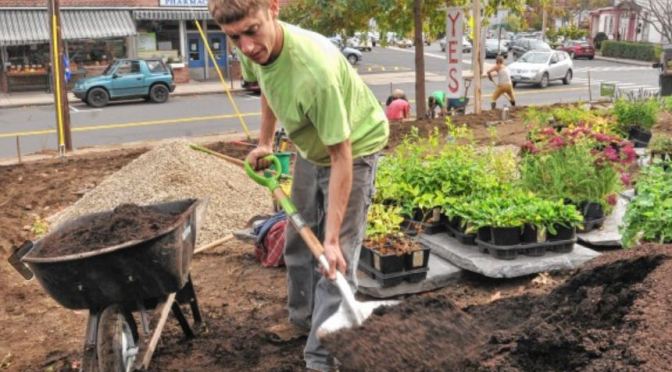
Owen Wormser designed this public space near the Hungry Ghost in Northampton, MA

Creating vibrant public spaces is no easy matter. Parks and other such places require a serendipitous combination of scale, public access and visual appeal to make them come alive.

As Jane Jacobs, the 20th-century journalist and urban theorist who championed city street life, wrote in her highly acclaimed “The Death and Life of Great American Cities” (1961), “The more successfully a city mingles everyday diversity of uses and users in its everyday streets, the more successfully, casually (and economically) its people thereby enliven and support well-located parks.”

Local Harmony, a Pioneer Valley-based non-profit organization, is creating an intimate stone amphitheater and medicinal garden on the small, grassy hillside owned by Smith College that runs from the Hungry Ghost Bakery to State Street in Northampton. Jacobs would undoubtedly give Local Harmony two thumbs up.

Local Harmony is the collaborative creation of Owen Wormser, owner of the Leverett-based landscape design company Abound Design, and Chris Marano, an herbalist who owns Clearpath Herbals in Montague (and teaches at the UMass Stockbridge School of Agriculture). Wormser said the organization’s goal is “to harness the skills of professional landscape designers, horticulturalists and gardeners to join forces with volunteers to create beautiful and accessible public spaces.”

Wormser, a landscape designer who is trained in architecture, said the idea for Local Harmony originated in a project he undertook several years ago. After launching his landscape design firm, Abound, he created the public fountain space at Cooper’s Corner store in Florence as a promotion for his fledgling business.

“I found it was really meaningful for people,” he said. “Cooper’s Corner was very successful in terms of people wanting to use the space. People are very appreciative of it. They take pride in their surroundings.”

After Cooper’s Corner, Wormser kept his eye out for other spaces.

“You need to have sympathetic property owners, and I figured that Smith College and the Hungry Ghost Bakery would be supportive,” he said.

A multi-use space

Local Harmony’s garden will have a variety of uses. It will be a place for educational activities and performances as well as a pleasant space for the public, including patrons of the bakery, which overlooks the garden.

“We want this to resonate with the public so they feel it’s theirs and that they want to be part of it,”Wormser said.

Among its functions will be that of a teaching garden; it will be composed only of medicinal plants. Marano called it a “sister garden” to a similar one at Clearpath Herbals in Montague. But the plants also have been chosen for their aesthetic appeal.

“People who don’t know anything about medicinal plants will still find it beautiful,” Wormser said. The herbal plants include commonly known varieties such as catmint (Nepeta) and coneflower (Echinacea) and others including Balloon Flower (Platycodon grandiflorus) and Yarrow (Achillea millefolium). Taller perennials will be placed along the border to create a sense of seclusion for the garden.

In addition to the medicinal perennials, the garden will include a border of serviceberry trees (Amelanchier) along the edge where Bedford Terrace curves into State Street. Serviceberry, also known as shadbush or shadblow, is a small tree that’s well-suited to the garden. It has delicate white blossoms in spring and colorful fall foliage, it’s drought tolerant and attracts birds.

Generous hosts

According to Wormser, Smith College, which owns the property, has provided generous funding for the project.

“Smith and Roger Mosier, the college’s associate vice president of facilities management, understand that this was an extremely valuable offer and that Smith, the Hungry Ghost and the entire community will gain from it, Wormser said. “The project wouldn’t happen without Smith’s level of support.”

The Hungry Ghost Bakery also has donated to the project, and will take on a major role in maintaining the garden.

In his role as owner of Abound Design, Wormser provided the professional landscape design, while Marano of Clearpath Herbals has provided expertise and advice about suitable medicinal plants for the garden beds. Ashfield Stone donated the Goshen stone for the amphitheater and pathways. Local Harmony will provide plants and materials at cost. Wormser estimates that $40,000 has been contributed to the project in terms of materials, time and labor. He noted that this is less than half what such a project would cost on the open market.

Another cost-cutting feature of the project is that, with the exception of some of the stonework, volunteers will install it. Wormser projects that between 400 and 600 hours of work will be donated in total.

“We have a large population of younger people in the Valley who want to work, grow food and gardens,” he said.

Enclosed in color, texture

Kevin Potter, 27, was one of the volunteers who helped excavate the site when the project broke ground Oct. 17. He has worked for Abound and studies herbalism with Marano at Clearpath Herbals.

“I’m excited about the opportunity to create a high-visibility community garden,” he said. “It’s huge to have a place to plant herbs and learn about them. It’s a great resource for people. And it’s accessible by foot and by public transportation.”

Wormser and Marano say they plan to have 70 percent of the plants in place this fall, with the remainder to be planted next spring.

“Once it’s completed and the plants are growing, it will feel enclosed with color and texture,” Wormser said. “It will feel like a sanctuary.”

Wormser said he is pleased with the garden’s size and location.

“It’s just manageable. We are able to do most of the work by hand,” he said. It’s not exactly in the middle of the city; it’s a little quieter here. It’s a good spot to watch the city go by.”

Sustainable inspiration

The State Street garden is one of several Local Harmony initiatives. The non-profit recently renovated five large concrete planters in downtown Turners Falls, with help from students at the Franklin County Technical School. Local Harmony is also working with the Hitchcock Center for the Environment in Amherst to create an extensive teaching garden that will be installed next spring at the center’s new site on the Hampshire College campus.

“We went through a great design process with Local Harmony that involved thorough thinking about all aspects of the project, including community collaboration, accessibility and the teaching function,” said Casey Beebe, community programs and special projects manager at the Hitchcock Center.

Wormser said he hopes the State Street amphitheater and garden will inspire people to launch similar projects.

“I want people to come here and say, ‘I could do that,’ because anyone can do this,” he said. “I want this to be a model that’s sustainable over time and that can work in any community.”

Inspiration is an important part of the work, he added.

“Our long-term goal is to remind people that our planet is a garden and we’ve wrecked it. But that we can rejuvenate it, make it beautiful and productive again for all living things.”

adam22
Adam Barnard (the creator of the “Yes Farms Yes Food” slogan for the Sustainable Food and Farming program volunteered to help install the new herb garden.

Mickey Rathbun can be reached at foxglover8@gmail.com

Original Article

Care Farming in the UK – Report

If you think the Stockbridge School of Agriculture should investigate Care Farming as a possible program of study for undergraduates, please join us to discuss this question on:

Monday, December 5, 2016 at 3:30pm – 5:00pm

210 Stockbridge Hall

All are welcome!

===============================================================

By Rachel Bragg;  University of Essex    rebragg@essex.ac.uk

  1. Care farming – key facts and figures at a glance

  • How many care farms are there in the UK and where are they? 115 care farms took part in a survey in 2012, representing 66% of the 180 care farms that are currently operating in the UK. Care farms are located mainly in England but also in Scotland, Wales and Northern Ireland; at the present time the South West, East Anglia and the West Midlands contain the largest number of care
  • What sort of farms are care farms? The majority of care farmers (78%) describe their care farm sites as farms or smallholdings and the organisational type as a farm, charity and/or company. Care farms have a mix of field enterprises and livestock, typically grazing, vegetables and woodland with chickens, sheep, pigs and cattle. Care farm size ranges from 0.4 to 648 ha – average care farm size 49

Continue reading Care Farming in the UK – Report

New Stockbridge Course on Food Waste/Recovery – STOCKSCH 197 W

STOCKSCH 197 W:  How to Recover a Truly Sustainable Food System:
A Look at Food Waste and Recovery

 Instructors:

  • Mary Bell, B.S., Local Food Waste researcher, educator, advocate
  • Angela Roell, M.Ed.

Class Meeting:  Tuesday 4:00-5:15 pm

Location:  Paige Lab Conference Room (202)

Office Hours:  By appointment

Contact Information:

Course Description:

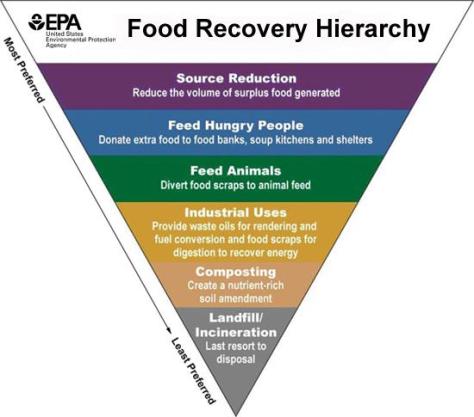
wasteThis course is an introduction to food waste, and the impact waste has on our food system.  We will introduces the current food recovery hierarchy, and examines how consumers, producers and distributors waste food.  We will explore the environmental and social impact of food waste in our food system, and introduce social and policy initiatives employed to recover food.  Students will read, reflect and discuss the actionable steps being taken to shift our local food system’s food waste into food recovery.

Prerequisites: Open to all UMass students interested in food recovery.

Required Course Materials:

A blank notebook should be brought to every class.  This notebook will be used for notes, reflections and homework assignments.  It is a vital part of your grade.  Laptops will be permitted as a note taking tool ONLY if students elect to create a digital journal.

There will be no formal text book for this course, readings will be distributed via .pdf

Grading:

Project Percentage
Pre-Course Self Assessment 10.00%
Reflection Journal:

·       Interview Project

·       Case Study Notes

·       Weekly Homework

·       Technology Tools

40.00%
Case Study Presentation 40.00%
Post-Course Self Reflection 10.00%

Course Schedule:

Week 1, 1/24/17, Course Introduction

In Class:

Review Syllabus

Based on current knowledge and assumptions students will build EPA Food Recovery Hierarchy in small groups

Self-Assessment Survey & Learning Styles Quiz

  • Students will complete initial self-assessment survey
  • Students will complete a learning style quiz:

http://www.learning-styles-online.com/inventory/

Homework:

Read:

  • American Wasteland, by Jonathan Bloom: Chapter 4, A Culture of Waste:  Our Fall from Thrift and Our Imminent Return (pg 59-66)
  • Wasted: How America Is Losing Up to 40 Percent of Its Food from Farm to Fork to Landfill, by Dana Gunders, Natural Resources Defense Council (pg 1-6)

Do:

  • Use your phone’s camera to document your own food waste. In one week take one photograph per day the food that you throw out, discard, spoilage, compost, etc.  Share photos via UMass UDRIVE

Week 2, 1/31/17, How Does Food Waste Impact the Food System

In Class:

A definition and discussion of the EPA Food Recovery Hierarchy

  • EPA Food Recovery Hierarchy and Three Reasons for a Growing Interest in Food Loss, Economic Research Service, USDA

Review and discuss our class’s cumulative weekly food waste

Homework:

Read:

  • American Wasteland, by Jonathan Bloom: Chapter 5, American Farms:  Growing Waste, Selling Perfection
  • Causes of Food Loss and Waste at the Farm, Farm-to-Retail, Retail, and Consumer Levels, Economic Research Service, USDA

Do:

  • Reflect on the Food Recovery Hierarchy, how is it different than you assumed? How is it similar?   

Week 3, 2/7/17, Why is there Food Waste?

In Class:

Discuss readings from American Wasteland and the Economic Research Service

Think/Pair/Share Activity

Homework:

Read/Do:

  • Review the website: http://www.leanpath.com/
  • Read one case study from the “case study” tab
    • How is Lean Path using technology to address food waste and recovery?
      • Record your thoughts in reflection journal


Week 4, 2/14/17, The Gap- Expiration Dates and Labeling

In Class:

Facilitated discussion with student questions

Experiential Activity

Case Study Overview and Distribution

Homework:

Review assigned Case Study, record brainstorm and any actionable steps in your journal

Week 5, 2/21, The Value of Food vs. The Cost of Waste

In Class:

Interview Questions Brainstorm

Discussion about Farm-Based Food Waste

Homework:

Read:

  • Closing the Food Gap: Resetting the Table in the Land of Plenty by Mark Winne: Chapter 7:  Growing Obese and Diabetic; Going Organic and Local

Do:

  • Interview Questions Project published/shared to begin

Week 6, 2/28, Food Insecurity and Nutrition

In Class:

An introduction to food insecurity with facilitated discussion and student questions

Homework:

Read:

  • How Food Made History by BW Higman: Chapter Seven: Cooking, Class, and Consumption

Do:

Week 7, 3/7, Gleaning as a Food Recovery Tool

In Class:

Facilitated discussion with student questions

In-Class reading: Farmers Help Fight Food Waste by Donating Wholesome Food

http://blogs.usda.gov/2015/04/03/farmers-help-fight-food-waste_by-donating-wholesome-food/

Homework:

Read:

Do:

  • Meet with your Case Study team, record brainstorm and actionable steps in your reflection journal

Week 8, Spring Break


Week 9, 3/21, Redirecting Food Waste: Farm-Based Food Recovery

In Class:

Panel Discussion, guests TBD

Homework:

Read:

Do:

  • How is Food Donation Connection using technology to address food waste? How could they do better?
    • Record your thoughts in reflection journal, 1-2 pages

Week 10, 3/28, Creative Community Initiatives Addressing Food Insecurity

In Class:

How is food insecurity being addressed in our community?

Facilitated discussion with student questions

Facilitated review of results found in Interview Questions Project

Homework:

Read:

  • Closing the Food Gap: Resetting the Table in the Land of Plenty by Mark Winne: Chapter 9:  Public Policy; Food for the People

Week 11, 4/4, Bill Emerson Food Donation Act

In Class:

Presentation by Mary Bell

Facilitated discussion with student questions

Homework:

Read:

Do:

  • Write about two new things you learned from the Mass Local Food Action Plan
    • How are these ideas actionable in your local or regional food system?
    • Are any of these ideas being implemented in our local food shed?

Week 12, 4/11, Mass Local Food Action Plan

In Class:

Discuss Mass Local Food Action Plan

Think/Pair/Share Activity  

Homework:

Review:

  • Legal Fact Sheet for Massachusetts Food Donation: Liability Protections, Harvard Food Law and Policy Clinic, July 2015
  • Federal enhanced – Tax Deduction for Food Donation – a legal guide, Harvard Food Law and Policy Clinic, April 2016

Week 13, Patriots Day: Monday Schedule

 Week 14, 4/25, Self Assessment and Course Review

In Class:

Students will complete a final self assessment

Students will complete an exit survey  

Homework:

Meet with group to work on final presentations

Week 15 & 16, 5/2-5/9, Final Presentations

In Class:

Final Presentations of Case Studies

Attendance at all presentations is mandatory to receive a passing grade

Assignments

Project Description Due Date
Case Studies in Food Recovery

◦   A Perfect Loop – Food Recovery in San Diego, BioCycle 2013

◦   The Good Food Fight for Good Samaritans: The History of Alleviating Liability and Equalizing Tax Incentives for Food Donors, Stacey H.Van Zuiden- 2012 Drake University

◦   3rd Case Study TBD

1.     Students will review one of three case studies of a food recovery project in our local/regional food system assigned by instructors

2.     Case studies are designed to address our three themes: farm/environmental impact, food security/food justice, and food policy

3.     Students will record main ideas from the reading in their reflection journal

4.     Students will generate a list of 3-5 ideas for addressing the thematic nature of the case study and record them in the reflection journal

5.     Students will work in small groups assigned by instructors

6.     Using case studies students will generate an actionable idea for addressing food waste and recovery at a campus, local or regional level

7.     Students will prepare a presentation of their main ideas and actionable steps to address food waste using Prezi or Power Point

5/2/17

5/9/17

Interview Project 1.     As a class students will compile interview questions

2.     Instructors will generate a survey based on student input and distribute digitally via Google Forms

3.     Students will interview 3 people in their communities about their food system experience: one consumer, one producer, one retailer or distributor

4.     Students will reflect on their findings in reflection journal

5.     Findings will be shared in class and discussed

03/28/17
Reflection Journal 1.     All weekly reflections and writing assignments MUST be kept in one reflection journal

2.     The journal will be collected on the last day of class

04/25/17

Course Policies

  1. The success of this course depends on student participation. Everyone is expected to arrive on time, ready to comment, answer questions, and actively contribute.  Cell phones, iPads, etc should be turned off during class unless you have requested accommodations from the instructor prior to class. Please bring all reading materials to class.  Laptops will be permitted as a note taking tool ONLY if students elect to create a digital journal.
  2. Written work is to be handed in on time. Late work will not be accepted.  We will make exceptions to this rule only in the case of serious emergency, and only if contacted via phone or email within 24 hours of missing the scheduled deadline.
  3. Students are responsible for course information sent to their UMass email accounts. We will respond to your email within 24 hours, please plan accordingly.
  4. Office hours will be by appointment, if a question or concerns arises
  5. Academic dishonesty will not be tolerated. Use care in written work to avoid the appearance of cheating/plagiarism.  Please discuss questions with us if you have a concern.
  6. If you are in need of learning accommodations, please come speak with one of us at the beginning of the semester so we can guarantee your needs are fully met throughout the course.   

“Ugly” Fruits and Vegetables Taste Just Fine

24uglyfood-web01-master768A customer shopped at Fruta Feia, a Portuguese cooperative created to sell imperfect food. The food industry has begun looking for ways to reduce waste. Bargain-hunting consumers seem to be going for the deals. Credit Patricia De Melo Moreira for The New York Times


Duck-shaped potatoes. Curvy cucumbers. Broken carrots.

Some food sellers, after decades of displaying piles of identical, aesthetically pleasing produce, are starting to sell slightly less beautiful — but still tasty — fruits and vegetables.

Millions of tons of food are thrown out or left to rot in fields every year in wealthy nations, simply because they do not meet cosmetic standards set by distributors or supermarkets. Under pressure from anti-waste advocates, the food industry has begun looking for ways to throw away less.

So now, in such cities as Pittsburgh and Paris, some of that imperfect produce has started to find its way into stores. And bargain-hunting consumers, who get a hefty discount for their willingness to munch on too-small apples and blemished oranges, seem to be buying it.

Along with targeting waste, being able to sell food that once would have been tossed aside gives growers a new stream of income and offers consumers a way to save money without compromising on taste or nutrition.

“There’s nothing more disheartening for a farmer than to grow something and then throw it away,” said Guy Poskitt, a carrot and parsnip farmer in Yorkshire. “Consumers hate waste, and as growers we’ve really got huge challenges in terms of profitability,” he said. Selling imperfect produce helps solve both problems, he said.

Often, the cosmetically challenged fruits and veggies are hardly distinguishable from ordinary ones — an orange with a bumpy scar on it, or a potato that is slightly smaller than its peers.

Dana Gunders, a food and agriculture expert at the Natural Resources Defense Council in San Francisco, recalled talking to a stone-fruit grower who every week produces 200,000 pounds, about 90,000 kilograms, of peaches and plums that cannot be sold. “He said, ‘Of those, you wouldn’t be able to tell me what’s wrong with eight out of 10 of them.’ ”

Abundance allows retailers in wealthy countries to be particular about aesthetics, and consumers have grown used to choosing from uniform rows of shiny red apples and perfect pears.

The industrial scale on which agriculture operates in many rich nations, and the long distances food often travels from farm to table, result in a great deal of waste. Retailers grade produce according to strict criteria to which farmers, fearful of shipping anything that might be rejected, must pay close attention.

“Sometimes it’s things like the cucumber is curved and so it doesn’t fit in the box as well as a straight cucumber,” said Ms. Gunders, author of the “Waste-Free Kitchen Handbook.”

Heather Garlich, spokeswoman for the Food Marketing Institute, a supermarket and wholesalers’ trade group in Arlington, Va., said sellers had an interest in making sure standards reflected consumer demand and that research showed shoppers choose produce based mainly on appearance.

Imperfect Produce ships aesthetically challenged fruit and vegetables to about 9,500 subscribers in and around San Francisco. Credit Jim Wilson/The New York Times

There are some hints things might be changing. In France, the Intermarché chain of supermarkets started selling what it calls “inglorious” fruits and vegetables in 2014, at 30 percent off, with an advertising and social media campaign decrying the throwing away of good food. It began as a small-scale trial, but now all Intermarché’s French stores sell imperfect produce when it is available, said Elyse Barbé, spokeswoman for Groupement des Mousquetaires, which owns the grocer.

Britain’s upscale Waitrose supermarkets offer carrots, parsnips, potatoes and onions branded “a little less than perfect,” as well as misshapen tomatoes and strawberries and weather-blemished apples, pears and green beans, when growers provide them.

Asda, a British grocery chain owned by Walmart, began offering boxes of “wonky veg” in February, at 3.50 pounds, or$4.65, for five kilograms. They were such a hit with customers that the company announced the following week it would quadruple the number of stores involved to 350. Asda said the boxes would help avert hundreds of tons of waste.

Inspired by such efforts, Giant Eagle, based in Pittsburgh, in February put “produce with personality” on sale in five stores, at up to 20 percent off. “The customer response has really been positive so far,” so the number of participating outlets has since been increased to 21, Dan Donovan, a spokesman, said.

Hannah Husband, a movement and nutrition coach of Oakland, Calif., said that after she signed up for weekly deliveries from the company Imperfect Produce, she began recommending the boxes to her clients.

“A lot of times when you’re switching gears and trying to go to a healthier way of eating, it feels like everything costs a lot,” so the discounted prices are appealing, she said.

Most of what arrives on her doorstep is just a little bigger or smaller than standard, but every now and then something truly unusual shows up. Once, “I got an eggplant that had like a nose coming off of it,” she said. “It’s been fun to post pictures of the funny vegetables and then of what I make with it afterward.”

Fighting food waste has been moving up environmentalists’ agenda as a means of combating climate change. In addition to the resources used to grow it, uneaten food generates methane, a powerful greenhouse gas, when it rots in landfills.

The United States, where the Agriculture Department says 66 million tons of food go to waste annually, last year announced a goal of halving that by 2030. Europe has a similar target.

In poorer nations, where most consumers would not dream of rejecting good food based on its odd appearance, most food waste results from infrastructure shortfalls, like a lack of refrigerated storage or poor roads that make it hard to get crops to market.

Ben Simon, chief executive of Imperfect Produce, which ships aesthetically challenged fruit and vegetables to about 9,500 subscribers in and around San Francisco, said he was stunned to see the scale of waste at farms he visited in the state’s main agricultural region, the Central Valley.

“When you look out across a huge facility and see machines just dumping out kiwis or oranges that are perfectly good, or you look across a field of celery and see that almost 50 percent of it is left behind, it really makes you wonder what we’re doing, and why,” he said.

Ms. Husband, the Imperfect Produce subscriber, said she thought consumers were more open-minded than retailers had traditionally given them credit for.

“Because we’ve been herded into this idea that everything is uniform, of course we’re used to that,” she said. “But if grocery stores included more variety, I think people would absolutely accept it.”

Related ArticleStarve the Landfill

Continue reading “Ugly” Fruits and Vegetables Taste Just Fine

The Food Movement is Unstoppable!

by Jonathan Latham, PhD

In 1381, for the first and only time, the dreaded Tower of London was captured from the King of England. The forces that seized it did not belong to a foreign power; nor were they rebellious workers – they were peasants who went on to behead the Lord Chancellor and the Archbishop of Canterbury who were, after the king, the country’s leading figures. A tad more recently, in the U.S. presidential election of 1892 a radical populist movement campaigned for wealth redistribution and profound economic reform. The populists won five states. All of them were rural.

Descent from such rebels is typically claimed by unions and groups on the political left; but, over the long run of history, the most effective opponents of excessive wealth and privilege have not normally been city dwellers, workers or unions. Instead, they have usually been those with close links to food and the land, what we would now identify as the food movement.

Even today, in more than a few countries, food is the organising principle behind the main challengers of existing power structures. In El Salvador, the National Coordinator of its Organic Agriculture Movement is Miguel Ramirez who recently explained:

We say that every square meter of land that is worked with agro-ecology is a liberated square meter. We see it as a tool to transform farmers’ social and economic conditions. We see it as a tool of liberation from the unsustainable capitalist agricultural model that oppresses farmers.

The Salvadoran Organic Agriculture Movement wants much more than improved farming. It is seeking enhanced political rights, long term ecological sustainability, social equity, and popular health. Ramirez calls it “this titanic but beautiful struggle, to reclaim the lives of all Salvadorans“.

They may be small farmers, but they have a grand ambition that is even shared worldwide. But, how realistic is it? Could the food movement be the missing vehicle for transformative social change?

The question is timely. Not long ago, the New York Times asserted that the centre aisles of US supermarkets are being called “the morgue” because sales of junk food are crashing; meanwhile, an international consultant told Bloomberg magazine that “there’s complete paranoia“, at major food companies where the food movement is being taken very seriously.

The context of that paranoia is that food movements are rapidly growing social and political phenomena almost all over the world. In the US alone, there have been surges of interest in heirloom seeds, in craft beers, in traditional bread and baking, in the demand for city garden plots, in organic food, and in opposition to GMOs. Simultaneously, there has been a massive growth of interest in food on social media and the initiation or renewal of institutions such as SlowFood USA and the Grange movement, to name just a few.

Even at the normally much quieter farming end of the food value chain, agribusiness has had to resort to buying up “independent” academics and social media supporters to boost the case for GMOs and pesticides.

So whereas not so very long ago food, and even more so agriculture, were painfully unfashionable subjects, all of a sudden, individuals all over the globe have developed an often passionate interest in the products and processes of the food system.

If food regime change is in the air, the questions are: Why? Why now? And the big one: How far will it go?

The direction of the food movement

The answer to these questions comes into focus if we analyse the food movement from the perspective of five different “puzzle pieces”. If we do that we can see that there are profound reasons why the food movement is succeeding and growing.

This analysis suggests that the food movement, compared to other great social movements of the 20th Century (such as the labour, environment, civil rights, climate and feminist movements), has many of their strengths but not their weaknesses.

Further, the food movement is unexpectedly radical on account of having a distinct philosophy. This philosophy is fundamentally unique in human history and is the underlying explanation for the explosion of the food movement.

Like any significant novel philosophy, that of the food movement challenges the dominant thought patterns of its day and threatens the political and economic structures built on them. Specifically, the food movement’s philosophy exposes longstanding weaknesses in the ideas underpinning Western political establishments. In the simplest terms possible, the opposite of neoliberal ideology is not communism or socialism, it is the food movement.

The reason is that, unlike other systems of thought, food movement philosophy is based on a biological understanding of the world. While neoliberalism and socialism are ideologies, the food movement is concerned with erasing (at least so far as is possible) all ideologies because all ideologies are, at bottom, impediments to an accurate understanding of the world and the universe.

By replacing them with an understanding based on pure biology, the food movement is therefore in a position to supply what our society lacks: mechanisms to align human needs with the needs of ecosystems and habitats.

The philosophy of the food movement even goes further, by recognising that our planetary problems and our social problems are really the same problem. The food movement therefore represents the beginnings of a historic ecological and social shift that will transform our relationships with each other and with the natural world.

1) The food movement is a leaderless movement

The first important piece of the food puzzle is to note that the food movement has no formal leaders. Its most famous members are individuals. Frances Moore Lappé, Joel Salatin, José Bové, Vandana Shiva, Wendell Berry, Michael Pollan, Jamie Oliver, and many others, are leaders only in the sense of being thought-leaders. Unlike most leaders, including of the environment movement, or the labour movement, or the climate movement, they have all attained visibility through popular acclaim and respect for their personal deeds, their writings, or their insights. Not one of them leads in any of the conventional senses of setting goals, giving orders, deciding tactics, or standing for high office. They are neither bureaucrats nor power-brokers, but leaders in the Confucian sense of being examples and inspirations. It is a remarkable and unprecedented characteristic that the food movement is a social movement that is organic and anarchic. This not to argue it is unstructured, far from it. Rather, the food movement is self-organised. It is a food swarm and absence of formal leadership is not a sign of weakness but of strength.

2) The food movement is a grassroots movement

A second and complementary piece of the puzzle is that the food movement is far more inclusive than other social movements. It is composed of the urban and the rural, the rich and the poor, of amateurs and experts, of home cooks and celebrity chefs, farmers and gardeners, parents and writers, the employed and the unemployed. Essentially anyone, in any walk of life, can contribute, learn or benefit. Most do all three. Importantly too, just about any skill level or contribution can often be accommodated. To take just one example, in how many other social movements can a 14-year-old make an international splash?

This inclusiveness has various aspects that contribute significantly to its success. The first of these is that, unlike many protests, there is no upper limit to membership of the food movement. It is not defined in opposition to anything – it would include the whole world if it could – and so there is no essential sense in which it is exclusive. Exclusivity is often the Achilles heel of social movements, but though its opponents have tried to label it as elitist, for good reasons they have not succeeded. Granted, Prince Charles is a very enthusiastic member, but so too are rappers from Oakland, the landless peasant movement of Brazil, the instigators of the Mexican soda tax and the urban agriculture movements of Detroit, Chicago and Cleveland. Such groups are neither elite nor elitist. A better analysis would conclude that anyone can find space under its broad umbrella because the food movement does not discriminate on any grounds, least of all class. It is beyond grassroots. People see what they want in it because it is for everyone.

The second aspect of its inclusivity is that the food movement has barriers to entry that are low or non-existent. This is an important reason it has grown rapidly. These porous boundaries make the food movement unusually hard to define, however, leading some people to mistakenly conclude it is non-existent.

3) The food movement is international

A third unconventional attribute of the food movement is to be international and multilingual. In each locality it assumes different forms. The Campaign for Real Ale, Via Campesina, the Zapatistas, Slow Food and Europe’s anti-GMO movement are very different, but instead of competing or quarreling, there are remarkable overlaps of purpose and vision between the parts. This was on show at last winter’s British Oxford Real Farming Conference where food producers and good food advocates from all over the world shared stages and perspectives and the effect was to complement and inspire each other.

4) The food movement is low-budget

The fourth distinguishing characteristic of the food movement is that it has little money behind it. It might seem natural for “social movements” to be unfunded but it is in fact very rare. The climate movement has Tom Steyer, the Tea Party has the Koch brothers, Adolf Hitler’s car, chauffeur, private secretary, and of course his blackshirts, were funded by Fritz Thyssen, Henry Ford, and some of the wealthiest people in Germany. Even the labour and environment movements have dues or wealthy backers. The food movement therefore is highly unusual in owing little to philanthropic foundations or billionaire backers. Instead, it consists overwhelmingly of amateurs, individuals and small groups and whatever money they possess has followed and not led them. This is yet another powerful indication that the food movement is spontaneous, vigorous and internally driven.

5) A movement of many values

Most social movements are organised around core values: civil rights, social equality or respect for nature are common ones. What is unique about the food movement is that it has multiple values. They include human health concerns, animal welfare, agricultural sustainability, ecological sustainability, food justice and political empowerment, but even this list does not adequately capture the range of its concerns. It is a movement with many component parts.

Explaining the philosophy and synergy of the food movement

For an emergent social movement to have such unique and seemingly unconnected properties suggests the possibility of a deep explanation, and in fact there is one: the food movement embodies a profound philosophical shift.

The narrative dominating international food policy, especially post-1945, has been that food is a commodity (when it is not a weapon) and agriculture is a business. According to this narrative, neither have much to do with the environment or your health. This economic and depleted conceptualisation of food is an ideological extension of the current dominant Western philosophy, which is that of the European enlightenment. The chief character of this philosophy is to be atomistic and mechanistic, meaning that in the formal and official worlds of business, government, the law, education, etc., phenomena are presumed unconnected until proven otherwise, which usually means proven by science.

The evidence for this mindset is ubiquitous. The separation of government ministries: Health from Agriculture and both being distinct from Environment. The reduction of food to the status of an industrial raw material completely measurable by yield or profit is another. The same ideology also allows, in the United States, the agriculture “industry” to be exempt from most anti-pollution legislation, and doctors not to be educated in nutrition. The privileging of the health requirements and food needs of one species (humans) – and usually just a few of those – above that of all other organisms – is a fourth data point.

Citizens in “modern” nations are thus surrounded in everyday life by institutions and practices whose founding rationale is the ideology of disconnection. Thanks to our education, we come to see this state of mind as natural – even though it came into being quite recently – and also inevitable, even though until recently it was unique to Western society.

In contrast, the food movement believes in something very different, which can be summarised as follows: that the purpose of life is health and that the optimal and most just way to attain human health is to maximise the health of all organisms, with the most effective way to do that being through food.

This belief system is derived from practical experience. The food movement has internalised certain observations: the potential of compost to improve crop growth and soil function, the human health benefits of a varied diet, the successes of numerous farming systems in the absence of synthetic inputs, these are a few of those. It also has noted apparent powerful connections between health, agriculture, animal welfare and the environment. These connections allow for the existence of a virtuous circle in which the most ecologically healthy farms generate foods that are the healthiest and the tastiest. These farms are also the most productive. For US examples see here: and for an example from rice see here.

Except for the obviously subjective ones (like taste), there is nothing unscientific about these claims.

We are familiar with the neo-Darwinist narrative of life-as-competition, but this slugfest interpretation hides a bigger and more important truth about life: that before there can be competition, there must first be at least two organisms. Life can, and often does, exist without competition, but competition cannot exist without life. In other words, the neo-Darwinist vision is wrong in that it trivialises biology. Food philosophy replaces this view with the idea that life thrives in the presence of other life. There is perfectly good evidence for this – we know, for example, that all of the tens of millions of species on earth are interdependent. Not a single species could exist if the others were removed. For example, plants and algae excrete oxygen, which all animals need. Animals eat plants and algae, but excrete nitrogen and phosphorus, which all plants and algae need.

Similarly, at the level of individuals, if we can look past the standard mechanistic view of biology offered by celebrated scientists like neo-Darwinist Richard Dawkins, who famously called organisms “lumbering robots”, we can note that all biological organisms are in fact self-optimising and self-repairing systems. They therefore tend to maximise their own robustness and health unless, as unfortunately but commonly occurs, they are actively prevented from doing so (e.g. by a limited environment or a deficient diet).

So food philosophy envisions life in an entirely novel way. There is quite a difference between seeing nature, as the self-styled biological rationalists like to portray it, as robots slowly succumbing to the teeth and claws of vicious nature in comparison to the food view of primarily mutually beneficial interactions between vibrant and dynamic systems. The unfortunate truth for the supposed rationalists is that, as recent research into the microbiome is showing, the food philosophy view better fits the facts than does the neo-Darwinist one. Prisoners of their enlightenment ideology, the neo-Darwinists have turned the message of life on its head.

The origins of food philosophy

Food philosophy has three notable antecedents. One is philosopher Peter Singer’s famous anti-speciesist argument from his book Animal Liberation: that humans have a duty of care towards all animals, with the crucial difference being that the food movement extends Singer’s argument to all organisms, not just animals.

The second antecedent is Gaia theory which proposes that life forms create and enhance their own living conditions. The main difference being that food philosophy applies this thesis to every scale, notably to soils and to landscapes.

The third is Barry Commoner and his four laws of ecology. His second and third laws are consistent with food philosophy. However, Commoner’s First law: “Everything is connected to everything else”, needs modification. The reason is that all things are not connected equally – most connections occur primarily through food. Commoner’s fourth law, which states “There is no such thing as a free lunch”, is flatly contradicted by the virtuous circle of the food movement. All ecological systems generate synergies and synergies between organisms are free lunches; which is why, excepting occasional shocks like meteor impacts, species diversity and biological productivity on earth have continuously risen over aeons.

Like every philosophy, food philosophy implies practical consequences. It becomes the task of a food system, or any sub-part of it – such as a farm – to maximise the positive aspects of each component, so that the circle can become ever more virtuous. By the same token, the food movement believes in the existence of a downward spiral – biological impoverishments such as those that result in dust bowls. Such negative possibilities could be safely ignored were it not the case that many governments and certain businesses seem determined, even enthusiastic, to plunge headlong into them.

Food philosophy therefore represents a major split from post-enlightenment philosophy in its vision of life and biology – which for most practical purposes represents the universe we live in. In so doing it highlights how much the enlightenment was not so enlightened. Enlightenment philosophers used the foundational statement “I think therefore I am” as the justification for effectively disregarding all previous thought. They then adopted the premise that only the tools of logic and deductive reasoning could extend this thought and tell us how to achieve true knowledge and spend our time. But this core presumption was wrong. As the influential philosopher of science, Paul Feyerabend put it, enlightenment ideas are “philosophical tumours” that exemplify “the poverty of abstract philosophical reasoning”.

Food philosophy is thus in the pre-enlightenment tradition of principles deduced from real world experience. It doesn’t ask: what does rational thought reveal about how we should live. It asks: what does nature reveal about how we should live? This is why food philosophy is not a different ideology from neoliberalism or communism; rather, it is the absence of ideology. So while neoliberalism and communism and socialism are products of the enlightenment, food philosophy is not, because it gathers its evidence as directly as possible from the natural world.

To the extent it can be simplified, we might summarise food philosophy approximately as follows:

1) biological interactions allow synergisms of individual health and system productivity, which can be taken advantage of in good farming; and,

2) these biological interactions occur primarily through food, which represents the chemical energy running through the system.

This philosophy is significant in two ways. First, it explains, in general, the form, structure, and composition of the food movement.

Secondly, it predicts the likely impact of the food movement on the food system and society as a whole.

Implications of food philosophy for the food movement

The distinctive features of the food movement can be seen to stem from this philosophy.

The first feature explained by its philosophy is the self-organising and leaderless nature of the food movement. Its members act as if they were reading from an invisible script, which in a sense they are. It also goes far in explaining the lack of money. The philosophy generates values and values are often the most powerful long term motivator of human behaviour.

The attitudes of the food movement also reflect the philosophy. Since the philosophy (see points 1) and 2) above) is universal, constructive, inclusive, flexible, and non-violent, so is the movement.

To take a more detailed example, whereas people outside of the food movement (with their enlightenment hats on) tend to see the issues of human health, food quality, animal welfare, and ecological and agricultural sustainability as concerns to be solved separately (if at all), those inside food movement are likely to see them as connected and therefore insoluble except together.

As people begin to sees these issues as connected, those who enter the orbit of the food movement are likely to move deeper into it. Someone who begins by buying free range eggs, perhaps for reasons of ethics, moves on to keeping chickens and perhaps to sourcing other meats more ethically or more locally. People attracted to flavourful meat or produce are likely to expand their interests into animal welfare or become locavores, and so on. This is why the food movement is deepening and growing.

This same reasoning around the connectedness of food issues also creates an important presumption: that anyone who advances one of these goals automatically advances the rest. Consequently, alliances between individuals and between organisations are likely to form around the common goals, and so the food movement emerges as a synergy between issues formerly identified as distinct, channeling a vast reservoir of positive social energy in consistent directions.

These are explanations for formation and growth of the social movement, but the food movement does not exist for its own sake; like any social movement, it aspires to solve society-sized problems. When the food movement tackles an issue, the features noted above can become enormous assets.

There is usually no actual decision (because typically there is no leader), instead, the philosophy leads its members to use whatever resources are at hand in the most appropriate manner. They develop arguments, write letters, make calls, avoid products, share information, and so on, wherever they perceive the need or opportunity to be greatest, just as the workers of an ant or bee colony do whatever job appears in front of them without explicit orders. To the multinational corporations who are its targets, movement activity may feel like a piranha feeding frenzy. Blood is scented; arguments are sharpened; protests register on social media; more attackers arrive; the target howls; opportunistic journalists pile in; maybe some legislators too, until finally the target agrees to amend, label, or remove the offending product, ingredient or publication. These are food swarms, and they are what direct democracy looks like.

Following once again its own philosophy, food is also a guide to action. Using its enlightenment rationalisations, a government can instruct people, for example, that irradiated or GMO food is safe to eat. But it cannot make them eat it. Resistance based on food logic is always likely to beat enlightenment logic when the subject is food, because it is both rational and relatively easy for the people to both form their own opinions and spend their money elsewhere. The food system is perhaps the one domain where the people retain this power, certainly more than they do in any other domain of public life.

In consequence, time and again the arguments of the food movement: over GMO safety, the benefits of organic food, the dangers of antibiotics in animal farming, food additives, GMO labeling, and so forth, have gained traction out in the public domain (though not always yet in public policy). The combination of solid logic and practical power is hard to resist. Through its philosophy, therefore, the food movement is succeeding both in building itself and winning practical victories as it does so.

Thus one can begin to see how food issues are the organizing principle for a grand social movement. Indeed, the successes of the food movement are now sufficiently evident that major parts of the old environment movement, plus the health and wellness movements, and even parts of the labour movement, have begun to reframe their activities as coming from a food system perspective. Some have largely migrated into the food movement altogether. For example, the Coalition of Immokalee Workers is much better known to the public and has been more successful through its food connections than through its union ones. To a significant degree, once separate social movements are converging to become branches of the food movement.

We can sum up this rather complex state of affairs by saying that food is a highly successful rallying point. It serves well because food is simultaneously a novel conceptual framing for much of human affairs that is strongly distinct from the standard enlightenment framings of economics and social Darwinism, but also because it acts as a potent organising principle for individuals to act around. Food succeeds as a conceptual framing because it is simultaneously anthropocentric and truthful, and it succeeds as an organising principle because food fruitfully highlights the practical biophysical linkages between issues. So while most frames are artificial mental constructs that have zero underlying biological or physical substance, the frame used by the food movement also precisely reflects the key biological reality that a universal daily requirement of all humanity, is food. Good food. And the same is true for other species. Thus, our good food also needs good food, and so on ad (almost) infinitum. Anyone who adopts that devastating logic has a huge advantage, not only in understanding how the world really works, but also in acting on that information.

How will the food movement impact society?

Ideas are the currency of power. Philosopher Peter Singer wrote the book Animal Liberation in 1975. It spawned the international animal rights movement and drove society-wide debates on the human usage of animals for research and in agriculture. Forty years later, the increasing popularity of veganism shows his ideas are still gathering momentum. Singer’s achievement was to show that enlightenment thinkers had attempted to rationalise – rather than ditch – the concept of human exceptionalism, which dated back at least to the Bible’s authorisation of Man’s dominion over the earth. At a stroke, Singer destroyed the arguments for treating animals badly and provided a perfect example of how enlightenment rationalisations have functioned to constrain modern thought, and most particularly the human potential to do good.

Because they go far beyond our treatment of sentient animals and extend to all organisms, the ideas of food philosophy are significantly more profound and far-reaching than those of Peter Singer. Food philosophy is an intellectual key to overthrowing mechanistic reductionist society. Much of standard economics, large parts of biology such as neo-Darwinism (selfish genes) and genetic determinism, reductionist biology and medicine, which at present are the centrepieces of Western education, will come to be seen in their proper light, which is as largely irrelevant to the functioning of whole systems. These are the “philosophical tumours” that stand in the way of human development. To the many individuals who suspect that enlightenment thought is the engine driving our societies over an ecological cliff, food philosophy offers the conceptual way out.

Enlightenment thought arose in tandem with industrialising societies. Enlightenment thinkers laid the groundwork for a meritocratic and commercial society to replace feudalism, but the grand irony is that they did not themselves gain acceptance solely on merit. Rather, they were selected for their usefulness. Their ideas justified the necessary concepts the new society came to rely on: mechanisation, individualism, and competition. Enlightenment philosophers were largely establishment figures giving form to establishment thought. Nowadays their ideas are used for preserving this order, but since the intellectual flaws of that understanding are increasingly manifesting as ecological crisis and social disorder, the same process is happening in reverse.

But the question has long been what will take their place? As I was completing this essay I consulted The History of Western Philosophy by Bertrand Russell. Even in 1946, Russell saw that a satisfactory philosophical resolution to the problem of how to reconcile power and the benefits of social cohesion with individual liberty was yet to be reached. At the very end of introducing modern philosophy he writes that the scientific enterprise tips the balance towards power, but is itself “a form of madness” in that it prioritises means over ends. Without a philosophical antidote this imbalance will become “dangerous”. He concludes “To achieve this a new philosophy will be needed”.

Enlightenment ideas have been developing for almost 400 years. They are largely mistaken, but they were also mistaken when they were conceived. There are two good reasons why no overhaul took place, even at the heights of the social movements of the 1960s or the environment movement in the 1970s. The first is that no adequate philosophical replacement was available. The second is nakedly political. No political force or social movement was previously in place to force the issue. The food movement, however, fulfills both requirements, and so the pieces are finally in place for a peaceful social revolution of thought and action.

The final analysis

This essay has attempted to understand how and why a successful social movement can arise, and even be called a social movement, when it lacks essentially all of the traditional props and attributes of social movements – strong leadership, organisational structures, formal outreach programs, money, and so forth.

This analysis attributes the success of the food movement largely to factors internal to itself. Its members share an infectious vision which is constructive, convivial, classless, raceless, international, and which embraces the whole world. That vision rests on a novel and harmonious philosophy. It is also deeply realistic because it is biological in nature; so while the remainder of society is naively getting further out of touch with the natural world by adopting ever fancier communications devices, internet apps, high speed travel, Pokemon Go, and so forth, the food movement is busy getting in touch with that world and being successful in working with it.

One issue largely missing from this analysis, however, is the imperative of confronting climate change. The food movement did not come together to solve this issue. Nevertheless, many in the food movement believe it has the tools to largely solve the problem. The reasons are simple. First, perhaps as much as 50% of all greenhouse gas emissions result from the activities of the industrial food sector. Secondly, carbon can easily be removed from the air and stored in soil and in the process creating the type of soil actively desired by organic and agroecological farmers. These farmers are still developing their techniques for carbon sequestration, but anecdotal evidence suggests that soil sequestration can combine with food production to store many tons of carbon per acre per year. Thus, as two recent reports show, the food system desired by the food movement can make our atmospheric carbon problem manageable and perhaps solve it completely.

This information seems not to have penetrated the mainstream climate movement. Climate leaders seem to believe solutions must be technical or social: but windmills, solar power, electric cars, dams, divestment, infrastructure protests, etc., are largely symbolic actions. Unlike reducing demand for energy by reforming and localising the food system or storing carbon in living soils, such “solutions” do not necessarily reduce overall use of fossil fuels nor prevent the release of greenhouse gases from disturbed ecosystems. Worse, as resource-intensive ways of generating and storing energy, technofix solutions have many negative consequences of their own.

Hopefully sooner, rather than later, the well-meaning but misled climate movement will come to understand the (typically enlightenment) error of singling out specific forms of pollution (CO2 or methane) and join with the food liberation movement. If not, the food movement may solve climate change without them.

In the ultimate analysis, the growth of the food movement is the people’s response to the failing ideas of the enlightenment. It represents a tectonic realignment of the forces underlying our society and a clash of ideas more profound than anything seen since the collapse of feudalism and the emergence of the industrial revolution. The outcome of this clash will determine not only the future of our society, but also whether our descendents get to live on a planet recognisable to us today. The portents are excellent. The food movement is prevailing because it takes advantage of the synergies and potentials inherent in biological systems, whereas the ideas of the enlightenment ignore, deny, and suppress these potentialities. It will indeed be a beautiful struggle to turn these portents into reality.

Original Post

Food Systems Work by UMass Students

stockbanner4

While it is true that the Stockbridge School of Agriculture has been offering courses in food production and marketing since the beginning, our students today are engaged in many learning activities that include farming but also focus on necessary changes to the larger food system.

Here are a few of the things Stockbridge and other UMass students have been up to in October….

  • UMass Permaculture gleaned 900 lbs. of butternut squash from Plainville Farm in Hadley.  Thanks to Stockbridge Alum Xochi Salazar and her team for providing food to a  local shelter, the Student Farmer’s Market, and “Pledge” a program supporting sustainability, the use of “ugly” vegetables, and less food waste!

squash

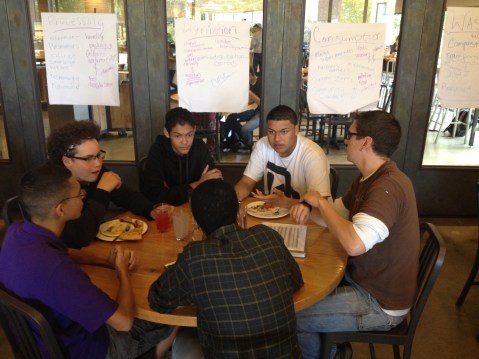
  • Our Stockbridge Community Food Systems and our Food Justice and Policy classes collaborated with Nuestras Raices to provide high school students with the tools to conduct a school food survey at Paulo Freire Social Justice High School, as well as a community visioning session about a new community garden;  and designed production tracking systems with urban farmers.  Here are a few of the high school students during a visioning session.  Thanks so much to Stockbridge instructor Catherine Sands for connecting our UMass students to students in Holyoke!

cfspfsjhampdining-1-2

  • The SERSI student RSO is interested in helping with the Food Recovery Network and will focus future efforts in this direction.  Here are some of the SERSI members from last year. We look forward to see what 2016-17 will bring!

sersi

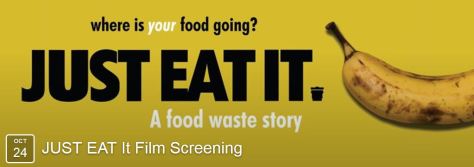
eatit

  • The UMass School of Public Policy and the Amherst Survival Centter is sponsoring an event with Congressman McGovern on  Oct. 26 Food Insecurity Event.    Stockbridge students plan to attend. 
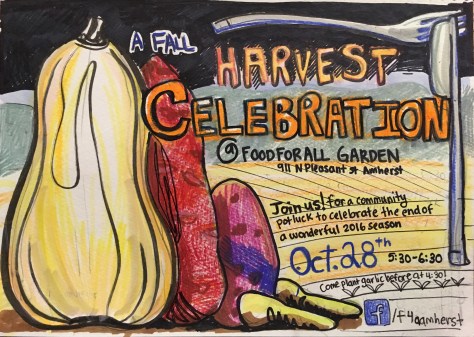
  • The Food for All Garden at the Agricultural Learning Center is having a FALL HARVEST CELEBRATION preceded by GARLIC PLANTING on Friday, October 28th @ 4:30pm (garlic plant) and 5:30 is our Community Potluck.  Bring a food or non-alcoholic drink to share or just come hungry.  Hope you can join us!

foodforall

AND… ANNOUNCING:

  • Stockbridge will offer a one credit seminar in the spring titled How to Recover a Truly Sustainable Food System – A Look at Food Waste and Recovery, on Tuesday afternoons at 4:00-5:15pm.  Thanks to Mary Bell and Angela Roell who will be the instructors!

fd_reccvry_hierachy_550pxw

Think U.S. Agriculture Will End World Hunger? Think Again.

By Anne Weir Schechinger, Senior Analyst, Economics and Craig Cox, Senior Vice President for Agriculture and Natural Resources

The United Nations has forecast that world food production must double to feed 9 billion people by 2050. That assertion has become a relentless talking point in the growing debate over the environmental, health and social consequences of American agriculture.

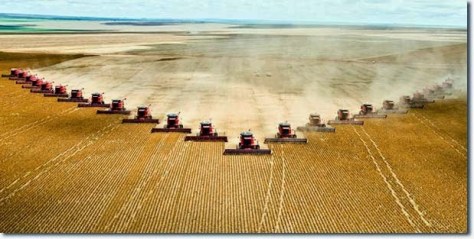
America’s farmers, we are told, must double their production of meat products and grains to “feed the world.” Otherwise, people will go hungry.

Agribusinesses such as Monsanto sometimes cite the so-called “moral imperative” to feed a hungry world in order to defend the status-quo farm policy and deflect attention from the destruction that “modern” agriculture is inflicting on the environment and human health.

The real experts know better. Jose Graziano da Silva, director-general of the U.N.’s Food and Agriculture Organization argues instead that the current conditions of “modern” agriculture are “no longer acceptable.”

The key to ending world hunger while protecting the environment is to help small farmers in the developing world increase their productivity and income, and to promote “agro-ecology” everywhere, including in the U.S.

Poverty is the root cause of hunger, not too few exports of U.S. wheat, corn, soybeans and meat. American exports go to people who can afford to buy them.


American farmers are helping meet growing demand from millions of people in developed and developing nations who can afford better, or at least more diversified diets. This is a welcome business opportunity for our farmers, but those exports aren’t going to the countries where hunger is chronic.

  • 86 percent of the value of U.S. agricultural exports last year went to 20 destinations with low numbers of hungry citizens and human development scores that are medium, high or very high, according to the U.N. Development Program.
  • Only half of one percent of U.S. agricultural exports, calculated according to their value, went to a group of 19 countries that includes Haiti, Yemen and Ethiopia. These are nations with high or very high levels of undernourishment, measured by the U.N. Food and Agriculture Organization.

Even the hungriest countries produce most of their own food. Overall, in 2013, American farmers contributed only 2.3 percent of the food supply for the 19 most undernourished countries through food exports and aid.

We won’t end world hunger by doubling production in the United States while putting our nation’s environment and health at risk. We can and must help end world hunger by helping people in the hungriest countries do a better job of feeding themselves and ensuring that their farmers make a good living.

Reducing poverty, increasing income for women, providing nutrition education, improving infrastructure like roads and markets to increase access to food, and ceasing wars and conflict could all help undernourished populations better feed themselves.


There is a small farm, community based alternative to the dominant vision of industrial agriculture feeding the world.  Come to learn and grow with us in the UMass Stockbridge School of Agriculture!

The Cost of Industrial Ag

img_1024

By Gracy Olmstead

When most Americans think about agriculture, they picture a small mom and pop farm with a few hundred acres and a small group of happy cows. Few realize that small agricultural enterprises are far from the norm today: as Leah Douglas wrote for Pacific Standard yesterday, “just four companies control 65 percent of pork slaughter, 84 percent of cattle slaughter, and 53 percent of chicken slaughter. Milk production is largely shaped by one large processor, Dean Foods, and one large cooperative, Dairy Farmers of America.” What are the practical results of this? Douglas writes,

Farmers face less competitive markets in which to sell their goods, leaving them vulnerable to any price offered by a buyer. Distributors and suppliers feel their prices squeezed as large retailers like Walmart leverage their growing power over the supply chain. Eaters are faced with an illusion of choice, wandering through supermarket aisles where dozens of seemingly competitive products might be owned by the same one or two food processors. Workers on farms and in meatpacking plants face pressure to increase production, sometimes at the expense of their safety. Animals living on factory farms are crowded into stifling barns, often receive unnecessary antibiotics, and are susceptible to disease.

Crony capitalism has been a problem in American agriculture for some time; our Farm Bill (which Jim Antle has called “welfare for the rich and politically connected”) doles out subsidies and financial supports to our country’s biggest corporatized farms. This can foster the sort of consolidation described above, while having a deleterious impact on the health of our land and communities, and a detrimental effect on competition and growth in our farming economy.

Throughout this presidential election, “big business” and “big banks” have gotten a lot of attention due to Bernie Sanders’s influence. Yet despite his crusade against large U.S. corporations, very little attention has been paid to agriculture and the role industrialized farms play in helping, or hurting, the U.S. economy. Neither Clinton nor Trump have a positive record when it comes to agriculture. Donald Trump’s only stated positions on farming put him directly in the pocket of Big Ag—he’s also attacked Cruz for his stance against ethanol mandates and subsidies, while declaring his own support for the industry. “His full-throated support for the ethanol mandate puts no room between him and Hillary, who has never met a corporate handout she didn’t like,” writes Tim Carney for the Washington Examiner.

Last month, the Obama administration issued an executive order that aims to support “a fair, efficient, and competitive marketplace.” The order condemns practices such as “unlawful collusion, illegal bid rigging, price fixing, and wage setting,” as well as other practices that “stifle competition and erode the foundation of America’s economic vitality.”

Yet despite the attention this new executive order draws to the problems in the American marketplace, it seems ill suited to address the problems therein.”When you see a headline like ‘Obama to Sign Executive Order to Ignite Corporate Competition’ you have to scratch your head at the premise,” notes Clyde Wayne Crews Jr. over at Forbes. “Igniting” or fostering competition often necessitates at least some deregulation, a freeing of the market and the players in that market—”something that doesn’t involve an executive order asking for action items from agencies in 60 days.”

As our system of agriculture has grown in size, it has also grown less sustainable. And while consolidation isn’t necessarily a problem in and of itself, the obstruction of competition and sustainability are. We have begun to see this, and are starting to consider necessary adjustments. But in order to see real reform, we need to consider changes that might be made at the congressional level, specifically to the Farm Bill, which could bring greater freedom to small farmers and entrepreneurs.

Original Post

A System Of Food Production For Human Need, Not Corporate Greed

Colin Todhunter

There has been an adverse trend in the food and agriculture sector in recent times with the control of seeds and chemical inputs being consolidated through various proposed mergers. If these mergers go through, it would mean that three companies would dominate the commercial agricultural seeds and chemicals sector. Over the past couple of decades, there has already been a restriction of choice with the squeezing out of competitors, resulting in higher costs for farmers, who are increasingly reliant on corporate seeds (and their chemical inputs).

Big agribusiness players like Monsanto rely on massive taxpayer handouts to keep their business models on track; highly profitable models that have immense social, health and environmental costs to be paid for by the public. Across the globe healthy, sustainable agriculture has been uprooted and transformed to suit the profit margins of transnational agribusiness concerns. The major players in the global agribusiness sector fuel a geo-politicised, globalised system of food production that result in numerous negative outcomes for both farmers and consumers alike (listed here: 4th paragraph from the end).

corporate-global-farms

Aside from the domination of the market being a cause for concern, we should also be worried about a food system controlled by companies that have a history (see this and this) of releasing health-damaging, environmentally polluting products onto the market and engaging in activities that might be considered as constituting crimes against humanity. If we continue to hand over the control of society’s most important infrastructure – food and agriculture – to these wealthy private interests, what will the future look like?

There is no need to engage in idle speculation. Foods based on CRISPR (a gene-editing technology for which Monsanto has just acquired a non-exclusive global licensing agreement for use) and synthetic biology are already entering the market without regulation or proper health or environmental assessments. And we can expect many more unregulated GM technologies to influence the nature of our food and flood the commercial market.

Despite nice sounding rhetoric by company spokespersons about the humanitarian motives behind these endeavours, the bottom line is patents and profit. And despite nice sounding rhetoric about the precision of the techniques involved, these technologies pose health and environmental risks. Moreover, CRIPRS technology could be used to create genes drives and terminator seed trait tools could be used for unscrupulous political and commercial ends.

There could well be severe social and economic consequences too. The impacts of synthetic biology (another sector dominated by a handful of private interests) on farmers in the Global South could result in a bio-economy of landlessness and hunger. Readers are urged to read this report which outlines the effects on farming, farmers and rural economies: synthetic biology has the potential to undermine livelihoods and would mean a shift to narrower range of export-oriented mono-cropping to produce biomass for synbio processes that place stress on water resources and food security in the exporting countries.

Aside from these social, health and environmental implications, can we trust private entities like Monsanto (or Bayer) to use these powerful (potentially bio-weapon) technologies responsibly? Given Monsanto’s long history of cover-ups and duplicity, trust took the last train out a long time ago. Moreover, the legalities of existing frameworks appear to mean little to certain companies: see here what Vandana Shiva says about the illegality of Monsanto’s enterprise in India. National laws that exist to protect the public interest are little more than mere hurdles to be got around by lobbyists, lawyers and political pressure. So what can be done?

Agroecology is a force for grass-root rural change that would be independent from the cartel of powerful biotech/agribusiness companies. This model of agriculture is already providing real solutions for sustainable, productive agriculture that prioritises the needs of farmers and consumers. It represents an alternative to corporate-controlled agriculture.

However, as much as people and communities strive to become independent from unscrupulous corporate concerns and as much as localised food systems try to extricate themselves from the impacts of rigged global trade and markets, there also has to be a concerted effort to roll back corporate power and challenge what it is doing to our food. These corporations will not just go away because people eat organic or choose agroecology.

The extremely wealthy interests behind these corporations do their level best to displace or dismantle alternative models of production – whether agroecology, organic, public sector agriculture systems or anything that exists independently from them – and replace them with ones that serve their needs. Look no further than attempts to undermine indigenous edible oils processing in India, for instance. Look no further than the ‘mustard seed crisis‘ in India in 1998. Or look no further than how transnational biotech helped fuel and then benefit from the destruction of Ethiopia’s traditional agrarian economy.

Whether it’s on the back of US-backed coups (Ukraine), military conflicts (Iraq), ‘structural adjustment’ (Africa) or slanted trade deals (India), transnational agribusiness is driving a global agenda to suit its interests and eradicate impediments to profit.

To underline this point, let’s turn to what Michel Chossudovsky says in his 1997 book ‘The Globalization of Poverty’. He argues that economies are:

“opened up through the concurrent displacement of a pre-existing productive system. Small and medium-sized enterprises are pushed into bankruptcy or obliged to produce for a global distributor, state enterprises are privatised or closed down, independent agricultural producers are impoverished.” (p.16)

Increasing profit and shareholder dividends are the bottom line. And it doesn’t matter how much devastation ensues or how unsustainable their business model is, ‘crisis management’ and ‘innovation’ fuel the corporate-controlled treadmill they seek to impose.

As long as the domination of the food system by powerful private interests is regarded as legitimate and as long as their hijack of governments, trade bodies and trade deals, regulatory agencies and universities is deemed normal or is unchallenged in the sham ‘liberal democracies’ they operate within, we are destined for a future of more contaminated food, ill health, degraded environments and an agriculture displaced and uprooted for the benefit of self-interest.

The problems associated with the food system cannot be dealt with on a single-issue basis: it is not just about the labelling of GM foods; it’s not just about the impacts of Monsanto’s Roundup; it’s not just about Monsanto (or Bayer) as a company; and it’s not just about engaging in endless debates with corporate shills about the science of GMOs.

Despite the promise of the Green Revolution, hundreds of millions still go to bed hungry, food has become denutrified, functioning rural economies have been destroyed, diseases have spiked in correlation with the increase in use of pesticides and GMOs, soil has been eroded or degraded, diets are less diverse, global food security has been undermined and access to food is determined by manipulated international markets and speculation – not supply and demand.

Food and agriculture have become wedded to power structures that have created food surplus and food deficit areas and have restructured indigenous agriculture across the world and tied it to an international system of trade based on export-oriented mono-cropping, commodity production for a manipulated and volatile international market and indebtedness to international financial institutions.

The problem is the system of international capitalism that is driving a globalised system of bad food and poor health, the destruction of healthy, sustainable agriculture and systemic, half-baked attacks on both groups and individuals who oppose these processes.

At the very least, there should be full public control over all GMO/synthetic biology production and research. And if we are serious about reining in the power of profiteering corporations over food – our most basic and essential infrastructure – they should be placed under democratic ownership and control.

In finishing, let us turn to Ghiselle Karim who at the end of her insightful article says:

“… we demand that it is our basic human right to protect our food supply… [food] would be planned to meet human need, not corporate greed.  We have hunger not because there is not enough food, but rather because it is not distributed equally. The core of the problem is not a shortage of food, but capitalism!”

Colin Todhunter is an independent writer/analyst

The Food We Don’t Eat

American food writer MFK Fisher once said, “First we eat, then we do everything else.”  Food is central to so much in our lives – family, health and community. But what about the food we don’t eat?

garbage
Eight percent of the world’s greenhouse gas emissions can be ascribed to food loss and waste. Photo by jbloom/Flickr

More than a billion tons of food is never consumed by people; that’s equivalent to one-third of all food the world produces.  What many people may not know is that one in nine people on earth don’t have enough food to lead an active life, or that food loss and waste costs the global economy $940 billion each year, an amount close to what the entire UK government will spend in 2016.

They may also not know the incredible effect food loss and waste has on the environment.  Eight percent of the greenhouse gases heating the planet are caused by food loss and waste. At the same time, food that’s harvested but lost or wasted uses 25 percent of water used in agriculture and requires cropland the size of China to be grown. What an incredibly inefficient use of precious natural resources.

When you look at the kind of impact food loss and waste has on our environment, economy and society, it’s clear why the United Nations included it among the most urgent global challenges the Sustainable Development Goals would address. Target 12.3 [2] of the goals calls for nations to “halve per capita global food waste at the retail and consumer levels and reduce food losses along production and supply chains, including post-harvest losses” by 2030. It’s certainly an ambitious challenge, but it is also one that’s achievable.

This week is Climate Week, an opportunity to take stock of where we are on critical environmental issues like food loss and waste. A new report [3] on behalf of Champions 12.3 [4] – a unique coalition of leaders across government, business and civil society who are dedicated to achieving Target 12.3 – assesses our progress so far.

The report details a number of notable steps that have happened around the world, including national food loss and waste reduction targets established in the United States and in countries across the European Union and African Union.

It also highlights efforts to help governments and companies measure food loss and waste, such as the FLW Standard [5] announced in June, and new funding like the Danish government’s subsidy program and The Rockefeller Foundation’s Yieldwise [6], a $130 million investment toward practical approaches to reducing food loss and waste in Kenya, Tanzania, Nigeria, the United States and Europe. There have also been advances in policies as well as education efforts like the Save the Food [7] campaign to raise awareness of food loss and waste.

The progress is promising. But the report also notes that the action does not yet match the scale of the problem, and much more work is needed worldwide if we are to successfully meet Target 12.3 in just 14 short years.