Teaching and Learning Food Systems

By Wayne Roberts

Earth Day has long been a day to celebrate joy in our relations with the earth, aearhdaynd renew commitments to do our personal best to respect the Earth’s needs and act on our ability to protect the planet.

In that vein, I want to introduce you to an article on researching food system agendas; it just came out in the April edition of a journal called Food Security. I think it’s game-changing for professional practitioners, citizen activists and young people looking for a career path in the food sector, as well as the target audience of academic researchers.

secuirityMy comments below aren’t a substitute for reading the article, which is an easy read. I

Continue reading Teaching and Learning Food Systems

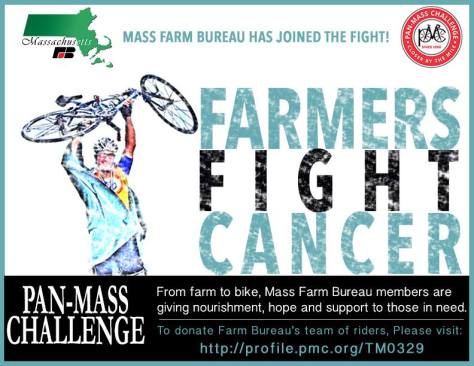
Massachusetts Farmers Fight Cancer

farmersforcancer

Massachusetts Farm Bureau Federation and Nourse Farms in Whately are planning ‘Camping for a Cure‘ on June 10.  This is a fundraiser for the Massachusetts Farm Bureau Federation’s Pan-Mass Challenge team.  Currently, five farmers are set to ride more than 750 miles combined on Aug. 5 & 6 to provide cancer patients, who can’t ride in this bike-a-thon, with hope and support.

Unlike most charities, the PMC donates 100 percent of the funds raised.  Last year the organization raised more than $47 million for Dana-Farber Cancer Research Institute, which is more than 80 percent of the institute’s annual funds.  For this reason, the PMC is much more than a ride, it’s a source of hope for those whom may have little to none. You can learn more about the pmc online at www.pmc.org or you visits our team profile at http://profile.pmc.org/TM0329.

To help us do this we would love to have some local farms, agricultural organizations, or some students to help us out by providing an educational or fun activity or craft or helping out for an hour or so to help campers set up tents at the Camping for a Cure event here.  Among the farms who have already made a commitment are Nourse Farms in Whately, Davidian Bros Farm in Northborough, Pine Island Farm in Sheffield, Sauchuk Farm in Plympton and Willow Brook Farm in Holliston.

During these events, young families will have the opportunity to experience farm life. During the day, each campsite will host a children’s fair, during which a petting farm, horse pulled wagon rides, face painting, read-a-longs, coloring events and more may be held. After a day full of these terrific activities, a camp-out will be held in the evening where a movie will be shown.

To volunteer or for more information, contact:

Pete Rizzo, Horticulturalist
Nourse Farms, Whately MA
UMass Sustainable Food and Farming Graduate 2011
(413) 665-2658 Ext 222
prizzo@noursefarms.com

Sustainable Food & Farming Spring Events

stockbanner4

We hope you can join us in some of the exciting campus and community events happening as we wrap up our spring semester!

Learn about our Major

April 19thSustainable Food & Farming Meet & Greet

greenthumbfinal

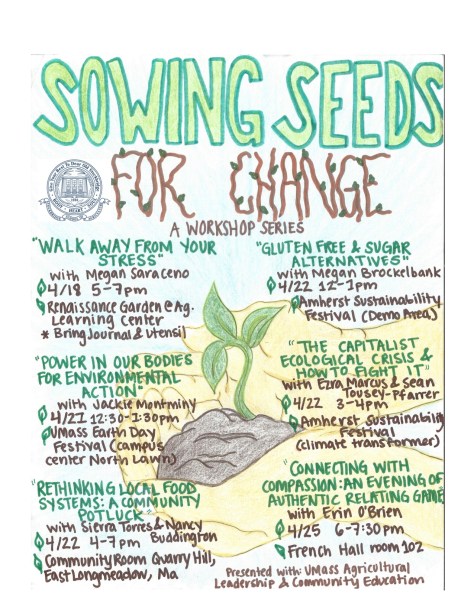
Our Spring Workshops

April 18th –Walk Away from Your Stress Workshop

  • 5-7pm, Renaissance Garden @ UMass Agricultural Learning Center
  • 650 East Pleasant Street, Amherst MA
  • Join Megan Saraceno, SFF Student, to practice and discuss tools for stress management & nature connection

——————————————————————————————-

April 21st Power in Our Bodies for Environmental Action Workshop

——————————————————————————————-

April 22ndGluten Free & Sugar Alternatives in Cooking & Baking Workshop

  • 12-1pm, Amherst Sustainability Festival Demo Area, Town Common
  • Join Megan Brockelbank, SFF student, share practical tips & tools for cooking & baking with alternatives

——————————————————————————————-

April 22nd– The Capitalist Ecological Crisis & How to Fight It Workshop

  • 3-4pm, Amherst Sustainability Festival Climate Transformer Space, Town Common
  • Join Ezra Marcus & Sean Tousey-Pfarrer discuss systems change & environmental activism

——————————————————————————————-

April 22nd– Rethinking Local Food Systems: A Community Potluck

  • 4-7pm, Community Room Quarry Hill, East Longmeadow MA
  • Join Sierra Torres & Nancy Buddington in an engaging discussion, demo and potluck featuring local food

——————————————————————————————-

April 25th– Connecting With Compassion: An Evening of Authentic Relating Games

sowing seeds flyer jpeg (2)

Celebrate with Our Seniors

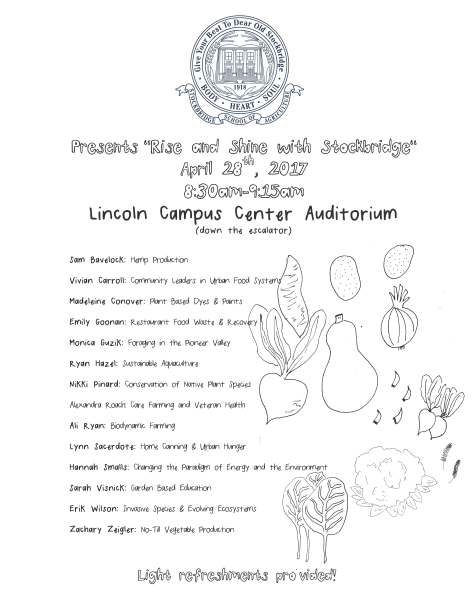
April 28th– Rise and Shine with Stockbridge Seniors

POSTER PROMOTION-2 (dragged)-2

—————————————————————–

For more information on the Bachelor of Sciences degree in Sustainable Food and Farming, see: SFF Major.

Student Forest Garden Manager Job

stockbanner4 (2)

The Stockbridge School of Agriculture is seeking applications for a Student Forest Garden Manager to manage all aspects of the Forest Garden at the UMass Agricultural Learning Center (ALC) this season. The Forest Garden is a 2 year old 1/4 acre garden located at the ALC with the following goals and objectives.

  • A permaculture demonstration garden and an aesthetically-pleasing leisure place for the university and
  • A site for active and hands-on learning by students and community members where workshops and classes are held.
  • The Food Forest produces an abundance of food and medicinals for the community and to be donated to those in need.
  • The Food Forest is a place of opportunity where students, faculty, and other individuals make a connection to where food comes from and begins to understand a new type of agriculture which works with natural systems.

Responsibilities include:

  • Pre-season, 3-5hrs/week (Late April): Assisting with irrigation planning and ram pump irrigation workshop. Working with other land managers either with the UMass Student Farm or Food For All garden to market or donate food from the food
  • Summer Season, 15 hrs/week (May-Sept)- Establish irrigation system, mulching and weeding existing beds, sheet mulching existing plantings, establish understory plantings, labeling,
  • Fall Season, 3-5 hrs/week (Sept-late Oct/early Nov) hosting UMass permaculture classes for workdays, harvest & deliver fall crops, prepare garden for winter

Compensation for is $12/hr.

Required Qualifications:

  • Current UMass Sustainable Food & Farming student with at least 1 of the following completed courses permaculture course (Intro to Permaculture or Permaculture Design and Practice)
  • Experience with establishing and caring for perennial food systems either with UMass Permaculture Initiative or other small farm or landscaping experience
  • Excellent leadership and communication skills
  • Ability to work independently in the field
  • Commit to 15 hours/week

Desired Qualifications

  • PDC Certificate holder
  • Prior coordinating or leadership position with UMass Permaculture Initiative or equivalent.

To Apply: Send Lisa DePiano a copy of your resume with 2 professional or academic references and a paragraph describing your interest & qualifications at: ldepiano@umass.edu by Friday March 31 st 2017.


Lets learn about urban food systems

Join UMass Sustainable Food and Farming for a FREE and public screening of the short documentary “Brooklyn Farmer” which tells the story of Brooklyn Grange, a group of urban farmers who endeavor to run a commercially viable farm in New York City.

Brooklyn farmer

The film will be followed by a panel discussion with Dana Lucas (Freight Farms Boston and UMass Hydroponics) & Frank Mangan (UMass Professor of Urban Farming).

The film will be held in

W.E.B. Du Bois Library,

Floor 19 – Room 1920

Film at 6:00pm

Panel at 7:00 pm

Synopsis of the Film:

“Brooklyn Farmer” explores the unique challenges facing Brooklyn Grange, a group of urban farmers who endeavor to run a commercially viable farm within the landscape of New York City. The film follows Head Farmer Ben Flanner, CEO Gwen Schantz, Communications Director Anastasia Plakias, Farm Manager Michael Meier, and Beekeeper Chase Emmons as their growing operation expands from Long Island City, Queens to a second roof in the Brooklyn Navy Yards. The team confronts the realities inherent in operating the world’s largest rooftop farm in one of the world’s biggest cities.

Panelists:

Frank Mangan
umassnutA focus of my program has been to evaluate production and marketing systems for vegetable and herb crops, with an emphasis on crops popular among immigrant communities. Since 2003, farmers in Massachusetts made more than five million dollars in retail sales of crops introduced from my program, crops that had not been grown in Massachusetts before. A majority of the research done by my program is at the UMass Research Farm in Deerfield MA. We also evaluate practical postharvest and pest management strategies for these new crops. Our program works closely with nutritionists at UMass to provide nutritionally balanced and culturally-appropriate recipes for these immigrant groups. This webpage provides information on the crops evaluated and introduced by my program: http://www.worldcrops.org/

Starting in 2011, we have begun to work with urban growers as part of an overall systems approach to provide fresh produce to urban populations. As part of this work we’re also evaluating the carbon footprint used to produce and transport fresh produce to urban settings. We have created a Facebook page to report on this work: https://www.facebook.com/umassurbanag

Dana Lucas
I am from a city and I cherish local food. I have found this appreciation for sustainable produce to be extremely helpful in my own personal development within controlled environmental agriculture.

I work for an urban farm that owns three Freight Farms. I have learned to successfully manage and market almost five acres of hydroponic produce. I also have recently created my own company for urban farm consulting. I design and build hydroponic systems for commercial and residential spaces around Boston, MA. I am most proud of recently receiving a grant to build and design a vertical farm on campus at UMass Amherst, which will provide hydroponic produce to dining halls on campus starting this winter.


I believe the further expansion of city farms will help to give urbanites the opportunity to experience food systems more accessible. Completing my education in agriculture is extremely exciting and important for my career and our world’s future sustainability. I believe that urban agriculture will have a great influence on social, economic, and resource consumption problems.


Designing a Renewable Food System

head

Thousands of organizations seeking food system change have pointed out the negative environmental and societal consequences of our current system, which many say is propped up on “too big to fail,” hyper-efficient production. The often quoted, Nixon-era agricultural mandate of “get big or get out”—a widely attributed pivot point in American agriculture from a diverse family farming system to the current corporate business form—mirrored the business zeitgeist of the time, building on the mid-20th-century ideal of industrialization and globalization.

Other systems, including our energy, water, and transportation systems, also fell in line with that ethos; but unlike the food system, these sectors are undertaking 21st-century upgrades that comport better with our modern norms and realities by creating more decentralized systems that are better adapted to local geography and sociology. Food system change agents stand to learn from the public policy trajectory of renewable energy in particular. The renewable energy industry currently employs 6.5 million worldwide with $329 billion in investments in 2015, and a number of its effective strategies would adapt well to food system reform.

1. Using public contracts to express public values and create markets for smaller producers.

The starting point for renewable energy was the Public Utility Regulatory Policies Act (PURPA), enacted during the oil crisis of 1978. It opened the door to a new energy system structure by requiring that utilities source a percentage of their energy from independent producers. Building on that, many states later required metric-based targets (Nevada set an early example with its goal of 25 percent renewable energy by 2025) as part of a suite of policy tools supporting the development of renewable energy, called renewable portfolio standards (RPS).

This metric-based approach finds parallel in the food procurement power of public institutions. A national example is Brazil, which passed a law requiring that schools spend 30 percent of their meal budgets on food produced by the country’s millions of smallholder farmers. The program is credited with providing economic viability to that farm sector, through access to a guaranteed market in a direct relationship with government.

School food is also a large public food sector in the United States. The National School Lunch Program spends more than $11 billion annually to feed the 30 million children who qualify for free or reduced-price lunches. The USDA Commodity program provides an additional $200 million or so per year in supplemental food to schools. Given this, federal targets to support local farms in school food purchases would undoubtedly make a meaningful shift in supporting the local farm economy, bolstering its existing Farm to School technical support and grant program.

But such targets would address only part of the food system picture. Community and environmental health are also important parts of a modern food system. Metrics based on these values (such as targets for healthy corner stores, sustainably produced food purchases, and purchases of food from fair labor producers and suppliers) would drive healthy food access, economic viability for the range of participants in the food chain, and a system of agriculture that supports regenerative farming practices.

Farmworkers harvest melons at an organic farm in Firebaugh, California (Photo by Paula Daniels)

A number of food procurement programs already incorporate environmental sustainability values into their goals, including Real Food Challenge for universities and Health Care Without Harm for hospitals. The Good Food Purchasing Program is even more analogous to the RPS system, in that it targets the public procurement dollars of school districts and is metric driven, emphasizing in equal measure five core values: local economies, environmental sustainability, valued workforce, animal welfare, and nutrition. It is designed to work for the food system in the way that LEED certification works for energy efficiency in buildings; it has a flexible, performance-based set of guidelines within a metric framework, as well as a ratings incentive.

A region could leverage these program tools and others toward achieving food system goals. Such regional goals for school food, hospitals, military bases, and other publicly funded food programs in each area would create more than enough aggregate dollars to make a notable difference in the food chain. Nationally networked, regional procurement goals would also have a powerful influence on the federal role in the food system.

2. Recognizing that regional governments are nimble leaders.

The generation of renewable energy accelerated when many states developed RPSs alongside federal and state tax incentives. The progress of these states toward their various mandated goals contributed to the current success of renewable energy worldwide. Target levels and motivations of each state vary according to their resources and attributes. For example, water-locked Hawaii is nearly halfway to the most ambitious goal in the United States: It plans to reach “100 percent renewable” by 2045. California recently upped its renewable energy goals to 50 percent by 2030, building on the success of its prodigious entrepreneurial ecosystem and diverse landscape in creating more than 21,000 megawatts of clean energy and 400,000 clean energy jobs.

Similarly, cities or states can become regional leaders of value-based food procurement goals designed for the characteristics of their area, and advance a suite of policies that would create a community of personal, environmental, and economic health in food. Cities are especially well-poised to do so: Most of the world’s population now lives in cities, and because city governments are closer to the ground than federal governments, they have a working understanding of the needs of their residents, and a better sense of the programs and processes that can work for them.

Of course, implementing value-based food system goals will require more than procurement metrics. We need policies and incentives to back them up. California is a good example. The state has consistently ranked first on the US Clean Tech Leadership Index, credited to the fact that it has the largest collection of clean energy policies and incentives (over 270, by some counts) backing its metrics. These include: rebates, low or no interest loans, loan guarantees, financing programs, tax exemptions, bonds, grants, favorable permit standards, access easements, building standards, zoning codes, and small business assistance.

An impressive number of food policies and incentives are already in place around the country. Pennsylvania’s well-known Fresh Food Financing Initiative, for example, became the basis for the small-market conversion programs in Philadelphia and the creation of Philadelphia’s Common Market food hub, a mission-driven, nonprofit aggregator of locally produced food distributed to schools, hospitals, and communities. And New York State recently gave a $15 million grant toward a $20 million food hub in New York City to implement its goals of supporting local farmers.

Another opportunity is to update tax incentives for food donations to extend to programs like Boston’s Daily Table, which addresses food waste and food insecurity by using otherwise unused, “imperfect” produce to prepare healthy food on a food stamp budget. California recently updated its agriculture tax incentives to include urban agriculture. Philanthropy, and local governments could also set up matching funds—modeled after the Veggie Voucher farmer’s market programs—for schools and small neighborhood markets that participate in values-based regional procurement programs.
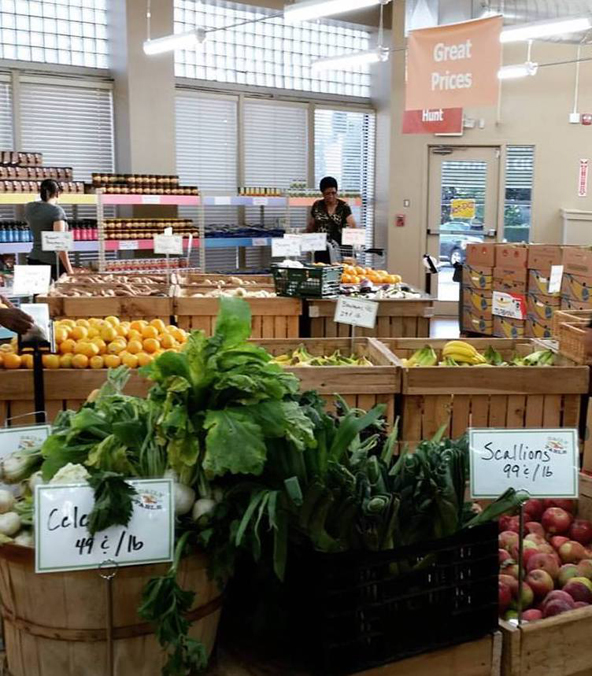
The Daily Table in Boston, Massachusetts, sells reclaimed produce at affordable prices. (Photo by Samantha Vise)

With regional metrics as an organizing framework, these programs and tools could become even more powerful drivers of food system design.

3. Creating coordinated networks to amplify best practices.

Affinity groups of cities can share best practices, operating as networked nodes of change. In 2005, Mayor Ken Livingston of London launched the C40, a network of the top 40 world cities that meet regularly to address climate change and energy efficiency. The group works to develop and implement policies and programs that generate measurable reductions in both greenhouse gas emissions and climate risks. When the C40 cities decide on a best practice—such as replacing incandescent bulbs in street lights with LEDs—they pool their combined buying power to create a bargaining block to obtain fair prices for both themselves and, because of the large size of the order, the manufacturer.

The Urban School Food Alliance, which includes the six biggest school districts in the United States, uses the same approach. In 2013, it asked tray manufacturers to develop a Styrofoam-free lunch tray. The manufacturers complied, motivated by the size of the order. This “alliance of alliances” between six cities represents 4,536 schools, more than 2.5 million students and 46 billion school meals, and a combined $552 million in food service. It has now turned its attention to the poultry supply chain with the aim of getting antibiotic-free chicken into schools.

In one year after adopting the Good Food Purchasing Program, LA Unified School District went from less than 10 percent to an average of 60 percent local produce, creating 150 new jobs in food processing. (Photo by Jorge Gil)

As with renewable energy, regional metrics for food that support community, economic, and environmental health would strategically align policies, programs, and organizations toward those goals, as well as accelerate progress and encourage entrepreneurship. By turning the wheel of the existing system toward proportionally designed and well-supported regional targets, cities can lead a flexible, village-within-a-global-world framework that provides the responsiveness and resilience our communities deserve.

UMass Hydro begins to feed campus

greenhouse

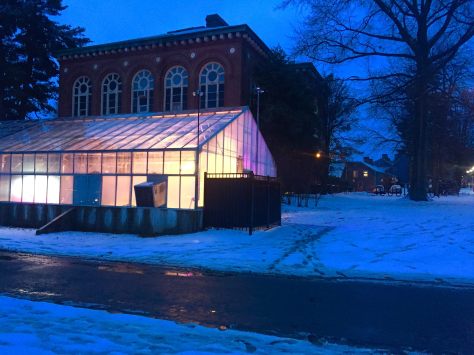
If you look out of the campus-side windows in Franklin Dining Commons after the sun has gone down, you can see a mix of white, blue and magenta lights illuminating the inside of the Clark Hall Greenhouse.

These lights mark the home of the UMass Hydroponics Farm Plan, where Dana Lucas, a junior sustainable food and farming major, and Evan Chakrin, a nontraditional student in the Stockbridge School of Agriculture, have been working throughout the winter growing fresh leafy greens.

Back in December, the duo received a $5,000 grant from the Stockbridge School of Agriculture to grow produce year-round on an on-campus hydroponic farm. Hydroponics, a method of farming with water and nutrients in place of soil, allows for a continual harvesting cycle.

hydroAlong with limited pesticide use and saving 90 percent more water than a traditional farm, the farm will produce approximately 70 heads of lettuce a week, every week of the year. Lucas and Chakrin emphasize the importance of this perpetual cycle in meeting the University’s sustainability efforts.

On the University of Massachusetts website, it states, “The University recognizes its responsibility to be a leader in sustainable development and education for the community, state and nation.”

“I don’t know how we can say our food is sustainable at UMass if it’s only grown 10 weeks of the year in New England,” Lucas said.

The location allows UMass Hydro to get their greens across campus by either walking, biking or driving short distances, leaving almost no carbon footprint.

“I think this is something that really excites me and Evan because we really see a demand for fresh, local food and this is a way to actually fulfill it,” Lucas said.

Although the farm’s production capacity cannot currently meet the needs of the dining halls, Lucas and Chakrin are looking into alternative options to get their greens on the plates of students.

hydro2“We’re kind of just centering on student businesses right now because they’re smaller and they’re run by our friends, so we can easily get into the market,” Lucas said.

Their first official account is with Greeno Sub Shop in Central Residential Area.

Last week, Greeno’s hosted a special where UMass Hydro’s microgreens were free to add to any menu item.

In a statement posted to their Facebook page, they stated, “One of the goals of our mission statement is to source locally whenever possible, with UMass Hydro right down the hill, this is almost as fresh as it can get.”

Chakrin and Lucas are currently working on getting their greens served at other on-campus eateries.

In addition to adding more accounts, there is a strong focus on getting other students interested in the emerging field of hydroponics.

“We can use this as a teaching facility for students. The techniques we’re using are used in multi-acre industrial greenhouses for lettuce, so we could scale right up potentially,” Chakrin said.

The two are hoping to work UMass Hydro into the curriculum in Stockbridge, allowing students to work hands-on with the systems while also earning credits.

“Maybe we can do a one credit, half semester thing or something,” said Chakrin.

sprout“There has been some discussion about having an accredited course for next fall where we can teach what I’m assuming are mostly going to be Stockbridge students, but we’re open to anybody and everyone who’s interested in getting involved with hydroponics,” Lucas said.
The grant covered the cost of seeds, equipment and other miscellaneous items like scissors, but the responsibility of building the farm fell entirely on Lucas and Chakrin.

“It felt really cool that we were given this much responsibility I feel like, to just buy the stuff and then build it,” Lucas said.

Chakrin noted how one of the biggest obstacles faced in getting the project off the ground was finding an available space on campus.

“Initially we were just asking for a 10-by-10 closet somewhere, then Stockbridge professor , Dr. Dan Cooley, was like ‘Do you think this greenhouse will work?’ and we were like ‘Of course!’” Chakrin said.

“He kind of posed it as a bummer that we weren’t going to be in a closet and we were like ‘No, no, no that’s fine!’” Lucas said, laughing.

“Without the space, none of it would be possible, so being allowed to use this space is just huge and we’re so lucky to have that,” Chakrin said.

The students also expressed appreciation to Dr. Daniel Cooley, who sponsored the project and Dr. Stephen Herbert for his support and donation of supplies.

Out of the entire space granted to UMass Hydro, only a portion of it is currently being used. In order to make use of the underutilized space, Chakrin and Lucas are hoping the future of UMass Hydro involves more funding.

“We want to see Dutch buckets and a vertical system in here so we can show students the breadth of what you can do with hydroponics,” Lucas said.

Visitors are encouraged to stop by at the Clark Hall Greenhouse on Tuesdays between 3 p.m. and 7 p.m.  And you can follow the project on Facebook at UMass Hydro!

Callie Hansson can be reached at chansson@umass.edu.

Original Post


INDUSTRIAL FARMING IS FAILING AMERICA

MATTERDALE, England — I am a traditional small farmer in the North of England. I farm sheep in a mountainous landscape, the Lake District fells. It is a farming system that dates back as many as 4,500 years. A remarkable survival. My flock grazes a mountain alongside 10 other flocks, through an ancient communal grazing system that has somehow survived the last two centuries of change. Wordsworth called it a “perfect republic of shepherds.”

It’s not your efficient modern agribusiness. My farm struggles to make enough money for my family to live on, even with 900 sheep. The price of my lambs is governed by the supply of imported lamb from the other side of the world. So I have one foot in something ancient and the other foot in the 21st-century global economy.

Less than 3 percent of people in modern industrial economies are farmers. But around the world, I am not alone: The United Nations estimates that more than two billion people are farmers, most of them small farmers; that’s about one in three people on the planet.

My farm is where I live, and there is actually no other way to farm my land, which is why it hasn’t changed much for a millennium or more. In truth, I could accept the changes around me philosophically, including the disappearance of farms like mine, if the results made for a better world and society. But the world I am seeing evolve in front of my eyes isn’t better, it is worse. Much worse.

In the week before the United States elected Donald J. Trump to the presidency, I traveled through Kentucky, through endless miles of farmland and small towns. It was my first visit to the United States, for a book tour. I was shocked by the signs of decline I saw in rural America.

kentucky

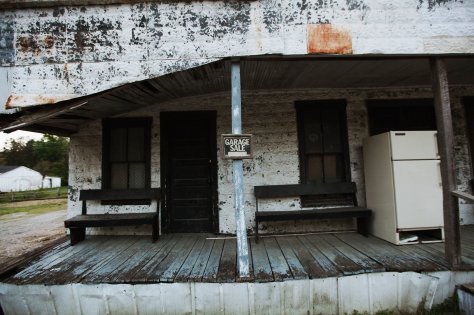
An abandoned building in Owsley County, Kentucky. Credit Mario Tama/Getty Images


I saw shabby wood-frame houses rotting by the roadside, and picket fences blown over by the wind. I passed boarded-up shops in the hearts of small towns, and tumbledown barns and abandoned farmland. The church notice boards were full of offers of help to people with drug or alcohol addictions. And yes, suddenly I was passing cars with Trump stickers on their bumpers, and passing houses with Trump flags on their lawns.

The economic distress and the Trump support are not unconnected, of course. Significant areas of rural America are broken, in terminal economic decline, as food production heads off to someplace else where it can be done supposedly more efficiently. In many areas, nothing has replaced the old industries. This is a cycle of degeneration that puts millions of people on the wrong side of economic history.

Economists say that when the world changes people will adapt, move and change to fit the new world. But of course, real human beings often don’t do that. They cling to the places they love, and their identity remains tied to the outdated or inefficient things they used to do, like being steel workers or farmers. Often, their skills are not transferable anyway, and they have no interest in the new opportunities. So, these people get left behind.

I ask myself what I would do if I didn’t farm sheep, or if I couldn’t any longer farm sheep. I have no idea.

Perhaps it is none of my business how Americans conduct their affairs and how they think about economics. I should doubtless go back to the mountains of my home here in Cumbria, and hold my tongue. But for my entire life, my own country has apathetically accepted an American model of farming and food retailing, mostly through a belief that it was the way of progress and the natural course of economic development. As a result, America’s future is the default for us all.

It is a future in which farming and food have changed and are changing radically — in my view, for the worse. Thus I look at the future with a skeptical eye. We have all become such suckers for a bargain that we take the low prices of our foodstuffs for granted and are somehow unable to connect these bargain-basement prices to our children’s inability to find meaningful work at a decently paid job.

Our demand for cheap food is killing the American dream for millions of people. Among its side effects, it is creating terrible health problems like obesity and antibiotic-resistant infections, and it is destroying the habitats upon which wildlife depends. It also concentrates vast wealth and power in fewer and fewer hands.

After my trip to rural America, I returned to my sheep and my strangely old-fashioned life. I am surrounded by beauty, and a community, and an old way of doing things that has worked for a long time rather well. I have come home convinced that it is time to think carefully, both within America and without, about food and farming and what kind of systems we want.

The future we have been sold doesn’t work. Applying the principles of the factory floor to the natural world just doesn’t work. Farming is more than a business. Food is more than a commodity. Land is more than a mineral resource.

Despite the growing scale of the problem, no major mainstream politician has taken farming or food seriously for decades. With the presidential campaign over and a president in the White House whom rural Kentuckians helped elect, the new political establishment might want to think about this carefully.

Suddenly, rural America matters. It matters for the whole world.


Original Post

James Rebanks (@herdyshepherd1) is the author of the memoir “The Shepherd’s Life: Modern Dispatches From an Ancient Landscape.”

Seeds of Time: Film and Discussion

UMass Sustainable Food and Farming (SFF) is hosting a three part PUBLIC and FREE film series to provide a community space where students can critically engage in issues surrounding the food system.  Each film is followed by a panel discussion featuring local individuals within the field.

seedsOn March 9th, 6-8pm in the W.E.B Dubois Library, Floor 19 Room 1920, SFF will be screening the documentary “Seeds of Time” followed by a panelist discussion at 7:30pm featuring professor of Economics, James Boyce, along with other individuals from the community.
Film Synopsis
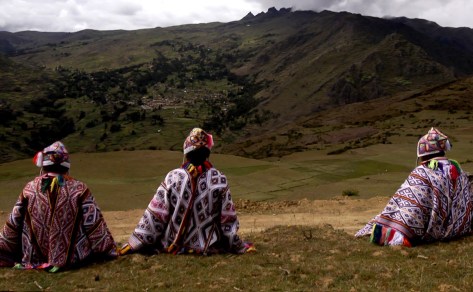
A perfect storm is brewing as agriculture pioneer Cary Fowler races against time to protect the future of our food. Seed banks around the world are crumbling, crop failures are producing starvation and rioting, and the accelerating effects of climate change are affecting farmers globally. Communities of indigenous Peruvian farmers are already suffering those effects, as they try desperately to save over 1,500 varieties of native potato in their fields. But with little time to waste, both Fowler and the farmers embark on passionate and personal journeys that may save the one resource we cannot live without: our seeds.


seeds2

10,000 years ago the biggest revolution in human history occurred: we became agrarians. We ceased hunting and gathering and began to farm, breeding and domesticating plants that have resulted in the crops we eat today. But the genetic diversity of these domesticated crops, which were developed over millennia, is vanishing today. And the consequences of this loss could be dire.

As the production of high yielding, uniform varieties has increased, diversity has declined. For example, in U.S. vegetable crops we now have less than seven percent of the diversity that existed just a century ago. We are confronted with the global pressures of feeding a growing population, in a time when staple crops face new threats from disease and changing climates.

Crop diversity pioneer Cary Fowler travels the world, educating the public about the dire consequences of our inaction. Along with his team at The Global Crop Diversity Trust in Rome, Cary struggles to re-invent a global food system so that it can, in his words: “last forever.” Cary aims to safeguard the last place that much of our diversity is left in tact: in the world’s vulnerable gene banks.

Across the Atlantic Ocean, a group of indigenous Peruvian farmers work to preserve over 1,500 native varieties of potato in their fields. Through the guidance of activist Alejandro Argumedo and the help of the International Potato Center gene bank in Lima, several communities join forces to create a new conservation grounds called “The Potato Park.”

But not all is well in this haven for diversity. The Andes Mountains, our planet’s most diverse region for potatoes, is already seeing the crippling effects of climate change. Potato production has risen more than 500 feet in altitude over the last 30 years, leaving varieties at lower elevations unable to produce. With erratic weather patterns already eroding biodiversity, what is to be done when these farmers can no longer continue moving “up”?

With a passion few possess, Cary set out to build the world’s first global seed vault – a seed collection on a scale larger than any other. The vault, located in Norway, is an unprecedented insurance policy for the crop diversity of the world. In an extraordinary gesture of support, the farmers of the Potato Park become the first indigenous community to send samples of their potato diversity to the vault for safekeeping.

But as the stakes of maintaining a secure global food system continue to rise, adaptation will become a requisite for our own survival. How can we best maintain the diversity that still exists for our food crops? How do we create new diversity to adapt our fields to a changing climate? The answers are as complex as the system they intend to fix. And it will require a combination of efforts: from scientists, plant breeders, researchers, farmers, politicians, and even gardeners.

PLEASE SHARE YOUR THOUGHTS/REFLECTIONS IN THE COMMENTS BOX BELOW

seeds3